
CRONENDROME / CASE FILE 05 / 1979
THE BROOD
When the family becomes the horror.
A child between two parents. A clinic that turns emotion into flesh. Follow the people, performances, objects and documents behind one of Cronenberg’s most unsettling films.
Contains spoilers and images from the film.
EXPLORE THE CASE FILE
Choose a chapter.
Open a chapter to follow its images and research. Each numbered note opens to the claim and its source.
01The film’s worldSomafree, the family and the institutions around them.3 research notes
FIELD GUIDE / INSTITUTIONS / FAMILY
The world inside the film.
The film’s central invention is a treatment that gives private feeling a physical existence. Somafree is both a place and a system of authority: Raglan interprets the body, Frank tries to recover his family, and Candice must live with the consequences. The everyday objects matter because the horror moves through recognisable rooms, clothes, school spaces and family routines.
Swipe or scroll sideways to read every column →
| Element | Place in the case file |
|---|---|
| Somafree Institute | Raglan’s therapeutic institution; the public demonstration and secluded treatment spaces. |
| Psychoplasmics | The fictional relation between emotion and bodily manifestation. |
| Krell Street School | The school name connects this film to Forbidden Planet. |
| The Shape of Rage | A fictional book-object lead within Raglan’s world. |
| The Carveth–Kelly family | Frank, Nola, Candice and Nola’s parents form the domestic network. |
BR-R047Why the school is called Krell Street
Cronenberg told Harkness that he had named the school Krell Street School without consciously connecting it to Forbidden Planet; the interview makes the connection explicit.
Printed p. 10 / PDF p. 3, Forbidden Planet exchange · John G. Harkness — Brilliantly Bizarre, Cinema Canada, March 1981 ↗
Orientation: Carrie Rickey ↗ · Jason Middleton ↗.
What kind of authority is Raglan?
The director’s later answers complicate a simple anti-therapy reading. They are another voice in the case file, alongside the performances and the critics’ arguments.
BR-R080The scientist as an artist figure
Responding to an audience member who mentions The Brood and asks about malevolent doctors, Cronenberg describes his scientists as artist-like figures: extreme attempts to interpret, remake and control a world.
Transcript PDF p. 11, audience question following the script/adaptation discussion · David Cronenberg / David Schwartz — Pinewood Dialogue, 11–12 January 1992 ↗
BR-R081A specific relationship, not a verdict on a profession
Cronenberg tells Miller that The Brood was not intended as a blanket attack on psychotherapy. He locates the drama in particular relationships and what happens when they go wrong.
Opening interview exchange · Jenni Miller / David Cronenberg — On the Analyst’s Couch, 21 November 2011 ↗
02Development & scriptDrafts, production dates, company credits and financing.25 research notes
DEVELOPMENT / PRODUCTION CALENDAR / SCREENPLAY
The film did not arrive fully formed.
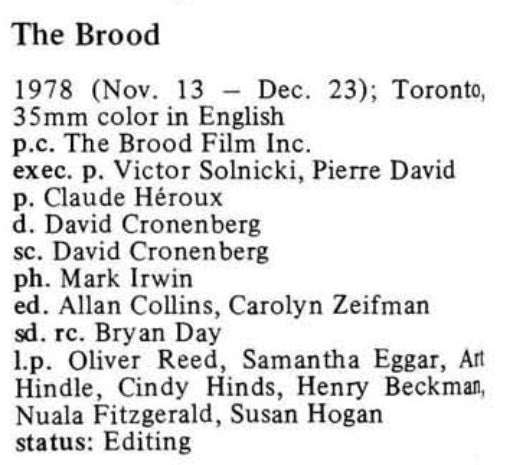
BR-R043A period shooting window
The production guide lists Toronto, 13 November–23 December 1978, 35 mm colour in English, and an editing status. It names The Brood Film Inc. as the production company.
Printed p. 10, The Brood entry; PDF p. 1 · Charlotte Hussey and Del Mehes — Production Guide, Cinema Canada, p. 10 ↗
BR-R044The production listing and final editorial roles
Cinema Canada’s editing field names Allan Collins and Carolyn Zeifman. The film credits Alan Collins as Editor and Carolyn Zeifman as Assistant Picture Editor.
Printed p. 10, ed. field · Charlotte Hussey and Del Mehes — Production Guide, Cinema Canada, p. 10 ↗ · The Brood — reference copy A, archived MP4 ↗
BR-R061The personal film inside a production boom
Botting places the project within Cronenberg’s divorce and the Canadian investment boom, and reports that writing The Brood displaced work on The Sensitives.
Middle section: personal origins and Canadian production context · Josephine Botting — Why I love … The Brood, BFI ↗
A working script, a different proposed birth.
BR-R054Performance notes in Eggar’s working copy
The photographed verso contains pencilled reminders to raise and advance the shoulders and use sidelong looks. Nola’s dialogue is highlighted on the two exposed interior pages.
Lot 69, photographs 3–6; pages B 105–106 and title-page verso · Julien’s Auctions — Eggar’s signed and annotated screenplay, lot 69 ↗
BR-R055A different birth on the page
Page B 106 scripts a sac separating through contractions before Nola picks it up and removes its membrane.
Lot 69, photograph 3, page B 106 · Julien’s Auctions — Eggar’s signed and annotated screenplay, lot 69 ↗
Swipe or scroll sideways to read every column →
| Witness | Source account |
|---|---|
| 1978 production guide | Toronto and a 13 November–23 December production window. |
| GARANCE catalogue | A 14 November shooting date and a 1978 production year. |
| Eggar’s diary recollection | She recalled four working days after consulting entries written by her secretary. |
| Eggar screenplay auction | A described annotated working copy and a different written birth action. |
A draft number becomes visible

BR-R089Eggar’s copy identifies itself as a fourth draft
The photographed title page reads FOURTH DRAFT, carries a 1978 copyright line and names Elgin International Productions Ltd. A large yellow Sam marking sits above the typed title.
Lot 69 public title-page photograph · Eggar screenplay — public title-page photograph, lot 69 ↗ · Julien’s Auctions — Eggar’s signed and annotated screenplay, lot 69 ↗
The limits of the autobiographical shortcut
BR-R083Personal proximity is not literal autobiography
In 2014 Cronenberg still calls The Brood his closest film to his own life, while stressing the distance introduced by horror fantasy. He compares that intimacy with the more intellectual autobiography of Consumed.
Question and answer beginning with the interviewer’s reference to the Grunberg book · Alison Nastasi / David Cronenberg — Flavorwire interview, 3 October 2014 ↗
Before the production could proceed
BR-R090A script waiting while Fast Company intervened
Cronenberg recalls having written The Brood and struggling to get it made when Fast Company was offered to him.
Printed p. 124 / PDF p. 133 · Robert J. Emery — The Directors: Take Four (Allworth Press, 2003) ↗
Inside the working copy
The auction gallery shows the title, cover, two numbered pages and an annotated verso from Eggar’s working copy.

BR-R105A marina heading and a more extensive bodily reveal
Page B 105 assigns scene 92 to a marina interior at night. It describes a plastic enclosure and growths across the body, including limbs, with two especially large sacs.
Lot 69, photograph 4, page B 105; scene 92 · Julien’s Auctions — Eggar’s signed and annotated screenplay, lot 69 ↗
Inspect the source photographs: B 105 ↗ · B 106 ↗. Full script pages are linked rather than reproduced here.
Reading the fourth draft
The fourth draft preserves proposed scenes and effects, including a birth sequence that differs from the released film.
BR-R109The fourth-draft screenplay
The public scan identifies a fourth draft, with a 1978 copyright line, B 1–111 and 101 numbered scenes.
Title; B 111 / PDF 112 · David Cronenberg — The Brood, fourth-draft screenplay scan ↗
BR-R110From Dr. Raskin to Dr. Raglan
The fourth draft names Dr. Hal Raskin; Criterion and the inspected end titles label Reed’s role Dr. Raglan.
B 1 / PDF 2; Criterion cast list; reference A 01:30:46 · David Cronenberg — The Brood, fourth-draft screenplay scan ↗ · Criterion — The Brood edition and credits ↗ · The Brood — reference copy A, archived MP4 ↗
BR-R111The fourth draft’s written action
The opening specifies reversible breast-like swelling; scene 38 places Wessler at the Ontario Science Centre.
B 5–6, 44–46 / PDF 6–7, 45–47 · David Cronenberg — The Brood, fourth-draft screenplay scan ↗
BR-R116The matching screenplay pages
The public scan and Eggar gallery have corresponding B 105–106 directions and pagination.
PDF 106–107; Julien’s lot 69, photographs 3–4 · David Cronenberg — The Brood, fourth-draft screenplay scan ↗ · Julien’s Auctions — Eggar’s signed and annotated screenplay, lot 69 ↗
BR-R118The autobiographical framing is contemporary
Cronenberg describes a family situation as his starting point, transformed into nightmare. He characterizes The Brood as quieter, more interior and less action-driven than Rabid.
Printed p. 15 / original PDF 18, middle column · Bob Martin / David Cronenberg — The Brood and Other Terrors, Fangoria no. 3 (1979) ↗
BR-R125Pierre David’s route through distribution
David recalls building Mutual Films, then a Canadian distribution venture with Roger Corman’s New World, in a market with abundant tax-shelter investment. He places The Brood among the Cronenberg films he made.
Opening career narrative, paragraphs on Mutual Films and New World · Luke Ford / Pierre David — producer interview ↗
Turning experience into a film
The interview chain now reaches both a near-contemporary account and a later extended discussion. Read these beside the draft, preserving the difference between a writer’s retrospective explanation and a document created during development.
BR-R126The displaced project, in the director’s account
Cronenberg recalls writing The Brood instead of The Sensitives; financing delays allowed further tightening.
Printed p. 75 / PDF 103 · Cronenberg on Cronenberg — edited by Chris Rodley, revised edition (1993) ↗
BR-R127Autobiography had to become fiction
He says the script worked only after he abandoned literal autobiographical fidelity.
Printed p. 78 / PDF 106 · Cronenberg on Cronenberg — edited by Chris Rodley, revised edition (1993) ↗
BR-R134The nightmare comparison was already in print in 1981
In Lucas’s 1981 interview, Cronenberg compares The Brood with Kramer vs. Kramer through dream logic and emotional experience. He also connects his approach to inventing fictional worlds with Nabokov. Lucas’s 2010 recollection explicitly says he took his essay title from the fictional psychological book in The Brood.
Newsletter printed pp. 10–13; Heavy Metal title and pagination in its introduction; Lucas 2010 opening four paragraphs · Timothy R. Lucas — David Cronenberg: A Postscript (1981) ↗ · Tim Lucas — Medium Cruel: Reflections on Videodrome (introduction) ↗ ·
Checking the book behind the citation
BR-R133Identify the edition from the book
The copyright page identifies the revised paperback as 1993, following first publication in 1992.
Title/copyright pages / PDF 5–6 · Cronenberg on Cronenberg — edited by Chris Rodley, revised edition (1993) ↗
Inside the collection
BR-R142Cronenberg’s papers at TIFF
TIFF’s collection description says every Cronenberg film is represented while noting comparatively little early-career textual documentation.
Special Collections 0003; description · TIFF — David Cronenberg Collection, Special Collections 0003 ↗
BR-R143The screenplay in TIFF’s collection
TIFF lists a screenplay under FRL-107916, call number PN 1997 B8714 1978; its version field is empty.
FRL-107916; call number, version and related-media fields · TIFF — screenplay holding, FRL-107916 ↗
A producer’s account of the investment model
BR-R144The producer describes a three-film investment structure
Pierre David recalls year-end filming to qualify for that year’s tax credits. He also describes investors contributing through a three-film package, spreading the chance of recovering their money, and places The Brood below Scanners and Videodrome in budget.
April 2019, p. 39; first Pierre David answer in the photographed opening spread · Fangoria volume 2 no. 3 — April 2019 oral history ↗
A reported production budget
BR-R167A period budget report, with its reprint lineage
A budget table reproduced in Statistics Canada’s Film industry 1978 lists The Brood at $1.4 million. The table is part of an excerpt from Saturday Night’s October 1979 report; the government volume was published in February 1981.
This is a reported budget, not a final production account or the size of CFDC’s contribution. The magazine report and its reprint form one evidence lineage.
Printed p.66 / PDF p.68; context pp.65–68; publication date PDF p.3 · Statistics Canada, February 1981, reprinting Saturday Night, October 1979 ↗

The screenplay’s draft sequence
BR-R150A near-contemporary draft count
Sammon reports that the screenplay evolved through five drafts.
Printed/PDF p. 30, development narrative · Paul M. Sammon — David Cronenberg, Cinefantastique 10:4 (Spring 1981) ↗
Company names in the film itself
BR-R158The credits identify companies without explaining every agreement
The opening names Mutual Productions and Elgin International beneath the executive producers. The closing roll credits Film Opticals, Toronto for titles and opticals, acknowledges CFDC assistance and displays a 1979 Montreal Trust Company of Canada copyright line.
00:00:44; 01:31:40; 01:32:01 · The Brood — reference copy A, archived MP4 ↗
03People & performanceCast identities, interviews and recollections from the set.17 research notes
PEOPLE & PERFORMANCE
A child’s view of the set.
Character ledger: film credits and draft identities
The closing roll supplies eighteen role labels and nineteen performers. The screenplay preserves additional character-name variants.
Swipe or scroll sideways to read every column →
| Character | Performer | Character context |
|---|---|---|
| Dr. Raglan | Oliver Reed | Somafree and psychoplasmics; the fourth draft’s Hal Raskin is a separate textual identity (BR-R110). |
| Nola Carveth | Samantha Eggar | Garment, body and performance; compare the script action with Eggar’s later recollection (BR-R106). |
| Frank Carveth | Art Hindle | The investigation and family network. |
| Candice Carveth | Cindy Hinds | Hinds’s childhood experience and her performance as Candice. |
| Barton Kelly | Henry Beckman | The Kelly family and domestic interiors; compare the paired bedroom ornaments and their draft description in BR-R159. |
| Juliana Kelly | Nuala Fitzgerald | Family photographs and domestic violence; the fourth draft’s household props are documented separately from surviving objects. |
| Ruth Mayer | Susan Hogan | School and classroom scenes. |
| Mike Trellan | Gary McKeehan | Michael in the fourth draft. The closing roll uses Gary McKeehan; the opening uses Garry McKeehan. Preserve the two screen witnesses. |
| Inspector | Michael Magee | Michael Magee is credited as Inspector. The fourth draft names the character Bruno Mrazek. |
| Jan Hartog | Robert Silverman | The patient’s challenge to the institute; keep his neck effect separate from the autopsy dummy (BR-R119 / BR-R149). |
| Dr. Birkin | Rainer Schwarz | End-title pairing at 01:30:54. The fourth draft expands the name to Larry. |
| Coroner | Joseph Shaw | Credited at 01:30:54; connect the examination scene with the autopsy-body evidence in BR-R149. |
| Lawyer | Larry Solway | Credited at 01:30:54; keep this generic role label distinct from unsupported expanded names. |
| Creatures | Felix Silla / John Ferguson | Both performers appear under this credit at 01:30:54. |
| Chris | Nicholas Campbell | Credited at 01:31:00; distinguish this character label from the performer’s name. |
| Wendy | Mary Swinton | Credited at 01:31:00; retain the role without inventing a surname. |
| Construction worker | Jerry Kostur | Screen credit at 01:31:00. |
| Man in auditorium | Christopher Britton | Credited at 01:31:00; the full forename is displayed. |
The Brood — reference copy A, archived MP4 ↗ · David Cronenberg — The Brood, fourth-draft screenplay scan ↗ · Criterion — The Brood edition and credits ↗
BR-R151Police and patient names in the screenplay
The fourth draft introduces Michael Trellan, Inspector Bruno Mrazek and psychologist Larry Birkin. Criterion credits Mike Trellan to Gary McKeehan and the Inspector to Michael Magee, without printing the inspector’s personal name.
Fourth draft B 1 and B 31–35 / PDF 2 and 32–36; Criterion; Copie Zéro p. 13; reference A 00:00:22 and 01:30:54 · David Cronenberg — The Brood, fourth-draft screenplay scan ↗ · Criterion — The Brood edition and credits ↗ · Copie Zéro — Annuaire longs métrages Québec 1979, entry 5043 ↗ · The Brood — reference copy A, archived MP4 ↗

The performance behind Candice
Hinds’s recollections describe the practical experience of acting as a child and the people who supported her on set.
BR-R007Candice’s first day
Hinds recalls the desk-and-crying scene as her first filming day, with Hindle helping her performance. She also recalls a surviving Polaroid.
Answers about the desk scene · Rob Freese / Cindy Hinds ↗
BR-R008The child’s view of the creatures
Hinds remembers being comfortable around Felix Silla and John Ferguson in makeup, while noticing the discomfort of wearing it.
Answer about walking in the snow · Rob Freese / Cindy Hinds ↗
BR-R009Age and character are different
Hinds recalls being eight while playing the five-year-old Candice.
Answer comparing the classroom and Deadline · Rob Freese / Cindy Hinds ↗
Meet the film’s makers 4 records + cast guide
Oliver Reed · Dr. Raglan
Samantha Eggar · Nola Carveth
Art Hindle · Frank Carveth
Cindy Hinds · Candice Carveth
Susan Hogan · Ruth Mayer
BR-R001A Canadian feature, 1979
TIFF catalogues a 92-minute, English-language, colour 35 mm feature.
Film information · TIFF Canadian Film Encyclopedia ↗
BR-R002The principal makers
Cronenberg wrote and directed; Claude Héroux produced; Pierre David and Victor Solnicki were executive producers. Mark Irwin photographed, Howard Shore composed and Carol Spier art-directed.
Cast and credits · Criterion ↗ · TIFF Canadian Film Encyclopedia ↗
BR-R003The opening title settles this copy’s editor spelling
The opening credit in reference copy A reads Alan Collins. Criterion agrees; TIFF and the contemporary credit block print Allan Collins.
Reference A 00:00:33; editor listings; Cinema Canada printed p. 33 · The Brood — reference copy A, archived MP4 ↗ · Criterion — The Brood edition and credits ↗ · TIFF Canadian Film Encyclopedia — The Brood ↗ · Andrew Dowler — The Brood, Cinema Canada ↗
BR-R004The period production record
Cinema Canada lists The Brood Inc., a 1978 year and a 92-minute runtime. These are period metadata, distinct from the 1979 release date.
Printed p. 33; PDF p. 2 · Andrew Dowler ↗

Different experiences on the same film
A playful set and a frightening mask can both belong to the same production. Keep each account attached to the person and scene it describes.
BR-R026A mask Woodley could not wear
Aaron Woodley recalls becoming frightened when a mask was glued to his face. He says Cronenberg instead placed him face-down among the dead creatures, using his own blond hair.
Answer about visiting his uncle’s Brood set · Walter Chaw interviews Aaron Woodley ↗
BR-R053Hindle’s route to Cronenberg
Hindle recalls that Cronenberg knew his motorcycle-racing brother and that this connection helped lead to his casting.
Answer: How did you meet David Cronenberg? · Gavin Schmitt — Art Hindle interview, 6 August 2015 ↗
What the director asked of his stars
BR-R091Nola’s constrained movement as an acting problem
Cronenberg recalls surprise at Eggar accepting a difficult role built around very limited movement. He draws a qualified comparison with Beckett, without calling the film a Beckett work.
Printed p. 126 / PDF p. 135 · Robert J. Emery — The Directors: Take Four (Allworth Press, 2003) ↗
BR-R092Reed’s reputation and the director’s working experience
Cronenberg remembers initial apprehension about Reed but describes him and Eggar as professional throughout filming.
Printed pp. 126–127 / PDF pp. 135–136 · Robert J. Emery — The Directors: Take Four (Allworth Press, 2003) ↗
A memory tested against a page
BR-R106The licking action is already typed into this copy
Page B 106 explicitly directs Nola to lick the newborn, using canine maternal behaviour as its comparison.
Lot 69, photograph 3, page B 106; Eggar’s July 2014 birthing-scene recollection · Julien’s Auctions — Eggar’s signed and annotated screenplay, lot 69 ↗ · Collecting Life — Samantha Eggar, part 2 ↗
Eggar recalls suggesting the licking gesture; the surviving fourth-draft page also specifies it. The two accounts preserve both her contribution as remembered and the action’s place in the written scene.
A photograph published during the original run
BR-R119A period behind-the-camera photograph
Printed p. 14 shows Hinds beside a camera with Cronenberg; adjoining images show the autopsy body and Hartog’s neck effect.
Printed p. 14 / original PDF 17 · Bob Martin / David Cronenberg — The Brood and Other Terrors, Fangoria no. 3 (1979) ↗
Fangoria’s printed page 14 includes the camera photograph. · Fangoria’s printed page 14 ↗
Eggar’s days on set
BR-R128Eggar’s filming schedule
Cronenberg remembers Eggar being there three days.
Printed p. 84 / PDF 112 · Cronenberg on Cronenberg — edited by Chris Rodley, revised edition (1993) ↗
Eggar and Cronenberg remember the schedule differently: her four days sit beside his recollection of three.
Working relationships, recalled forty years later
BR-R145Two recollections of entering and working on the film
Eggar recalls the attraction of working with Oliver Reed again and says she learned of Nola’s autobiographical basis much later. Spier describes a calm, collaborative set around Cronenberg.
April 2019, p. 39; complete visible Eggar and Spier answers · Fangoria volume 2 no. 3 — April 2019 oral history ↗
What the actor knew, and what he could see
BR-R165Frank was not played from an advance autobiographical briefing
Hindle says he learned the personal background near the end of shooting. He remembers having to imagine the birth effect for his reverse angle when Eggar was covered.
Hindle 11:43–13:58 and 20:48–21:42 · Fangoria — S1 Ep30: Class of 79: Art Hindle (The Brood Series) ↗
04Effects, costume & locationsThe bodies, garments and spaces made for the film.30 research notes
MAKING THE FILM
Behind the locked door.
Costume, makeup, staging and the production record.


Start with the document
The original credit block opens paths into costume, sound and makeup. The interviews add recollections of specific scenes. Each record keeps those different kinds of evidence visible.
BR-R005Costume and makeup, as printed
The period list credits Delphine White for costume and Shonagh Jabour for makeup.
Printed p. 33, credit block · Andrew Dowler ↗
BR-R006Sound work beyond the score
The period credits name Bryan Day for sound, Tom Mather for boom, Peter Burgess for sound editing and Joe Grimaldi for sound recording.
Printed p. 33, credit block · Andrew Dowler ↗
BR-R010Light on the classroom set
Irwin recalls a playful approach to staging the school attack with children. That is his account of the shoot, not a universal assessment of every participant’s experience.
Classroom answers · Oliver Pfeiffer / Mark Irwin and Art Hindle ↗
BR-R011The bunkhouse staging problem
Irwin remembers young gymnasts, restrictive masks and parents hidden behind bunks to help stage the attack.
Bunkhouse answers · Oliver Pfeiffer / Mark Irwin and Art Hindle — SciFiNow ↗
BR-R012A hospital autopsy room
Hindle recalls shooting the examination scene in a working hospital’s autopsy room.
Autopsy-room anecdote · Oliver Pfeiffer / Mark Irwin and Art Hindle ↗
Light, framing and attribution.
BR-R045Darkness was a decision
In 1981 Irwin described Cronenberg pushing the photography darker and moodier. Irwin initially worried about unflattering the performers, then committed to the story’s visual demands.
Printed p. 37, right column · Charles Lazer — Mark Irwin: Keeping it Simple, Cinema Canada, pp. 37–38 ↗
BR-R046The lighting changes as the film develops
Irwin’s 2021 account describes a relatively natural, low-contrast beginning that becomes darker as the story progresses. The 1981 interview documents his broader preference for motivated, bounced light.
ASC: The Brood subsection; Lazer: p. 37 · Iain Marcks — The Darker Side of Mark Irwin, ASC, CSC ↗ · Charles Lazer — Mark Irwin: Keeping it Simple, Cinema Canada, pp. 37–38 ↗
BR-R048Framing by exclusion
Discussing The Brood’s tight frames, Cronenberg emphasized controlling what enters the image. He described working out actor movements and coverage on set rather than arriving with every shot prescribed.
Printed p. 12 / PDF p. 5, framing and shot-list exchanges · John G. Harkness — Brilliantly Bizarre, Cinema Canada, March 1981 ↗
BR-R050Additional makeup and effects names
GARANCE lists Jack H. Young and Dennis Pike for makeup, and Allan Cotter as special-effects coordinator.
GARANCE technical credits; reference A 01:31:16 and 01:31:24 · GARANCE — The Brood / Chromosome 3 ↗ · The Brood — reference copy A, archived MP4 ↗
BR-R051Rick Porter and Tom Moore
GARANCE names Rick Porter as still photographer; the Cinémathèque’s individual photographs credit Tom Moore.
GARANCE: photographe de plateau; CQ: photograph captions · GARANCE — The Brood / Chromosome 3 ↗ · Cinémathèque québécoise — The Brood photographs ↗
A spelling discrepancy worth retaining
BR-R077Allan Kotter’s special-effects credit
The screen credits name Allan Kotter under Special Effects, matching Copie Zéro and Capricci. GARANCE prints Allan Cotter.
Reference A 01:31:24; Copie Zéro p. 13; later catalogue effects fields · The Brood — reference copy A, archived MP4 ↗ · Copie Zéro — Annuaire longs métrages Québec 1979, entry 5043 ↗ · Capricci — Chromosome 3, 2021 French reissue ↗ · GARANCE — The Brood / Chromosome 3 ↗
Architecture and filming locations


BR-R097Two exteriors ready for a location comparison
Frame 29 records the institute’s sloping roof, raised glazed volumes and long window band. Frame 46 records a school elevation with blue double doors, corner windows, basketball backboard and playground markings. These provide concrete comparison features.
Gallery items 29 and 46; exact filenames in image provenance · FILMGRAB — The Brood, 14 February 2015 ↗
Brown School: architecture and circulation
The film’s school is more than a classroom. Its changes of level and interrupted sightlines make an ordinary institution feel difficult to oversee. That is an interpretation of the pictured spaces; the images below document the evidence on which it rests.


BR-R099Brown School: a verified address, a qualified film match
The school authority places Brown Junior Public School at 454 Avenue Road and dates its replacement building to 1972. Hitchcock’s 2017 photograph shows the named brick building, stacked corner windows and blue entrance doors. These support the proposed location’s architectural plausibility, alongside Filmap’s identification.
TDSB history/address; Hitchcock photograph 36834343874; Filmap comparison post · Toronto District School Board — Brown Junior Public School: About Us ↗ · Jeff Hitchcock / Arbron — Brown Public School, 9 September 2017 ↗ · Filmap — The Brood: School, 31 March 2015 ↗
BR-R100The school is organised through levels and barriers
Filmap’s school frames show elevated circulation, brick parapets, stairs and a lower court. Behind Frank, lower-level doors and a stair opening sit beyond a foreground timber railing.
Images ending o2_1280.png and o4_r1_1280.png; source URLs in image provenance · Filmap — The Brood: School, 31 March 2015 ↗
Somafree’s proposed real counterpart

Location guides identify the Kortright Visitor Centre as Somafree’s exterior. Its steep roofs, raised glazing and timber structure echo the building seen in the film.
BR-R101Kortright’s opening has a precise historical account
Carr describes a temporary Kortright facility operating from three portable classrooms in 1974, followed by the centre’s official opening on 21 June 1979. His author note identifies him as Boyd Conservation Field Centre’s education supervisor and a long-serving authority educator.
Printed pp. 8 and 10 / PDF pp. 10 and 12 · Allen Terry Carr — A Forty-Year Retrospective 1950–1990, Pathways 8:4, July/August 1996 ↗
BR-R102Two official accounts disagree about construction
Later institutional accounts give different construction dates: the 2011 authority resolution lists 1979, while the 2022 STEP brief gives 1982. Both describe a three-level post-and-beam visitor building of roughly 30,000 square feet.
TRCA printed p. 120 / PDF p. 51; STEP p. 2 · TRCA — Authority Meeting 3/11, 25 March 2011, resolution A51/11 ↗ · STEP — Existing Building Commissioning of Kortright Visitor Centre, 2022 ↗
BR-R103The surviving centre is an altered building
TRCA’s 2012–2013 report documents changes to the visitor centre’s cladding, windows, lighting and mechanical systems. In August 2012, manager Alex Waters described plans to replace Western Cedar cladding with Eastern White Cedar and add valley-side windows and skylights as part of Levitt Goodman Architects’ retrofit.
Sustainability report printed p. 32 / PDF p. 34; resolution p. 120; official entrance photograph; Waters, Building Re-skinning section and exterior concept illustrations · TRCA — Sustainability Report 2012–2013: Kortright Centre Retrofit Project ↗ · TRCA — Authority Meeting 3/11, 25 March 2011, resolution A51/11 ↗ · Kortright Centre — What We Do ↗ · Alex Waters — Environmental Visitor Centre Gets a Serious Green Makeover (31 August 2012) ↗ ·

Space, bodies and departmental responsibility
BR-R113The draft gives the finale a connected geography
Its marina, upper boathouse and intercom form a connected setting.
B 95–109 / PDF 96–110 · David Cronenberg — The Brood, fourth-draft screenplay scan ↗
BR-R114Biology and aftermath on the page
The autopsy adds gill slits; after Nola’s death, the brood remains alive but uncoordinated.
B 75, 110 / PDF 76, 111 · David Cronenberg — The Brood, fourth-draft screenplay scan ↗
BR-R123The production departments
Copie Zéro separates Shonagh Jabour and Inge Klaudi’s makeup work from special makeup credited to Jack Young and Dennis Pike, and effects credited to Allan Kotter.
Entry 5043, printed/PDF p. 13 · Copie Zéro — Annuaire longs métrages Québec 1979, entry 5043 ↗
The crew, beyond the headline credits
Swipe or scroll sideways to read every column →
| Department | Printed names |
|---|---|
| Art direction | Carol Spier |
| Properties / assistant | Peter Lauterman / Tom Reid |
| Sets / assistant | Angelo Stea / Michael Fruet |
| Construction | Bill Harman |
| Wardrobe / assistant | Delphine White / Granada Venne |
| Makeup / assistant | Shonagh Jabour / Inge Klaudi |
| Special makeup | Jack Young / Dennis Pike |
| Special effects | Allan Kotter |
| Cinematography | Mark Irwin |
| Camera assistants | Robin Miller / Greg Villeneuve |
| Key grip / chief electrician | Maris Jansons / Jock Brandis |
| Sound recording / boom | Bryan Day / Tom Mather |
| Picture editing / assistant | Alan Collins / Carolyn Zeifman |
| Postproduction | John Board |
| Sound editing / assistant | Peter Burgess / Jeremy Maclaverty |
| Dialogue editing / assistant | Brian Holland / Lois Tupper |
| Re-recording | Joe Grimaldi |
| Still photography | Rick Porter |
| Location management | David Coatsworth |
| Continuity | Nancy Eagles |
Information reproduced with credit to Copie Zéro / La Cinémathèque québécoise ↗, entry 5043, printed page 13. Selected departments; role labels translated or shortened for this table.
BR-R124The postproduction department extends beyond the composer
The directory lists Alan Collins, Carolyn Zeifman, John Board, Peter Burgess, Jeremy Maclaverty, Brian Holland, Lois Tupper and Joe Grimaldi across picture editing, postproduction and sound roles.
Entry 5043, printed/PDF p. 13; departmental table below · Copie Zéro — Annuaire longs métrages Québec 1979, entry 5043 ↗
A near-contemporary construction account
Sammon’s feature combines a technical sidebar with Cronenberg’s account, connecting individual effects to their construction and use.
BR-R147Pike’s external womb: a component account
The sidebar attributes the womb to Dennis Pike: weather-balloon section, synthetic outer skin, studio blood, spaghetti and model baby. The balloon contained their weight and pressure.
Printed/PDF p. 26, effects sidebar · Paul M. Sammon — David Cronenberg, Cinefantastique 10:4 (Spring 1981) ↗
BR-R148Young’s application work is explicitly described
The sidebar names Jack Young applying latex masks, wigs and body humps, with a reported three-hour application. It describes ten young girl gymnasts alongside two adult performers.
Printed/PDF p. 26, sidebar and makeup-application photographs · Paul M. Sammon — David Cronenberg, Cinefantastique 10:4 (Spring 1981) ↗
BR-R149The autopsy body’s limitations shaped its photography
Cronenberg identifies a built dummy, praises Pike’s version above others and credits him with the newborn. He links the scene’s purplish appearance and restricted inspection to the body effect’s limitations; he wanted to turn it over.
Printed/PDF p. 31, autopsy questions and answers · Paul M. Sammon — David Cronenberg, Cinefantastique 10:4 (Spring 1981) ↗
Designing the brood creatures
The effects table follows the masks, birth apparatus, autopsy bodies and other objects through their production accounts.
Swipe or scroll sideways to read every column →
| Object / references | Production account |
|---|---|
| Creature masks and performer staging BR-R011 · BR-R026 · BR-R035 · BR-R123 · BR-R148 | Performer accounts, photographs and now named application/material evidence (BR-R148). |
| Birth appliance and newborn BR-R028 · BR-R029 · BR-R105 · BR-R106 · BR-R119 · BR-R131 · BR-R147 · BR-R149 | An attributed component account, supplemented by performer, script and editing testimony. |
| Autopsy body BR-R012 · BR-R119 · BR-R149 | The director’s object-specific account now connects fabrication with photographic limits. |
| Hartog’s neck growth BR-R119 · BR-R123 | Period photographs and departmental credits. |
| Door breach BR-R074 · BR-R123 | A selected frame and a separate archive photograph. |
| Proposed effects in the draft BR-R111 · BR-R114 | Written proposals with page locators. |
A catalogue conflict, left visible
BR-R141The mallet in the collection catalogue
One TIFF record associates a mallet with The Brood and names Chris Walas, but its alternate titles concern crushing black centipedes.
2000-001-01.0104; media, maker and other-title fields · TIFF — mallet, 2000-001-01.0104 ↗
The film’s screen credits
BR-R155The film separates people whom catalogues group together
Direct credit images distinguish picture editing, makeup, special makeup and special effects, and expand the cast ledger to the minor credited roles. They also preserve the film’s own Garry/Gary McKeehan spelling variation.
Opening 00:00:22–00:00:44; end titles 01:30:46–01:31:40 · The Brood — reference copy A, archived MP4 ↗
Swipe or scroll sideways to read every column →
| Credited field | Name as displayed | File time |
|---|---|---|
| Editor | Alan Collins | 00:00:33 |
| Art Director | Carol Spier | 00:00:30 |
| Director of Photography | Mark Irwin | 00:00:38 |
| Property Master / Assistant Props | Peter Lauterman / Tom Reid | 01:31:16 |
| Set Dresser / Assistant Set Dresser | Angelo Stea / Michael Fruet | 01:31:16 |
| Construction Manager | Bill Harman | 01:31:16 |
| Wardrobe Mistress / Assistant Wardrobe | Delphine White / Granada Venné | 01:31:16 |
| Makeup / Assistant Makeup | Shonagh Jabour / Inge Klaudi | 01:31:16 |
| Special Makeup | Jack Young / Dennis Pike | 01:31:16 |
| Special Effects | Allan Kotter | 01:31:24 |
| Stillsman / Location Manager | Rick Porter / David Coatsworth | 01:31:24 |
| Assistant Picture Editor | Carolyn Zeifman | 01:31:32 |
| Post Production Co-ordinator | John Board | 01:31:32 |
| Sound Recordist / Boom Operator | Bryan Day / Tom Mather | 01:31:08 |
| Sound Editor / Assistant Sound Editor | Peter Burgess / Jeremy MacLaverty | 01:31:32 |
| Dialogue Editor / Assistant Dialogue Editor | Brian Holland / Lois Tupper | 01:31:32 |
| Sound Re-recording | Joe Grimaldi | 01:31:32 |
| Laboratory | Medallion Film Labs | 01:31:40 |
| Titles and Opticals | Film Opticals, Toronto | 01:31:40 |
| Mixing Facilities | Pathé Sound and Post Production Centre | 01:31:40 |
Photographing the practical limits
BR-R162Winter daylight shaped the shooting problem
Irwin connects late-year financing and short Toronto days with planning outward-facing views in daylight and reverse angles later under artificial light. He separately stresses that Juliana’s killing was staged as a sunny-day scene.
Irwin 10:45–13:43 · Fangoria — S1 Ep29: Class of 79: Mark Irwin (The Brood Series) ↗
BR-R163The winter walk was conceived at a distance
Irwin recalls a long-lens treatment of the snow-road procession and limiting close views of the creature faces. He also describes backlight, top light and shadow in the bunkhouse.
Irwin 19:28–20:06 and 21:35–21:50 · Fangoria — S1 Ep29: Class of 79: Mark Irwin (The Brood Series) ↗
Keep the models and their photographed appearance separate
BR-R164A rigid autopsy model and a separate colour account
Hindle recalls a wax-like, rigid body being rejected and replaced for a return shoot. Irwin describes a wax body brought by Young and attributes the purple appearance to post-production. Cronenberg’s earlier account identifies multiple models and prefers Pike’s.
Hindle 17:24–18:49; Irwin 20:06–20:55; Sammon printed/PDF p. 31 · Fangoria — S1 Ep30: Class of 79: Art Hindle (The Brood Series) ↗ · Fangoria — S1 Ep29: Class of 79: Mark Irwin (The Brood Series) ↗ · Paul M. Sammon — David Cronenberg, Cinefantastique 10:4 (Spring 1981) ↗
05Objects & visual evidenceProps, graphics, costumes and the photographic archive.29 research notes
OBJECTS / COSTUMES / ARCHIVE PHOTOGRAPHS
Look closer. There is more in the frame.
A newspaper, a neckline, the construction of a hood. Selected photographs open specific research paths into the film’s material world.

The newspaper on the breakfast table
BR-R034The newspaper has a readable headline
In the archive’s 1995.0696.PH.30 preview, Frank holds a newspaper headed “BIZARRE SECOND KELLY MURDER.” The visible masthead includes SUN.
1995.0696.PH.30; image filename 1995_0626_ph_30 · Cinémathèque québécoise ↗

The creatures as costume and performance
BR-R035Costumes on screen and in production
The 1995.0696.PH.02 group photograph shows pale hooded garments, gathered neck openings and stained fronts. The masks and sleeves can be compared across several figures.
1995.0696.PH.02; image filename 1995_0626_ph_02 · Cinémathèque québécoise ↗

Nola: garment, body, performance
BR-R036Nola’s garment in a colour photograph
The 2000.0606.PH.04 preview shows Nola seated on a bed in a loose white garment, with its sleeves, neckline and drape visible.
2000.0606.PH.04 · Cinémathèque québécoise — The Brood photographs ↗
BR-R027Four days, according to her appointment book
Eggar says consulting her date diary surprised her: her Brood work occupied four shooting days. She later clarifies that the entries were in her secretary’s handwriting.
Opening Brood answers; closing date-diary clarification · Collecting Life — Samantha Eggar, part 2 ↗
BR-R028What Eggar remembers on her stomach
Eggar describes pieces cut from condoms and attached with glue. This is her account of one practical effect, not a complete account of the creature workshop.
Answer to the question about her stomach · Collecting Life — Samantha Eggar, part 2 ↗
BR-R029Eggar’s recollection of proposing the licking gesture
Eggar says she suggested the newborn-licking gesture after thinking of cats and dogs with their young. She describes the imitation blood as coloured sugar water.
Birthing-scene answers · Collecting Life — Samantha Eggar, part 2 ↗ · Julien’s Auctions — Eggar’s signed and annotated screenplay, lot 69 ↗
Explore the complete Tom Moore photograph index 21 accessioned previews · 2 series · linked originals
BR-R033The credited production photographs
The Cinémathèque québécoise displays 21 Brood photographs credited to Tom Moore, in two accession series. The index below preserves every displayed number.
Photograph captions · Cinémathèque québécoise ↗

The room as an effects problem
Candice, a latch and a damaged door panel make the physical breach immediate. The photograph shows the effect’s relationship to performance and staging.

A domestic world before it becomes a crime scene
The telephone, cushions, patterned furnishings and layered clothing give the domestic scenes a dense material identity.
Six captures, a closer material study
Capricci’s reissue package includes six numbered 1920 × 1080 film captures, revealing details of the costumes, furnishings and props.

Colour is only part of the costume
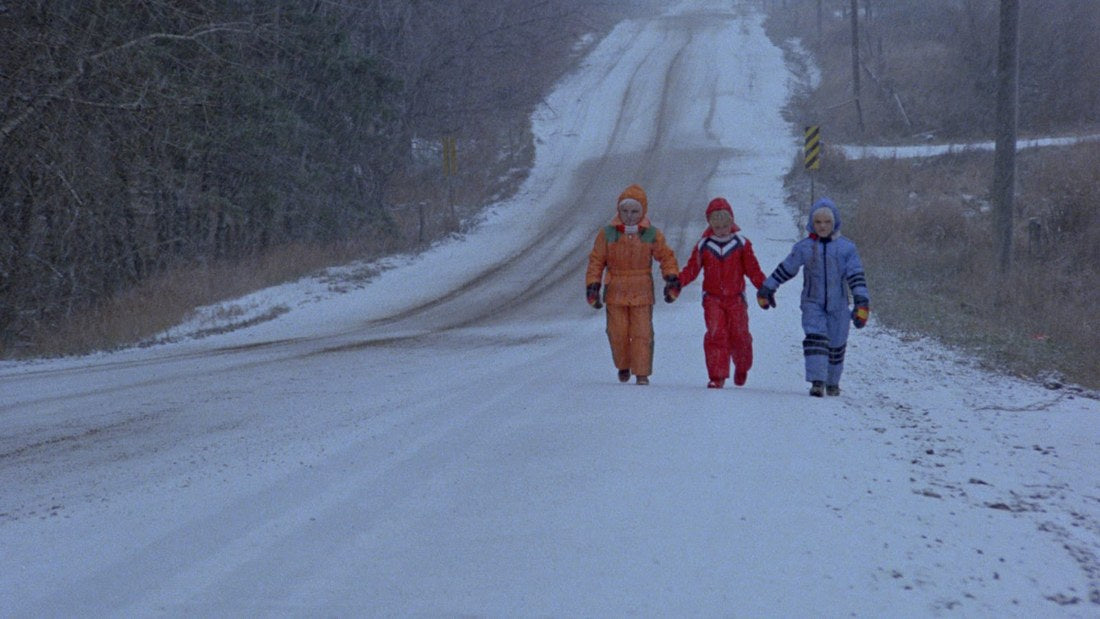
BR-R072The winter group has three different graphic treatments
Capricci capture 3 shows an orange suit with green panels, a central red suit with a light-and-dark chest chevron, and a blue suit with dark bands on arms and legs.
chromosome 3 (3).png, 1920 × 1080 · Capricci — six HD Chromosome 3 captures ↗
Panel shapes and stripes reinforce the costumes’ orange, red and blue grouping.

A close view against the archive photograph
BR-R073Nola’s neckline and shoulder detail
Capricci capture 4 gives a close view of Nola’s high white collar and gathered fabric at the shoulder.
chromosome 3 (4).png, 1920 × 1080 · Capricci — six HD Chromosome 3 captures ↗
The close capture and wider photograph answer different questions. One exposes neckline and shoulder detail; the other preserves overall drape and the relation of garment to bed. Neither gives a complete pattern.

Damage in the released image
BR-R074The breached door in script and film
Capricci capture 5 shows a bloodied arm extending through the door beside Candice; the metal bolt and pale torn-looking panel edge are visible. Tom Moore’s 2000.0606.PH.03 supplies a separate archive photograph of the door situation.
chromosome 3 (5).png; CQ 2000.0606.PH.03 · Capricci — six HD Chromosome 3 captures ↗ · Cinémathèque québécoise — The Brood photographs ↗ · Fangoria — S1 Ep28: Class of 79: Cindy Hinds (The Brood Series) ↗

An object before an identification
BR-R075A small rounded object deserves its own reference
Capricci capture 2 isolates a hand holding a rounded object with a red translucent-looking centre and pale irregular reflective areas.
chromosome 3 (2).png, 1920 × 1080 · Capricci — six HD Chromosome 3 captures ↗ · The Brood — reference copy A, archived MP4 ↗ · David Cronenberg — The Brood, fourth-draft screenplay scan ↗
Keep the reference open until adjacent footage shows how the object is handled and where it belongs. An isolated close-up is a useful lead, but a confident noun can quietly become a false production fact.
The two remaining capturesStair enclosure and public demonstration


The stair view preserves the spacing of the white balusters and dark rail. The demonstration view preserves the proximity of the two seated figures and the audience behind them. These are composition references; neither names the filming building.
Raglan’s book and the Somafree identity
BR-R076The book’s production attribution
Probert’s 2013 disc review attributes the cover of Raglan’s The Shape of Rage to Carol Spier.
Third substantive review paragraph · John Llewellyn Probert — The Brood, 14 September 2013 ↗
Domestic hardware and pattern
BR-R088Ruth’s telephone comes with a usable visual record
The publicity image shows a light-coloured pushbutton desk telephone with a coiled cord, striped cushions and the patterned sleeves of Ruth’s clothing. These details anchor a domestic design reference without relying on a low-resolution memory of the scene.
Pictured still, foreground and costume · Royal Books — Eight original Brood publicity photographs, item 150770 ↗
The complete publicity photograph appears in the release-material study above.
Institutional lettering and narrative paper


BR-R094Somafree identity travels on the bus
Frame 02 shows white condensed capitals across a green bus-side band, with rust-red, pale and yellow bands below. The institute name is readable; the final part of the treatment term extends beyond the image edge.
Gallery frame broodblu00002.jpg · Chris Galloway — Criterion Forum Blu-ray review and frame gallery, 12 October 2015 ↗ · The Brood — reference copy A, archived MP4 ↗
BR-R095A second newspaper: The Globe and Mail
Frame 17 shows The Globe and Mail masthead, the headline “Police seek dwarf killers,” a child’s portrait at left and a stretcher photograph at right. This is distinct from BR-R034’s Kelly-murder newspaper.
Gallery frame broodblu00017.jpg · Chris Galloway — Criterion Forum Blu-ray review and frame gallery, 12 October 2015 ↗
The wall display and the surviving book

BR-R096The Shape of Rage appears as a wall display
Frame 09 shows a horizontal black display behind Raglan, with a pale border, large white title, gold-coloured smaller lettering and a row of five illustrated panels. This is evidence of a promotional graphic, not a complete view of the bound book.
Gallery item 09; 09 (1008).jpg?bwg=1547462431 · FILMGRAB — The Brood, 14 February 2015 ↗
From directions to designed objects
BR-R112The screenplay’s prop directions
The draft proposes a transforming fist graphic, a CUSTODY photo folder and a Globe & Mail layout.
B 8, 42, 91 / PDF 9, 43, 92 · David Cronenberg — The Brood, fourth-draft screenplay scan ↗
BR-R115Nola has a room beyond the clinic
Scene 78 describes an attic flat with artist and analyst portraits.
B 89–91 / PDF 90–92 · David Cronenberg — The Brood, fourth-draft screenplay scan ↗
Institutions with incomplete paper trails
BR-R129The school-name connection revisited
He connects choosing Krell School’s name with recognizing the Forbidden Planet parallel.
Printed p. 84 / PDF 112 · Cronenberg on Cronenberg — edited by Chris Rodley, revised edition (1993) ↗
BR-R130The fictional treatment’s bodily starting point
He links psychoplasmics to stress rashes and muscular tension, while expressing interest in writing Raglan’s fictional book.
Printed p. 80 / PDF 108 · Cronenberg on Cronenberg — edited by Chris Rodley, revised edition (1993) ↗
Objects with an archival address
The book and its advertisement now have separate catalogue identities, dimensions and material descriptions. Costume sheets connect design drawings to photographs and, in one entry, a swatch. These records move the inquiry beyond general department credits while preserving the difference between catalogue descriptions, previews and physical inspection.
BR-R136A surviving book mock-up with an attribution
TIFF identifies the Raglan book mock-up with Carol Spier, measures it at 23.0 × 15.1 × 1.9 cm, and records paper, cardboard and a gouache-collaged cover.
2000-001-01.0122; maker, measurements, materials and description fields · TIFF — book mock-up, 2000-001-01.0122 ↗
BR-R137The advertisement is a separate surviving object
TIFF attributes the book advertisement to Spier and describes a colour copy mounted on cardboard with hand-painted elements, measuring 38.2 × 61.1 cm.
2019-015-02.0009; maker, materials and measurements fields · TIFF — book advertisement, 2019-015-02.0009 ↗
BR-R138A drawing, photograph and swatch together
TIFF lists a circa-1979 Delphine White collage combining a costume design, Polaroid and attached fabric swatch on a 22 × 28 cm support.
2019-010-02.0004; materials and description · TIFF — costume collage, 2019-010-02.0004 ↗
BR-R139Two sides, two costume references
A second White collage is catalogued with a yellow dress and red overcoat on its recto, and a white nightgown design with a photograph on its verso.
2019-010-02.0005; description of recto and verso · TIFF — two-sided costume collage, 2019-010-02.0005 ↗
BR-R140Four costume Polaroids have a specific locator
TIFF describes four colour Polaroids and three Brood press clippings on the verso of a Delphine White portfolio page; its recto concerns Hog Wild.
2019-010-02.0015; description · TIFF — White portfolio page, 2019-010-02.0015 ↗
Graphics and objects in a timecoded reference copy
BR-R156Somafree’s lettering can now be read across adjacent views
The bus-side wording resolves as Somafree Institute of Psychoplasmics. White condensed letters sit on green above a rust-red band; the fourth draft separately proposes primary-colour Somafree lettering and matching lodge signage.
Reference A 00:05:50 and 00:05:55; fourth draft scene 4, B 7 / PDF 8 · The Brood — reference copy A, archived MP4 ↗ · David Cronenberg — The Brood, fourth-draft screenplay scan ↗ · Chris Galloway — Criterion Forum Blu-ray review and frame gallery, 12 October 2015 ↗
Swipe or scroll sideways to read every column →
| File time | Object or graphic | Visible detail |
|---|---|---|
| 00:00:12 | Feature title | Blue/cyan-looking letters on black in this transfer; unlike the trailer’s white title over action. No calibrated colour claim. |
| 00:05:50; 00:05:55 | Somafree bus | Overlapping views resolve the institute wording and band hierarchy. |
| 00:09:35 | Desk intercom | Pale sloping case, grille and switches; no readable manufacturer/model established. |
| 00:20:45 | Haulage container | Orange container with black lettering, a maple-leaf mark and excavating/grading text. This is a different commercial graphic from Somafree; no fictional-company or product-placement claim. |
| 00:29:45 | Instant camera | Front-facing camera and flash assembly visible; an exact model is not assigned. |
| 00:33:45 | Hartog’s sportswear | The trefoil emblem and three stripes identify the tracksuit’s visual language. |
| 01:04:15 | Winter suits at classroom cubbies | Side-by-side red, orange/green and blue/purple constructions, scarves and contrasting bands support the existing costume study. |
| 01:05:15 | Classroom objects | Paint cups, large reused bottles and work surfaces surround the figures. |
| 01:22:00; 01:23:00 | Nola’s garment | The images show the garment’s open front and gathered sleeves in the seated scene. |
The ornament becomes a weapon
BR-R159The rounded objects belong to the bedroom attack
Reference A shows a creature handling two rounded ornaments at 00:46:53–00:46:57, followed by the attack on Barton. The fourth draft describes a matched pair of snow-globe-like spheres on heavy marble bases; its object description is more specific than the film images can securely establish.
Reference A 00:46:53, 00:46:55, 00:46:57 and attack samples 00:47:12–00:47:24; fourth draft B 67–68 / PDF 68–69 · The Brood — reference copy A, archived MP4 ↗ · David Cronenberg — The Brood, fourth-draft screenplay scan ↗ · Capricci — six HD Chromosome 3 captures ↗
The scene turns a pair of domestic ornaments into weapons. A large pale sphere on the living-room table at 00:17:45 is a separate object.
A photograph inside the family history
BR-R160The hospital photograph joins two generations
Hinds says she posed with Fitzgerald for the childhood hospital photograph. Reference A shows its child-in-bed and adult arrangement at 00:16:34–00:16:40. The fourth draft instead specifies a child unlike Candice.
Hinds 05:32–06:08; reference A 00:16:34, 00:16:36, 00:16:38 and 00:16:40; fourth draft B 23–24 / PDF 24–25 · Fangoria — S1 Ep28: Class of 79: Cindy Hinds (The Brood Series) ↗ · The Brood — reference copy A, archived MP4 ↗ · David Cronenberg — The Brood, fourth-draft screenplay scan ↗
A more specific shirt reference
BR-R166A colour recollection for the More Blood shirt
Irwin remembers white shirts with red blood imagery and the More Blood exclamation; Hindle separately recalls commissioning dripping letters.
Irwin 24:47–24:59; Hindle 28:20–28:37 · Fangoria — S1 Ep29: Class of 79: Mark Irwin (The Brood Series) ↗ · Fangoria — S1 Ep30: Class of 79: Art Hindle (The Brood Series) ↗
06Music & soundShore’s score, recording evidence and the concert work.7 research notes
SOUND & MUSIC
The film’s musical afterlife.
From screen to concert hall
The score, concert work and record sleeve are related objects with different histories. Follow them separately.
BR-R014The film music becomes a concert work
Shore’s catalogue gives the concert work an approximate 13-minute duration. Schott specifies three violins, one viola, two cellos and double bass, or string orchestra, and dates the work to 1996.
Shore: description and instrumentation; Schott March 2025 brochure pp. 2, 7 / PDF 2, 7 · Howard Shore — The Brood / The Shape of Rage ↗ · Schott — Howard Shore composer brochure, March 2025 ↗
BR-R015The concert premiere
The composer’s catalogue records the premiere on 1 November 1996 in Seville, conducted by Shore. This is a concert-work date, not the film’s first screening.
Productions / World Premiere · Howard Shore ↗
BR-R016The 2015 album is a suite presentation
Shore’s announcement lists The Shape of Rage: A Suite for 21 Strings at 12:17 on the Brood side of the Scanners / The Brood LP. It is not described as a complete film-score release.
Side B track listing · Howard Shore ↗
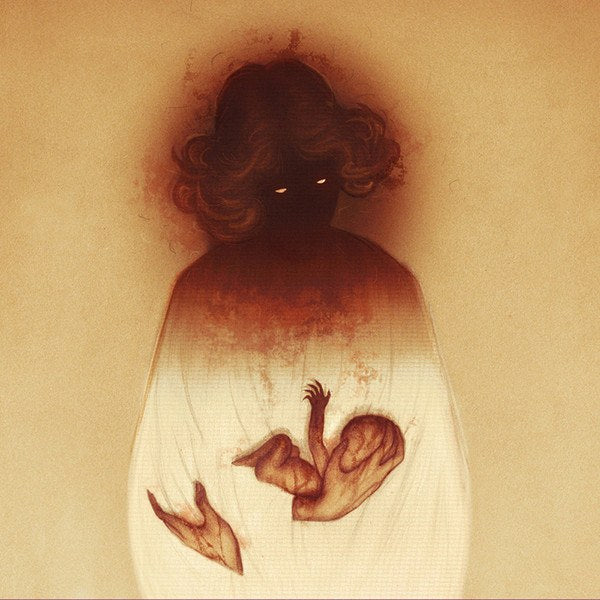
BR-R017The album has its own visual history
The 2015 announcement credits both sides of the packaging to Sam Wolfe Connelly. That artwork belongs to the later album, not the original theatrical campaign.
Packaging announcement · Howard Shore ↗
Before the suite: making the film score
The commission, the recording session and the later concert work leave different evidence. Reading the director beside the composer makes that distinction clearer.
BR-R065A score shaped for the film
Cronenberg told Chaw that The Brood was his first opportunity to commission a score instead of fitting library music around the film. He could attend sessions and discuss placement and dialogue-sensitive dynamics.
The Brood interview questions, after the discussion of stock music · Walter Chaw — David Cronenberg Re-examines David Cronenberg ↗
BR-R066Twenty-one strings, seven hours
In the reproduced Schelle interview, Shore recalls writing The Brood for twenty-one strings and recording it in seven hours, moving rapidly from rehearsal to take.
Shore interview, Brood/Scanners/Videodrome paragraph, around printed p. 325 · Michael Schelle — The Score: Howard Shore interview excerpt ↗ · Silman-James Press — The Score ↗
BR-R067Film scoring as an experimental outlet
In his 1998 conference discussion, Shore describes early Cronenberg films as a place to develop experimental compositions. He also recalls reconsidering earlier film music after his Seville retrospective, looking for ideas that could develop beyond their screen timings.
Opening film-scoring answer; concert-work and Seville answers · Howard Shore / Philip Brophy — Composing with a very wide palette ↗
07Editions & versionsCuts, transfers, classification records and supplements.15 research notes
EDITIONS & VERSIONS
Which Brood are you watching?

The film’s home-video history spans different cuts, transfers, formats and supplement programmes.
BR-R018The UK cinema classification
The BBFC records Alpha Films’ cinema submission on 18 July 1979 at 91m 30s.
Cinema record · BBFC ↗
BR-R019Home-video runtimes
BBFC entries include 87m 41s for Anchor Bay in 2005 and 88m 18s for Second Sight in 2013. These are registration runtimes, not a verified list of removed shots.
Home entertainment records · BBFC ↗
BR-R020The Criterion transfer is 2K
Criterion identifies a director-supervised 2K transfer of The Brood with mono sound. The 4K transfer in the same extras list belongs to Crimes of the Future.
Special edition features · Criterion ↗
BR-R021The retrospective interviews
Rick Baker and Joe Blasco appear in Criterion’s documentary on Cronenberg’s early career.
Documentary participant listing · Criterion ↗
Open the UK submission register 7 recorded versions
Swipe or scroll sideways to read every column →
| Classified | Distributor | Recorded runtime |
|---|---|---|
| 18 Jul 1979 | Alpha Films · cinema | 91:30 |
| 13 Nov 1986 | Placecross · video | 87:42 |
| 27 Jan 1992 | Video Gems | 87:43 |
| 17 Apr 1997 | Arrow | 88:08 |
| 11 Jun 1998 | Polygram | 88:08 |
| 4 May 2005 | Anchor Bay | 87:41 |
| 8 May 2013 | Second Sight | 88:18 |
| 31 December 1987 · trailer | Placecross Ltd | 3m 17s |

The newer Second Sight edition
BR-R030A separate 4K restoration
Second Sight advertises a Cronenberg-approved 4K restoration, with Dolby Vision on UHD and LPCM mono audio. Catalogue 2NDBR4238 combines UHD and Blu-ray.
Special Features; catalogue and technical specification · Second Sight ↗
BR-R031Two commentary routes and a Shore interview
Second Sight lists Conterio/Ellinger and William Beard commentaries, plus interviews with Shore, Irwin, Pierre David, Silverman, Hindle and Hinds. These create targeted viewing routes into music, photography, production and performance.
Special Features · Second Sight ↗
BR-R032A modern package with its own authorship
The limited edition credits new artwork to Krishna Shenoi and includes a 120-page essay book and six art cards.
Limited Edition Contents · Second Sight ↗
BR-R064The video trail is longer than two editions
The BBFC also records submissions in 1986, 1992, 1997 and 1998, plus a 3-minute-17-second trailer classified on 31 December 1987.
Home entertainment and trailers entries · BBFC — The Brood classification history ↗
Comparing the releases
A version record with its components intact
BR-R120A classification decision tied to a particular DVD
New Zealand record 1300389.000 restricts the DVD to viewers aged 16 or over for violence and horror and recommends no excisions. It entered the register on 21 May 2013.
Decision p. 1 · New Zealand Classification Office — The Brood DVD, 1300389.000 ↗
BR-R121Feature runtime and package runtime are separate
The decision lists The Brood at 92:05 and the whole submitted package at 154:53. The remaining time belongs to an interview programme, trailer and notices.
Components table, p. 2 · New Zealand Classification Office — The Brood DVD, 1300389.000 ↗
Swipe or scroll sideways to read every column →
| Component | Recorded runtime |
|---|---|
| The Brood — feature | 92:05 |
| The Directors: The Films of David Cronenberg | 58:28 |
| The Brood — trailer | 2:43 |
| Notices | 1:37 |
| Package total | 154:53 |
Source: Classification decision, page 2 ↗. Times describe the submitted DVD package; they are not a new viewing log.
BR-R122The associated slick is an artwork decision
Record 1300389.001 approves a slick without conditions on 20 May 2013.
Single-page notice · New Zealand Classification Office — The Brood slick, 1300389.001 ↗
The gesture, the coverage and the cut
BR-R131A close-up recalled as missing
Cronenberg recalls an extended, affectionate newborn-licking close-up removed by censors and absent from final versions known to him.
Printed p. 85 / PDF 113; earlier related statement in Sammon, printed/PDF p. 26 · Cronenberg on Cronenberg — edited by Chris Rodley, revised edition (1993) ↗ · Paul M. Sammon — David Cronenberg, Cinefantastique 10:4 (Spring 1981) ↗
The fourth-draft direction, Eggar’s recollection and Cronenberg’s editing account describe the scene from writing through performance to the released cut.
Where the reported cuts fall
BR-R152A cut map tied to two named releases
The 2010 report compares German TOPPIC VHS with U.S. MGM DVD. It assigns 36 seconds to six scene extensions and another 18 to MGM logos. Its MGM disc carries an R label despite the longer content.
Report published 30 June 2010; scene locators tabulated below · magiccop — The Brood: R-Rated / Unrated comparison (2010) ↗
Swipe or scroll sideways to read every column →
| Locator | Passage | Reported extension |
|---|---|---|
| 18:40 | Juliana attack | 8.6 s |
| 63:16 | Ruth aftermath | 10.3 s |
| 79:16 | Opening the sac | 3.5 s |
| 79:38 | Licking shot | 2.1 s |
| 79:42 | Closer view | 9.2 s |
| 82:01 | Raglan’s body | 2.3 s |
The birth sequence in the surviving images
BR-R157Retained birth images are now locatable
Reference A contains the sac-opening image at 01:23:00 and closer newborn-licking images at 01:23:35 and 01:23:40. The fourth draft already contains the licking direction. These are separate witnesses to writing, photographed action and a surviving edit.
Reference A times below; fourth draft B 106 / PDF 107; BR-R106, BR-R131 and BR-R152 · The Brood — reference copy A, archived MP4 ↗ · David Cronenberg — The Brood, fourth-draft screenplay scan ↗ · magiccop — The Brood: R-Rated / Unrated comparison (2010) ↗ · Paul M. Sammon — David Cronenberg, Cinefantastique 10:4 (Spring 1981) ↗ · Cronenberg on Cronenberg — edited by Chris Rodley, revised edition (1993) ↗
Swipe or scroll sideways to read every column →
| Passage | Reference A sample times | Visible evidence | Published comparison target |
|---|---|---|---|
| Juliana attack | 00:19:20; 00:19:30 | Blood on chair; attack image. | Report 18:40 / 8.6 s extension |
| Ruth aftermath | 01:06:15 | Bloodied face held by Frank. | Report 63:16 / 10.3 s extension |
| Sac opening | 01:23:00; 01:23:05 | Hands opening the external sac; newborn visible. | Report 79:16 / 3.5 s extension |
| Newborn close views | 01:23:35; 01:23:40 | Nola brings her mouth/tongue to the newborn in close framing. | Report 79:38 and 79:42 / 2.1 s and 9.2 s extensions |
| Raglan’s body | 01:28:15 | Body visible at the far end of the bunkhouse. | Report 82:01 / 2.3 s extension |
Scripted stillness and remembered alternatives
BR-R161Hinds remembers a more active Candice during the killings
Discussing removed material, Hinds recalls crumpling the photograph and striking/rubbing her head during Juliana’s killing, and pounding a wall with bloodied hands during Ruth’s. The fourth draft instead has Candice freeze at the first attack and quietly leave the classroom before the second.
Hinds 18:55–21:59, especially 20:55–21:45; fourth draft B 27 and B 85–87 / PDF 28 and 86–88 · Fangoria — S1 Ep28: Class of 79: Cindy Hinds (The Brood Series) ↗ · David Cronenberg — The Brood, fourth-draft screenplay scan ↗
Reading the supplement evidence
Birth Pains has been examined through the complete available automatic-caption track of a public upload. This provides a text-review record; its picture, sound and speaker identities still require direct verification. The candidate passages have not been used here as new fabrication or performance claims.
08Release & campaignTerritories, posters, publicity and theatrical presentation.13 research notes
DISTRIBUTION / TERRITORIES / PUBLICITY
A release is more than a date.
BR-R049Cronenberg on the American release
In March 1981 Cronenberg said he was disappointed with The Brood’s American handling and connected that experience to taking Scanners elsewhere rather than New World.
Printed p. 13 / PDF p. 6, distribution exchange · John G. Harkness — Brilliantly Bizarre, Cinema Canada, March 1981 ↗
BR-R052The French release has a separate paper trail
GARANCE records a French opening on 10 October 1979, Audifilm distribution, visa 50866, and an under-16 restriction. It also lists a deposited French-dubbed version as Chromosome 3.
Identity, production-distribution and versions fields · GARANCE — The Brood / Chromosome 3 ↗
Swipe or scroll sideways to read every column →
| Territory / witness | Documented point |
|---|---|
| United States / Cronenberg, 1981 | His dissatisfaction with New World’s handling. |
| United Kingdom / BBFC | 18 July 1979 cinema classification, Alpha Films, 91m 30s. |
| France / GARANCE | 10 October 1979 opening; Audifilm; visa 50866. |
| Publicity archive / FI-055 | Specific Brood folder at 4.11. |
Chromosome 3: the later campaign
BR-R070The French film returns in 2021
Capricci records a French theatrical reissue on 3 November 2021. The campaign’s press kit advertises a restored 2K copy.
Distributor release date; press-kit PDF p. 4 · Capricci — Chromosome 3, 2021 French reissue ↗ · Capricci — Chromosome 3 press kit ↗
BR-R071A credited reissue poster designer
The 2021 campaign press kit credits Marc Lafon with graphic design of the poster.
PDF p. 4, small vertical credit at right · Capricci — Chromosome 3 press kit ↗
The later French campaign gives Chromosome 3 its own title treatment, poster artwork and selection of critical responses.
Distributor page ↗ · Four-page press kit ↗ · Official high-resolution poster ↗
Original campaign paper: image, format, address
The one-sheet and quad show how a related central image is reorganised for different display formats. They belong to the museum of the film’s publicity, separate from both objects inside its fictional world and later artist editions.


BR-R084The U.S. one-sheet encloses the threat
The U.S. poster places an eye-and-hand creature inside a rounded, reddish enclosure beneath a large pale title. A smaller lower-left slogan addresses the audience directly.
Item 4643, supplied poster image · Posteritati — The Brood U.S. one-sheet, item 4643 ↗
BR-R085The British quad rearranges the campaign image
The quad uses a closely corresponding central creature motif in a landscape layout: promotional copy and the two principal star names at left, image toward the right, large yellow title below. An X appears beside the title.
Item 4644 compared with item 4643 · Posteritati — The Brood British quad, item 4644 ↗ · Posteritati — The Brood U.S. one-sheet, item 4643 ↗
A character-led alternative campaign
BR-R086Four character sheets, four different invitations
The four photographed Alpha sheets share orange actor names and title, pale secondary text, a portrait panel and black ground. Candy’s innocence is questioned; Frank becomes a lone opponent; Nola faces a family choice; Raglan is presented as a potentially dangerous mastermind. Reed’s image shows a handgun. Heritage gives each sheet as 20 × 29.75 inches.
Heritage auction 7405, lot 86301; printed catalogue p. 184 / PDF 186, all four photographs · Heritage Auctions — The Brood British double-crown set, lot 86301 ↗
The character campaign, sheet by sheet


When the caption is part of the object
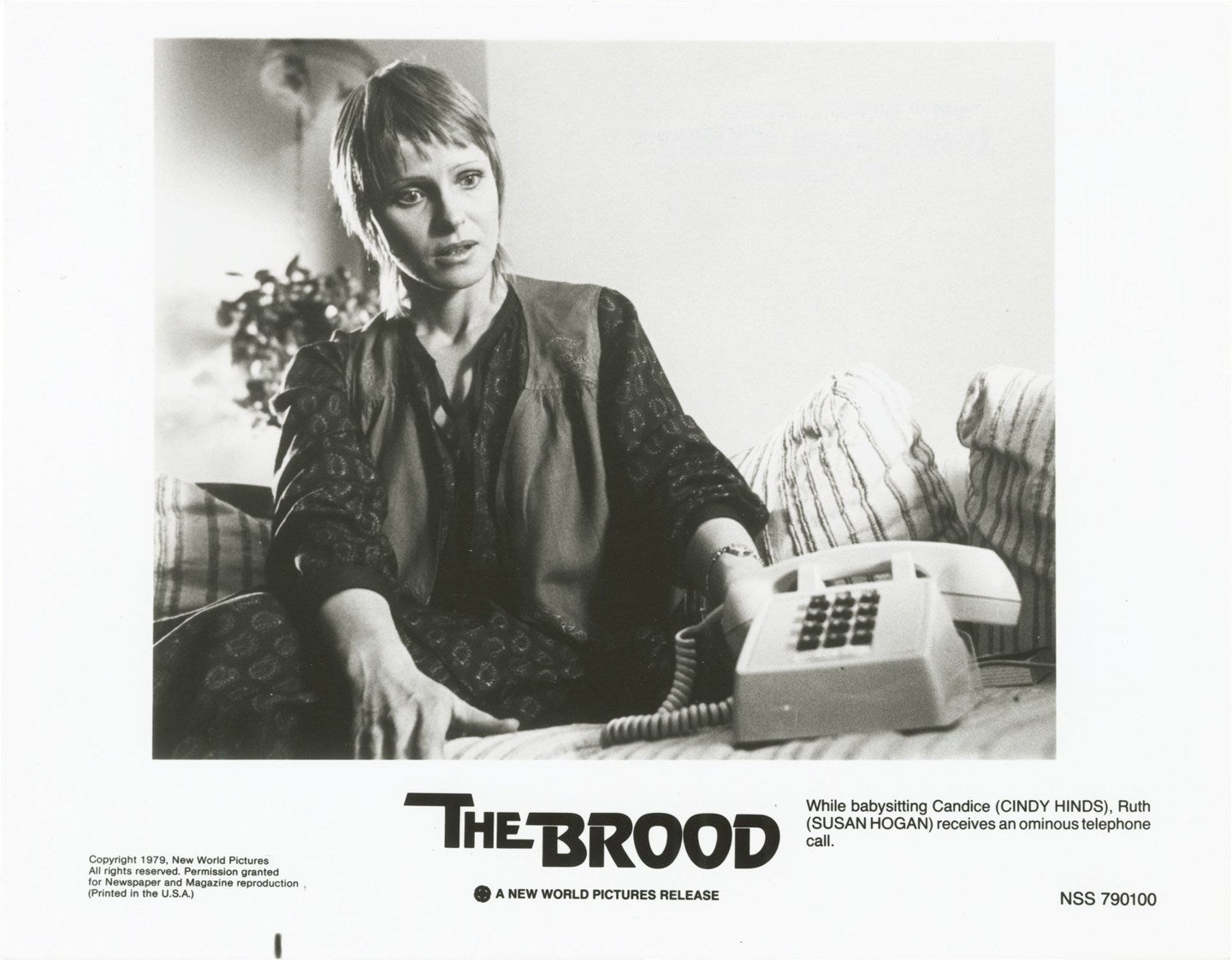
BR-R087A publicity print preserves its own release information
The pictured Ruth still has a printed New World Pictures release line, a 1979 copyright block and the identifier NSS 790100. Its caption names Susan Hogan as Ruth and places the telephone call during her care of Candice.
Item 150770, pictured front and lower printed margin · Royal Books — Eight original Brood publicity photographs, item 150770 ↗
The printed margins preserve the release line, copyright, still number and caption as part of the publicity object.
Another side of the distribution relationship
BR-R093Corman remembers an acquisition worth distributing
Corman describes his role as distribution of a film Cronenberg had already made, praising the filmmaker’s ability to exceed ordinary low-budget expectations. Read alongside BR-R049, this preserves distinct perspectives: distributor enthusiasm and the director’s dissatisfaction with New World’s handling.
The Brood entry · Tony Timpone / Roger Corman — Roger’s Retrospective, Fangoria, 14 May 2024 ↗
How the film reached theatres
BR-R117Cronenberg describes a restricted Los Angeles run
In the 1979 interview, Cronenberg says Los Angeles bookings lasted one week with no possibility of a holdover, regardless of performance. He attributes the difficulty to distributors’ unequal bargaining power.
Printed p. 15 / original PDF 18, first column · Bob Martin / David Cronenberg — The Brood and Other Terrors, Fangoria no. 3 (1979) ↗
Cronenberg’s frustration with limited bookings sits beside Corman’s later satisfaction as distributor: two perspectives on the film’s commercial history.
Reception and source inconsistencies
BR-R135A different 1979 critical framework
Schupp groups The Brood with catastrophe and ecology films. His essay links screen monsters to isolation and social anxiety, while ranking Cronenberg’s shock tactics below Scott’s and Kubrick’s.
Printed pp. 31–32 / PDF 6–7 · Patrick Schupp — Les monstres de l’été, Séquences 98 (October 1979) ↗
BR-R132A distributor inconsistency inside one page
Rodley’s editorial bridge names New World, then AIP, for the American release.
Printed p. 85 / PDF 113, italic editorial text · Cronenberg on Cronenberg — edited by Chris Rodley, revised edition (1993) ↗
A trailer’s own visual argument
BR-R154The trailer places its title inside the violence
The inspected samples show the title in large white capitals over action, beneath a smaller director attribution. A readable Shreddies carton appears in the opening kitchen passage. Later samples include the therapy demonstration, family confrontation and bedroom-door attack.
Host MP4: 480 × 360, 25 fps, 3m 19.2s; selected locators below · The Brood — trailer hosted by critic.de ↗
Swipe or scroll sideways to read every column →
| File time | Visible element |
|---|---|
| 00:08 | Carton and scattered cereal |
| 00:52 | Title over Juliana |
| 00:56–01:20 | Therapy-demonstration samples |
| 02:24 | Nola and newborn |
| 03:12; 03:16 | Title over the door attack |
09From the MuseumA surviving Spanish poster and its material details.Collection object
10Reception & readingsPeriod reviews and the film’s critical afterlife.13 research notes
RECEPTION & INTERPRETATION
A film that changes with its audience.

BR-R022Recovering the correct byline
The seven-page Cinema Canada file preserves the review’s continuation and Andrew Dowler’s signature on printed p. 34. Bill Beard signs the adjacent Fast Company review. The masthead dates the issue to September 1979, no. 58.
Review printed pp. 33–34 / PDF pp. 2–3; issue masthead and contents, printed p. 3 / separate PDF p. 1 · Andrew Dowler — The Brood, Cinema Canada no. 58 (September 1979) ↗ ·
BR-R023A contemporary prediction of endurance
Dowler praises the suspense and predicts lasting revival appeal despite what he describes as a brief Toronto run.
Printed p. 34 · Andrew Dowler ↗
BR-R024A critic revisits the family
Rickey contrasts her earlier reading as psychotherapy satire with a later response centred on divorce’s effects on a child. It is a history of interpretation, not a production fact.
Opening paragraphs · Carrie Rickey ↗
BR-R025Somafree and psychoplasmics
Rickey describes Raglan’s Somafree Institute and a therapy that gives emotional distress physical form.
Raglan and Somafree discussion · Carrie Rickey ↗
Competing readings belong together.
BR-R060A feminist reading changes the point of view
Middleton asks readers to question their identification with Frank’s disgust. His analysis treats Raglan, Frank and Nola’s father as different failures of paternal authority, opening the film beyond a simple monstrous-mother reading.
Discussion of the climax and final two analytical paragraphs · Jason Middleton — Birthing from Within, Films for the Feminist Classroom 6.1 ↗
BR-R062The hostile critical response
Botting cites hostile British responses by Derek Malcolm and Tom Hutchinson and describes the trailer’s sensational, science-fiction-inflected sales pitch.
Opening paragraphs and trailer discussion · Josephine Botting — Why I love … The Brood, BFI ↗
Contemporary disagreement, recovered
Dowler’s enthusiasm, Ebert’s hostility and Tesson’s account of embodied resentment give us a more useful reception history than a simple story of universal rejection followed by rediscovery. Their objects of attention differ: narrative suspense, aesthetic disgust and the body’s place in family conflict.
BR-R069Ebert’s objection was also to form
Ebert’s 1979 review attacks the pacing, dialogue and predictability as well as the disgust. He contrasts the film unfavourably with Alien and Dawn of the Dead and compares the small, brightly clothed killers with Don’t Look Now. In a 2014 interview with Barend de Voogd, Cronenberg argues that Ebert initially concentrated on the horrific surface and later understood his filmmaking better; he emphasizes the film’s emotional truth alongside its invented biology.
Full review; publisher metadata dated 5 June 1979; de Voogd, question beginning “But the attitude of critics” and its answer · Roger Ebert — The Brood, 5 June 1979 ↗ · Barend de Voogd — Some Place Really Deep: David Cronenberg (2014 interview) ↗ ·
BR-R068Tesson: resentment takes physical form
The Capricci reprint attributes to Charles Tesson a reading of monstrosity as produced through desire, resentment and family conflict, rather than simply inherited. Its original issue, Cahiers no. 306, is dated December 1979 by the magazine’s collection.
Press-kit PDF p. 3; Cahiers issue metadata · Capricci — Chromosome 3 press kit ↗ · Cahiers du cinéma — no. 306, December 1979 ↗
BR-R078The director’s memory of tone is one voice
Asked about The Brood’s bitterness in 2003, Cronenberg describes it as unusually personal and recalls no humour, while explicitly allowing that he should revisit it.
Final Brood exchange before the Scanners section · Walter Chaw — David Cronenberg Re-examines David Cronenberg ↗
Two more ways of seeing the film
Lucas’s mixed contemporary response adds a question about when horror reveals its mechanism. Rejtman’s later selection draws attention to the environments and the precision of the performances.
BR-R079Lucas: achievement with a problem of disclosure
Lucas judges this Cronenberg’s strongest film so far while criticizing over-explanation and an early autopsy that weakens later suspense. He praises Eggar’s emotional range and reads Reed’s quiet anger as repression. His conclusion treats the film as a promising step toward locating horror in conscience rather than science.
Complete review, p. 42 / PDF 42; contents / PDF 2 · Tim Lucas — The Brood, Cinefantastique 9:1, Fall 1979 ↗
BR-R082Rejtman’s future is already in these rooms
Choosing The Brood for PROA in 2012, Rejtman groups it with early Cronenberg films whose Canadian modern architecture, furnishings, technology and cold landscapes still suggest the future to him. He also admires their economy of staging and performance, and finds humour within their seriousness.
Press-kit p. 2, The Brood paragraph; programme on p. 1 · Martín Rejtman — Fundación PROA programme introduction, 2012 ↗
These accounts can be read beside the existing reviews without resolving them into a single verdict. Rejtman’s response also keeps the ordinary rooms, furniture and cold exterior spaces in the foreground of the visual investigation.
The award nomination
BR-R108Eggar’s nomination survives as a document
The certificate identifies Eggar’s 1980 Genie nomination for Best Performance by a Foreign Actress in The Brood. Its lower panel is dated March 1980 and names chairman Ronald Cohen.
Lot 67, front photograph; reverse also inspected · Julien’s Auctions — Eggar’s 1980 Genie nomination certificate, lot 67 ↗
A Canadian viewer revisits the film
BR-R153Canadian familiarity becomes an atmosphere
McKellar recalls first encountering the film through a Toronto cinema-door window. His later essay connects its institutional spaces and bright snowsuits with Canadian familiarity; he also reports discussing those suits with Cronenberg. His identification shifts from the child to Frank as he grows older.
CLC 143, printed pp. 166–167 / PDF pp. 141–142; originally Sight and Sound, July 1999 · Don McKellar — Children of Canada (1999) ↗
11Books & afterlivesThe novelization, related works and unrealized projects.10 research notes
AFTERLIVES / PRINT / UNMADE CINEMA
Other versions of The Brood.
The novel, the publicity archive and an unproduced remake take the research beyond the released film.
The book and the paper trail
BR-R037A physical publicity trail in Texas
The Harry Ransom Center holds John McCarty’s Brood publicity material. The full finding aid now supplies container 4.11; its stills index also points to 14.15.
FI-055, Series I.B; container 4.11; stills index 14.15 · Harry Ransom Center — John McCarty Papers ↗ · Harry Ransom Center — John McCarty Papers, FI-055, full EAD ↗
BR-R038Starks’s account
Richard Starks lists The Brood among his works of fiction.
Richard Starks biography · Richard Starks ↗
The remake that stayed on paper
BR-R039A pitch before a screenplay
Goodman recalls developing a roughly twenty-minute pitch, selling it to Spyglass, then waiting while a rights issue was resolved before writing.
Opening development answers · Jason Jenkins / Cory Goodman ↗
BR-R040A different balance of blame
Goodman says he wanted Nola to have more agency and her husband to acknowledge his responsibility. Jenkins’s account of the unproduced script describes a car-crash backstory and a changed ending.
Story account; Goodman’s answers about Nola · Jason Jenkins / Cory Goodman ↗
BR-R041Proposed casting
Goodman says proposed actors were discussed, but he did not know whether they received the script. He was told Pascal Laugier was attached, yet never spoke with him.
Director and proposed-cast answers · Jason Jenkins / Cory Goodman ↗
BR-R042Development ended without a film
Goodman recalls Spyglass passing, a later unsuccessful attempt involving Universal interest, and the project eventually falling away.
Closing development answer · Jason Jenkins / Cory Goodman ↗
BR-R063The Brood monograph
The Center for Cartoon Studies identifies Stephen R. Bissette’s Midnight Movie Monograph on The Brood and links it to PS Publishing. It is a major named acquisition priority. Author-account posts report printing on 5 February 2020 and shipping by 28 March. A photographed signed leaf specifies 200 copies; this is not the total print run.
Institutional announcement and publisher link; author-account posts 1 and 8 (5 February / 28 March 2020); signed-leaf photograph attached to post 8 · The Center for Cartoon Studies — Stephen R. Bissette’s Brood monograph ↗ · Stephen R. Bissette — publication updates and signed-edition photograph ↗ ·

A curatorial afterlife
BR-R098The film’s title becomes an exhibition metaphor
The Dowse’s 2025 exhibition borrowed The Brood’s title for nine commissions, curated by Chelsea Nichols and Aaron Lister as Curator of Screams. Its statement uses the film as a metaphor for artists releasing unsettling ideas, while explicitly saying the works were not made directly in response to the film.
Exhibition dates and curatorial statement · The Dowse Art Museum — The Brood, 15 February–22 June 2025 ↗
The novelization’s commissioning route
BR-R104How Starks received the novelization commission
Starks says sharing a Toronto literary agent with Cronenberg was a major reason he was asked to adapt The Brood.
Individual answer to Norman Crane’s novelization question · Richard Starks — answer to Norman Crane about The Brood novelization ↗
The therapy scenes enter the gallery
BR-R146Treatment turns role-play into a second performance
Candice Breitz’s two-channel Treatment (2013), commissioned by TIFF, pairs three therapy scenes from The Brood with newly recorded voices. Her psychotherapist voices Raglan; Breitz and her parents voice the patients. The second projection shows the recording process.
KOW project description, paragraphs on the two projections and credits · KOW — Candice Breitz, Treatment (2013) ↗
12Surviving materialArchive holdings, estate objects and precise accessions.5 research notes
ARCHIVAL HOLDINGS / ESTATE MATERIAL
Where the evidence survives.
BR-R056Scene 33 material in Eggar’s estate
The auctioneer describes an eight-inch 35 mm reel and a separate deteriorated magnetic-audio element. Its transcription gives scene 33, slate 479, take 1, dated 18 December 1978; it reports inspecting only the opening feet.
Lot 68, description, paragraphs on inspection and clapperboard · Julien’s Auctions — 35 mm outtake material, lot 68 ↗
BR-R057A novelisation from Eggar’s library
Lot 82 lists Richard Starks’s The Brood, Virgo Press, Toronto, 1979, as a first-edition softcover among Eggar’s books, with her bookplate.
Lot 82, first bibliographic entry · Julien’s Auctions, lot 82 — Books from Eggar’s film and TV productions (Lot-Art mirror) ↗
BR-R058One colour slide in New York
NYPL’s David Morgan finding aid lists one Brood item in Color / Slides, box 1 folder 3, described as a later duplicate and associated with New World.
*T-Vim 2018-005; printed p. 7 / PDF p. 9 · NYPL — David Morgan collection of film stills, *T-Vim 2018-005 ↗
BR-R059The Ransom Center’s exact references
The full McCarty finding aid identifies Brood publicity in container 4.11 and indexes Brood stills to 14.15. This replaces the earlier collection-level lead with retrievable references.
FI-055; Series I.B, container 4.11; stills index, 14.15 · Harry Ransom Center — John McCarty Papers, FI-055, full EAD ↗
Swipe or scroll sideways to read every column →
| Repository / object | Locator |
|---|---|
| Cinémathèque québécoise / Tom Moore photographs | 21 linked previews; both caption and file accession variants retained. |
| Harry Ransom Center / John McCarty Papers | FI-055, 4.11 publicity; 14.15 stills index. |
| NYPL / David Morgan film stills | *T-Vim 2018-005, box 1 folder 3, Color / Slides. |
| Eggar estate screenplay | Julien’s, 24 June 2026, lot 69. |
| Eggar estate film element | Same sale, lot 68, described as 35 mm outtake. |
| Eggar estate novelisation | Same sale, lot 82; Starks, Virgo Press, 1979. |
Scene 33: the object and the reported footage
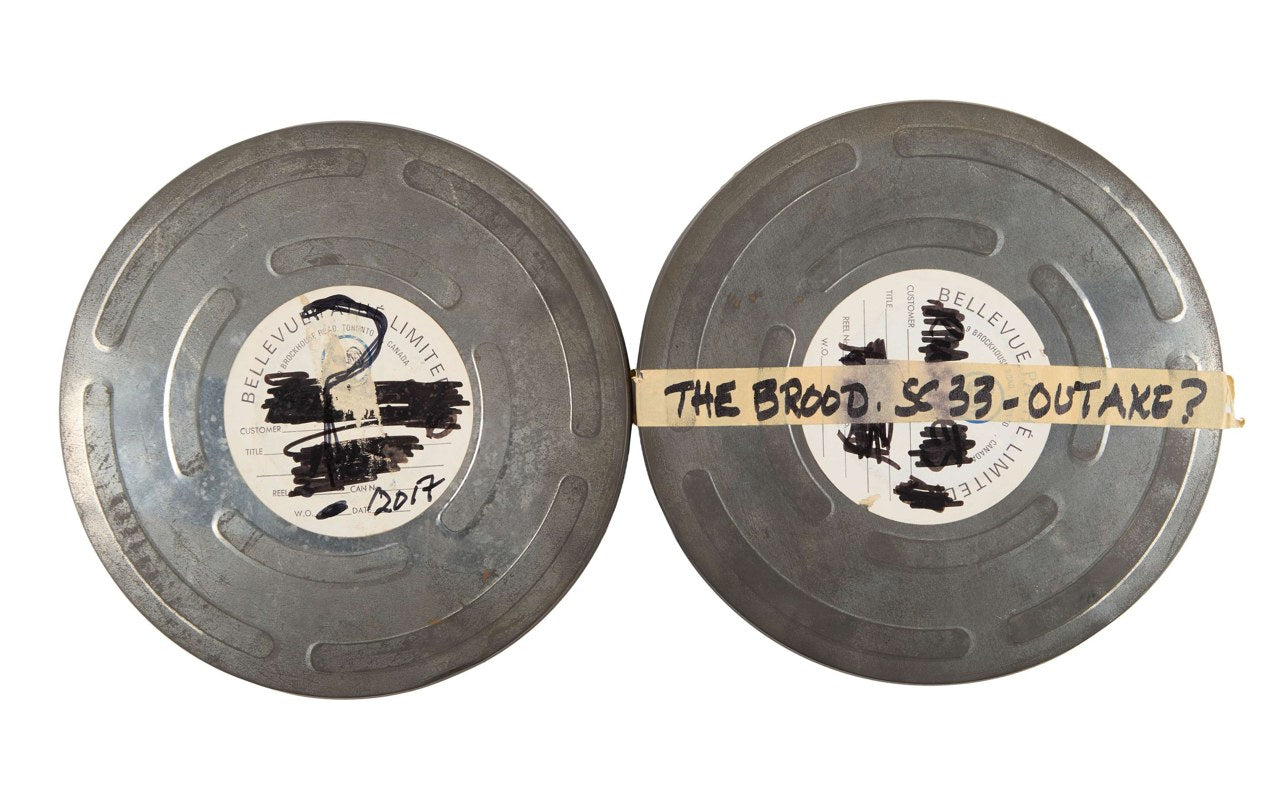
BR-R107The can retains a question mark
The photographed can label identifies scene 33 and leaves its outtake status as a question. Other views show handwritten leaders, newspaper packing and a short, reddish strip of Eggar performing with both hands raised.
Lot 68, photographs 1–4; can-lid view and frame strip · Julien’s Auctions — 35 mm outtake material, lot 68 ↗
13Sources & viewing room105 source entries, grouped for further reading.105 source entries
READ THE ORIGINALS
Sources & viewing room.
Documents and source records81 entries
- Criterion — The Brood edition and credits ↗
- Andrew Dowler — The Brood, Cinema Canada no. 58 (September 1979) ↗Issue masthead and contents ↗
- Rob Freese / Cindy Hinds — Rue Morgue ↗
- Oliver Pfeiffer / Mark Irwin and Art Hindle — SciFiNow ↗
- TIFF Canadian Film Encyclopedia — The Brood ↗
- Howard Shore — The Brood / The Shape of Rage ↗
- Howard Shore — Scanners / The Brood on vinyl ↗
- BBFC — The Brood classification history ↗
- Carrie Rickey — The Brood: Separation Trials ↗
- Jason Jenkins / Cory Goodman — the unmade Brood remake ↗
- Roger Ebert — The Brood, 5 June 1979 ↗
- Walter Chaw interviews Aaron Woodley ↗
- Collecting Life — Samantha Eggar, part 2 ↗
- Second Sight — The Brood Limited Edition 4K UHD & Blu-ray ↗
- Cinémathèque québécoise — The Brood photographs ↗
- Harry Ransom Center — John McCarty Papers ↗
- Richard Starks — author biography ↗
- Charlotte Hussey and Del Mehes — Production Guide, Cinema Canada, p. 10 ↗
- Charles Lazer — Mark Irwin: Keeping it Simple, Cinema Canada, pp. 37–38 ↗
- John G. Harkness — Brilliantly Bizarre, Cinema Canada, March 1981 ↗
- Iain Marcks — The Darker Side of Mark Irwin, ASC, CSC ↗
- GARANCE — The Brood / Chromosome 3 ↗
- Gavin Schmitt — Art Hindle interview, 6 August 2015 ↗
- Julien’s Auctions, lot 69 — Eggar’s annotated Brood screenplay (Lot-Art catalogue mirror) ↗
- Julien’s Auctions, lot 82 — Books from Eggar’s film and TV productions (Lot-Art mirror) ↗
- NYPL — David Morgan collection of film stills, *T-Vim 2018-005 ↗
- Harry Ransom Center — John McCarty Papers, FI-055, full EAD ↗
- Josephine Botting — Why I love … The Brood, BFI ↗
- Jason Middleton — Birthing from Within, Films for the Feminist Classroom 6.1 ↗
- The Center for Cartoon Studies — Stephen R. Bissette’s Brood monograph ↗
- Walter Chaw — David Cronenberg Re-examines David Cronenberg ↗
- Silman-James Press — The Score ↗
- Howard Shore / Philip Brophy — Composing with a very wide palette ↗
- Capricci — Chromosome 3, 2021 French reissue ↗
- Capricci — Chromosome 3 press kit ↗
- Cahiers du cinéma — no. 306, December 1979 ↗
- Capricci — six HD Chromosome 3 captures ↗
- John Llewellyn Probert — The Brood, 14 September 2013 ↗
- CAFTCAD Awards — Delphine White biography ↗
- Tim Lucas — The Brood, Cinefantastique 9:1, Fall 1979 ↗
- Jenni Miller / David Cronenberg — On the Analyst’s Couch, 21 November 2011 ↗
- Alison Nastasi / David Cronenberg — Flavorwire interview, 3 October 2014 ↗
- Posteritati — The Brood U.S. one-sheet, item 4643 ↗
- Posteritati — The Brood British quad, item 4644 ↗
- Heritage Auctions — The Brood British double-crown set, lot 86301 ↗
- Royal Books — Eight original Brood publicity photographs, item 150770 ↗
- Eggar screenplay — public title-page photograph, lot 69 ↗
- Tony Timpone / Roger Corman — Roger’s Retrospective, Fangoria, 14 May 2024 ↗
- Chris Galloway — Criterion Forum Blu-ray review and frame gallery, 12 October 2015 ↗
- FILMGRAB — The Brood, 14 February 2015 ↗
- The Dowse Art Museum — The Brood, 15 February–22 June 2025 ↗
- Toronto District School Board — Brown Junior Public School: About Us ↗
- Jeff Hitchcock / Arbron — Brown Public School, 9 September 2017 ↗
- Filmap — The Brood: School, 31 March 2015 ↗
- Kortright Centre — What We Do ↗
- Julien’s Auctions — 35 mm outtake material, lot 68 ↗
- Julien’s Auctions — Eggar’s 1980 Genie nomination certificate, lot 67 ↗
- Richard Starks — answer to Norman Crane about The Brood novelization ↗
- David Cronenberg — The Brood, fourth-draft screenplay scan ↗
- New Zealand Classification Office — The Brood DVD, 1300389.000 ↗
- New Zealand Classification Office — The Brood slick, 1300389.001 ↗
- Patrick Schupp — Les monstres de l’été, Séquences 98 (October 1979) ↗
- Paul M. Sammon — David Cronenberg, Cinefantastique 10:4 (Spring 1981) ↗
- TIFF — book mock-up, 2000-001-01.0122 ↗
- TIFF — book advertisement, 2019-015-02.0009 ↗
- TIFF — costume collage, 2019-010-02.0004 ↗
- TIFF — two-sided costume collage, 2019-010-02.0005 ↗
- TIFF — White portfolio page, 2019-010-02.0015 ↗
- TIFF — mallet, 2000-001-01.0104 ↗
- TIFF — David Cronenberg Collection, Special Collections 0003 ↗
- TIFF — screenplay holding, FRL-107916 ↗
- KOW — Candice Breitz, Treatment (2013) ↗
- magiccop — The Brood: R-Rated / Unrated comparison (2010) ↗
- Don McKellar — Children of Canada (1999) ↗
- Fangoria — S1 Ep30: Class of 79: Art Hindle (The Brood Series) ↗
- Fangoria — S1 Ep29: Class of 79: Mark Irwin (The Brood Series) ↗
- Fangoria — S1 Ep28: Class of 79: Cindy Hinds (The Brood Series) ↗
- Schott — Howard Shore composer brochure, March 2025 ↗
- Stephen R. Bissette — publication updates and signed-edition photograph ↗
- Barend de Voogd — Some Place Really Deep: David Cronenberg (2014 interview) ↗
- Alex Waters — Environmental Visitor Centre Gets a Serious Green Makeover (31 August 2012) ↗
Books and extended interviews21 entries
- The Projection Booth — Cronenberg double feature ↗
- Michael Schelle — The Score: Howard Shore interview excerpt ↗
- David Cronenberg / David Schwartz — Pinewood Dialogue, 11–12 January 1992 ↗
- Martín Rejtman — Fundación PROA programme introduction, 2012 ↗
- Bob Martin / David Cronenberg — The Brood and Other Terrors, Fangoria no. 3 (1979) ↗
- Fangoria volume 2 no. 3 — April 2019 oral history ↗
- Robert J. Emery — The Directors: Take Four (Allworth Press, 2003) ↗
- Allen Terry Carr — A Forty-Year Retrospective 1950–1990, Pathways 8:4, July/August 1996 ↗
- TRCA — Authority Meeting 3/11, 25 March 2011, resolution A51/11 ↗
- STEP — Existing Building Commissioning of Kortright Visitor Centre, 2022 ↗
- TRCA — Sustainability Report 2012–2013: Kortright Centre Retrofit Project ↗
- Julien’s Auctions — Eggar’s signed and annotated screenplay, lot 69 ↗
- Copie Zéro — Annuaire longs métrages Québec 1979, entry 5043 ↗
- Luke Ford / Pierre David — producer interview ↗
- Cronenberg on Cronenberg — edited by Chris Rodley, revised edition (1993) ↗
- Timothy R. Lucas — David Cronenberg: A Postscript (1981) ↗
- The Brood — trailer hosted by critic.de ↗
- The Brood — reference copy A, archived MP4 ↗
- Birth Pains — Criterion Channel ↗
Caption guide to the public upload. Locators refer to its automatic-caption track.
Caption-reviewed public upload ↗ - Tim Lucas — Medium Cruel: Reflections on Videodrome (introduction) ↗
- Statistics Canada — Culture statistics: Film industry 1978 (February 1981) ↗
Table visually checked at printed p.66 / PDF p.68. The Brood aligns with 1.4 in the millions-of-dollars column. Source attribution: Saturday Night, October 1979, introduced on p.65 and identified again on p.68. Statistics Canada published this volume in February 1981.
Additional references3 entries
From screen to collection
Three ways to collect.
Collect the cinema that stays with you: original film material, identities from the screen and new CRONENDROME editions.

The Museum
Original theatrical posters, Japanese chirashi, lobby cards and artist editions from our sister collections.
Enter the Museum ↗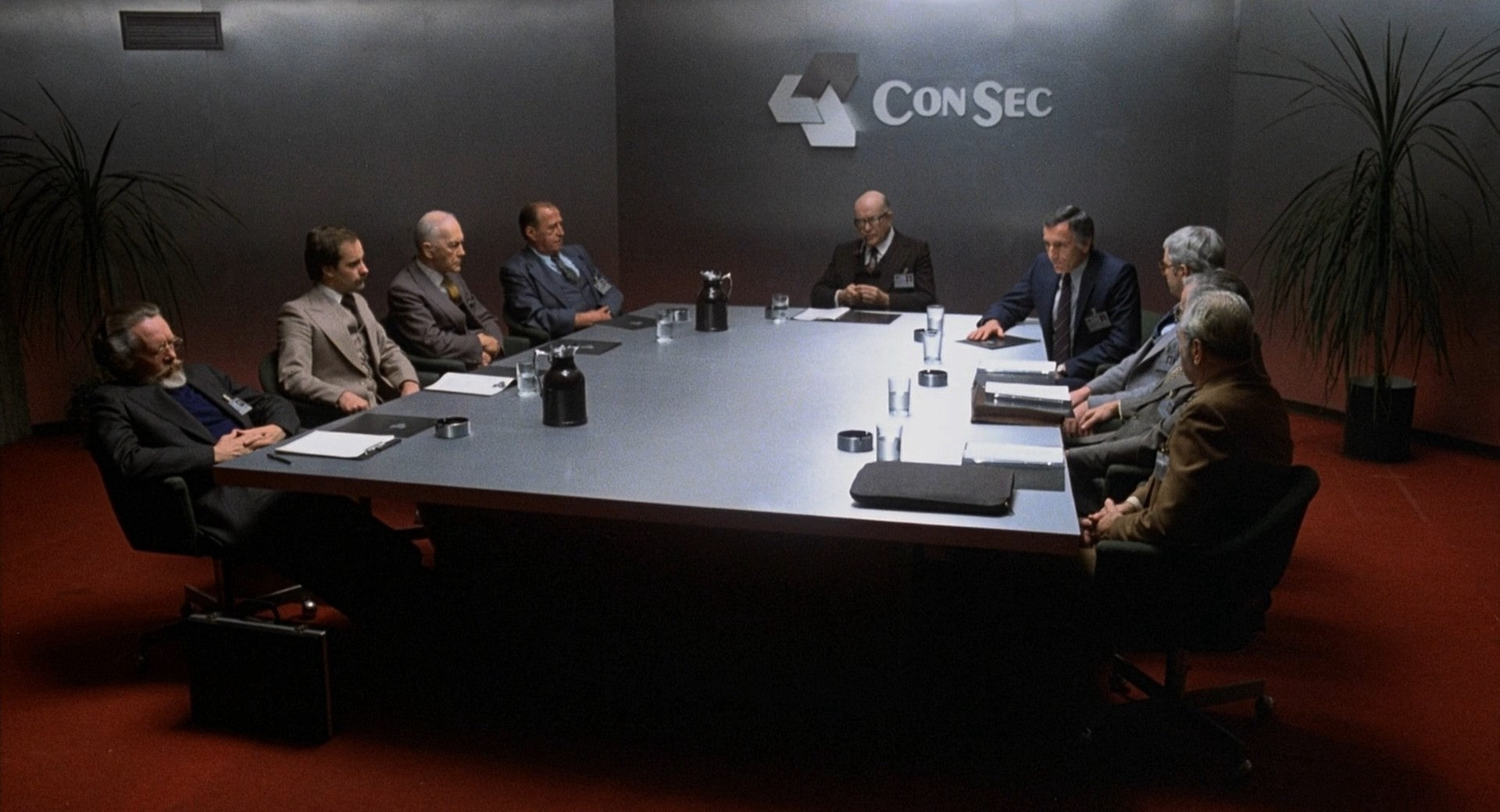
Wear the film world.
ConSec and other identities from the films, developed as shirts and everyday objects.
Explore Film merch ↗The print editions
Original Cronendrome images in limited editions. Landscape and portrait. Framed or unframed.
Explore Art prints ↗