
CRIMES
OF THE FUTURE
THE BODY IS STILL BECOMING
An organ becomes art.
A change becomes a crime.
An illustrated investigation of organic machines, bodily authorship and the institutions that try to classify a changing species.
Enter the visual register ↓This dossier includes plot developments and the film’s central revelations.

WHOLE-DOSSIER SEARCH
Find a person, object or idea.
Across people, objects, production accounts, readings and sources—even in closed chapters.
Enter a word or choose a section to explore the index.
01 / CASE FILE 13
Who owns the next body?
A reading of the film’s central arrangement: an artist, a partner and a system of classification.
The body produces something new. An artist removes it. A registry gives it a name. Crimes of the Future turns those three acts into a struggle over who gets to decide what a human being is.
Saul Tenser and Caprice work at the border between care and performance. Their instruments belong to a world where furniture resembles anatomy and administrative routines survive amid physical decay. The machinery is intimate; the institutions are invasive.
This file follows the film through its makers’ accounts, production drawings, publicity photographs and critical responses. The 1970 film has its own case file: the shared title opens a conversation across fifty years, rather than identifying a remake.
Cast at a glance
13 principal assignments +
| Performer | Role | Place in the story |
|---|---|---|
| Viggo Mortensen | Saul Tenser | The performer whose body produces the work. |
| Léa Seydoux | Caprice | Saul’s creative and surgical partner. |
| Kristen Stewart | Timlin | An investigator at the National Organ Registry. |
| Don McKellar | Wippet | A registry official with an appetite for anomalies. |
| Scott Speedman | Lang Dotrice | A father pursuing recognition of a different future. |
| Welket Bungué | Detective Cope | The New Vice Unit’s investigator. |
| Nadia Litz | Router | One of the technicians maintaining the apparatus. |
| Tanaya Beatty | Berst | Router’s colleague in equipment service. |
| Lihi Kornowski | Djuna | Lang’s estranged partner and Brecken’s mother. |
| Yorgos Pirpassopoulos | Dr Nasatir | The inner-beauty enthusiast. |
| Sotiris Siozos | Brecken | Lang and Djuna’s child. |
| Tassos Karahalios | Klinek / Ear Man | The performer covered in ears. |
| Denise Capezza | Odile | The woman whose altered face becomes a display surface. |
CHARACTER STUDIES / TWELVE ENCOUNTERS
The people inside the system.
Follow the partnerships, offices and family ties through individual images. Each study connects a person to the objects and spaces around them.
The creative partnership

Viggo Mortensen
Saul Tenser
The artist supplies both the work and the body that produces it.
Read the character study
IN THE IMAGE
The hood leaves Saul’s face suspended in darkness. Cloth removes the outline of the torso while a shallow band of light makes the eyes and mouth available for inspection. His public identity is built around revelation, yet this image depends on concealment. Compare the shrouded figure with the exposed face at the end: the change in visibility becomes a change in our access to him.
FOLLOW THE CONNECTIONS
Link to this character
Léa Seydoux
Caprice
Saul’s partner gives the body’s unpredictable production a deliberate public form.
Read the character study
IN THE IMAGE
A pale neckline draws the eye toward Caprice’s face, while the mottled wall refuses the clean separation of a studio portrait. Her clothing and the room share a restrained, worn palette. Set beside the red performance dress, this image makes the distinction between presentation and private attention legible without requiring a wholly separate visual world for each.
THE ACTOR’S ACCOUNT
Seydoux was drawn to the relationship’s contradictions. She recalls having room to interpret the role, with Cronenberg watching what the performers brought to his writing.
FOLLOW THE CONNECTIONS
Link to this characterWatching and classifying

Kristen Stewart
Timlin
The registry investigator’s professional interest becomes an intimate fascination.
Read the character study
IN THE IMAGE
The close framing excludes the desk and files that make Timlin an official. Light picks out one side of her face; her gaze travels beyond the image toward another person. Compare this unshielded encounter with the eyepiece photograph. Both concentrate attention, but the instrument supplies a professional alibi that the bare face cannot.
THE ACTOR’S ACCOUNT
Stewart describes Timlin as a believer in her job and the institutions around it. The encounter with Saul brings an awakening: fascination with someone able to put an inner life into public form.
FOLLOW THE CONNECTIONS
Link to this character
Don McKellar
Wippet
A registry official whose interest in new organs exceeds routine administration.
Read the character study
IN THE IMAGE
Wippet’s pale shirt supplies the clearest shape in a room of dark verticals. The body looks ordinary; the institutional setting gives it authority. Nothing in the image requires futuristic uniform or insignia. The office’s familiarity is part of its force: extraordinary anatomy can enter a recognizably mundane working day.
FOLLOW THE CONNECTIONS
Link to this character
Welket Bungué
Detective Cope
The New Vice Unit turns bodily change into an investigative problem.
Read the character study
IN THE IMAGE
Cope sits behind a broad horizontal surface, with his face held in silhouette against a lighter wall. Authority is established through distance and withholding. The composition makes the other person approach a position already occupied. It is a useful counterpart to the registry’s clutter: both spaces organize access, using very different amounts of visible information.
FOLLOW THE CONNECTIONS
Link to this characterA family becomes evidence

Scott Speedman
Lang Dotrice
Brecken’s father asks the artists to make his son’s body a public argument.
Read the character study
IN THE IMAGE
The open jacket and exposed neck keep Lang’s outline accessible, unlike Saul’s wrapped silhouette. A green lamp sits behind him as a separate, hard point of light. His face is visible, but visibility is not the same as disclosure: the dark space around the portrait leaves his wider network outside the frame.
THE ACTOR’S ACCOUNT
Speedman describes preparing through movement and behaviour, rather than seeking a complete explanation of the conspiracy. That practical approach keeps the character’s immediate purpose playable.
FOLLOW THE CONNECTIONS
Link to this character
Lihi Kornowski
Djuna
Brecken’s mother occupies the domestic end of the film’s evolutionary conflict.
Read the character study
IN THE IMAGE
The bathroom places Djuna low in the frame, enclosed by fixtures and worn surfaces. The sink occupies space that another portrait might give to a face. This cramped arrangement offers a domestic counterweight to the platforms and audiences that appear elsewhere: bodily difference first presses on an inhabited room, before institutions and artists make it their subject.
THE ACTOR’S ACCOUNT
Speedman told /Film that he and Kornowski first met at Cannes. Their separated performances were brought into a family relationship by the film.
FOLLOW THE CONNECTIONS
Link to this character
Sotiris Siozos
Brecken
The child’s unusual appetite links household life to a claim about humanity’s future.
Read the character study
IN THE IMAGE
Brecken bends toward the shore while a stranded vessel dominates the distance. The enormous, unusable object and the small active body occupy different scales of survival. Water joins them within the frame. Read this image alongside the plastic-wastebasket study: the landscape’s damaged material world becomes something the child can physically encounter.
FOLLOW THE CONNECTIONS
Link to this characterService and spectacle

Nadia Litz & Tanaya Beatty
Router & Berst
The technicians maintain equipment that supports Saul’s daily life and work.
Read the character study
IN THE IMAGE
The two figures share the frame and the apparatus. Their relaxed, extended gestures give the machine a social use, beyond its mechanical purpose. Read against Delic’s isolated concept sheets, the image is a reminder that occupation changes design: a device that looks singular and solemn on paper can become a place for an encounter.
FOLLOW THE CONNECTIONS
Link to this character
Yorgos Pirpassopoulos
Dr Nasatir
The inner-beauty enthusiast gives anatomy a competitive frame.
Read the character study
IN THE IMAGE
An overhead lamp isolates a small area of inspection while the rest of the room stays dim. The examiner’s proximity and the reclining figure make looking into a practical arrangement of bodies. Beauty here needs equipment and a privileged viewpoint. Compare the registry eyepiece: an instrument can support either classification or appreciation.
FOLLOW THE CONNECTIONS
Link to this character
Denise Capezza
Odile
Her altered face makes the skin itself a display surface.
Read the character study
IN THE IMAGE
The facial lines remain visible at conversational distance. A dark, patterned collar carries the eye upward, joining costume and marked skin without making them identical. The person facing Odile is softer and partly turned away. The encounter therefore gives her face two audiences: the listener within the scene and the viewer examining the image.
FOLLOW THE CONNECTIONS
Link to this character
Tassos Karahalios
Klinek / Ear Man
An altered performer makes the multiplication of a sense organ visible.
Read the character study
IN THE IMAGE
Ears punctuate the bare torso while the arms extend into the surrounding darkness. The body becomes a distributed pattern, rather than a face with two listening organs. Compare the wide performance frame, where the audience and architecture restore the social occasion. The close view sells the alteration; the long view shows the act of exhibiting it.
THE ACTOR’S ACCOUNT
Karahalios says Cronenberg supplied the initial choreographic idea and he contributed to its development. The movement had to make sense of a transformed body.
FOLLOW THE CONNECTIONS
Link to this character02 / CASE FILE 13
A body of designs.
Concepts, costumes, spaces and performances. Each image opens at a larger size; each record identifies the kind of material being examined.
Filter the 26 illustrated object records in this chapter. For people, workshop accounts and sources, use the whole-dossier search.
26 object records
No matching records. Reset the filters to see the full register.

CF.01 / Devices
The feeding chair
Concept sheet / multiple views
A spinal upright, articulated arms and foot supports make furniture resemble a standing skeleton.
Open object record
- Material examined
- Goran Delic / equipment concept
- Visible form
- Three upright views isolate a narrow back, paired armatures and long curved legs. Empty space passes through the design: the chair describes the outline of a body without becoming a solid enclosure. Its small contact points make support look distributed and exacting.
- Context & comparison
- Compare the isolated proposal with Saul seated in the finished BreakFaster chair. Clothing, a bowl and a room turn an abstract skeleton into a domestic dependency. The drawing explains the design language; the film frame supplies the lived scale.
RELATED RECORDS
Link to CF.01
CF.02 / Devices
Suspension studies
Concept sheet / bed revision
Branching supports explore the suspended bed as a structure grown around its occupant.
Open object record
- Material examined
- Goran Delic / suspended-bed concept
- Visible form
- The views change from a frontal, almost symmetrical arrangement to an oblique view that reveals the depth of the cradle. Long stems rise from a compact lower support. Some curl away while others remain nearly straight, giving the design a tension between growth and suspension.
- Context & comparison
- Read this sheet beside the warmer, textured bed study and the room view. The useful comparison is between ways of holding a sleeper. The numbered portfolio images are not a dated sequence of approved revisions.
RELATED RECORDS
Link to CF.02
CF.03 / Devices
The SARK on its stand
Concept sheet / support variations
Four views test how the shell is carried above the floor.
Open object record
- Material examined
- Goran Delic / SARK support study
- Visible form
- The shell is repeated at similar angles while the base changes below it. An arched upper element is held apart from the lower vessel. The dark gap between them makes the interior readable even before an occupant is introduced.
- Context & comparison
- Look especially at the point where the object meets the floor. A broad pedestal and a more open support give the same shell different apparent weights. The finished room view provides a separate record of the apparatus among people.
RELATED RECORDS
Link to CF.03
CF.04 / Devices
Opening the shell
Concept sheet / opening sequence
Separated plates turn the closed hull into an accessible working surface.
Open object record
- Material examined
- Goran Delic / opening-mechanism proposal
- Visible form
- The repeated overhead silhouette makes small changes easy to compare. Plates separate along the centre while the outer boundary remains recognizable. The upper row adds side and opened views, translating a sealed shape into a container with depth.
- Context & comparison
- This is a design explanation of access. Read each configuration as a proposed mechanical state, rather than a set of frames from the film. The plate pattern connects it to the colour study; the production account distinguishes fabricated surfaces from digital movement.
RELATED RECORDS
Link to CF.04
CF.05 / Devices
Anatomy of a casing
Concept sheet / form studies
Paired structures establish symmetry while textures vary from plated to deeply ridged.
Open object record
- Material examined
- Goran Delic / casing-form exploration
- Visible form
- Narrow, bilaterally organized bodies fill the sheet. Repeated ridges, dark slots and stacked forms make several of them resemble exposed spinal or rib structures. The grouping invites comparison of surface density: some appear tightly armoured, others open and porous.
- Context & comparison
- The variation matters more than a single preferred silhouette. It shows how an organic machine can be made legible through repetition and symmetry while retaining an unfamiliar anatomy. Compare the enclosed shell elsewhere in the register to see how much texture can disappear beneath a casing.
RELATED RECORDS
Link to CF.05
CF.06 / Devices
Colour over the carapace
Concept sheet / colour study
Cool plates interrupt warmer seams: the surface reads as shell and engineered housing.
Open object record
- Material examined
- Goran Delic / SARK colour-and-surface proposal
- Visible form
- Three closed views distribute grey-blue plates across a rounded body. Dark seams organize the surface into irregular islands. The muted reddish centre and warmer edges interrupt the cool exterior, suggesting a difference between protective surface and softer interior.
- Context & comparison
- Colour is part of the structural argument: the eye can follow plate boundaries before understanding their mechanism. The image is a rendered finish proposal, not a measured colour reference for a surviving prop. Its closed outline pairs directly with the opening sheet.
RELATED RECORDS
Link to CF.06
CF.07 / Devices
The suspended patient
Concept sheet / bed revision
Multiple angles emphasize a narrow cradle hanging from tendril-like lines.
Open object record
- Material examined
- Goran Delic / bed form and suspended occupant
- Visible form
- The lower support is narrow and folded, with a warmer brown surface than the pale revision sheet. Long, irregular lines lift away from it. Side and underside views make the cradle look shallow, emphasizing how little separates the occupant from open space.
- Context & comparison
- The drawing joins protection to exposure: the body is held, but the structure does not become a conventional mattress or room. Compare its suspension with the film’s architectural framing. The published design and the photographed bed can be examined together without treating them as identical objects.
RELATED RECORDS
Link to CF.07
CF.08 / Devices
Access to the interior
Concept sheet / operation study
The opened body is framed by coordinated tools and apparatus.
Open object record
- Material examined
- Goran Delic / operation concept
- Visible form
- Paired limbs or tools spread out from the open torso, creating a strong bilateral arrangement around the incision. Warm reds and yellows pull attention inward. The small inset offers another scale of the procedure, making the body both a whole figure and a field of work.
- Context & comparison
- The composition treats access as something designed. Instruments frame the interior rather than appearing as an unrelated collection of tools. Compare the concept’s exposed anatomy with the publicity photograph’s emphasis on Caprice’s face, hands and attention.
RELATED RECORDS
Link to CF.08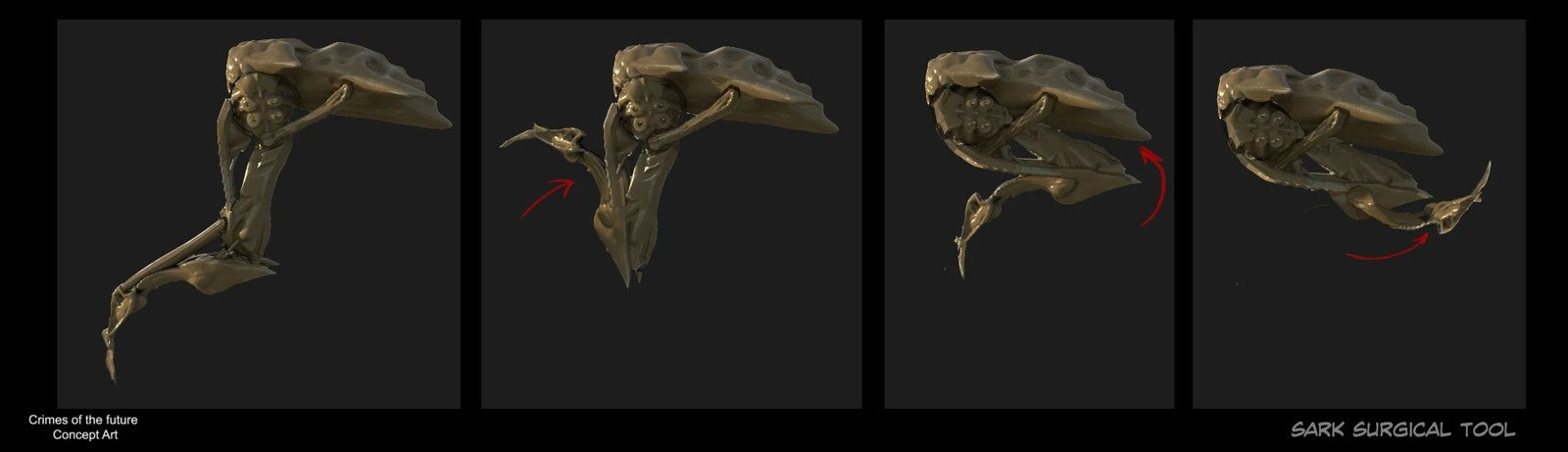
CF.09 / Devices
A tool that folds
Concept sheet / surgical tool
Successive silhouettes show an articulated instrument changing shape.
Open object record
- Material examined
- Goran Delic / articulated surgical-tool proposal
- Visible form
- Four views give the small instrument an unusually bodily silhouette. Narrow connections join thicker curved parts, and the changing angles suggest a grasping or folding action. Its green-brown finish keeps it within the same visual family as the larger support devices.
- Context & comparison
- The sheet makes motion imaginable through separated poses. It supplies no reason to assign a particular material, motor or force to the mechanism. Read it with the operation study to see how a compact object becomes one part of a coordinated surgical image.
RELATED RECORDS
Link to CF.09
CF.10 / Devices
Feeding equipment
Concept sheet / bowl and utensils
A compartmented bowl and elongated implements give eating its own designed system.
Open object record
- Material examined
- Goran Delic / feeding bowl, spoon and fork
- Visible form
- The bowl is divided into compartments by a raised-looking internal cross. Its rounded rim and enclosing bands echo the film’s larger shells. The utensils are exceptionally long and thin beside it, giving a familiar table setting an awkward, specialized proportion.
- Context & comparison
- The design extends the world below the scale of spectacular machinery. A meal needs small objects as well as a chair. Compare the bowl in the film frame for context, while keeping this clean, isolated rendering identifiable as a proposal.
RELATED RECORDS
Link to CF.10
CF.11 / Devices
The throat-device proposal
Concept sheet / collar and controller
Views of the collar separate its structure, fit and controller relationship.
Open object record
- Material examined
- Goran Delic / collar and control-device concept
- Visible form
- The upper views separate a curved collar from the body; the middle row places it on a neutral head and shoulders. A lower composition introduces a small control unit. The sheet moves from object shape to fit, then to a relationship between components.
- Context & comparison
- Keep this entry within the concept collection. Its usefulness is the visible design problem of a device following the throat while remaining distinct from it. The drawing alone does not establish an appearance in the finished film or a construction specification.
RELATED RECORDS
Link to CF.11
CF.12 / Costume
Saul closes the silhouette
Nikos Nikolopoulos / publicity photograph
Black folds conceal the body that the performances expose.
Open object record
- Material examined
- Nikos Nikolopoulos / Cannes publicity photograph
- Visible form
- A peaked hood and dense folds surround Saul’s face. Most of the body disappears into one dark vertical mass. The rough, pale wall provides enough contrast to make the outer contour clear without revealing the garment’s internal construction.
- Context & comparison
- The silhouette controls access. In this image Saul can be recognized through a small opening while withholding the rest of himself. Compare the exposed face beside Caprice and the lighter registry clothing to see how dress organizes different kinds of encounter.
RELATED RECORDS
Link to CF.12
CF.13 / Costume
Caprice in performance
Designer portfolio / film image
The burgundy dress creates a formal stage presence amid the room’s worn surfaces.
Open object record
- Material examined
- Mayou Trikerioti portfolio / film image
- Visible form
- The burgundy bodice has a defined neckline and narrow straps; Caprice’s bare shoulders separate sharply from the darker space behind her. The garment creates a composed centre within a room occupied by other people and scattered points of light.
- Context & comparison
- The image gives the surgical partner a stage presence of her own. Compare the pale work garment’s looser drape and greater coverage. The difference is observable in cut and colour without assigning an undocumented symbolic intention to the designer.
RELATED RECORDS
Link to CF.13
CF.14 / Costume
Caprice at work
Designer portfolio / film image
A pale, loose neckline gives the working costume a softer outline.
Open object record
- Material examined
- Mayou Trikerioti portfolio / film image
- Visible form
- The pale top falls in soft folds from a loose neckline. A raised hand holds a small dark object near the face, giving the otherwise quiet image a point of concentration. The garment’s light value remains legible against the dim background.
- Context & comparison
- The image belongs to the practical, attentive side of Caprice’s presentation. Its draping can be compared with the published costume drawing, but similar silhouettes do not establish that the drawing is an exact plan for this garment.
RELATED RECORDS
Link to CF.14
CF.15 / Performance
Timlin and the eyepiece
Designer portfolio / film image
The viewing instrument compresses observation into an intensely private gesture.
Open object record
- Material examined
- Mayou Trikerioti portfolio / Timlin film image
- Visible form
- The instrument meets Timlin’s eye at the edge of the face. Her hand steadies it, while a pale sleeve and the side of her neck remain visible against darkness. The framing emphasizes bodily proximity more than the overall layout of the equipment.
- Context & comparison
- Observation here requires a posture. Leaning in and closing the distance make looking appear active and private. The brighter registry view changes that impression by placing the same character within an ordinary office and a shared institutional task.
RELATED RECORDS
Link to CF.15
CF.16 / Performance
A face becomes a surface
Designer portfolio / film image
Ordered cuts cross the forehead above a dark, patterned collar.
Open object record
- Material examined
- Mayou Trikerioti portfolio / Odile film image
- Visible form
- Repeated marks traverse the forehead and face above a high, patterned dark collar. The raised hair leaves the altered surface exposed. Another person occupies the near edge of the image, keeping the face within a conversation rather than isolating it as a specimen.
- Context & comparison
- Clothing and skin both carry pattern, but their boundaries remain visible. That comparison makes bodily modification part of social presentation. The alternate frame in the world collection supplies a different angle on the relation between the face and its decorative surround.
RELATED RECORDS
Link to CF.16
CF.17 / Performance
Ear Man
Designer portfolio / film image
Extra ears and closed facial openings disrupt the expected map of perception.
Open object record
- Material examined
- Mayou Trikerioti portfolio / Klinek close view
- Visible form
- Two large ears sit high above the forehead, while the mouth and eyes appear closed with stitch-like marks. A hand meets the chin. The tight framing emphasizes an altered distribution of openings and appendages across an otherwise recognizable face.
- Context & comparison
- Compare this detail with the long performance view: the prosthetic arrangement becomes part of an event with floor space and spectators. A third record follows the release campaign’s isolated replica ear, whose presentation and provenance are different again.
RELATED RECORDS
Link to CF.17
CF.18 / Places
Intimacy in a damaged room
Nikos Nikolopoulos / publicity photograph
Flaking walls and hard window light surround an intimate encounter.
Open object record
- Material examined
- Nikos Nikolopoulos / Cannes publicity photograph
- Visible form
- A broad window supplies horizontal bars of light above a radiator. Peeling wall surfaces surround the two standing figures, whose pale and dark clothing produce a strong division within their close contact. The room’s familiar fittings remain unusually prominent.
- Context & comparison
- Intimacy takes place in a space with a material history. The architecture does not need to explain the future through new construction. Compare the enclosed room with the night lane: worn surfaces persist across both private and public encounters.
RELATED RECORDS
Link to CF.18
CF.19 / Places
The audience within the image
Nikos Nikolopoulos / publicity photograph
A seated foreground group and standing spectators turn the room into layers of attention.
Open object record
- Material examined
- Nikos Nikolopoulos / Cannes publicity photograph
- Visible form
- Saul reclines between a red-clad Caprice and pale-clad Timlin. Behind them, figures stand or sit at different heights. The foreground grouping is sharply legible while the back of the room remains broken into patches of light and shadow.
- Context & comparison
- This image records a social arrangement as much as a set. Clothes, posture and depth establish several ways of occupying a performance space. Compare the long view of Ear Man to shift attention from these watchers to the distance between an audience and a performer.
RELATED RECORDS
Link to CF.19CF.20 / Performance
Care beside the apparatus
Nikos Nikolopoulos / publicity photograph
Caprice’s pale clothing and lowered gaze soften the surrounding machinery.
Open object record
- Material examined
- Nikos Nikolopoulos / Cannes publicity photograph
- Visible form
- Saul’s head is low in the foreground while Caprice’s face and pale sleeves rise above him. Her hands occupy the small interval between their faces. Dark ridged supports surround the pair, but the light keeps attention on skin, cloth and touch.
- Context & comparison
- The image makes the apparatus a setting for a relationship. The care is legible through gaze and gesture before the mechanism is understood. Compare the symmetrical operation drawing, where the body’s interior dominates, to see a very different distribution of attention.
RELATED RECORDS
Link to CF.20
CF.21 / Production
Hands around a practical object
Nikos Nikolopoulos / production photograph
The makers lean over a tabletop device, bringing the film’s strange technology back to manual work.
Open object record
- Material examined
- Nikos Nikolopoulos / production photograph
- Visible form
- A brightly lit table holds small components while two figures lean toward the same compact device. Hands, a work surface and concentrated postures give the image a scale quite different from the finished apparatus seen in performance.
- Context & comparison
- The photograph documents people attending to a tangible object. It does not, by itself, identify every component’s department or explain the completed shot. The effects comparison supplies that second layer through the makers’ accounts of physical and digital work.
RELATED RECORDS
Link to CF.21
CF.22 / Production
The body under the title
Justin Stephenson / main-title image reproduced by CAROUSEL
Pale lettering crosses a deep red field of irregular, raised-looking texture. The stable horizontal name and the restless surface introduce two competing ways of organizing the image: something to read and something to inspect.
Open object record
- Material examined
- Justin Stephenson / title image via CAROUSEL
- Visible form
- A single line of pale capitals holds the horizontal centre of a densely textured red field. Irregular strands and darker channels surround the lettering. The type is easy to read even while the background resists being resolved into one stable shape.
- Context & comparison
- This entry examines one reproduced title image. Its visual tension can be compared with the registry’s orderly files: text offers a repeatable name for something with an unruly surface. The designer’s portfolio presents the moving sequence as a separate viewing route.
RELATED RECORDS
Link to CF.22
CF.23 / Costume
A costume drawing enters print
Mayou Trikerioti / Fantômas 4 reproduction
The photographed magazine spread preserves a draped pale top, dark trousers and an extended silhouette on paper. The drawing carries fabric and posture together: the fall of a neckline matters as much as the outline of the garment.
Open object record
- Material examined
- Mayou Trikerioti / photographed magazine spread
- Visible form
- A full-length figure stands inside a printed page, surrounded by columns of text. A pale draped top falls over dark trousers and boots. The long folds connect the neckline to the lower body, making posture part of the costume’s drawn silhouette.
- Context & comparison
- The page itself is part of this record: this is a photograph of a published drawing, not an isolated production sketch. Compare its draping with Caprice’s working clothes and use the fitting-room account to understand how a proposal could develop through being worn.
RELATED RECORDS
Link to CF.23
CF.24 / Performance
An incision becomes a line
Film frame / Caprice beside Saul
A dark, wavering incision crosses Caprice’s upper chest. Beside it, the unmarked expanse of shoulder and the close pairing of the faces give the alteration an intimate scale.
Open object record
- Material examined
- Selected film frame showing Caprice’s chest and the two partners together.
- Visible form
- The cut runs horizontally across the upper chest, with small changes of width and direction. Its dark red edge contrasts with the softly lit skin. Saul’s face is placed alongside Caprice’s rather than above her, making their proximity the composition’s principal relationship.
- Context & comparison
- Compare the incision with Odile’s facial marks and with the opening plates of the SARK. Each exposes a surface to deliberate interruption, but the image here concentrates on contact between two people. This frame shows Caprice’s incision; the production interviews’ abdominal port belongs to a different bodily alteration.
RELATED RECORDS
Link to CF.24
CF.25 / Production
The specimen album
Film frame / an illustrated register
An open ring binder turns organic forms into two flat, portable images. The three figures stand around a record that can be inspected without bringing the body itself into the room.
Open object record
- Material examined
- Selected film frame showing an open binder with two mounted illustrations.
- Visible form
- Heavy covers, metal rings and warm-toned sheets give the album an ordinary administrative form. The visible images have irregular internal shapes, set within pale rectangular mounts. Their arrangement repeats the larger rectangular page.
- Context & comparison
- The album makes an organ available as an image: something can be pointed to, compared and retained. Read it beside the wall of files and Timlin’s eyepiece. The institution employs different tools for seeing a body and preserving what has been seen.
RELATED RECORDS
Link to CF.25
CF.26 / Performance
The closed face
Film frame / Klinek’s stitched eyes and mouth
Dark stitches close the eyes and lips while extra ears sit above the brow. Hands attend to a seam, holding the altered face between an expressive portrait and a worked surface.
Open object record
- Material examined
- Selected film frame showing the performer’s face and attending hands.
- Visible form
- The closed lids retain their fleshy volume beneath uneven dark ties. Across the mouth, another stitched line interrupts the place where speech would become visible. The added ears supply rounded shapes above the brow.
- Context & comparison
- Compare the full torso and the wider performance frame. The distribution of extra ears advertises an expanded sense, while the closed eyes and mouth remove familiar channels of communication. The close view concentrates that tension within the face.
RELATED RECORDS
Link to CF.26LOOK AGAIN / THREE PAIRS
Design changes the relationship.
Original visual readings of the selected images.
The body hidden / the body offered
Saul’s exterior silhouette is closed and guarded. Beside Caprice, his face is exposed within the apparatus. Read together, the images make access to the body a matter of relationship and setting.
Work clothes / performance clothes
The pale working garment and dark red performance dress separate two modes of presentation without changing the person. Costume helps distinguish preparation from the public event.
Shell closed / shell opened
The concept sheets let an unfamiliar object be understood through a simple transformation: sealed enclosure becomes access. The design supplies a readable action before it supplies an explanation.
CLOSE STUDIES / TEN ENCOUNTERS
Read the spaces between bodies.
Original visual readings of selected film frames. Open a study to follow the architecture, clothing, objects and light within the image.
PLACE / FILMGRAB FRAME 01
A shore without a fresh start
Read the study
The child sits low in the foreground. Behind him, a large vessel lies tipped into shallow water: transport has become scenery. The image places a small, vulnerable body against an object designed for movement that no longer appears able to move. The bright exterior does not promise a clean or expansive future. Its horizon is already occupied by something exhausted.
This is a useful key to the film’s environments. New anatomy arrives inside an old material world. Walls, boats, offices and household fittings retain their wear while bodies acquire unfamiliar capacities. The contrast makes mutation feel like an uneven process: the organism can change more quickly than the infrastructure around it. The shoreline offers scale and distance, but no reassuring separation from human debris.

DOMESTIC DESIGN / FILMGRAB FRAME 04
The bed and the window
Read the study
The suspended bed occupies one side of the room while the open doorway supplies a rectangle of daylight on the other. Its hanging supports continue upward beyond the occupant, binding a private act of rest to the architecture. The contraption does not sit tidily inside a domestic interior; it reorganizes the room around a body that needs it.
The opening to the outside is hard-edged and familiar. The cradle is curved, dark and folded. Their coexistence allows the strange object to become legible without a polished laboratory or a futuristic control room. Sleep belongs to the same damaged world as everything else. The visual distance between the bed and the threshold also makes the occupant look protected and confined at once.

INSTITUTION / FILMGRAB FRAME 17
An office outlasts the familiar body
Read the study
Wippet and Timlin stand beneath a wall clock, in pale shirts against a worn institutional wall. The clock is small but useful: it gives the room ordinary administrative time. Whatever is happening to the human species, someone still has office hours. The clothing, doorway and subdued palette make the setting look like a workplace before it looks like a centre of extraordinary research.
That ordinary surface changes the force of the registry’s activity. The new is not greeted only with awe or panic; it is met by people who have jobs to do. Classification can seem modest, even helpful, while establishing the terms through which the body will be recognized. The image’s restraint lets the institution’s implications emerge from the contrast between familiar procedure and unfamiliar material.

PAPER / FILMGRAB FRAME 41
Records occupy the room
Read the study
A standing rack of files occupies the centre of the frame, with the hooded figure set to the right. Light picks out paper, shelves and the working table. The body becomes a dark silhouette beside the accumulated material of record keeping. This is a future pictured through storage and handling, rather than an interface designed to look advanced.
The arrangement gives bureaucracy physical weight. Records take up space; someone must sort, retrieve and move them. The repeated rectangles of the folders oppose the irregular, changing anatomy that this institution seeks to describe. As a visual counterpart to the organ, the file is almost aggressively regular. One resists a settled identity; the other exists to make an identity repeatable.
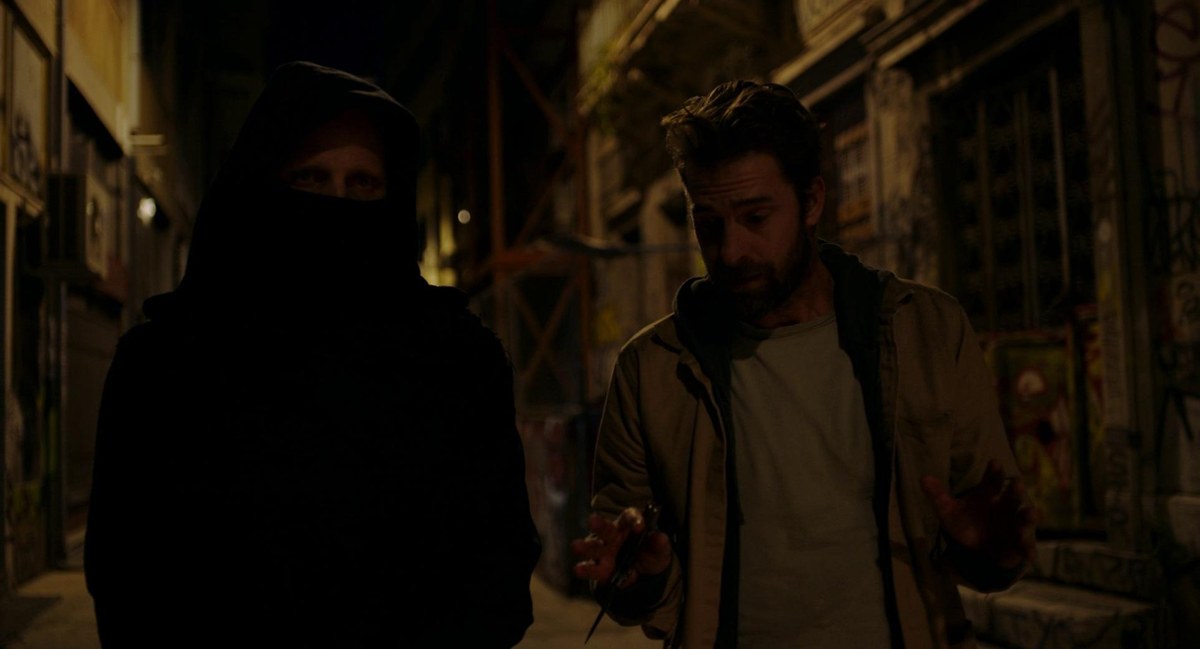
LOCATION / FILMGRAB FRAME 26
The night has already been written on
Read the study
Saul’s dark hood and Caprice’s lighter clothes pass through a narrow lane whose surfaces are crowded with marks. Graffiti, grilles and recesses give the background a density that does not depend on a single spectacular piece of scenery. The figures can be read clearly, but the environment refuses the blankness of a conventional science-fiction backdrop.
The lane belongs with the tattooed organ as an image of a surface claimed by writing. Both images ask us to look at a material thing and the marks placed over it. The city carries evidence of prior use, occupation and expression; the body is entering its own contested history of inscriptions.

PERFORMANCE / FILMGRAB FRAME 25
A performer and the empty room
Read the study
Ear Man is small within a high, shadowed room. The audience forms a dark band along one side; large curved architectural forms occupy the space behind him. At this scale the body reads first as a moving figure offered to spectators. The anatomical novelty that dominates a close view has to share attention with the conditions of presentation.
The long view makes the performance a social arrangement. There must be a floor, a place from which to watch and an interval between viewer and body. Those distances are part of the artwork’s form. Seen beside the close portrait in the visual register, this frame shows how an effect becomes an event: prosthetic detail supplies the image, while staging determines the relationship that an audience has to it.

COSTUME / FILMGRAB FRAME 14
The public dress, the private hand
Read the study
Caprice’s burgundy dress gathers into a firm, symmetrical shape at the neckline. Its straps and fitted bodice create a composed silhouette, while the dim background allows her face and upper body to hold the frame. This is clothing that makes a partner in a procedure visible as a performer in her own right.
The dress also changes how to read the same hands that attend Saul in more ordinary clothing. Care does not vanish when it is presented to an audience; it acquires a formal surface. The costume works as a boundary between preparation and presentation without requiring a mask or a complete transformation of identity. Caprice remains recognizable across both modes, and that continuity is central to the uneasy intimacy of the work.

PLACE / FILMGRAB FRAME 50
The meeting beneath the wreck
Read the study
A rusted hull extends across the upper half of the image. The figures below it look small, almost provisional, beside an industrial object whose former purpose remains obvious. The warm light catches corrosion and rounded openings; the ground is rough, with little sense of a maintained civic space.
The wreck is useful as more than a symbol of decline. It provides a roof, a wall and a scale against which a conversation can be staged. A failed object continues to organize human activity. Paired mentally with the opening shoreline, it gives the film a recurring material vocabulary of things that remain after their intended use. The body’s changing function and the vessel’s exhausted function belong to the same world, at very different speeds.

ENDING / FILMGRAB FRAME 52
A last image built around a face
Read the study
The final close view strips away much of the surrounding apparatus. Saul’s eyes, parted mouth and the skin around them dominate the image; the monochrome treatment separates it from the olive, brown and flesh tones used throughout the selected colour frames. A film full of people interpreting bodies arrives at an expression that cannot be reduced to a registration entry.
The face can suggest relief, revelation and vulnerability at the same time. The power of the image lies in that coexistence. It does not need a diagram of a new organ to make bodily change felt. After the public performances and administrative encounters, the smallest change in expression becomes consequential. Looking at Saul becomes a different activity from inspecting him.

PARTNERSHIP / THE EXAMINING CHAIR
Care is work
Read the study
The reclining body creates a long diagonal, while Caprice’s pale blouse forms an upright shape above it. Her hand and the small instrument draw attention toward the exposed abdomen. Saul’s dark clothing continues across the chair, allowing the two faces and the uncovered skin to remain the clearest areas of contact.
Caprice’s expression and raised arm give the encounter a lighter register than the heavy, worn room around them. The image holds technical attention and familiarity together. The apparatus belongs to an inhabited relationship: someone lies down, someone looks, and the work proceeds between them.
Compare the production photograph of the medical examination. A gridded light and surrounding crew make visible another layer of coordinated labour. The film frame and the set photograph each organize a body within a working space, for different audiences.
03 / CASE FILE 13
Making an unfamiliar world tangible.
A production history built from named testimony, published artwork and institutional records.
PRODUCTION DOCUMENTS / FOUR VIEWS
Outside the finished frame.
Location equipment, a crew portrait, a working setup and a certificate. Each preserves a different part of the film’s making.

LOCATION-PRODUCTION PHOTOGRAPH
The equipment outside the frame
Cable coils, hard cases, stands and padded bags fill a bright turquoise room. The windows repeat across the upper half, while the foreground becomes a loose inventory of things needed to make an image. Published with the local film office’s wrap report, the photograph offers a useful counter-image to the finished film’s sparse and carefully restricted spaces.
Link to this document
PRODUCTION PHOTOGRAPH
People against the wrecks
Three men stand close together against the pale sky and rusted ships. The central black jacket interrupts the lighter shirts on either side, giving a casual group portrait a firm compositional centre. The relaxed faces and everyday clothing make this a working location inhabited by people, before the film transforms it into a place of secrecy.
Link to this document
PRODUCTION PHOTOGRAPH
An examination, surrounded by work
A large gridded light hangs above the reclining performer. Dark-clothed crew members partly enclose him, while the raised hand at left and apparatus at right turn preparation into a set of overlapping tasks. The bright rectangle dominates this production photograph; the finished scene can make the source itself disappear while retaining its effect on a face.
Link to this document
PRODUCTION DOCUMENT
A name inside a department
The black-and-gold heading, large winner designation and signatures turn the page into an official record. Michael James Derrah’s name sits above the film title and a line identifying Outstanding Directorial Achievement in Feature Film. Read beside his account of concept work, the certificate documents recognition without changing his stated departmental role.
Link to this document1970
The first title
Cronenberg’s earlier film establishes a separate work bearing the same title.
Late 1990s
The screenplay takes shape
The production notes date the script to 1999; interviews place its origins around 1998–99.
2002 / reprinted 2012
Painkillers, and another title
Hughes’s period interview records the unmade project and the possibility of reusing Crimes of the Future.
1 February 2021
The older project resurfaces
Mortensen discusses a planned summer collaboration on an older Cronenberg screenplay in GQ.
August–September 2021
Athens production
The Hellenic Film Commission announces filming exclusively in Athens during these months.
23 May 2022
The Cannes entrance
The festival’s dated red-carpet record places Cronenberg at the film’s presentation. The film competes in the official selection.
3 June 2022
US theatrical release
NEON’s nationwide release date accompanies the published surgery-scene breakdown.
10 June 2022
The score on record
Decca’s digital soundtrack release presents seventeen tracks by Howard Shore.
Development
A title before a story
Cronenberg traces the title to a phrase glimpsed in Henning Carlsen’s Hunger. He used it in 1970, then returned to the possibilities it still suggested. The connection is an unfinished question about future prohibitions.
Evolution without improvement
In conversation with McKellar, Cronenberg separates biological change from the promise of progress. Wippet’s anxiety gives that distinction a bureaucratic voice: an unfamiliar organ can trouble the definition of humanity itself.
Genre is a sales category
Cronenberg tells The Film Stage that genre labels do not guide his directing. His practical questions concern people, clothing and spaces. That distinction helps explain a film whose surgical premise is played through intimacy and conversation.
An artwork outside the film
In March 2022, Cronenberg discussed a photographic NFT project titled Kidney Stones and Inner Beauty. Placing something produced by his own body into an art context creates a striking parallel with Saul.
Painkillers in 2002
Hughes’s 2002 interview already records Cronenberg considering Crimes of the Future as a replacement title for Painkillers. The author republished the exchange in 2012.
An early account of performance art
Cronenberg recalls a fellow student’s story about public self-surgery as an early stimulus.
A collaboration anticipated in 2021
Mortensen told GQ in February 2021 that Cronenberg had refined an older unmade script. He hoped they would shoot that summer and described a strange noir quality.
Why Painkillers lost its title
Cronenberg told Den of Geek that the title had become crowded by other books and screen works. He credited his producer with proposing the earlier film’s title. Compare the earlier interview in the title-history record below.
Names that survived clearance
Cronenberg tells Film Comment that legal clearance changed the detective’s name to Cope and also forced changes to machine names. Existing names could create legal objections even when their real-world use was unrelated.
The shoot reaches Elefsina
Athens Film Office reports filming from August into early September 2021, with Elefsina as the final location. Its wrap notice provides a local production record alongside the earlier announcements.
Giving this film its own colour
Cronenberg relates the warmer visual identity to this project’s needs. Financing, rather than a planned career trajectory, helps determine when a film gets made.
A body already joined to technology
Speaking to AP, Cronenberg points to his own artificial eye lenses and hearing aids as intimate encounters with technology. The interview connects the film’s concerns to ordinary experience rather than treating bodily intervention as exclusively futuristic.
Design
Athens changes the imagined city
Cronenberg’s statement to the Hellenic Film Commission describes the city’s buildings, textures and sea as decisive gifts. The production embraced a place with accumulated history instead of disguising it as a generic future.
A room inside an instrument
Spier’s published account connects Saul’s protected, curved apartment to a bunker and his bedroom to a photograph taken inside a cello. Shelter and resonance become two useful ways to understand the room.
The SpiderWebBed that did not work
Cronenberg tells Letterboxd that the original web-like bed proved visually and mechanically unsatisfactory. The redesign moved toward a fleshy plant, using the chair and SARK as guides. The OrchidBed emerged through revision.
A drawing is a proposal
Delic’s gallery includes alternate shells, supports and mechanisms. Reading them beside the publicity stills reveals a process of selection, rather than one drawing simply becoming the final prop.
Old surfaces, an unnamed future
Spier describes Athens as offering an age and texture unavailable in North America. The location does not become a travelogue: Greek and English graffiti remain part of an unsettled, unnamed setting. Her account even notes the coincidence of a local graffiti artist’s Tenser tag.
Costumes without a fixed period
Trikerioti describes a world outside both a recognizable past and a conventional future. Her task was to make clothing feel suspended between those categories.
Approval before the fitting room
In her Fantômas essay, Trikerioti recalls Cronenberg approving drawings, then leaving fittings to her and the actors. Alternatives could develop through wearing and discussion; not every costume option found a scene.
The wreck enters the film
Cronenberg told MovieMaker that the opening wreck was a location discovery, absent from the script. Athens changed a film originally conceived for Toronto.
A concept artist within the department
Michael Derrah’s archive identifies his concept-art contribution to Carol Spier’s sets. His reproduced DGC certificate names the film’s directorial achievement; it is a separate record of recognition, rather than a production-design award.
Effects
New anatomy from familiar biology
Anger and Pavez describe looking at marine anatomy and tumours for forms that could register as organic without resembling a familiar human organ. The design problem was recognizability at the level of material, not anatomy.
Soft enough to move, difficult to tattoo
Pavez identifies silicone with adjusted softness as the prosthetic material. Anger explains that organ tattooing became difficult because the pieces needed to remain pliable for performance; a tattoo artist in Greece helped execute the designs.
The port went through many versions
Pavez recalls roughly twenty versions of Saul’s abdominal ports. The effects team worked through alternatives with Cronenberg instead of treating his initial description as a finished blueprint.
An appliance under the costume
The HERO interview describes Mortensen wearing a silicone vest beneath his wardrobe in intense heat, and Seydoux spending several days with silicone pieces on her head. The performers’ physical endurance is part of the effect.
Where the physical prop ends
Cronenberg identifies digital surgery and opening plates alongside physical tools; the controller’s lights were added later.
Three kinds of effects work
BFI’s credits list Rocket Science VFX for visual effects, Alahouzos Studio FX and Walter Klassen FX for special effects, and Black Spot FX for prosthetics. These are complementary departments, not interchangeable credits.
A short film opens the door
Dread Central traces Black Spot FX’s relationship with Cronenberg from Slasher: Flesh and Blood to his short The Death of David Cronenberg, then to Crimes. Alexandra Anger and Monica Pavez entered the feature with a working relationship already established.
A sugar basket and digital drool
Cronenberg describes sugar wastebaskets for the child’s plastic-eating scene. Limited replacement props made takes precious; adding drool digitally simplified the young performer’s work.
Blood adjusted for visibility
Cronenberg says digital blood let him control its quantity and keep the surgery visible.
The SARK also had a digital body
Rocket Science VFX reports creating a complete CG SARK with instruments and mechanical arms. Its digital model belongs alongside the documented physical apparatus in the production history.
Bodies and locations completed digitally
The studio also lists CG body doubles, wounds and gore, matte-painted extensions and compositing. Its account covers a range of interventions, including changes to the surrounding world.
Performance
Timlin’s voice belongs to Stewart
Cronenberg credits Stewart with Timlin’s vocal approach. His description moves from apparent timidity to ambition and manipulation: the performance allows those qualities to coexist rather than replacing one with another.
An artist trying to identify himself
In the Letterboxd interview, Cronenberg describes Saul’s art as a way of discovering what he is. The performance is therefore more than exhibition: it is an attempt at self-definition that remains vulnerable to the next change.
The colour an actor dislikes
Trikerioti remembers Stewart initially disliking a metallic lilac two-piece, then finding that very discomfort appropriate to Timlin. The anecdote locates a character choice in the exchange between designer and performer.
Choosing Saul over the investigator
Mortensen initially preferred the investigator. Cronenberg persuaded him to play Saul, whose vulnerability and constant reactions became the acting challenge.
Tenderness as the attraction
Mortensen told Den of Geek that the love story, humour and unexpected sweetness drew him to the screenplay. That emphasis offers a performance context for the register’s images of Caprice attending Saul.
Playing Lang through behaviour
Speedman describes walking and working on physical behaviour instead of demanding a complete account of the conspiracy. Cronenberg was available for questions, but extensive explanatory discussion was not a prerequisite.
A family assembled across separate work
Speedman recalls shooting his scenes in one or two takes and says he did not meet Kornowski until Cannes.
The invitation arrives directly
Speedman told The Canadian Press that Cronenberg invited him by email. He experienced the approach as unusually direct for a major role.
Forty ears and four hours
Karahalios recalls approximately forty replicas made from his ear mould and roughly four hours of application. Sealed eyes and mouth made the filming day physically restrictive.
Belief before desire
Stewart describes Timlin as constrained by her investment in work and government. Encountering an artist awakens a desire to experience another way of living, with admiration and envy bound together.
Caprice develops through interpretation
Seydoux recalls freedom to interpret the role. The relationship’s contradictions drew her in; the material became more recognizable as she worked through it.
Cinematography
A meeting through the earlier films
Koch revisited Cronenberg’s work, including eXistenZ, before their remote interview. Their conversation established preferences for spherical photography, the 1.85:1 frame and avoiding handheld camerawork. Koch had previously photographed Cronenberg as an actor in Don McKellar’s Last Night.
A largely lit world
Koch recalls few day exteriors: interiors, distressed buildings and nocturnal graffiti lanes gave the production unusual control over what entered the image. He contrasts this with the contemporary Toronto locations of their later collaboration, The Shrouds.
The first day establishes trust
Koch remembers beginning with atmospheric, lit interiors. Cronenberg’s enthusiastic response relieved the cinematographer’s initial nerves and gave him confidence to continue in that direction.
The capture package
Koch used an Alexa Mini in Super 35 mode, Arri/Zeiss Master Primes and medical endoscopic cameras; the presentation ratio is 1.85:1.
Saving detail inside the darkness
Koch describes rating the Mini at 400–500 ISO and exposing about a stop above normal to preserve shadow information for grading.
A refinery kept outside the frame
At the ship graveyard, a working refinery was excluded: its visible functionality contradicted the damaged world Cronenberg wanted.
Light without a broadcast
Cronenberg rejected a proposed television glow because it implied functioning broadcasting. Koch substituted light motivated by practical lamps.
The apparatus supplies its own glow
The performance used overhead softboxes and warm audience spots; concealed LED strips helped suggest light coming from the SARK.
Recording from inside the operation
Prop builders supplied endoscopic cameras. Camera assistants and the DIT developed recording arrangements, while LEDs were tested on the surgical arms.
Sound and method
Sound that might be music
Cronenberg and Shore sought ambiguity between music, ambience and machinery.
Preparation makes room for discovery
Cronenberg recalls eight weeks of preparation and six of shooting. His account emphasizes decisions made in prep, economical coverage and opportunities found on location. The apparent looseness rests on extensive prior work.
The people completing the image
Company 3 credits Bill Ferwerda for color and Adrian Saywell as finishing editor, with Gino Carletti as its producer. These credits extend the image-making record beyond the shoot.
The final sound mix
Christian T. Cooke and Mark Zsifkovits are Company 3’s credited re-recording mixers. Their work belongs beside Shore’s score in the film’s sound history, with different responsibilities.
Five days removed
Cronenberg told Vanity Fair that financing required cutting five shooting days. He connected his economical coverage to growing confidence about what the edit needed.
A score begins with the screenplay
Shore had read the script in the late 1990s. He tells Dexerto that Cronenberg involves him early, discussing story and casting before the eventual score takes shape.
Nine motifs before placement
Shore tells 15Questions that he composed nine motifs away from the film, then worked out where they belonged in it. Musical invention preceded the task of fitting those ideas to particular scenes.
Composing a musical culture
Shore describes creating the film’s world through composition and orchestration. Its invented culture gave him the opportunity to establish a musical identity rather than inherit one from a familiar historical setting.
Supporting without directing
Discussing the Cronenberg collaborations, Shore distinguishes support at the edge of awareness from music that explicitly guides narrative understanding. His comparison is with the clarifying leitmotifs of The Lord of the Rings.
Athens reaches the composer
Shore recalls being struck by the actors and by the textures and colours of the Athens exteriors when he saw the footage. The finished images supplied qualities he had not anticipated from the screenplay alone.
Performance shaped in the edit
In Amanda Sage’s profile, Cronenberg credits Donaldson’s attention to acting, rhythm and tone with helping shape Crimes of the Future and The Shrouds.
The edit as another draft
Cronenberg compares editing to another writing stage: a return from the crowded set to concentrated work with one collaborator.
Titles and campaign
Writing over anatomy
Justin Stephenson describes the main titles as an encounter between the organ itself and the tattoo that marks it. The opening therefore introduces the film’s problem of bodily authorship before the registry or the stage explains it.
An ear becomes a collectible
NEON’s June 2022 giveaway offered replica Ear Man ears in lucite cases with certificates signed by Cronenberg. Fangoria identifies Alexandra Anger as their maker and reports that the original mould was used. A production technique becomes a promotional object.
SOURCE COMPARISONS
What changes between records?
1970 / 2022
- A shared title
- Cronenberg connects both titles to Hunger.
- Separate films
- The director describes a new exploration rather than a remake.
The two case files belong beside one another, without collapsing their characters or histories.
SpiderWebBed / OrchidBed
- Written proposal
- A moving web supports the sleeper.
- Revised design
- A fleshy, plant-like structure replaces the web.
The documented change comes from Cronenberg’s account; it is not presented as a direct reading of an acquired screenplay.
Practical / digital
- On set
- Fabricated SARK and tools.
- In the shot
- Digital openings and incisions.
The scene joins both methods.
Concept / finished object
- Artist portfolio
- Sheets show variants and proposals.
- Film publicity
- Photographs record staged images of the finished production.
The sheet records a stage in the design’s development.
107 / 108 minutes
- Festival listing
- Cannes lists 107 minutes.
- UK programme
- BFI lists 108 minutes.
The listings differ; neither establishes a distinct edit by itself.
Future city / Athens
- Fictional setting
- The images do not establish a named city or a calendar year.
- Production geography
- Contemporary production records identify Athens in 2021.
Keep the real location available to the reader without forcing it into the story as a spoken address.
Publicity / extracted frame
- Publicity image
- A photograph has its own credit and supplying institution.
- Film frame
- A selected frame records one composition from the film.
The captions identify which kind of image is being examined. Neither should be silently substituted for a different kind of production evidence.
Screen prosthetic / promotional ear
- Film production
- Ear appliances form part of Klinek’s makeup.
- Release campaign
- NEON gives away original-mould replicas in presentation cases.
The giveaway replica was made from the same mould as the production object.
Costume drawing / wardrobe choice
- Design stage
- The designer proposes a silhouette on paper.
- Fitting stage
- Trikerioti and the performers test and develop alternatives.
A drawing documents an option. The fitting-room account explains why the finished wardrobe cannot be reduced to a single approved sketch.
When did the title return?
- 2002 interview
- Cronenberg is already considering reusing Crimes of the Future for Painkillers.
- 2022 recollection
- He credits his producer with proposing the title after Painkillers became crowded.
The earlier record dates the possibility well before the release-period anecdote.
Unchanged script / changed film
- Director’s shorthand
- Cronenberg tells MovieMaker that the old script did not change.
- A concrete addition
- In the same interview, he identifies the opening shipwreck as absent from the script.
Read the broad statement as continuity of the project, not a line-by-line claim. His own example distinguishes the written premise from discoveries during production.
Frame / physical location
- Image observation
- The opening frame places a child in front of a tipped vessel.
- Production testimony
- Cronenberg recalls discovering the wreck while considering locations.
The frame shows the composition; testimony explains its origin.
Nine motifs / seventeen album tracks
- Composition
- Shore describes nine motifs written before their placement in the film.
- Release
- The soundtrack publisher lists seventeen album tracks.
These count different things: thematic ideas and released tracks. Neither count establishes a one-to-one map between a character, a motif and a scene.
One apparatus, more than one material form
- On set
- Production accounts and photographs document a physical SARK.
- In post-production
- Rocket Science VFX identifies a fully digital SARK among its assets.
The physical prop and CG model document the production’s practical and digital resources.
04 / CASE FILE 13
A vocabulary for a changing species.
Manufacturers, institutions, apparatus and systems of value.

Naming the new
National Organ Registry
Read the record
Wippet and Timlin make bodily novelty administratively legible. Their office brings the language of records and classification into contact with something that may refuse stable categories. The registry’s quiet setting gives its work a peculiar force: radical change can enter through a routine appointment. Its interest in the organ also overlaps with the artist’s interest, though recognition and authorship are different kinds of possession.
The body under investigation
New Vice Unit
Read the record
Detective Cope represents enforcement within the film’s institutional landscape. The body is not simply a medical or artistic subject; it can become a matter of policing. In the selected frame, the figure is held in shadow behind a table. Read alongside the brighter registry office, the setting separates two kinds of authority: one seeks to name the anomaly, the other to establish what must be done about it.

Rest as a service
OrchidBed
Read the record
The bed holds the sleeper within a suspended organic structure. Its branches and folded supports make rest depend on a system that seems to have anatomy of its own. In the frame, the occupant’s raised hands make the apparatus feel close enough to negotiate with. This is domestic technology at the scale of vulnerability: an object organized around a body’s inability to settle itself.

Eating as a procedure
BreakFaster chair
Read the record
The chair gives a basic household activity an elaborate support structure. Its pale, segmented pieces clasp the seated figure at several levels, making a meal look like an appointment with a machine. The contrast between the ordinary food bowl and the extraordinary furniture is essential. Eating remains recognizable even when the body can no longer perform it comfortably without assistance.

Autopsy becomes performance
SARK
Read the record
The shell occupies the room like a table, a sarcophagus and a piece of equipment at once. Its closed surface promises a space inside, while the figures around it establish its working height and scale. The film’s artistic partnership reassigns an autopsy apparatus to performance. That change of use is central: a device associated with examining the dead becomes a means of displaying and interpreting a living body.

Authorship inside the body
The organ as artwork
Read the record
The working table brings the body into a space of tools, attention and presentation. The organ can be produced without the artist fully controlling its form; removing and displaying it then imposes another kind of authorship. The artwork is neither simply found nor simply manufactured. That unstable relation between biological production and deliberate framing makes the artist’s body both a studio and something the studio cannot master.
The corporate body
LifeFormWare
Read the record
Router and Berst place a human service relationship around the unusual equipment. The machinery can be beautiful, unsettling and intimate, while still requiring maintenance. That combination gives the film’s technology a consumer dimension. The company’s name joins life to a manufactured product, and its technicians make bodily dependency look like an ongoing customer relationship.
Competition moves inside
Inner Beauty Pageant
Read the record
Dr Nasatir’s world extends the film’s systems of appraisal. Once the internal organ can be admired as an achievement, it can also become an entry in a competition. The premise turns beauty inward without escaping judging, display or status. The examination setting makes the idea particularly dry: extraordinary biological change still finds itself in a chair under someone else’s light.

A different metabolism
Plastic as food
Read the record
The child’s proximity to household plastic makes an apparently ordinary domestic material strange. Lang’s argument links new digestion to a possible future for the species. The category of waste becomes unstable when a body can use what another body must reject. The idea does not clean up the damaged environment; it changes the terms on which an organism might continue to live within it.
Observation becomes intimate
The eyepiece
Read the record
The viewing device concentrates attention through a small point of access. In the selected image, Timlin’s face comes close to the instrument: looking becomes an emphatic bodily gesture. The apparatus promises knowledge, but the proximity also reveals appetite. Scientific observation, spectatorship and attraction share the same physical arrangement.
Skin as a public surface
The marked face
Read the record
The dark, patterned collar frames an altered face. Decoration and incision occupy neighbouring visual registers: both draw attention to a surface, though one belongs to clothing and the other to the body. The frame makes alteration social through conversation. A startling appearance becomes part of an encounter between people rather than remaining an isolated effects display.

Attention as work
Care beside the machine
Read the record
Caprice’s lowered gaze and concentrated posture give the act of attending Saul a personal scale. Her pale shirt and exposed forearms sit beside the bed’s ridged supports. The figure brings an ordinary human attention to the elaborate structure. The machine may hold the body, but the image’s emotional centre is the person leaning toward it.
READING THE WORLD
Three arrangements of power.
Art, adaptation and control
The body makes a claim
Saul’s practice takes a new organ out of the body and gives it an audience. Lang asks what bodily change might enable if it were allowed to become a way of living. One arrangement makes a separate object; the other makes a continuing capacity. The disagreement concerns the future use of the same unstable material: a human body.
Cronenberg tells Film Comment that both positions express hope. He describes Lang as the figure closest to a prophet, and the artists’ work as a way of understanding events and finding some control.
The office instead of the throne
Authority has an address
The register’s desks, files and examinations make power tangible at the scale of an appointment. A visitor can encounter a clerk, an investigator or a rule without ever seeing the full system behind them. The film’s future is administered through rooms that already feel used.
Cronenberg identifies bureaucracy as the state structure he depicts directly, while leaving larger questions about government and military organization unspecified.
Private contact, public evidence
An audience changes an incision
A cut can be intimate, administrative or theatrical according to who attends it and what they expect to learn. Compare Caprice’s marked chest, the registry’s examination and the SARK performance. The changing arrangement of witnesses helps determine whether the body is treated as a partner, a case or a work.
05 / CASE FILE 13
Selling the body. Preserving the film.
The campaign converts unease into a promise; later editions preserve conversations about how that promise was made.
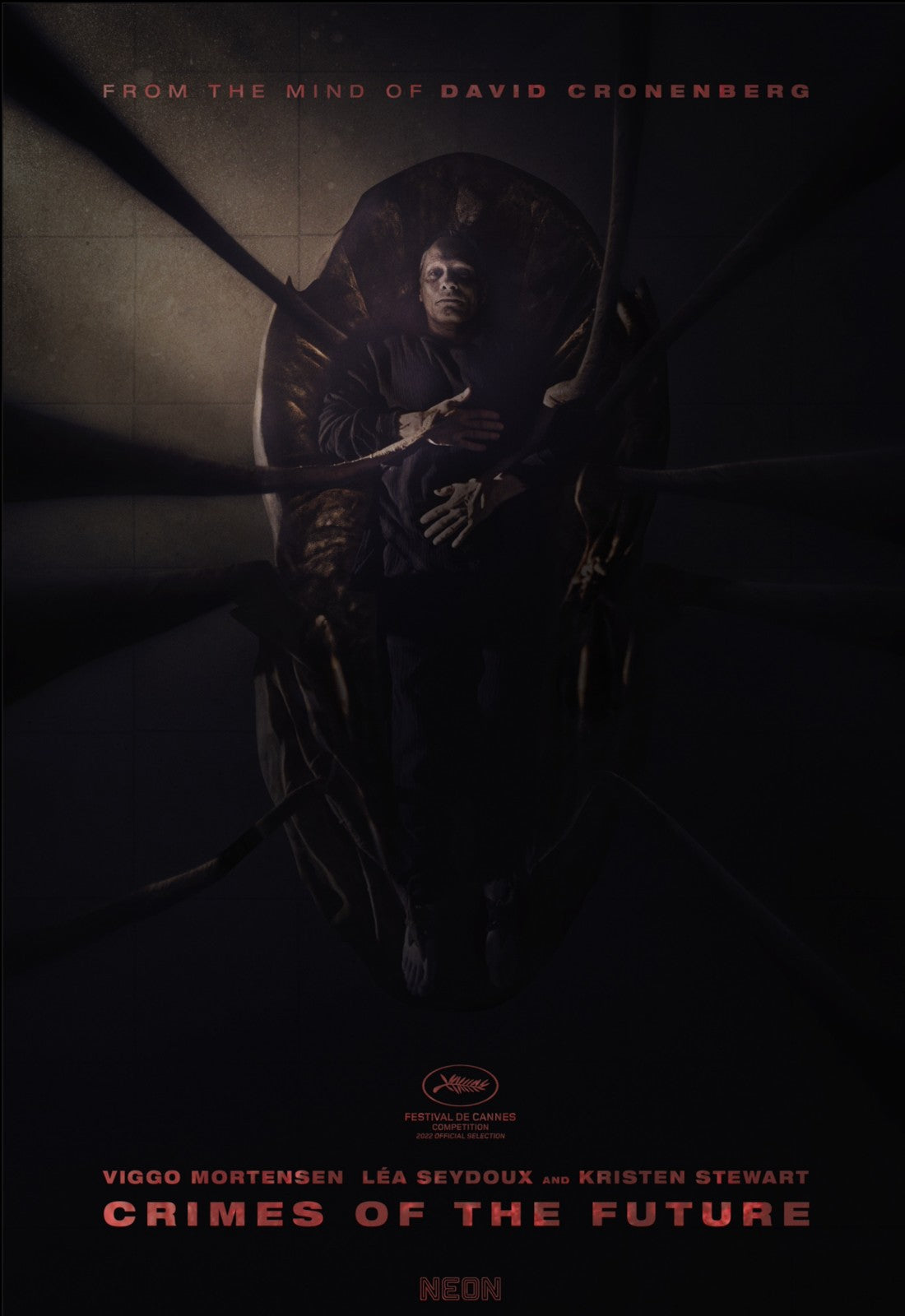
The machine as enclosure
The English-language sheet makes the apparatus a dark frame around Saul. Its enclosing silhouette sells a bodily predicament before explaining the world.

A face assembled from faces
The French sheet builds a composite portrait from its three stars. Identity appears edited and recombined.

The film as a designed object
Slipcase, book and cards turn the home-video edition into another visual interpretation.
Cannes / 2022
The theatrical record
The festival lists 107 minutes and Canada–Greece. Its film page preserves credits, a press kit, trailer, extracts and publicity imagery.
4K UHD + Blu-ray / 2NDBR4192
Second Sight: film and craft
The publisher lists Dolby Vision, DTS-HD Master Audio 5.1, UHD region-free and Region B Blu-ray. Extras include Caelum Vatnsdal’s commentary, cast and crew interviews, a Leigh Singer essay, production-design materials, a making-of and The Death of David Cronenberg.
Limited packaging
Second Sight: the physical edition
Marko Manev supplies the new artwork. The set includes a 120-page book and six art cards, extending the release into an illustrated critical object.
Decca / digital release, 10 June 2022
The soundtrack album
Seventeen tracks connect characters, machines and ideas through their titles. Howe’s announcement identifies the score as Shore’s sixteenth feature collaboration with Cronenberg since 1979. The album is a separate listening object, not a complete cue-by-cue reconstruction of the film.
CRITICAL RECEPTION
The return, and the argument.
Stephanie Zacharek
TIME / 24 May 2022
Coolness and absurdity
Zacharek finds an elegant, often silly spectacle beneath the anticipated shock. Her response emphasizes the contrast between outrageous images and a controlled presentation, while questioning the burden of explanation.
Anthony Lane
The New Yorker / June 2022
The cost of returning
Lane admires the spectacle but finds familiar imagery and weak narrative momentum. His objection makes a useful counterpoint to readings that treat repetition as a productive return to long-running concerns.
Bright Lights Film Journal
2022 / critical essay
A future that resembles a past
The essay connects the films through new organs and evolutionary anxiety, while contrasting the later work’s decayed, apparently low-tech environment with conventional images of futurity.
Josh Pearce
Seize The Press / 15 April 2023
Who gets to adapt?
Pearce reads the struggle over plastic digestion through class and ecological damage. His emphasis falls on the difference between an art world able to exhibit bodily change and people who need adaptation to survive. Suppression protects an existing order from that possibility.
Tomris Laffly
RogerEbert.com / 3 June 2022
Sensuality and unfinished questions
Laffly finds a compelling erotic charge in the machines, performances and photography, while questioning familiar imagery and ideas left incomplete. Her mixed response connects the pleasure of the film’s design to the difficulty of assembling its philosophical claims.
RELEASE OBJECT / JUNE 2022
The ear in the presentation case.
NEON’s giveaway turns a fragment of Ear Man into a self-contained display. The replica is separated from the performer, enclosed in lucite and accompanied by a signed certificate. The campaign repeats the film’s interest in extracting, naming and exhibiting a bodily object.
The production link is concrete: Fangoria reports that Alexandra Anger made the limited run using the original mould. These are promotional replicas, with their own provenance.
WATCH & LISTEN
ASC podcast / episode 110
Douglas Koch on photographing the film
The cinematographer’s interview offers a route from the still-image studies into a longer discussion of the production.
Open the presentation ↗Justin Stephenson / artist portfolio
The main titles as a separate work
Watch the title sequence through its designer’s own presentation, with Howard Shore credited for the music.
Open the presentation ↗Vanity Fair / Notes on a Scene
A surgery scene, explained by its makers
Cronenberg, Mortensen and Seydoux discuss the physical performance and the construction of the sequence.
Open the presentation ↗CRITICAL DIALOGUES
Three ways into the argument.
Read the makers and critics together, then follow their questions back into the images.
How should a late film resemble the earlier work?
Return, repetition, accumulation
Across the sources
Laffly’s review locates both attraction and predictability in the return to familiar imagery. Cronenberg’s answer to Gorber stresses what the particular project requires. These positions address different experiences: the critic meets a body of work; the filmmaker must make one film function.
Return to the film
Follow the instruments, clothing and interiors as a system within this film. The devices support eating, sleeping, looking and performing. Their family resemblance matters because they occupy distinct parts of an ordinary day, bringing the unusual into repeated use.
The private body and the collective claim
A future for whom?
Across the sources
Pearce emphasizes unequal access to survival in a poisoned world. That political reading makes Lang’s project a counterweight to the artists’ public acts: an altered digestive capacity could change how people live, beyond the value of a single performance.
Return to the film
The final close-up brings this large argument back to one face. An intimate expression can be decisive for a person while leaving the wider social arrangement open. Read the image alongside the registry’s files: bodily experience and institutional recognition operate at different scales.
An artist, a partner and a spectator
Who is allowed to make art?
Across the sources
Stewart sees Timlin’s response as an awakening, including the wish to share another person’s capacity for expression. Cronenberg tells AP that making the inner self public leaves the artist exposed. The spectator’s desire and the artist’s vulnerability belong to the same encounter.
Return to the film
Caprice adds a third position. She attends to the body and helps organize what others will see. The artist’s apparent solitude depends on another person’s work. This makes the central partnership a useful point of entry into questions of authorship, care and control.
06 / CASE FILE 13
Follow the evidence.
Maker interviews, production artwork, institutional records, campaign imagery and criticism.
Open a source for its publication details and the records it informs. Use the research index to search by author, publication, material or topic.
REFERENCED IN THIS DOSSIER
S01 / Festival recordFestival de Cannes: official film record
Festival de Cannes / 2022
Credits, 107-minute festival listing and credited publicity photographs.
Open source ↗S02 / Production documentProduction notes and director interview
Cannes-hosted production publicity / 23-page PDF
Selected synopsis, director interview, production-design and character sections; printed pages 4–15. Promotional testimony is attributed to its speaker.
Open source ↗S03 / Maker interviewWippet Good
Don McKellar in conversation with David Cronenberg / Cinema Scope 91
Bed redesign, found locations, preparation and shooting method. Script details here are the participants’ recollections.
Open source ↗S04 / Director interviewDon’t Call it Body Horror
Rory O’Connor / The Film Stage / 2022
Genre, Athens, design revisions and Kristen Stewart’s performance. The article’s variant SARC spelling is not treated as a separate device.
Open source ↗S05 / Director interviewFlesh for Fantasy
Letterboxd Journal / director interview / 2022
Saul’s unstable identity and the progression from SpiderWebBed to OrchidBed.
Open source ↗S06 / Effects interviewBehind the prosthetics
Maria Lattila / whynow / 5 September 2022
Alexandra Anger and Monica Pavez on silicone, organ references, tattooing and deliberately unresolved healing.
Open source ↗S07 / Effects interviewThe prosthetic team picks apart the flesh
Ella Joyce / HERO / 9 September 2022
Anger and Pavez discuss port iterations, performer appliances and the separation between prosthetic and mechanical departments.
Open source ↗S08 / Scene breakdownNotes on a Scene: the surgery performance
Vanity Fair / 9 June 2022
Published transcript examined. Cronenberg, Mortensen and Seydoux distinguish practical devices from digital alterations.
Open source ↗S09 / Concept artworkCrimes of the Future: concept gallery
Goran Delic / artist portfolio
Eleven published concept sheets document proposals and variations in the designs.
Open source ↗S10 / Designer portfolioCrimes of the Future: costume portfolio
Mayou Trikerioti / designer portfolio
Selected film and publicity imagery inspected. Visual readings below are editorial observations, not undocumented statements of costume-design intent.
Open source ↗S11 / Production announcementFilming begins in Athens
Hellenic Film Commission / 4 August 2021
Contemporary August–September Athens schedule and Canadian–Greek production framework.
Open source ↗S12 / Institutional testimonyThe experience of filming in Greece
Hellenic Film Commission / 24 March 2022
Statements from Cronenberg and Robert Lantos on locations and the Greek–Canadian crew.
Open source ↗S13 / Music releaseOfficial soundtrack announcement
Howe Records / Decca Records / 2022
Digital release, collaboration history and the 17-track album listing.
Open source ↗S14 / Edition inventoryLimited Edition 4K UHD & Blu-ray
Second Sight Films / catalogue 2NDBR4192
Publisher specifications, supplemental inventory, book and packaging.
Open source ↗S15 / Contemporary criticismSilly, elegant, and might make you squirm
Stephanie Zacharek / TIME / 24 May 2022
A Cannes response attentive to the film’s coolness, absurdity and exposition.
Open source ↗S16 / Contemporary criticismThemes of the Past
Anthony Lane / The New Yorker / June 2022
A dissenting reading of repetition, narrative energy and performance.
Open source ↗S17 / Critical essayA Great Future in Plastics
Bright Lights Film Journal / 2022
A critical comparison of the two Crimes films and their evolutionary imagination.
Open source ↗S18 / Distributor recordCrimes of the Future
NEON / US distributor
Official synopsis, principal cast and US rating.
Open source ↗S19 / Campaign reproductionsOriginal campaign gallery
IMP Awards / 2022
Campaign reference index. The dossier’s French sheet is the credited image supplied by Cannes.
Open source ↗S20 / Programme and creditsBFI Southbank programme notes
BFI / 9 September 2022
Cast, department credits and UK programme information. The director interview is reprinted production publicity, not an independent interview.
Open source ↗S21 / Release interview pageSurgery is the answer
Brian Formo / Fandango / 3 June 2022
Written introduction consulted for the pageant and narrative framework. Its 1980s script date conflicts with the director’s account and is not adopted.
Open source ↗S22 / Director interviewLife Is Suffering
Nick Newman / The Film Stage / 28 March 2022
The artist’s Kidney Stones and Inner Beauty project provides a contemporary parallel to the film’s bodily art.
Open source ↗S23 / Cinematographer interviewDouglas Koch looks back at Crimes
Ryan Rosenblum / Keslow Camera / 25 April 2025
The Crimes-specific recollections distinguish its constructed, largely lit world from The Shrouds. Photographs on that page belong to the later film.
Open source ↗S24 / Production designer interviewCarol Spier on the future in Athens
Edward Douglas / Below the Line / 9 June 2022
Spier’s account of aged architecture and retained graffiti supplies the location testimony.
Open source ↗S25 / Designer testimonyCostumes: the designer’s own account
Mayou Trikerioti / Fantômas 4 essay and Georgia Karkani interview, Marie Claire Greece, 16 December 2025
The designer republishes her essay, costume drawings and later fitting-room recollections on her press page.
Open source ↗S26 / Title designer portfolioCrimes of the Future: opening titles
Justin Stephenson / artist’s Vimeo portfolio
Stephenson identifies the tension between organs and their markings as the point of departure for his main titles.
Open source ↗S27 / Company creditsPicture finishing and sound credits
Company 3 / project record
Named color, finishing and re-recording personnel.
Open source ↗S28 / Listen furtherASC podcast: Douglas Koch
Iain Marcks / American Society of Cinematographers, hosted on iVoox / episode 110, 25 August 2022
A cinematography interview to accompany the still-image studies.
Open source ↗S29 / Release campaign recordThe Ear Man promotional replicas
Angel Melanson / Fangoria / 3 June 2022
Reproduces NEON’s giveaway announcement and describes original-mould replicas made by Alexandra Anger.
Open source ↗S30 / Effects interview pageBlack Spot FX: the route to Crimes
Josh Korngut / Dread Central / 2 June 2022
The written introduction traces the collaboration through Slasher and The Death of David Cronenberg. The page also hosts an interview and workshop images.
Open source ↗S31 / Film-frame archiveCrimes of the Future: frame collection
FilmGrab / 12 August 2022
Selected frames inspected for composition, architecture, objects and costume. Frame numbers identify this collection, not timestamps.
Open source ↗S32 / Director and cast interviewThe script that returned
Clark Collis / Entertainment Weekly / 3 June 2022
Cronenberg describes Robert Lantos reviving the project and the subsequent financing period.
Open source ↗S33 / Title-sequence presentationJustin Stephenson and David Cronenberg
CAROUSEL / 21 December 2022
Reproduces a main-title image and presents the sequence as a design collaboration.
Open source ↗S34 / Director interviewWalkouts, Kubrick and CG drool
Jordan Ruimy / MovieMaker / 2022
Toronto conception, Athens discoveries and the child’s practical and digital effects.
Open source ↗S35 / Director and cast interviewWhat if transformation is a good thing?
Don Kaye / Den of Geek / 2022
The replacement of the Painkillers title and Mortensen’s interest in tenderness.
Open source ↗S36 / Period interview / author’s reprintCronenberg in Cannes, 2002
David Hughes / Empire interview, republished by its author, 25 May 2012
A 2002 discussion of Painkillers already considers reusing the earlier title. Publication here is the later reprint.
Open source ↗S37 / Actor interviewMortensen discusses an unmade Cronenberg script
Gabriella Paiella / GQ / 1 February 2021
A contemporary report of a planned summer collaboration, before the film’s title was announced.
Open source ↗S38 / Director and actor interviewConvincing Mortensen to play Saul
Rebecca Ford / Vanity Fair / 27 May 2022
Casting, schedule reduction and controlled digital blood.
Open source ↗S39 / Dated festival event recordCannes: the Crimes red carpet
Festival de Cannes / 23 May 2022
Official photograph of Cronenberg’s red-carpet entrance, dated 23 May 2022.
Open source ↗S40 / Composer interviewCreating a world in music
Chris Tilly / Dexerto / 5 September 2022
Howard Shore on the early screenplay, composition, orchestration and the finished images.
Open source ↗S41 / Composer interviewWriting nine motifs away from the film
15Questions / Howard Shore interview
Shore describes his thematic preparation and the different narrative functions of his scores.
Open source ↗S42 / Director interviewArt at the edge of the apocalypse
Devika Girish / Film Comment / 2022
Naming, legal clearance, bureaucracy and the different hopes represented by Lang and the artists.
Open source ↗S43 / Actor interviewActivating Lang
Witney Seibold / /Film / 3 June 2022
Scott Speedman on physical preparation, few takes and the separation of the family’s performances.
Open source ↗S44 / Actor interviewScott Speedman: a different kind of leading man
Sadaf Ahsan / The Canadian Press, via CityNews / 2 June 2022
The invitation to join the film and Lang’s appeal to the artists; reported at the Toronto premiere.
Open source ↗S45 / Cinematographer interviewDeep Cuts: photographing Crimes of the Future
Iain Marcks / American Cinematographer / 18 October 2022
The Crimes section of the three-film feature: capture, lighting, locations and grading, with production photographs.
Open source ↗S46 / Performer interviewEar Man explains the transformation
Gabriella Paiella / GQ / 6 June 2022
Tassos Karahalios describes choreography, the ear mould and the experience of wearing the prosthetics.
Open source ↗S47 / Effects-studio accountBuilding the digital SARK
Rocket Science VFX / award announcement / April 2023
The vendor identifies its digital assets and compositing work on the film.
Open source ↗S48 / Location-production recordThe Athens shoot wraps
Athens Film Office / September 2021
The local film office records the shoot’s completion and its final location.
Open source ↗S49 / Maker archiveA concept artist’s production-design record
Michael Derrah / personal press archive / 2022 entry
Derrah identifies his contribution to Carol Spier’s department and reproduces a DGC certificate.
Open source ↗S50 / Editor profileChristopher Donaldson and the work of editing
Amanda Sage / Queen’s Alumni / 3 July 2025
A career interview with a director’s assessment of Donaldson’s contribution to the two Cronenberg collaborations.
Open source ↗S51 / Actor interviewTimlin’s awakening
Jake Coyle / Associated Press, via CityNews / 25 May 2022
Stewart discusses belief, artistic envy and her character’s encounter with the artists.
Open source ↗S52 / Director interviewThe artist’s vulnerable interior
Jake Coyle / Associated Press, via Spectrum News / 31 May 2022
Cronenberg connects the organ metaphor to artistic exposure and considers technology within his own body.
Open source ↗S53 / Director and actor interviewsCronenberg, Seydoux and Mortensen at Cannes
Jason Gorber / RogerEbert.com / 3 June 2022
A three-part conversation about collaboration, the film’s visual character and cinema.
Open source ↗S54 / Critical essayI Want to Feel You from the Inside
Josh Pearce / Seize The Press / 15 April 2023
An ecological and class reading of adaptation and the institutions resisting it.
Open source ↗S55 / ReviewCrimes of the Future: a return to the flesh
Tomris Laffly / RogerEbert.com / 3 June 2022
A response attentive to sensual design, familiar imagery and the film’s unresolved ideas.
Open source ↗About the images and readings
Concept sheets document design proposals. Publicity photographs and portfolio images document selected views of the production. Captions credit the maker or supplying archive. Paired visual readings are original editorial interpretations; descriptions of supplements identify their published contents.
Chapters & search
Open a chapter, or search across the file.