
eXistenZ
ENTER THROUGH THE BODY
A game that needs flesh.
A world that keeps changing its rules.
An atlas of biological hardware, corporate identities, improvised spaces and uncertain performances. Follow the evidence from the demonstration room to the surviving objects.
Open the evidence atlas ↓The file examines the complete film, including its ending.
- Written & directed
- David Cronenberg
- Principal cast
- Jennifer Jason Leigh / Jude Law
- Photographed
- Peter Suschitzky
- Designed
- Carol Spier
- Edited / scored
- Ronald Sanders / Howard Shore
- Format
- 1999 · colour · 97 min
WHOLE-FILE INDEX
Find a thread through the file.
Search the objects, workshops, production accounts, release history and source records together.
Three routes through the materials
A company becomes an object
Antenna’s credential → Spier’s designed world → the surviving Trout Farm pass.
A device becomes a performance
The game pod → its effects team → the original and exhibition replica.
A game becomes an industry
Trout Farm’s identity → creature development → the surviving farm puppets.
01 / FIELD NOTES
Whose game are we in?
The film gives its systems names, staff and consumer promises. None of those identities can make experience entirely reliable.
Allegra’s public platformAntenna Research
The opening demonstration associates Allegra’s game with Antenna. Ted’s credential supplies an independently visible company identity. Start with the badge and banners when studying the graphics.
Competition made materialCortical Systematics
The rival name becomes a photographed retail identity on the Micro-Pod package. Separate the visible mark from the shifting explanations of corporate allegiance offered by characters.
The retailer and its back roomD’Arcy Nader’s Game Emporium
Window lettering, sales-floor lighting, a staff badge and a worn testing room make the shop a complete environment. The front and back promise different kinds of access.
An unstable political positionThe Realists
The resistance to games is part of the drama’s argument about who may create a reality for other people. The changing claims of allegiance make the movement itself difficult to pin down.
The later frame around the storyPilgrImage / transCendenZ
The final gathering reassigns the apparent game and its authorship. Its hard blue headsets contrast with the earlier organic equipment. That contrast offers a clue to construction, not a guarantee of reality.
A vocabulary beyond the screenMarway / UmbyCord
Shore’s official soundtrack carries these names into its track listing. This is evidence of the film’s vocabulary circulating on a record sleeve; a lettering reconstruction still needs a photographed prop or title as its reference.
An employer inside the gameTrout Farm
The Larry Ashen credential gives Ted’s assigned job a portrait, barcode and employee number. The institution has an administrative identity as well as a processing floor. Its surviving pass and creature props bring the employer’s graphic and biological worlds together.
Read the changing frame of the story +
Allegra presents eXistenZ. An attack turns a public product event into a flight.
Ted enters the game with her. Shops, work and meals begin to carry compulsions that feel like programmed roles.
The later church gathering introduces transCendenZ and different equipment. It reframes what came before without supplying a final guarantee.
Narrative orientation: TIFF. The final question keeps the apparent return open.
HARDWARE / QUICK REFERENCE
A vocabulary built from the body.
- MetaFlesh
- The story’s engineered biological material. It names the imagined substance of the system, rather than the silicone used to fabricate a screen prop.
- Game pod
- A living console, vulnerable to illness. The French glossary describes its fictional origin in amphibian eggs and synthetic DNA.
- UmbyCord / Ombicâble
- The connecting cord. Its umbilical appearance makes a familiar cable into a bodily relationship; the album and French glossary use different forms of the name.
- Bioport
- The bodily socket through which the player connects. In the fiction, the player’s metabolism supplies the system with energy.
- Micro-Pod
- The packaged miniature device sold in the Game Emporium. Its backing card gives the biological system an ordinary retail presentation.
Fictional vocabulary: S34 · album naming: S12 · retail image: S01. Surviving prop materials are catalogued below.
02 / FIELD NOTES
The person and the part.
The same face can carry a new assignment. Read the cast through the roles the game gives them, and the performances those roles demand.
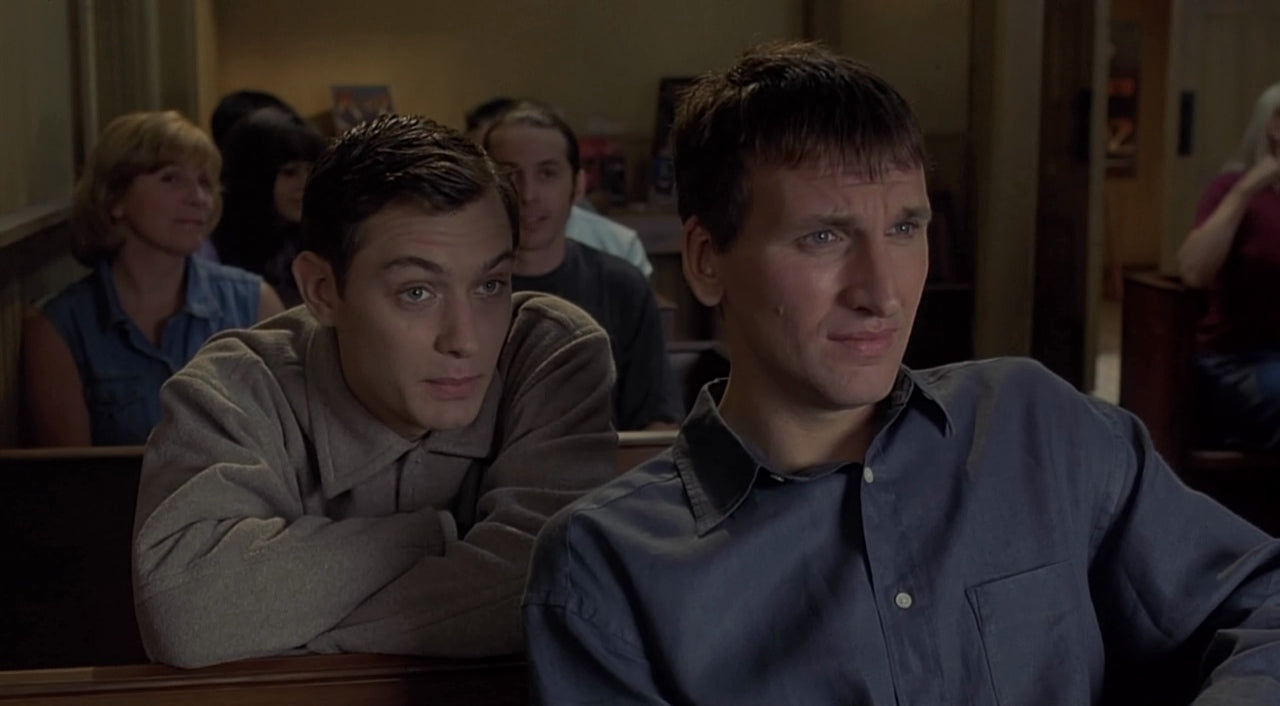
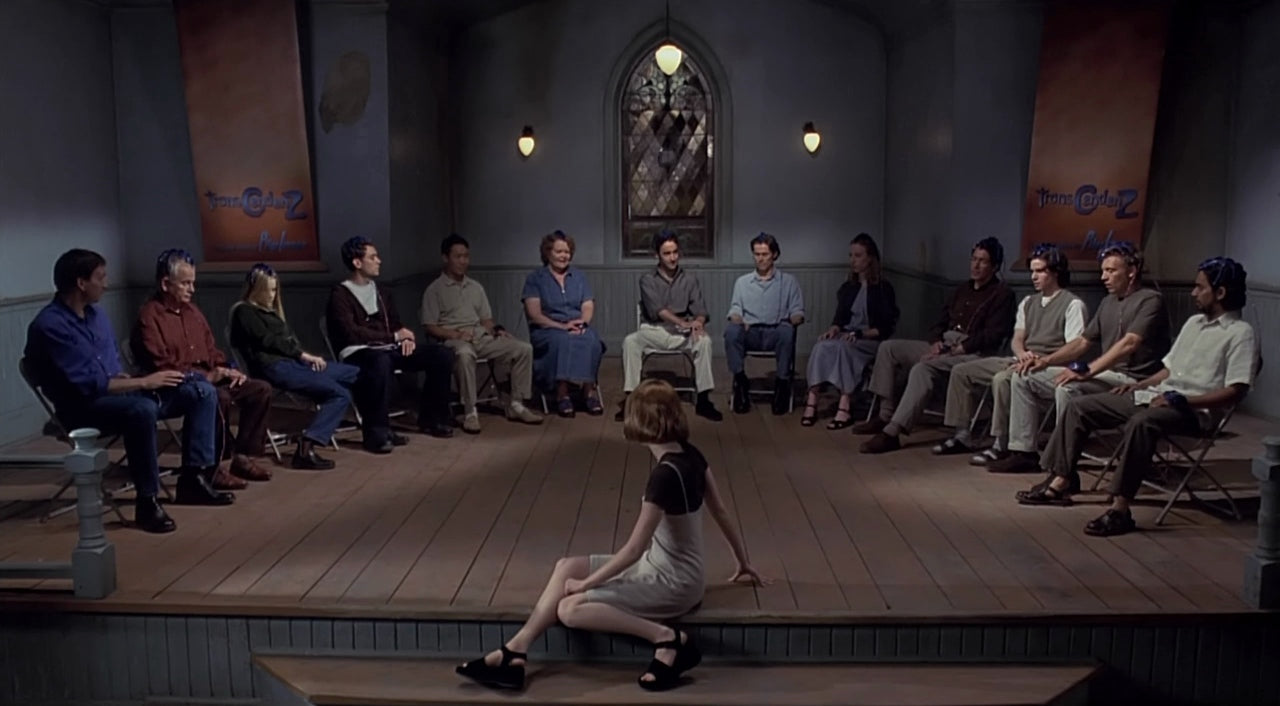
A cast that keeps being recast.
The first gathering directs attention towards a celebrated author; the later one redistributes it among participants. Read the table as a guide to changing assignments. The last gathering offers another account of the experience, while its final question keeps that account unsettled.
| Performer | Credited role / name | Assignment in the story |
|---|---|---|
| Jennifer Jason Leigh | Allegra Geller | Celebrated designer; later a player who hopes to become one. |
| Jude Law | Ted Pikul | Reluctant escort; game worker called Larry; Allegra’s partner at the return. |
| Ian Holm | Kiri Vinokur | Technician whose repair work conceals corporate recruitment. |
| Willem Dafoe | Gas | Garage operator, installer and would-be beneficiary of a bounty. |
| Don McKellar | Yevgeny Nourish | Factory contact; subsequently introduced as transCendenZ’s designer. |
| Callum Keith Rennie | Hugo Carlaw | Shop assistant and interpreter of shifting allegiances. |
| Sarah Polley | Merle | Facilitator at the later gathering. |
| Christopher Eccleston | Seminar leader / Levi | Host who introduces Allegra and organizes the demonstration. |
| Robert A. Silverman | D’Arcy Nader | Shopkeeper whose repeated behaviour demands the right cue. |
| Oscar Hsu | Chinese waiter | Restaurant contact; final questioner of the apparent return. |
| Kris Lemche | Noel Dichter | Attacker who turns the demonstration into flight. |
Cast: S14 · dialogue reference: S32 · image comparison: S01. The table follows the characters’ changing narrative functions.
03 / FIELD NOTES
Objects that make the world believable.
Open each record for close observation and a separate interpretation. Search across the visible objects, places and performances.
29 records
No records match. Try another word or reset the filters.
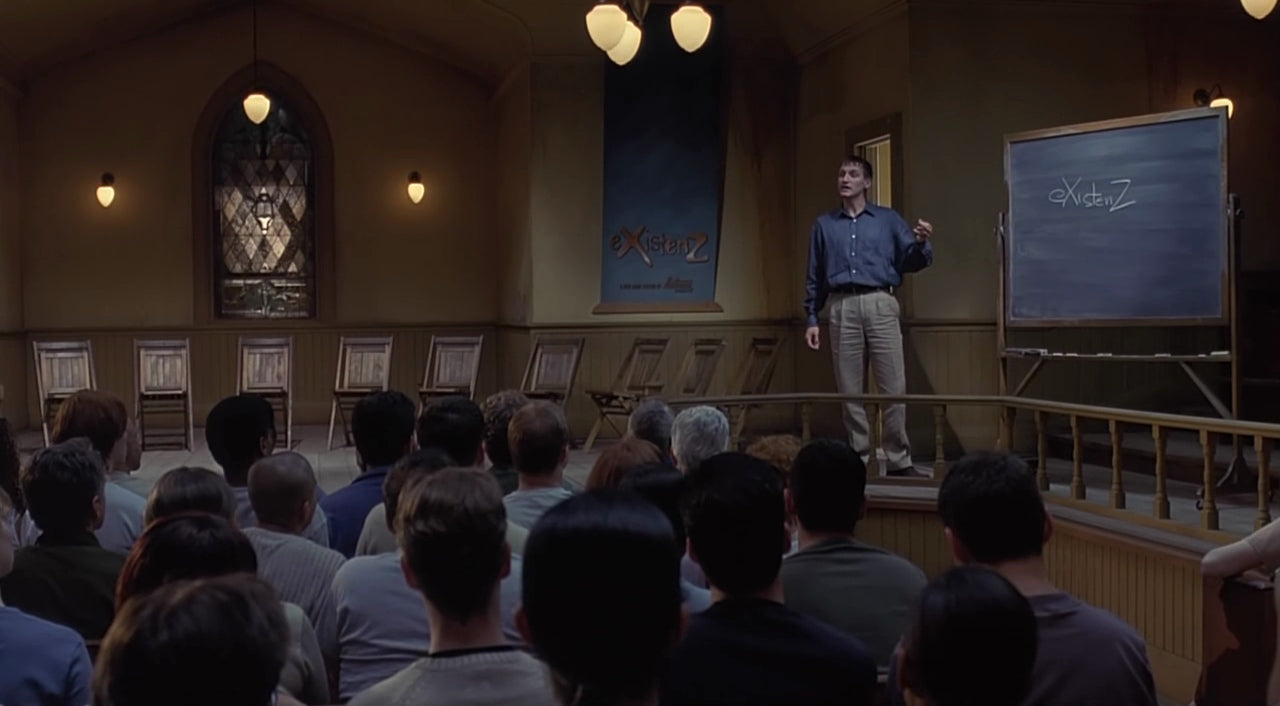
EX.01 / Graphics
The chalkboard title
Read record +
Church demonstration · frame 003
Visible evidence
Levi stands beside a handwritten eXistenZ on a wheeled board. A printed blue banner repeats the title against the church’s brown walls. The same word exists as live demonstration and finished advertising.
A reading
The hand and the brand occupy the same stage. This is a useful opening to the film’s tension between individual authorship and corporate presentation.
Frame study · S01
EX.02 / Graphics
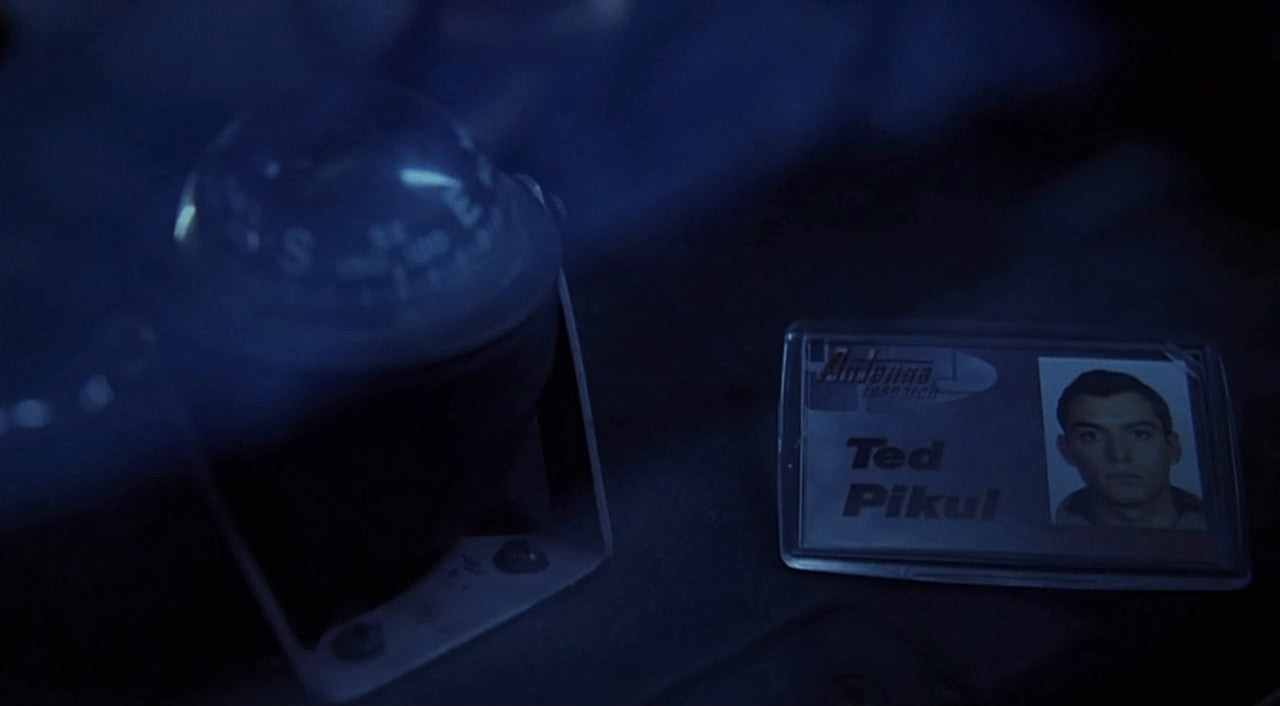
Antenna Research: the credential
Read record +
Car interior · frame 011
Visible evidence
Ted Pikul’s photo identification places the Antenna Research mark above a large, two-line name. The photograph, rounded holder and compact layout give the company a tangible administrative presence.
A reading
The card is stronger evidence for the company’s actual lettering than a plot synopsis. Its low blue light should be preserved as scene context; a clean reconstruction must be labelled separately.
Frame study · S01

EX.03 / Devices + Graphics
The Micro-Pod: a complete retail system
Read record +
Game Emporium · frame 026
Visible evidence
The company name appears on the red Micro-Pod backing card. The asymmetric lettering contrasts with the heavy outlined product title and blue promotional ovals.
The Micro-Pod blister pack
A pale, curled object and a small cylindrical accessory sit under clear plastic on a red hanging card. The die-cut slot and moulded blister make biological hardware look like an ordinary shop purchase.
Compatibility and reassurance
The small print refers to industry-standard bioports and VR-SP requirements. These are fictional packaging claims visible on the card, not technical specifications of a real product.
Meta-Lube in the package
The accessory has a blue-and-red label and a white end. Its placement above the pod gives both objects equal retail legitimacy, even though one resembles a living organ.
A reading
Here corporate competition becomes packaging. It is a different graphic register from Antenna’s understated credential: brightly demonstrative, crowded, and ready for a peg display.
Frame study · S01
EX.07 / Graphics
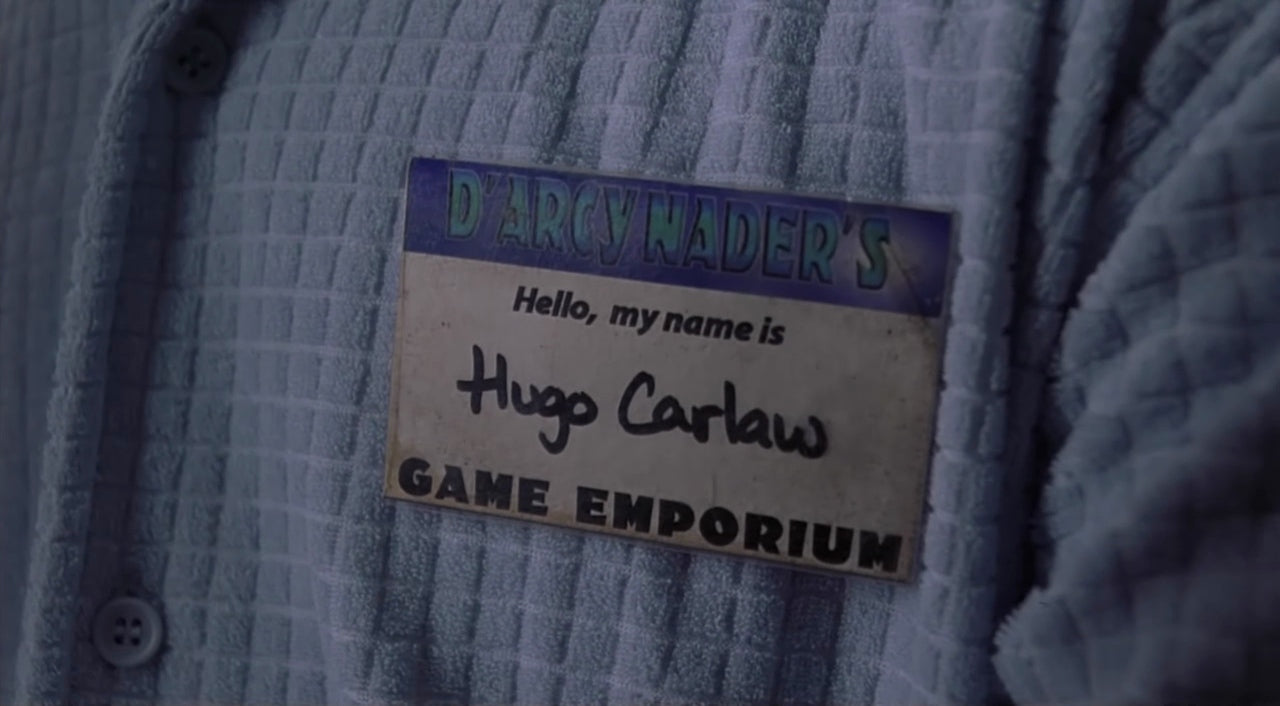
D’Arcy Nader’s name badge
Read record +
Hugo Carlaw · frame 037
Visible evidence
A purple header, pale central field and bold footer identify D’Arcy Nader’s Game Emporium. Hugo Carlaw’s name is handwritten between them. The badge is pinned against a textured, pale-blue shirt.
A reading
It combines a repeatable shop identity with a personal, improvised mark. The business exists at the scale of a staff label as well as a storefront.
Frame study · S01
EX.08 / Places
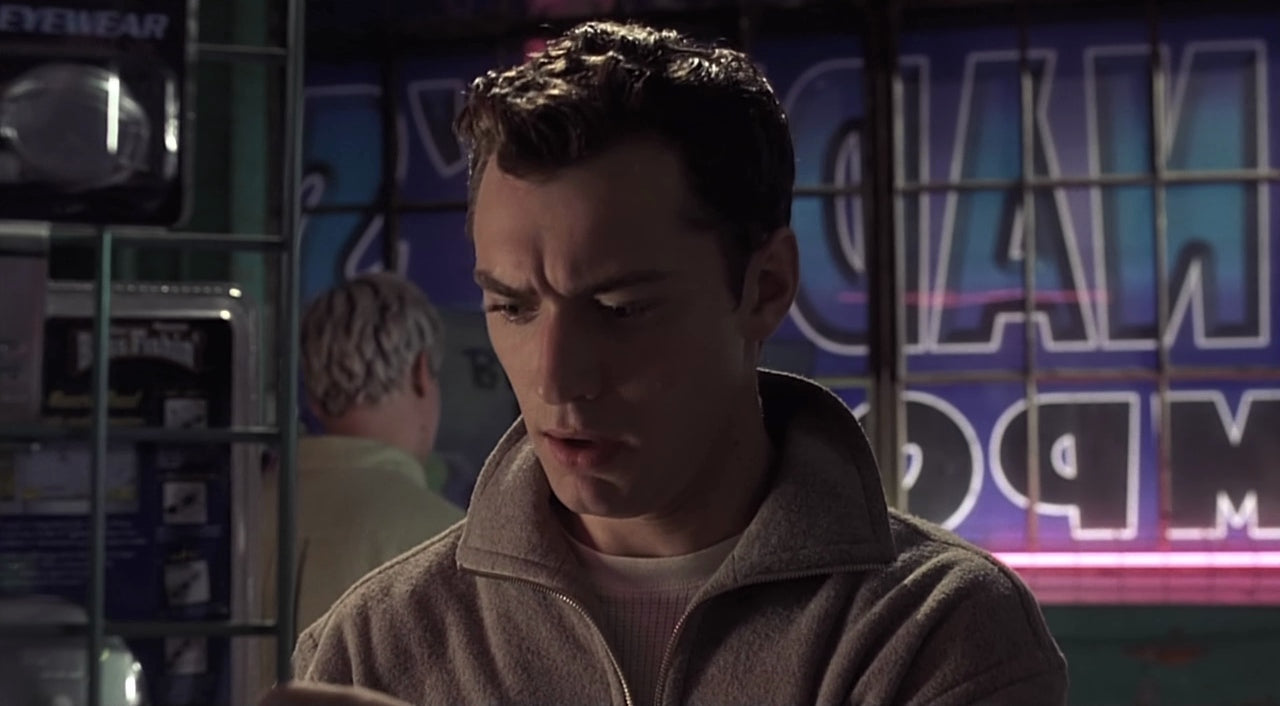
The shop window from inside
Read record +
Game Emporium · frame 025
Visible evidence
Large display lettering is seen in reverse through the glass behind Pikul. Tubing, saturated light and overlapping signs crowd the entrance.
A reading
The logo is seen from the reverse, giving its familiar lettering a displaced, partial presence in the frame.
Frame study · S01

EX.09 / Places
The room behind the shop
Read record +
Game Emporium back room · frame 028
Visible evidence
A red-lit window, damaged green walls, a metal bed and dense exposed connections replace the sales floor. The three figures stand inside a visibly worn, confined room.
A reading
The front-to-back transition is a change from promise to procedure. The film makes a commercial doorway feel like entry into a different kind of institution.
Frame study · S01
EX.10 / Devices
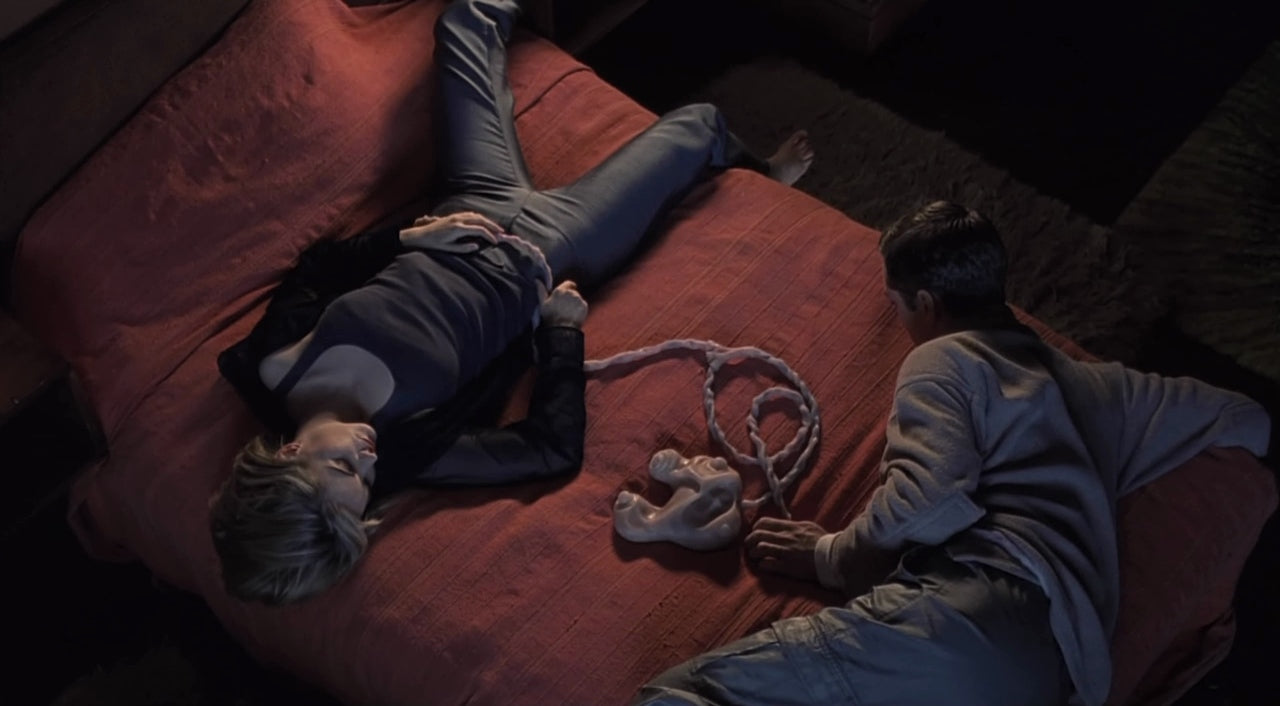
The full-size game pod
Read record +
Bed connection · frame 033
Visible evidence
Two reclining bodies are linked to a fleshy central object by looping cords. The device shares the bed with its players; its size and position suggest a third body in the arrangement.
A reading
Reading the pod as a console alone misses the staging. Connection is intimate, horizontal and dependent on someone else’s body being nearby.
Frame study · S01
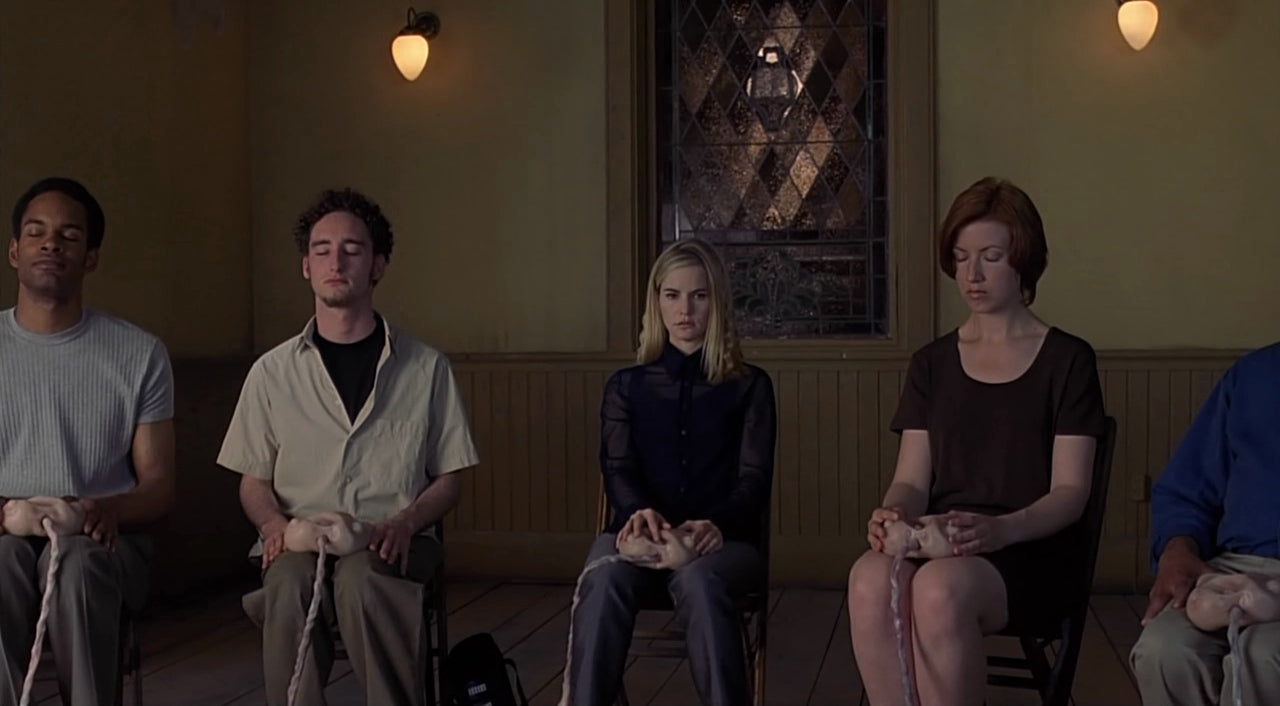
EX.11 / Devices
The shared connection
Read record +
Church circle · frame 008
Visible evidence
Pale cords run from the seated participants toward the centre. Each player holds a device on their lap, and the repeated pose turns the group into a coordinated system.
A reading
The opening gives the private act of plugging in a public choreography. The cables also draw a visible social diagram without a screen or a projected interface.
Frame study · S01
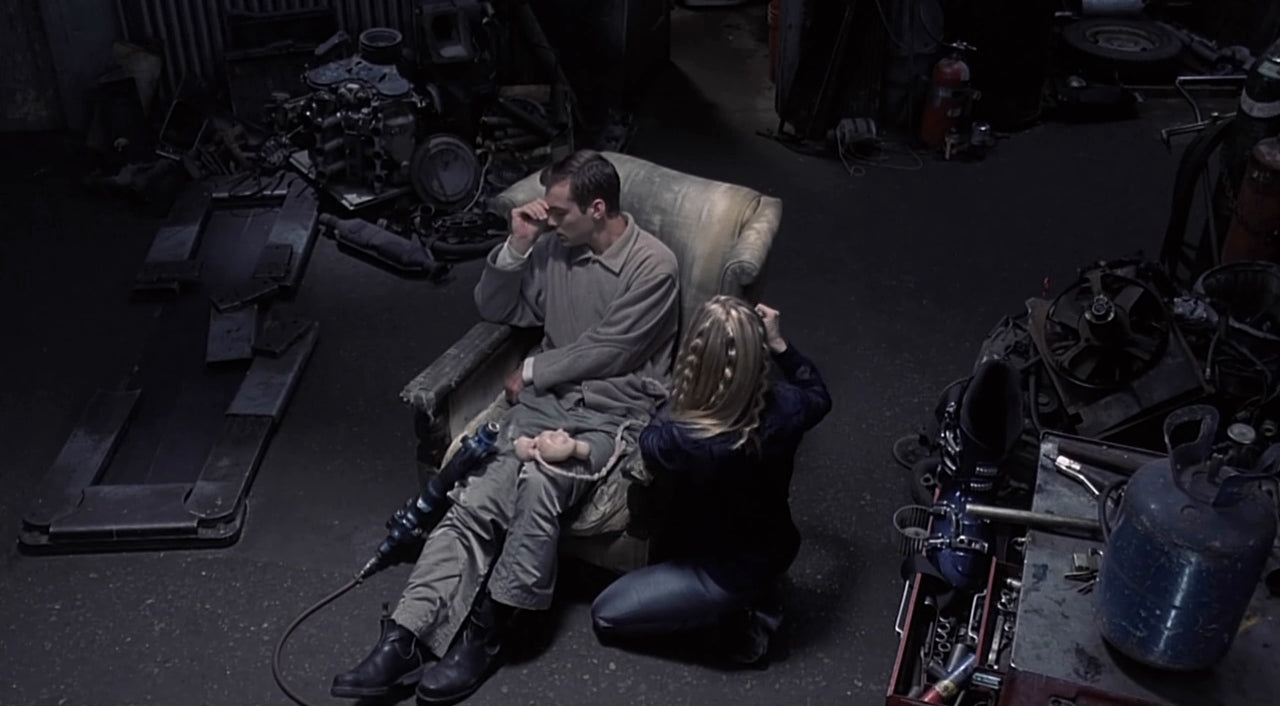
EX.12 / Devices
The bioport procedure
Read record +
Gas’s workshop · frame 020
Visible evidence
Pikul sits forward with his lower back exposed while Gas works behind him. The overhead view places their bodies among machine parts, cables and dark workshop surfaces.
A reading
A garage becomes a place of bodily modification. The setting supplies the discomfort: a familiar repair economy has been extended to the human customer.
Frame study · S01
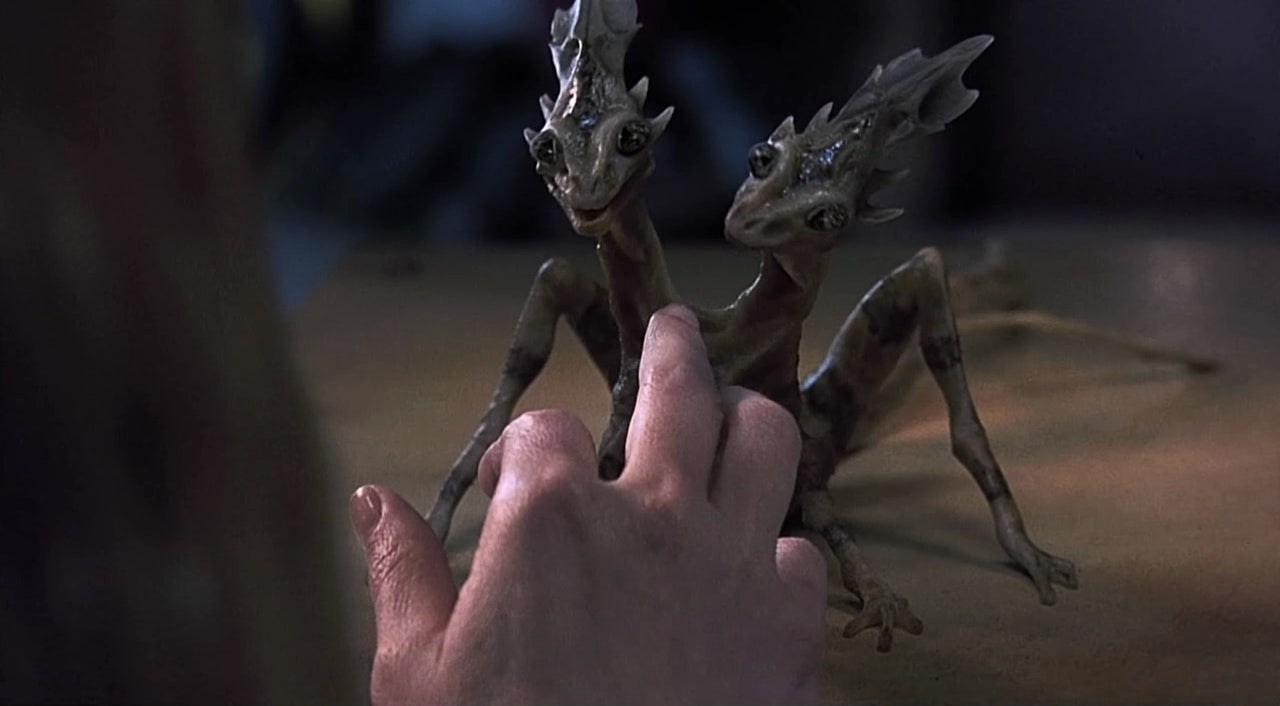
EX.13 / Devices
The two-headed amphibian
Read record +
Creature close-up · frame 019
Visible evidence
The small creature has two raised heads, a narrow body and widely planted limbs. A human hand approaches it at close range.
A reading
Scale matters. The small, inquisitive form encourages tenderness before the film’s broader use of biological matter complicates that response. A silhouette alone would lose the hand-to-creature relationship.
Frame study · S01

EX.14 / Devices
Biological components
Read record +
Processing detail · frame 031
Visible evidence
A dark mass of organs and trailing tissue rests on a clean, curved tray. The close framing removes the surrounding workplace and isolates the material itself.
A reading
The tray converts something messy into something sortable. This is the point where creature design meets an industrial system of parts.
Frame study · S01
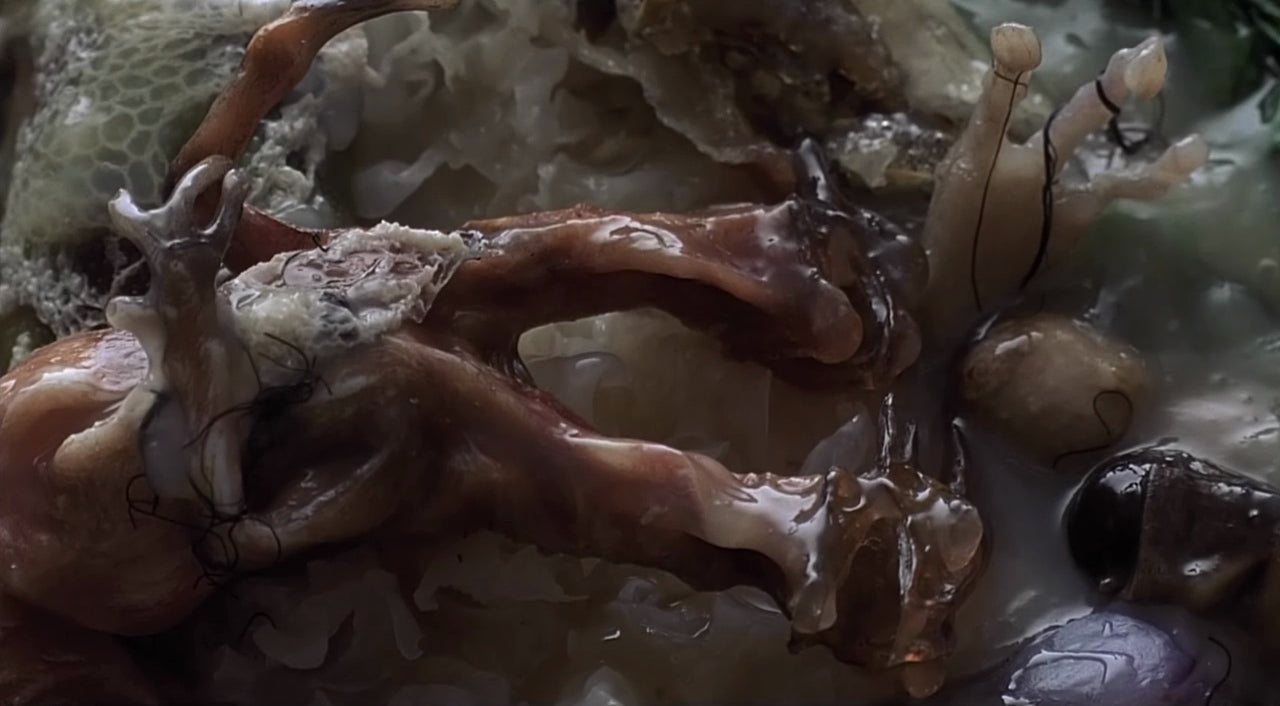
EX.15 / Devices
The restaurant special
Read record +
Plate detail · frame 034
Visible evidence
The food fills the frame: glistening flesh, bone-like structures and uneven textures crowd the dish. The camera gives it the scrutiny normally reserved for a technical object.
A reading
The meal is both hospitality and a collection of usable forms. Its legibility depends on the table sequence, where looking, eating and assembling become closely related activities.
Frame study · S01
EX.16 / Devices
The gristle gun
Read record +
Restaurant confrontation · frame 036
Visible evidence
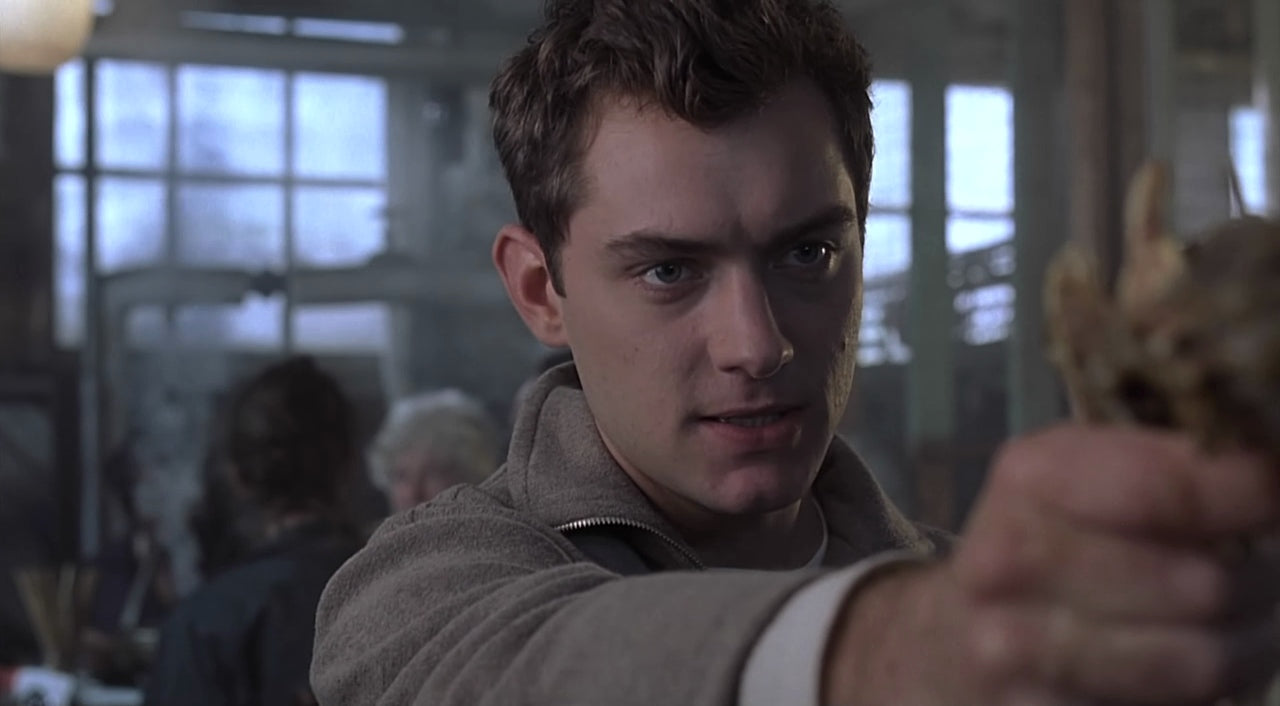
Pikul aims an irregular organic weapon toward the camera. The familiar pose makes the object readable as a gun before its precise construction can be understood.
A reading
The design exploits the body’s knowledge of a weapon: grip, aim and threat. The film’s biological vocabulary disrupts the object without making it unrecognizable.

EX.17 / Devices
The final headset
Read record +
Return to the church · frame 041
Visible evidence
A rigid, glossy blue device sits over Allegra’s head. Segmented arms and a pointed central piece visibly differ from the soft cords and hand-held pods seen earlier.
A reading
The change in equipment is a material cue, not proof that the new scene is finally real. The film changes the apparent platform while leaving the reliability of experience unsettled.
Frame study · S01
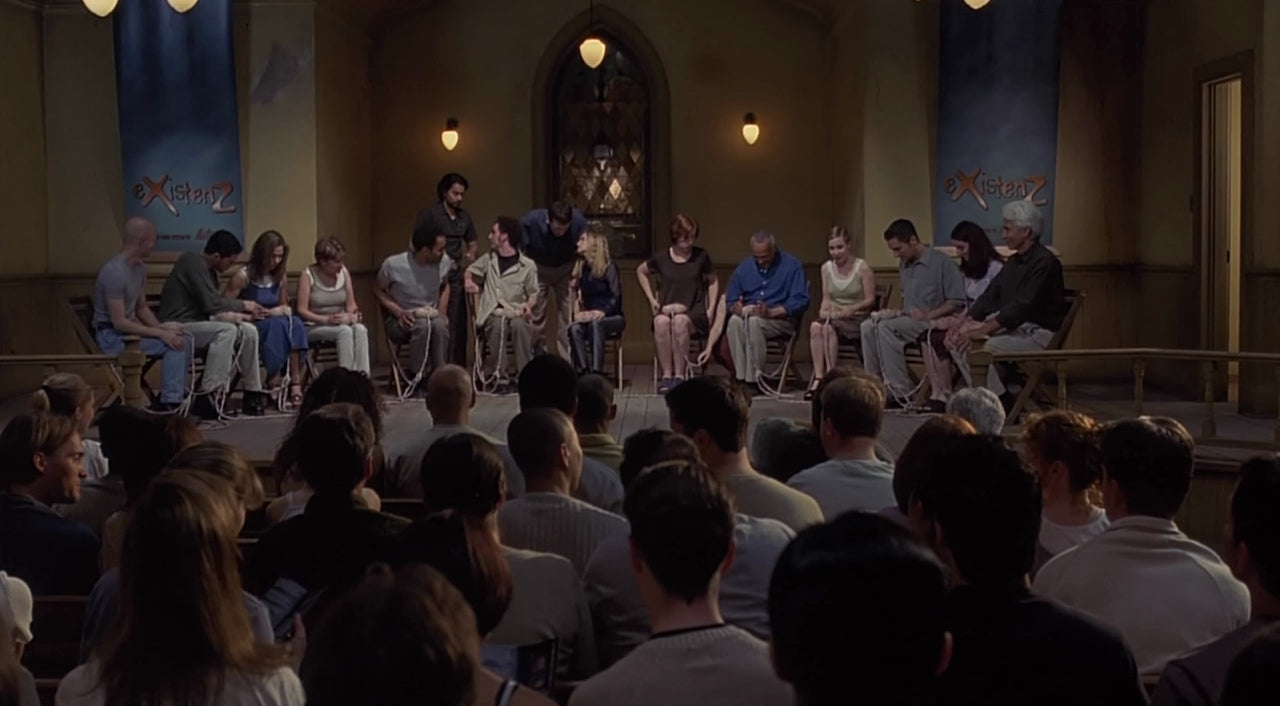
EX.18 / Places
A church arranged for testing
Read record +
Opening demonstration · frame 005
Visible evidence
A semicircle of players faces the audience inside a timber-lined church. The presentation platform, banners and ordinary chairs turn the building into a provisional product venue.
A reading
The venue brings belief, congregation and product enthusiasm into one frame.
Frame study · S01
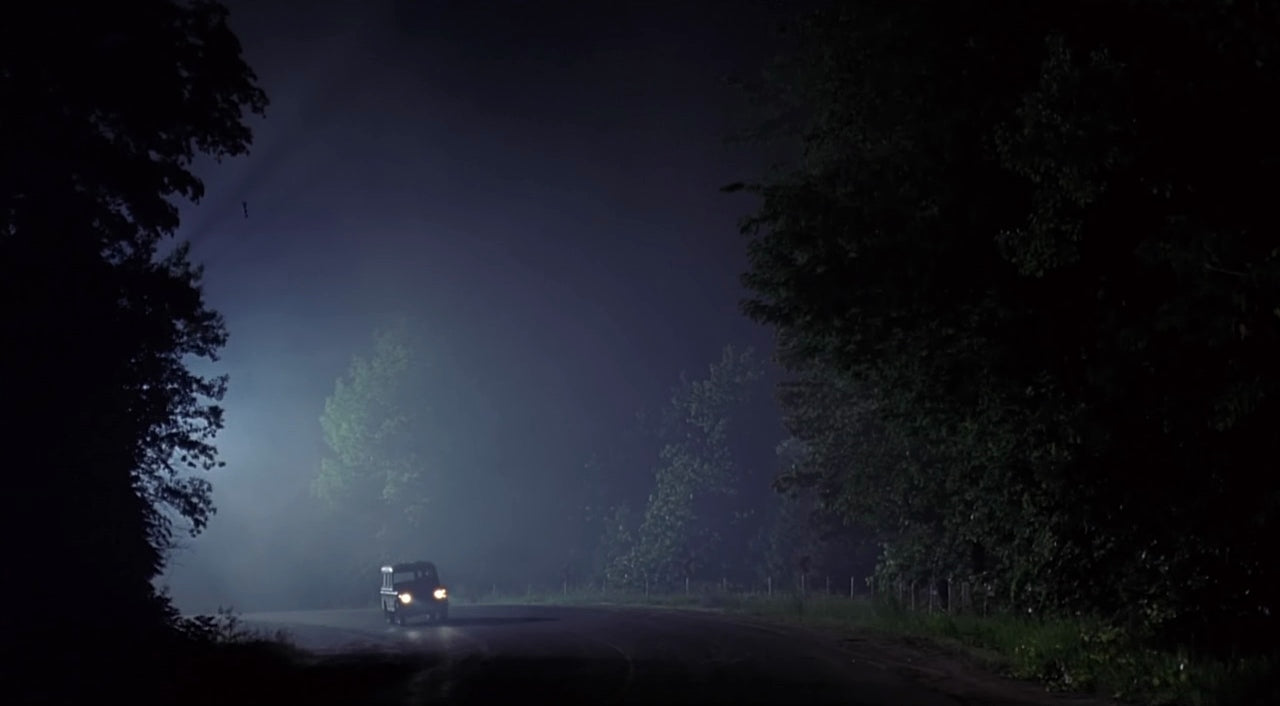
EX.19 / Places
The road outside the network
Read record +
Night exterior · frame 014
Visible evidence
A vehicle is dwarfed by an empty road, tree silhouettes and a concentrated pool of blue light. There is little geographic information to orient the viewer.
A reading
The image gives the escape a destinationless quality. Rural space is not relief from the game world; it can be just as enclosed and selective as an interior.
Frame study · S01
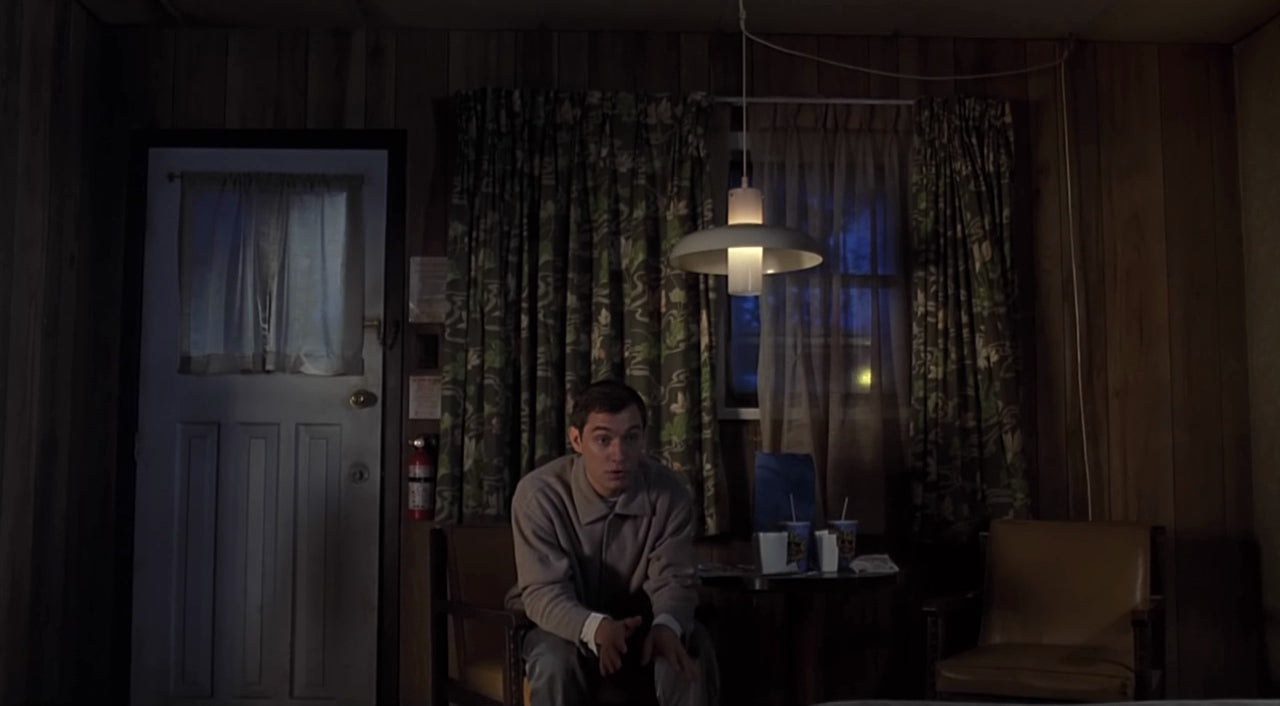
EX.20 / Places
The motel’s ordinary surfaces
Read record +
Motel room · frame 015
Visible evidence
Curtains, a standing lamp, a couch and wood-toned surfaces surround Pikul. The composition lets domestic furnishings occupy more of the frame than the figure.
A reading
The room does not announce itself as futuristic. Its familiar textures make unfamiliar bodily hardware more intrusive when that hardware enters the same space.
Frame study · S01

EX.21 / Places
The garage as clinic
Read record +
Gas station interior · frame 017
Visible evidence
Pikul stands amid circular hoses, metal tools and a radiator. The pale walls and tightly packed work surfaces make the space practical rather than spectacular.
A reading
The mechanic’s shop supplies a ready-made visual language for maintenance. The film can move from vehicle repair to bodily repair without building a shining laboratory.
Frame study · S01
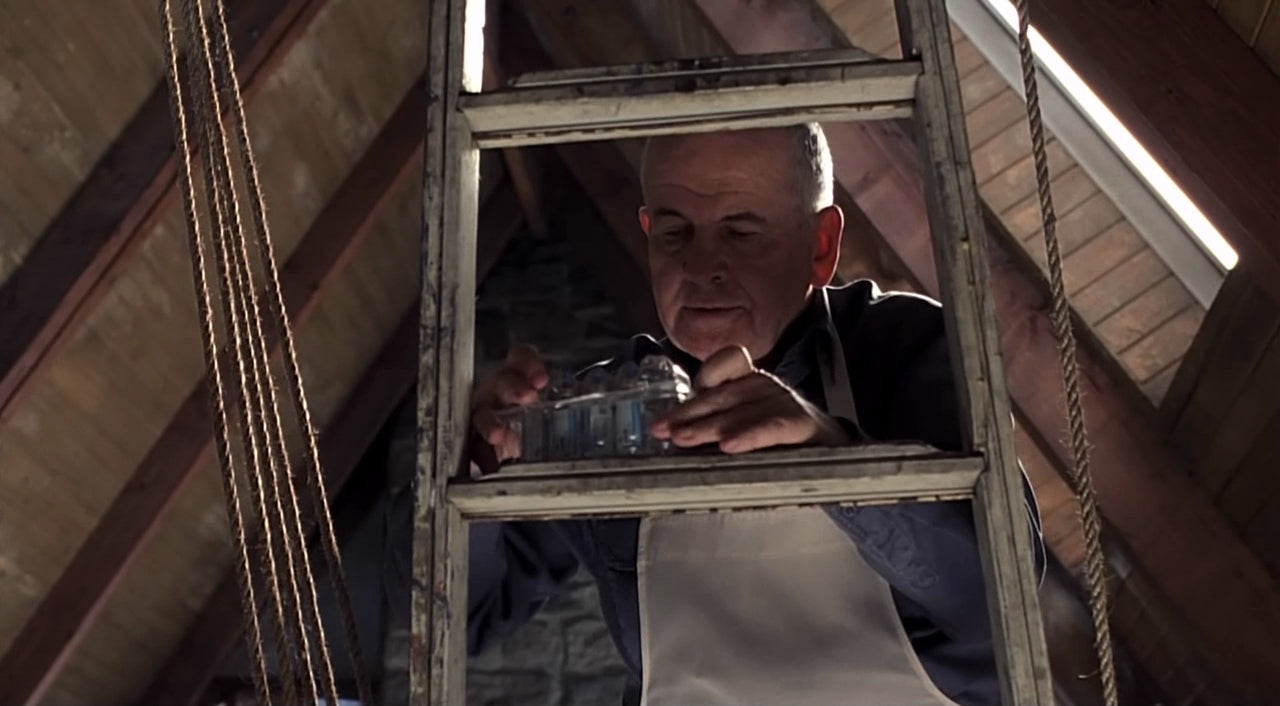
EX.22 / Places
Kiri’s working space
Read record +
Lodge workshop · frame 021
Visible evidence
Vinokur is seen through a ladder-like structure within steep wooden architecture. Timber beams break the image into smaller compartments.
A reading
The obstruction makes access to expertise feel indirect. It also gives the repair environment a handmade, improvised character, distinct from both the garage and the shop.
Frame study · S01

EX.23 / Places
The processing floor
Read record +
Trout-farm work environment · frame 032
Visible evidence
Large industrial windows, rough structural elements and diffuse light frame Pikul. A work tag and plain clothing tie the figure to the surrounding labour space.
A reading
Biotechnology is staged through work rather than spectacle. The design asks what a production line for living hardware might feel like to stand inside.
Frame study · S01
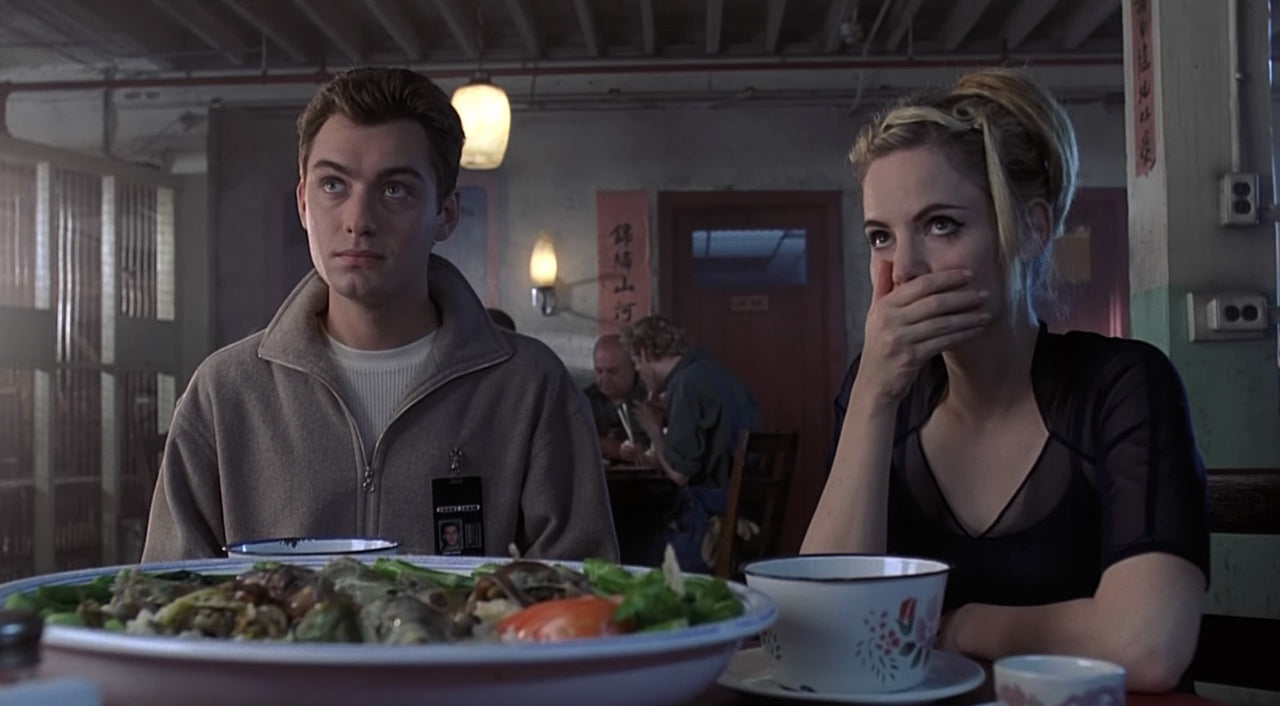
EX.24 / Places
The restaurant table
Read record +
Restaurant two-shot · frame 035
Visible evidence
Allegra and Ted sit behind an oversized serving plate, with patterned tableware and a hazy interior behind them. Their different expressions divide the same meal into different experiences.
A reading
The table is a performance space and an effects display at once. The dish occupies the foreground while the actors supply the audience’s competing responses.
Frame study · S01
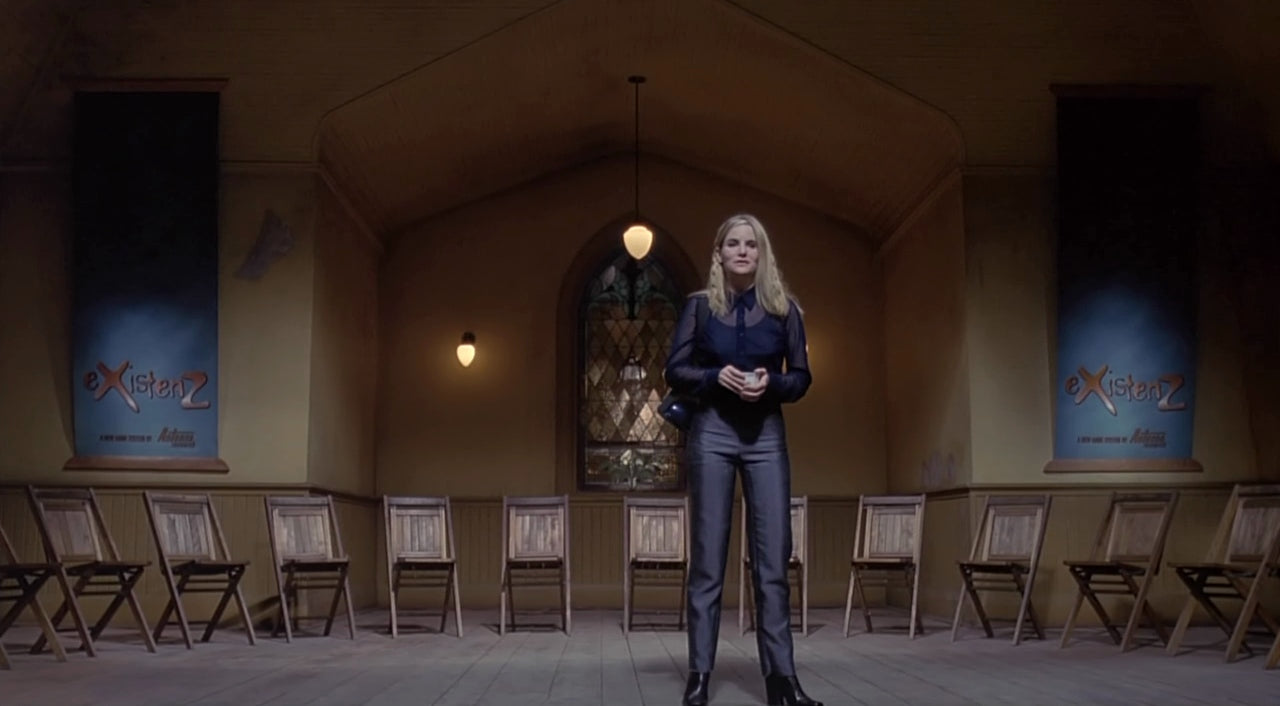
EX.25 / Performance
Allegra on the platform
Read record +
Jennifer Jason Leigh · frame 004
Visible evidence
Allegra stands alone in a dark outfit before the empty chairs. Her hands are held close to her body; the large room amplifies her isolation.
A reading
Authorship begins as a public performance. The character’s relationship with a crowd is visually different from her later absorption in the device and the game.
Frame study · S01
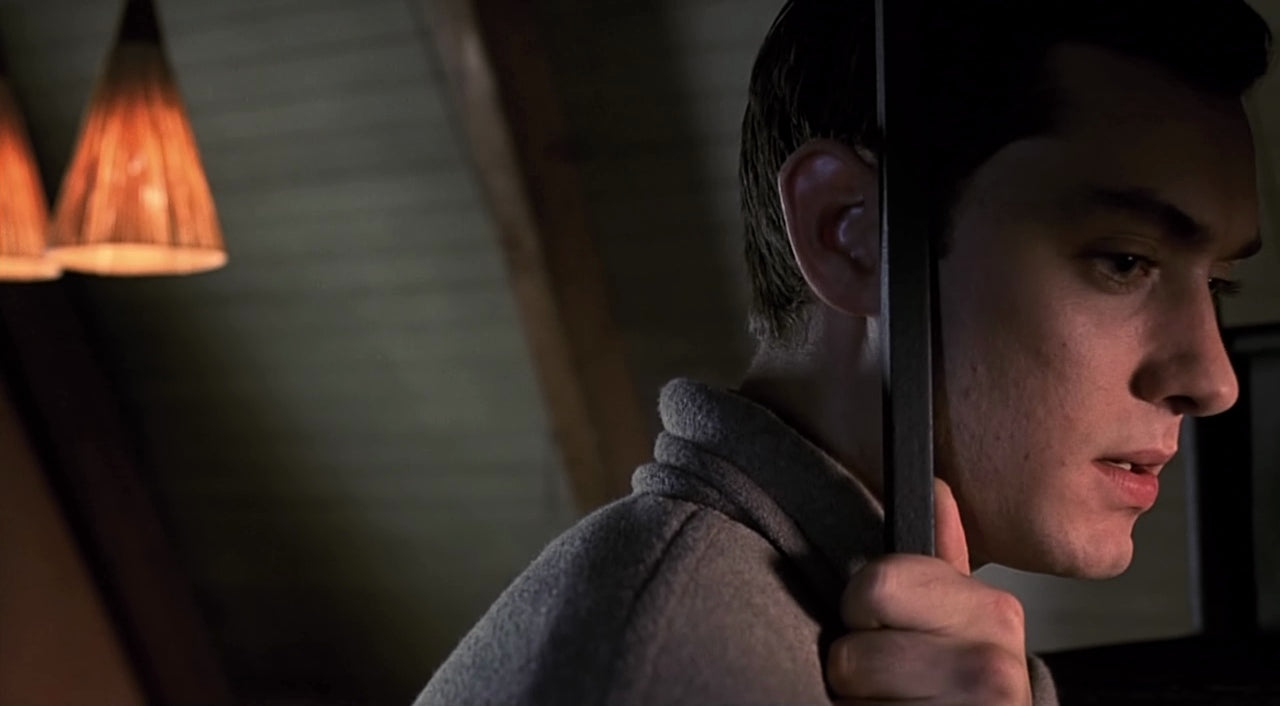
EX.26 / Performance
Pikul as reluctant participant
Read record +
Jude Law · frame 023
Visible evidence
The close profile and tightly held weapon isolate Pikul from the room. His plain pale clothing offers little visual armour.
A reading
The anxious guide is also the viewer’s point of entry. His uncertainty makes exposition part of a relationship instead of a separate explanation of the technology.
Frame study · S01

EX.27 / Performance
Gas’s salesmanship
Read record +
Willem Dafoe · frame 018
Visible evidence
Gas’s face is brightly animated against a dense mechanical background. His blue work shirt joins performance to the practical world of the workshop.
A reading
The enthusiasm is part of the danger. Helpfulness, fandom and commerce can occupy the same expression before the scene resolves their relationship.
Frame study · S01
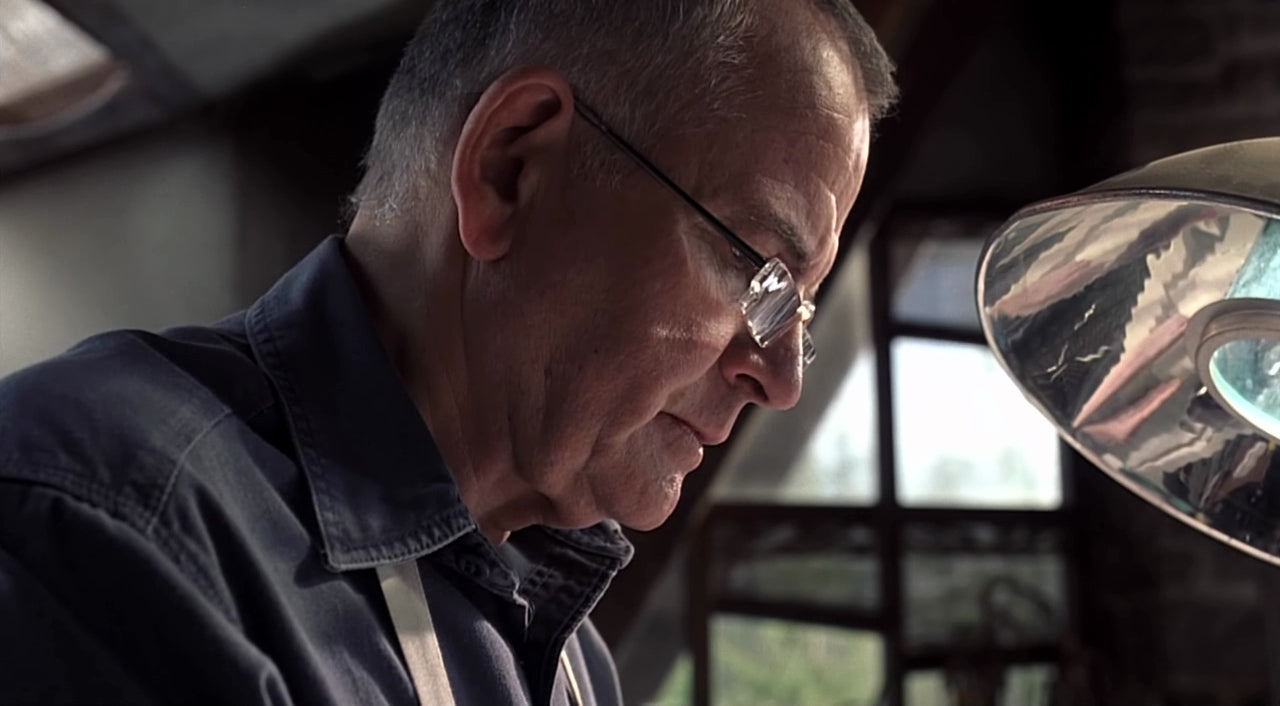
EX.28 / Performance
Vinokur’s close attention
Read record +
Ian Holm · frame 022
Visible evidence
Glasses, a focused profile and a nearby work light make Vinokur’s attention appear precise. The frame emphasizes looking and working at close range.
A reading
Expertise has a visual costume even without a laboratory coat. The film borrows the reassuring concentration of a technician and places it inside an unstable narrative.
Frame study · S01
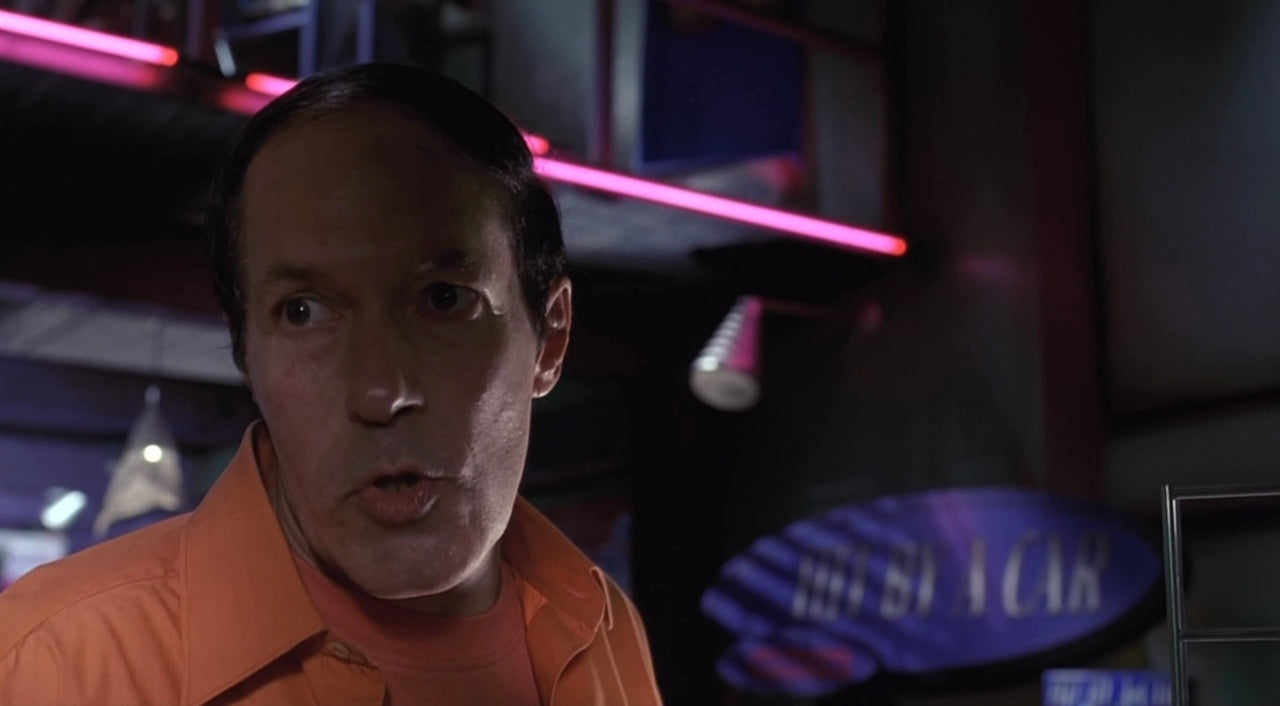
EX.29 / Performance
Nader as shopkeeper
Read record +
Robert A. Silverman · frame 027
Visible evidence
Nader’s orange shirt is an emphatic block of colour against the shop’s blue and magenta lighting. His face is framed almost like another retail display.
A reading
The supporting performances can feel packaged: a distinct pose, colour and voice waiting for a player’s response. This is a reading of the game’s social texture.
Frame study · S01
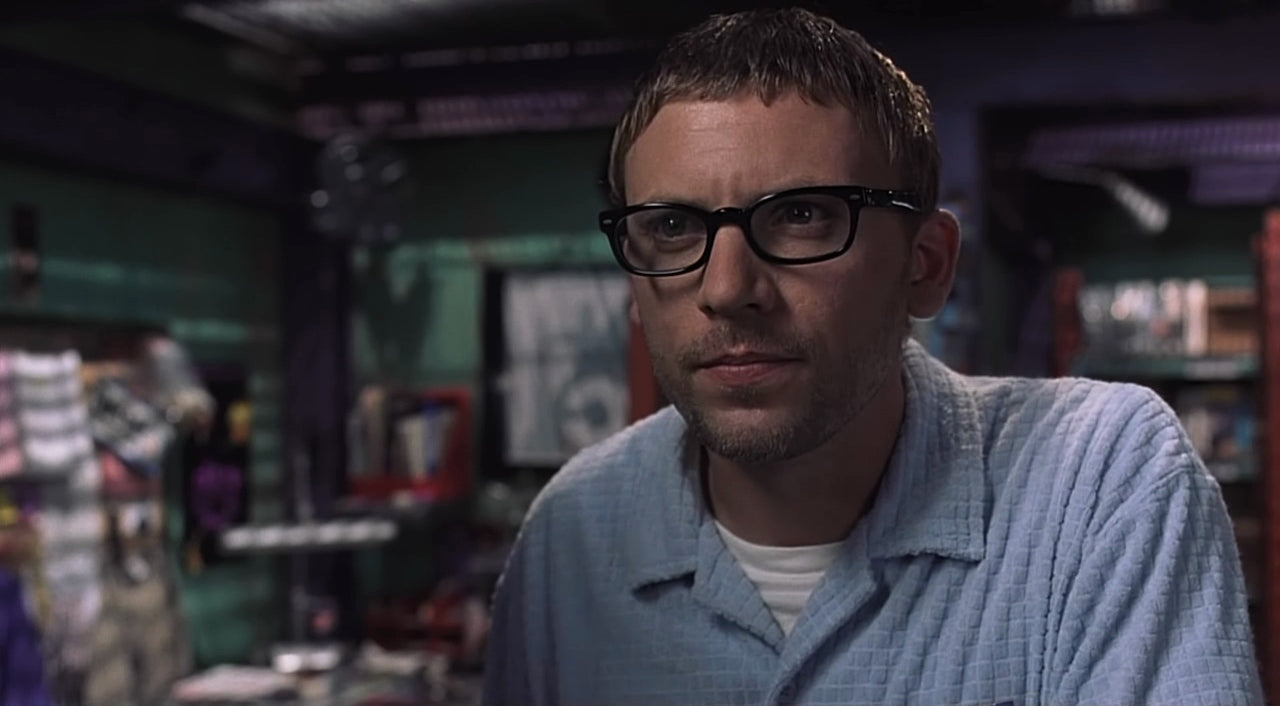
EX.30 / Performance
Carlaw behind the counter
Read record +
Callum Keith Rennie · frame 038
Visible evidence
Carlaw’s pale-blue shirt, dark glasses and badge form a modest work uniform in a crowded shop interior.
A reading
The costume’s credibility makes his changing narrative function more disquieting. Familiar service roles are among the game’s most effective disguises.
Frame study · S01
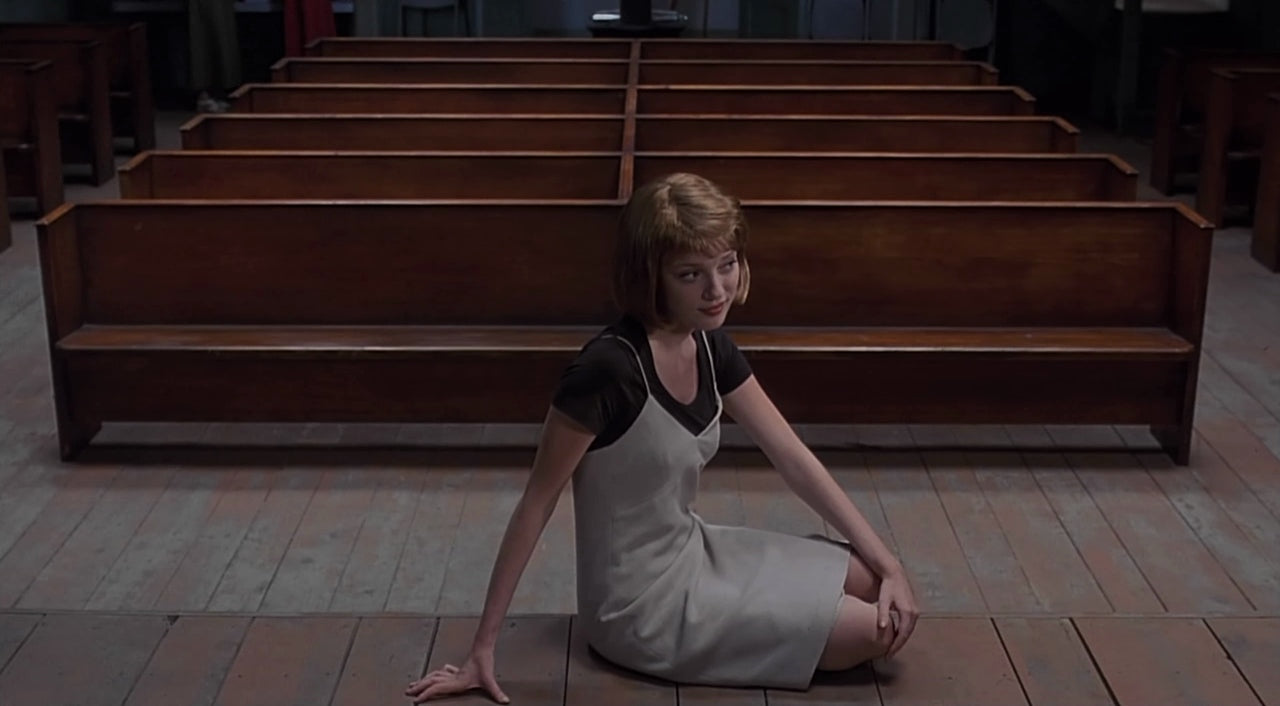
EX.31 / Performance
Merle in the emptied church
Read record +
Sarah Polley · frame 042
Visible evidence
Merle sits low against the empty wooden pews in a pale dress with a contrasting dark upper layer. The arrangement restores the building’s ordinary seating to view.
A reading
The return is not a simple reset: the people, equipment and spatial organization now ask the viewer to reinterpret the first gathering.
Frame study · S01
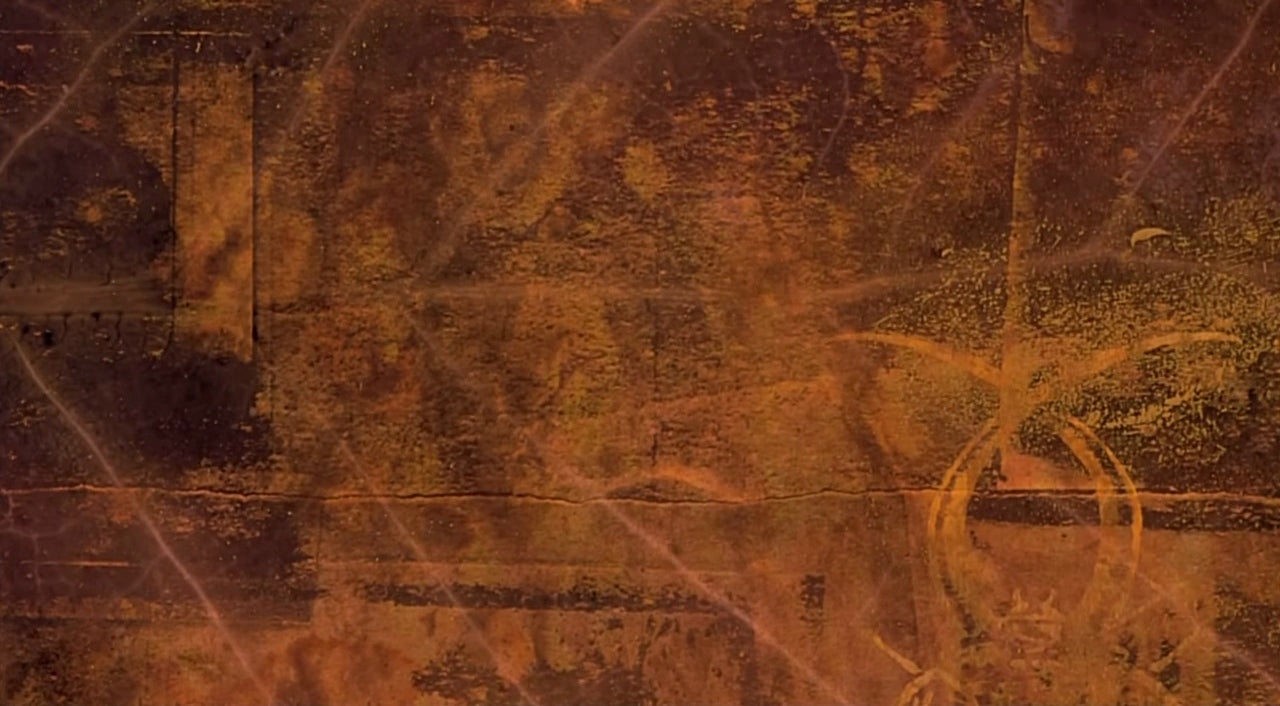
EX.32 / Graphics
Titles as a worked surface
Read record +
Opening title texture · frame 001
Visible evidence
Orange-brown layers, fine linear marks and uneven dark patches cover the image. The surface feels scratched, accumulated and difficult to separate into layers.
A reading
Before the film introduces a device, its titles suggest material that has been handled or examined. The dossier’s rust, bone and dark-brown palette takes its cue from this surface.
Frame study · S01
EX numbers locate dossier records; frame numbers locate images in the FilmGrab selection.
04 / FIELD NOTES
Connections worth looking at twice.
Four comparisons follow the film’s design across objects, settings and bodies. These are original readings of the selected images.
COMPARISON 01
The game is a manufacturing system
The most revealing sequence of objects runs from the tray of biological parts to the retail blister pack and then to the player’s body. These are different stages of a consumer system: material, merchandise and use. The film’s body horror becomes more specific when the pod is understood as a thing that must be made, marketed, sold, serviced and disposed of. Each stage has a place and a worker attached to it.
COMPARISON 02
Two kinds of company image
Antenna’s badge organizes a person: logo, name, portrait. Cortical’s packaging organizes a purchase: product name, claims, accessory, display slot. Neither image needs to tell the whole corporate history. Together they show how the film gives its companies different jobs in the viewer’s imagination. The distinction is visible in the objects themselves, not inferred from a company name alone.
COMPARISON 03
A world held together by temporary venues
The church becomes a demonstration hall, the garage becomes a clinic, and the shop opens onto a room for bodily connection. These spaces do not have to become wholly new buildings. The film’s dislocation comes from asking familiar interiors to perform unfamiliar work. Thresholds matter as much as spectacular props: a door can change the rules before a character understands that anything has changed.
COMPARISON 04
Connection is a choreography
The church circle arranges connection as a public ritual; the bed arranges it as intimate dependence. Cords draw both groups together. In the final headset image, the connection appears to move onto the head, with an altogether different hard, segmented shape. The visual sequence does not settle the ending. It shows how the film changes the terms on which an experience feels credible.
05 / FIELD NOTES
Making the uncertainty tangible.
Development, design, effects, performance and sound—documented through creator interviews, period criticism and institutional records.
1 OCT 1996
MAR–APR 1997
Already written
In Film Comment’s Crash interview, Cronenberg identifies eXistenZ as a written science-fiction project that might be his next film. This is a dated contemporary statement, not only a later recollection.
13 APR 1998
The cast is announced
GameSpot reports Alliance Communications’ announcement of Leigh as the designer and Law among the cast. The games press treated the film as news before release.
APR–JUN 1998
The Ontario shoot
The provincial production ledger records this shooting window. It establishes where and when at province level, without turning fictional settings into real addresses.
JUN 1998–MAR 1999
The trailers circulate
Quebec’s register records successive English and French 35mm trailer submissions ahead of the feature.
APR 1999
3 JUL 2024
A French theatrical return
L’Atelier’s reissue gives the film a restoration-led campaign and a new theatrical date.
DESIGN WORKSHOP
Rooms, surfaces and a reason to believe.
Six studies connect production accounts with the finished image: assembled rooms, worn surfaces, retail graphics, title design and the changing light around a performer.
DESIGN STUDY
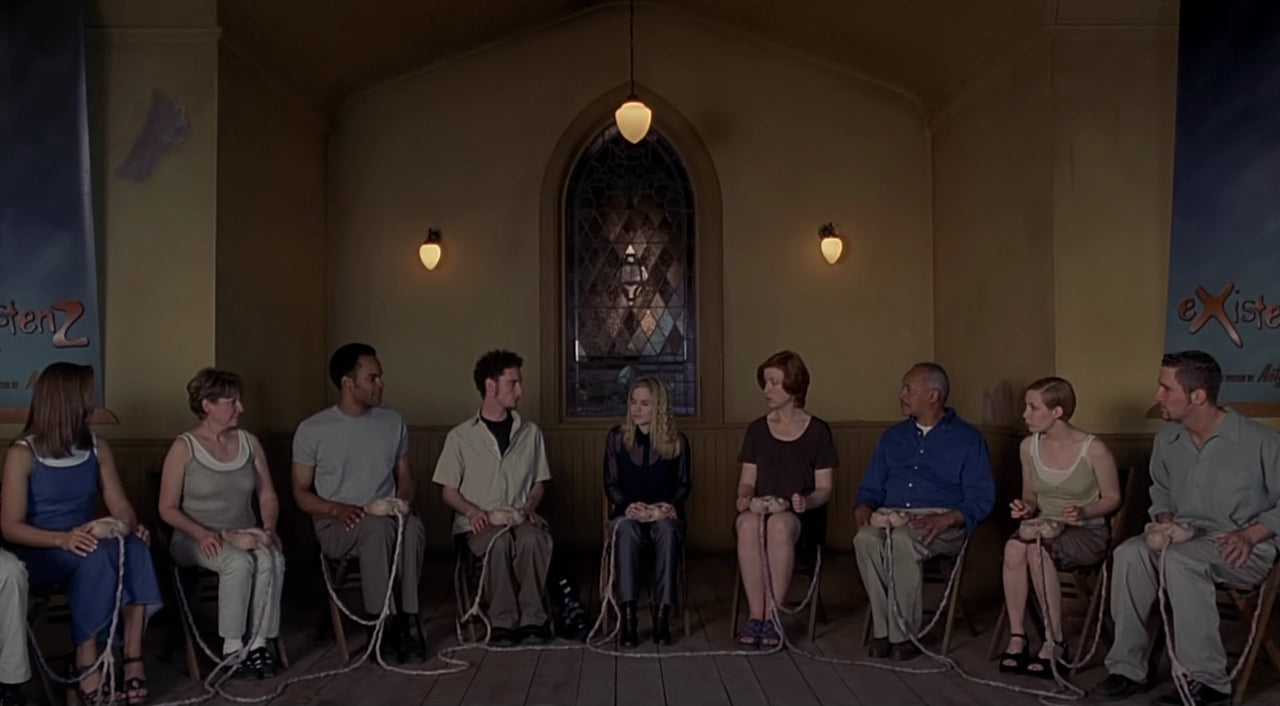
The church is an assembled space.
A modified exterior and a larger interior built on a stage could read as one building. Walker’s account of Spier’s documentary describes the exterior being adjusted to a concept drawing. The continuity belongs to the finished film; the two spaces need not fit inside one another.
Look closer
The selected frame makes the interior legible as a gathering place: chairs along the walls, a clear central floor and a high, narrow window. The room can hold a demonstration or an apparent debrief without changing its basic geometry.
DESIGN STUDY
A location can play more than one role.
Walker also describes a ski lodge being redressed and relit to supply different settings. The practical lesson is that a production location and a fictional place are different things: surfaces, furniture and illumination can recast a room.
Look closer
In the lodge sequence, timber surrounds the technical activity. Compare that material setting with the shop’s worn testing room. Both accommodate advanced equipment inside spaces that appear to have a history before the game arrived.

DESIGN STUDY
Wear is part of the interface.
The Game Emporium’s testing room has chipped paint, exposed wall layers and mismatched furniture. Its deterioration makes the retail encounter feel less controlled once the players move behind the sales floor. This is a reading of the photographed space.
Look closer
The pod needs no sleek laboratory to appear consequential. A small object, a chair and a damaged wall are enough to stage a threshold. The design gives the player somewhere to sit before it gives the spectator a reason to trust the room.
S01 · frame 030
DESIGN STUDY
The fantastic still needs a sales pitch.
The Micro-Pod backing card divides attention between a large product title, the company mark, accessory compartments and promotional panels. The package supplies several routes into the same product: recognition, affiliation, compatibility and the promise of a complete kit.
Look closer
Read it beside the credential and demonstration banner. Each has a different job: identify an employee, persuade an audience, close a sale. The film’s corporate world becomes convincing through those small changes of graphic register.
S01 · frames 011, 026, 003
DESIGN STUDY
The title begins as a worked surface.
Watch the Titles credits Rob Pilichowski with the opening sequence. Mondo Digital’s account of his later interview identifies Saul Bass as an influence and places the work within the renewed interest in title design during the 1990s.
Look closer
The opening image is a field of amber-brown layers: scratches, ruled divisions, circular traces and patches that seem rubbed away. It resembles a handled sheet as much as a display. Before a pod appears, the film gives its surface the suggestion of accumulated contact.
DESIGN STUDY
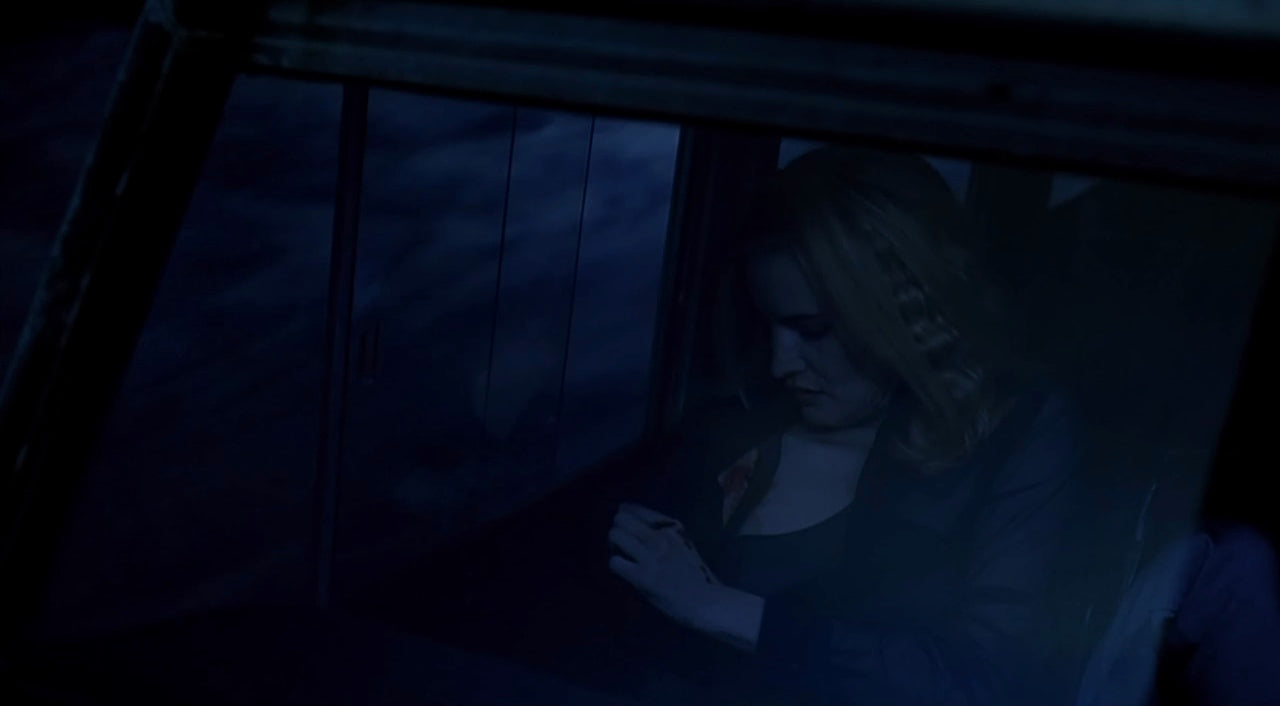
Light keeps the body difficult to read.
Looking back on his working method in 2016, Suschitzky described absorbing the script, locations, actors and wardrobe before a film’s look took shape. That account of his broader practice complements Cronenberg’s period praise of his subtle approach to eXistenZ.
Look closer
Through the car window, Allegra’s face and hands emerge inside a deep blue field. Reflections and the window frame divide the view without explaining what she feels. Compare the warm, open demonstration room: the same person moves from public visibility into a private, partially obscured space. The change in light performs part of the escape.
COSTUME STUDY / DENISE CRONENBERG
Clothes that refuse a date.
Denise Cronenberg describes an intentionally noncommittal wardrobe, designed to keep the period difficult to place.
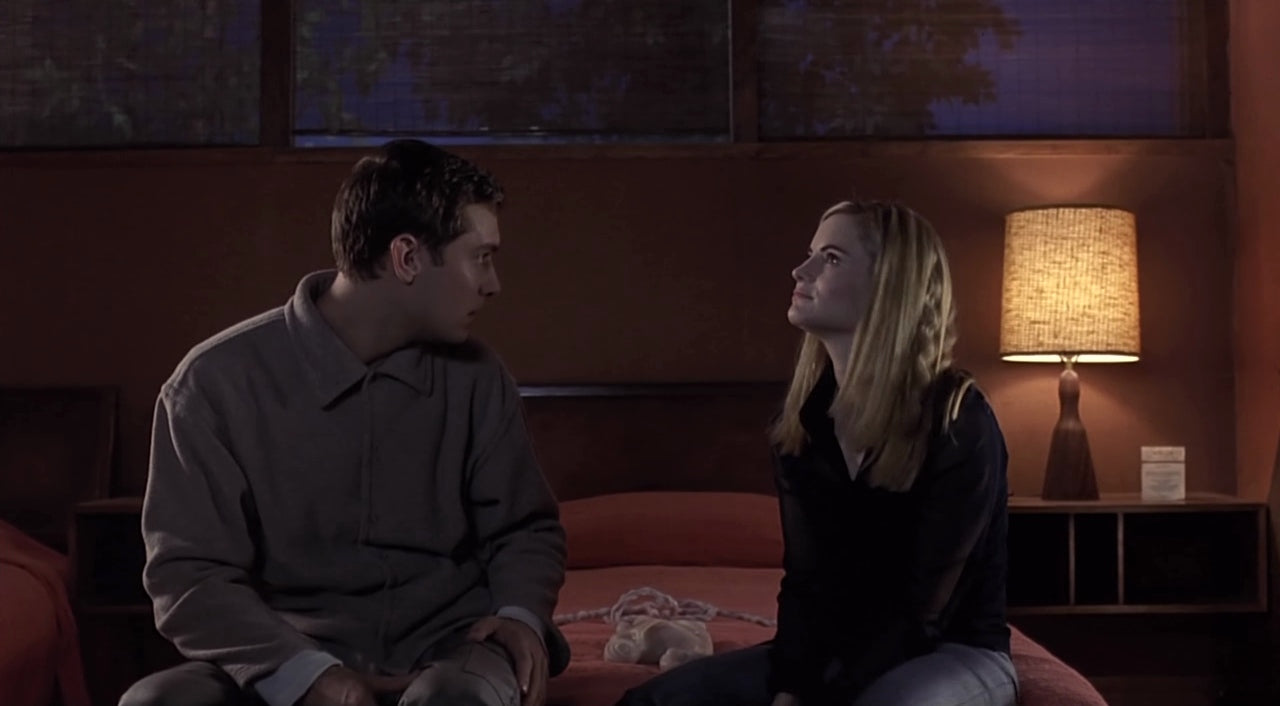
Quiet shapes around the device
On the bed, Ted’s muted collared outer layer and Allegra’s dark top create broad, quiet shapes. The small pod between them becomes the scene’s most unusual material. Clothing gives the bodies a familiar outline while leaving the machinery to announce the strangeness.

A changed outline at the return
At the later gathering, Ted’s pale textured shirt and dark straps change that outline. The new equipment and clothes help the film announce another arrangement of roles. A different costume makes the return perceptible while leaving its authority open.
The future is not a skyline. It is something that enters the room—and the body.
An editorial reading of the film’s design.
Watch TIFF’s restaurant-effects account ↗Development and decisions
01 / DevelopmentA fugitive artist, then a playable world
Cronenberg told Salon that the initial idea centred on an artist under threat. He first imagined leaving the game unseen; wanting to enter it changed the project’s centre of gravity. The result retains the persecuted artist while making the artist’s medium the space of the story.
02 / ChronologyWritten before Crash
In Sean Axmaker’s 1999 interview, Cronenberg says he had expected eXistenZ to be made before Crash. MGM had initially developed it. That chronology matters: the film can be read beside the controversy around Crash, but calling it a direct response to that controversy reverses the order of composition.
03 / Development and castingWhy Allegra became a woman
In Rodley’s account, the script came together after Cronenberg changed the artist from a man to a woman. He also recalled studio anxiety about a female lead in a game-centred science-fiction film. The reversal makes Allegra the experienced initiator and Ted the uncertain newcomer.
16 / Production chronologyAn Ontario shoot, April–June 1998
Ontario’s annual production list places eXistenZ’s shoot in April–June 1998. Its entry names Michael MacDonald as production manager and Sandra Tucker as associate producer. This gives the film a documented production window and provincial setting while leaving the specific buildings to be established individually.
S24 · PDF page 2
18 / Development referencesGames the director had actually played
Cronenberg named MechWarrior 2, Myst and Gadget in his Metro interview. Gadget reached him through his agent as a possible film property.
20 / Development at MGMWhy the studio wanted a different story
Cronenberg recalled MGM wanting a more conventional character arc, with consistent personalities, than his changing game roles allowed. The disagreement makes the production history unusually close to the film’s subject: who gets to determine the rules by which a character becomes credible?
22 / The director’s earlier workVideodrome as a relationship, not a blueprint
Asked about Videodrome, Cronenberg resisted a deliberate sequel reading and said he had not revisited it for years. He also described viewers as collaborators who bring their own experience. Comparisons between the films can be productive without being presented as a plan he followed in production.
28 / Cronenberg’s technology conceptThe interface is a wish to enter the game
In the production notes, Cronenberg describes goggles and gloves as incomplete attempts to join the nervous system to a game. The biological connection takes that wish further. The player supplies energy, while the experience changes with the people playing. Participation alters the system itself.
Design and the photographed world
04 / Costume and production designThe things taken out
Cronenberg described removing computer screens, televisions, mirrors, jewellery, patterned clothes and running shoes. Subtraction produces a slightly unlocatable present. The plain clothing and old interiors make the body hardware the most conspicuous technology in the frame. The future emerges through that deliberate subtraction.
05 / Design and game logicA limited visual vocabulary
Rodley records Cronenberg linking plain clothing to the memory demands of early game graphics. The analogy is instructive without making the image literally computer-generated: large fields of colour and pared-down information let a photographed person evoke a programmed character.
06 / Carol Spier’s design practiceBones, tools and character
Liselotte Doeswijk’s report of Spier’s IFFR conversation describes research into dental instruments and bones for eXistenZ’s devices. It also emphasizes the production designer’s close work with the cinematographer. The visible result is a world in which an object’s surface, the actor’s handling and the light cooperate.
10 / Peter SuschitzkyLighting without a declaration
In the same interview, Cronenberg praises Suschitzky’s subtle, film-centred approach. The selected frames show several distinct lighting situations: the warm church, blue road, green back room and diffuse processing floor. Each environment gives the actors a different degree of visibility.
19 / An unrealized effectThe camera trick he declined
In the same interview, Cronenberg recalls declining a proposed time-slice effect after seeing the technology used in a Gap advertisement. A spectacular camera move was available; he chose not to make it part of this film’s visual language.
26 / Spier’s world-buildingA game industry dispersed into the countryside
Spier describes a world where game companies have left the city for small, secretive rural operations. Churches host demonstrations and garages supply access to the technology. Familiar buildings become the infrastructure of an unfamiliar industry.
27 / Set logisticsA constructed chalet goes on location
Spier recalls moving a studio-built chalet sixty miles north to a ski hill. The account gives this seemingly settled environment a second history: a constructed set transported into a landscape.
Creatures, effects and performance
23 / Animatronics and performanceA creature designed to be held
Jim Isaac describes the pod as an animatronic creature that could carry Allegra’s emotions. Leigh recalls responding to its movement, sound and touch on set. Dupuis charts a three-month evolution from a baboon-like head through Picasso-inspired forms to a smooth, melting-watch shape. Affection was part of the design brief.
24 / Creature developmentThe mutant changed species during design
Isaac recalls the two-headed creature beginning as a praying mantis. As the design moved away from insect technology, it became amphibian. The shift connects the small creature to the wet, cultivated world of the trout farm.
25 / Visual effects / ToyboxPractical creatures, digital finishing
The production notes identify Toronto’s Toybox as Isaac’s post-production collaborator for motion-control photography, 3D animation and compositing. They name Domino, Cineon and Inferno systems. The account places digital image-making alongside the physical creatures the performers handled.
07 / Practical effectsThe restaurant effect stays with the actor
TIFF’s craft interview explains that ear appliances were worn from the start, followed by a separate face appliance for the later impact. The account stresses maintaining the performer’s movement and using a protective layer beneath the effect; Bob Hall is named as a collaborator. This is evidence of a staged effects sequence, not a single interchangeable “exploding head” trick.
S07 · 0:59–2:44
09 / Acting and directionPerformance can change the game
Cronenberg told Porton that the role-playing accents developed during production rather than being specified in the script. He also recalled using Jennifer Jason Leigh’s illness in the restaurant scene. These are two different kinds of production change: a chosen performance device and an immediate physical circumstance.
17 / Actor preparationA reading list for the performers
Alan Jones reports that Cronenberg encouraged Leigh and Law to read Sartre, Nietzsche and Camus. In the same article, the director connects the changing accents to what a player wants—or fears—to be. The useful distinction is between an actor playing a character and that character projecting another self.
S26 · p. 7
21 / Bodies and metaphorConnection carries the sexual scene
Cronenberg told SPLICEDwire that he considered conventional sex scenes but felt they would unbalance the sexual metaphor already carried by the act of plugging in. The intimacy of the equipment is therefore structural: connecting bodies does dramatic work that another film might assign to a separate love scene.
08 / Prop conservationA real object that could not stop ageing
CCI records the surviving MetaFlesh prop as flexible silicone with inset metal and surface pigment. It developed sticky residue and cracks around the metal. Alison Fleming treated it in 2013; because deterioration could not be stabilized, a replica in more stable silicone was made to preserve its form and support travelling display. Original and conservation replica therefore need separate labels.
Sound, editing and adaptation
11 / Howard ShoreThe score begins with the script
Shore told Philip Brophy that Cronenberg sends him a script early and that their conversations initially extend beyond music. He visited the Toronto eXistenZ set; after the director’s cut, a later spotting session moved the discussion into individual scenes. The score emerged from a continuing dialogue with the film.
12 / Music and recordingThe orchestra’s depth is unstable too
A reproduced Shore statement describes shifting the perceived positions of orchestral groups, bringing sounds from the back forward. It places the theremin within the orchestra rather than using it only as a conspicuous solo effect; the page credits Lydia Kavina. Spatial uncertainty is therefore a useful listening question as well as a visual one.
13 / Music as printed matterSoundtrack language travels outside the film
Shore’s official track list preserves names such as MetaFlesh, UmbyCord and Marway, and credits the opening and closing game pieces to Antenna and Pilgrimage. The album becomes a secondary home for the fictional corporations. Its spelling and capitalization give the album its own record of this fictional commercial world.
14 / Ronald SandersEditing makes a promise it can withdraw
The church, bedroom and work spaces can each appear to be a stable point of reference until a later transition revises them. Compare the two church groupings below: the building supplies continuity while equipment and roles change. The comparison shows continuity becoming a source of uncertainty. TIFF records Sanders’s Genie award for editing.
15 / AdaptationA novel made darker after the screening
Priest recalls working from a screenplay, through his publisher, without direct contact with Cronenberg. He read its humour as central. Asked to make the book more menacing, he and his editor attended a Shepperton screening; he then altered weather, daylight, sounds and language. He disputes the claim that his first draft was rejected.
A DOCUMENTED ALLUSION
The snack bag leads to Philip K. Dick.
In the Cineaste interview, Cronenberg identifies Perky Pat’s as an intentional reference to The Three Stigmata of Palmer Eldritch. A passing consumer name connects this game world to another story about manufactured experience. The attribution comes from the director’s testimony.
S04 · question on Philip K. Dick.
SCREENPLAY / OPENING EXCERPT
The church comes first.
The indexed opening of the fourth draft, dated 1 October 1996, already places Levi before an audience in a converted church. The released images give that premise a material form: chalkboard, banners, chairs and a demonstration platform. This comparison concerns the opening excerpt.
06 / FIELD NOTES
The object after the fiction.
Three photographs distinguish a device imagined as living tissue from the materials used to make it—and the work needed to preserve it.

Game pod
Stephan Dupuis and Jim Isaac · silicone, mixed media and hidden metal · 20 × 16 × 8 cm.
The published caption assigns these dimensions to the photographed object.
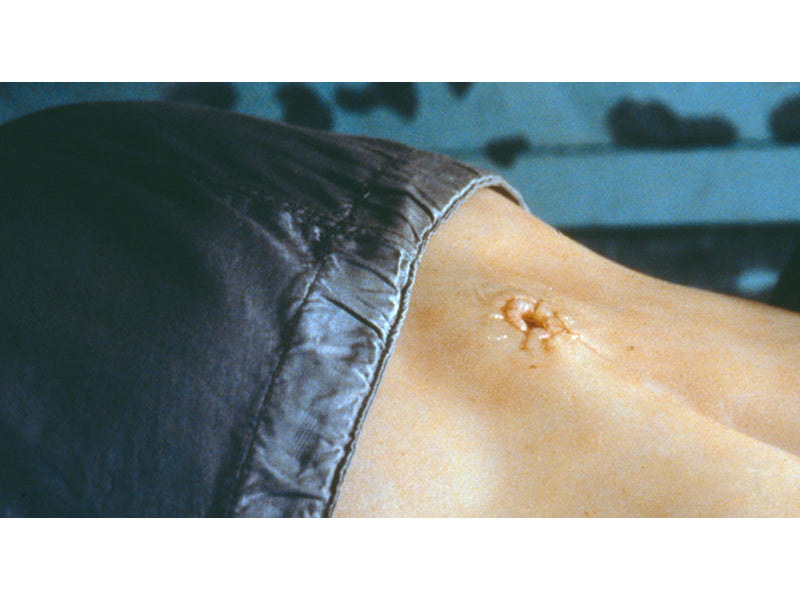
Bioport, worn by Jude Law
A production photograph records the appliance on the actor’s lower back.
On the body, the appliance can disappear into a small incision. The photograph shows the scale of the illusion without exposing all the fabricated material.
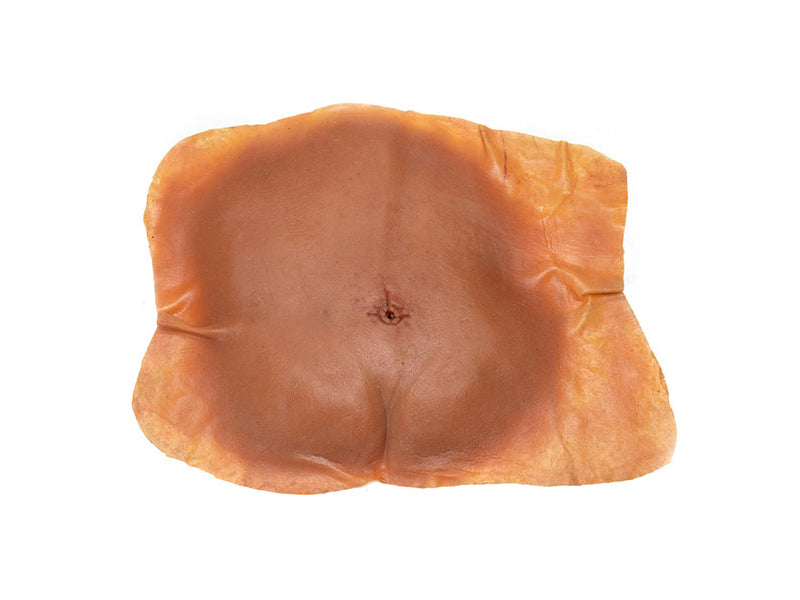
Detached bioport appliance
Stephan Dupuis · silicone, paint and mixed media · 3 × 43 × 35 cm.
Off the body, the surrounding sheet of material becomes visible. Compare the apparent size of the fictional socket with the practical size of the appliance.
AUCTION RECORDS / MATERIAL EVIDENCE
Hardware with a life beyond the set.
Four auction-catalogue photographs reveal the objects’ construction, materials and condition.
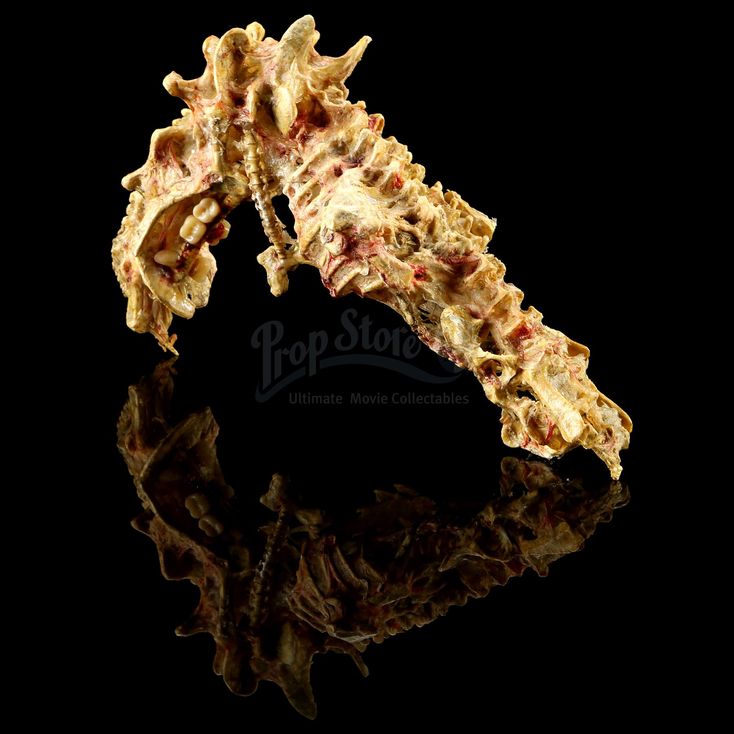
2017 / LOT 131
Bone in the fiction, resin in the catalogue
Propstore catalogues this gun as resin with synthetic skin, measuring 25 × 17 × 9 cm. The photograph exposes the uneven surface, tooth forms and open spaces that make its mechanical outline look anatomical.
The catalogue associates the weapon with the opening attack. Its listed materials describe this surviving prop, while the film gives the gun an entirely organic identity.
S42 · seller’s catalogue and photograph
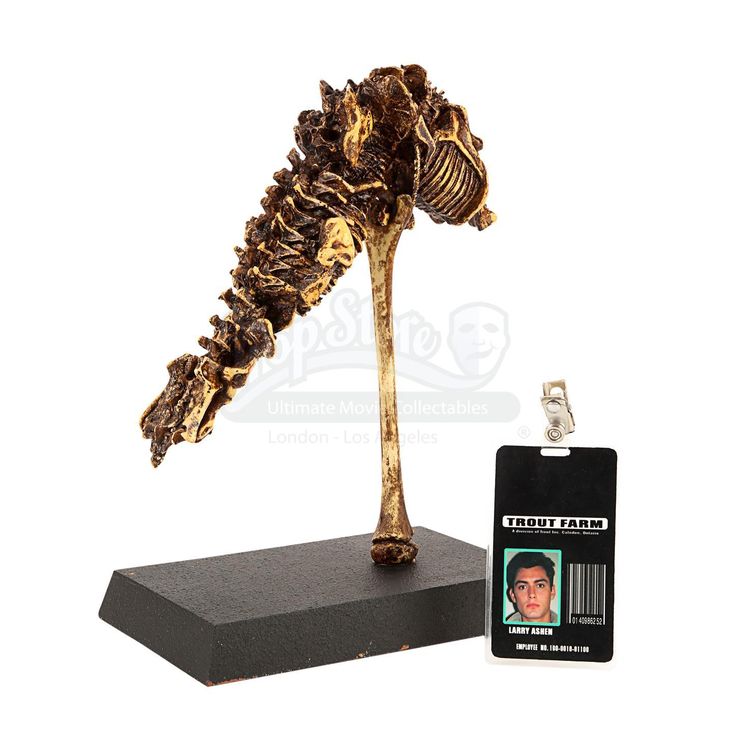
2019 / LOT 269
An employee identity and a static weapon
The photographed Trout Farm pass carries Law’s portrait, the name Larry Ashen, a barcode and an employee number. Propstore describes a laminated card with a metal clip, measuring 13.5 × 6.5 × 1 cm.
The accompanying pistol is catalogued as painted resin with no moving parts. Its display dimensions include the mount. The badge’s flat administrative order sits beside the gun’s irregular anatomy: two very different ways of making the game’s world convincing.
S43 · seller’s catalogue and photograph
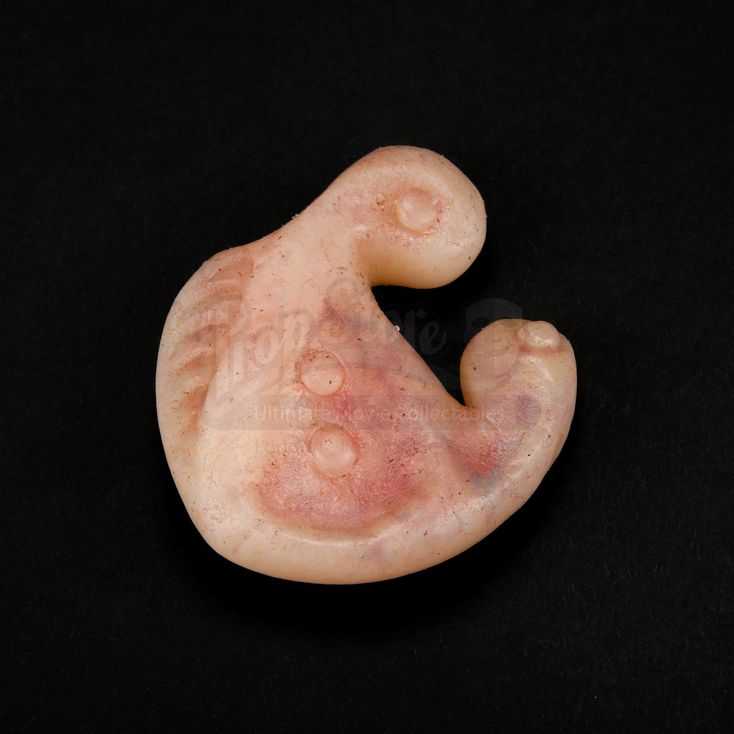
SOLD ARCHIVE / STOCK 75219
The Micro-Pod outside its packaging
Propstore identifies this small fleshy object as a silicone Micro-Pod. Its rounded lobes, open centre and shallow circular pads give the miniature device a different silhouette from the larger console.
The seller records a sticky surface with attached fibres and dust. The catalogue therefore preserves two histories at once: the prop’s intended flesh-like finish and the later condition of its material.
S46 · seller’s catalogue and photograph
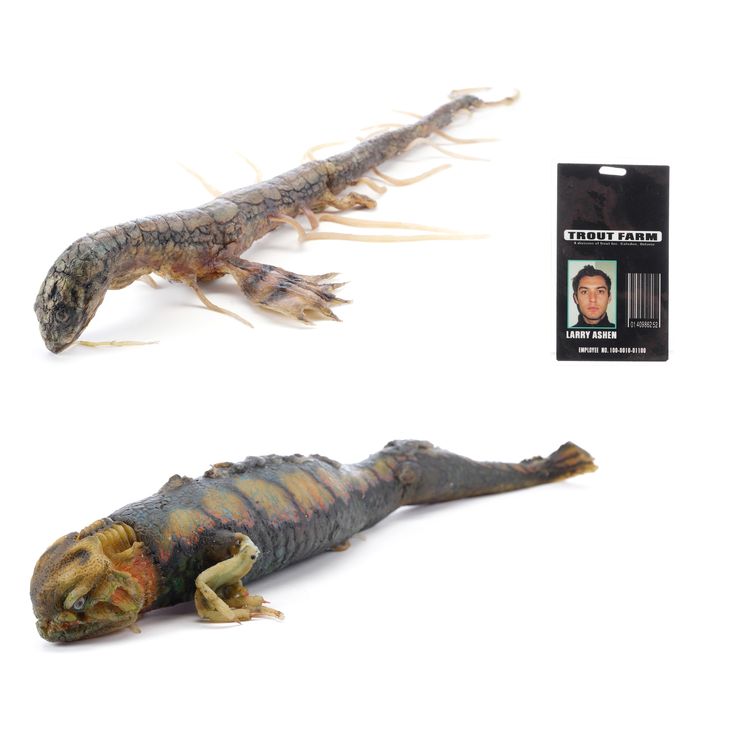
2022 AUCTION / LOT 887
Two creatures from the processing floor
The group photograph pairs an elongated, many-legged creature with a shorter, broad-bodied fish. Their fins, limbs and mottled surfaces make the farm’s stock look cultivated and anatomically unstable.
Propstore lists silicone, foam latex and plastic among the puppet materials, with a nonworking battery pack inside the larger fish. The pass, pod and cord were offered in the same sale lot.
S47 · seller’s catalogue and photograph
07 / FIELD NOTES
Four ways to sell an uncertain world.
Three original campaign designs and a later restoration sheet. Compare their images and promises; open each to inspect its lettering and credits.
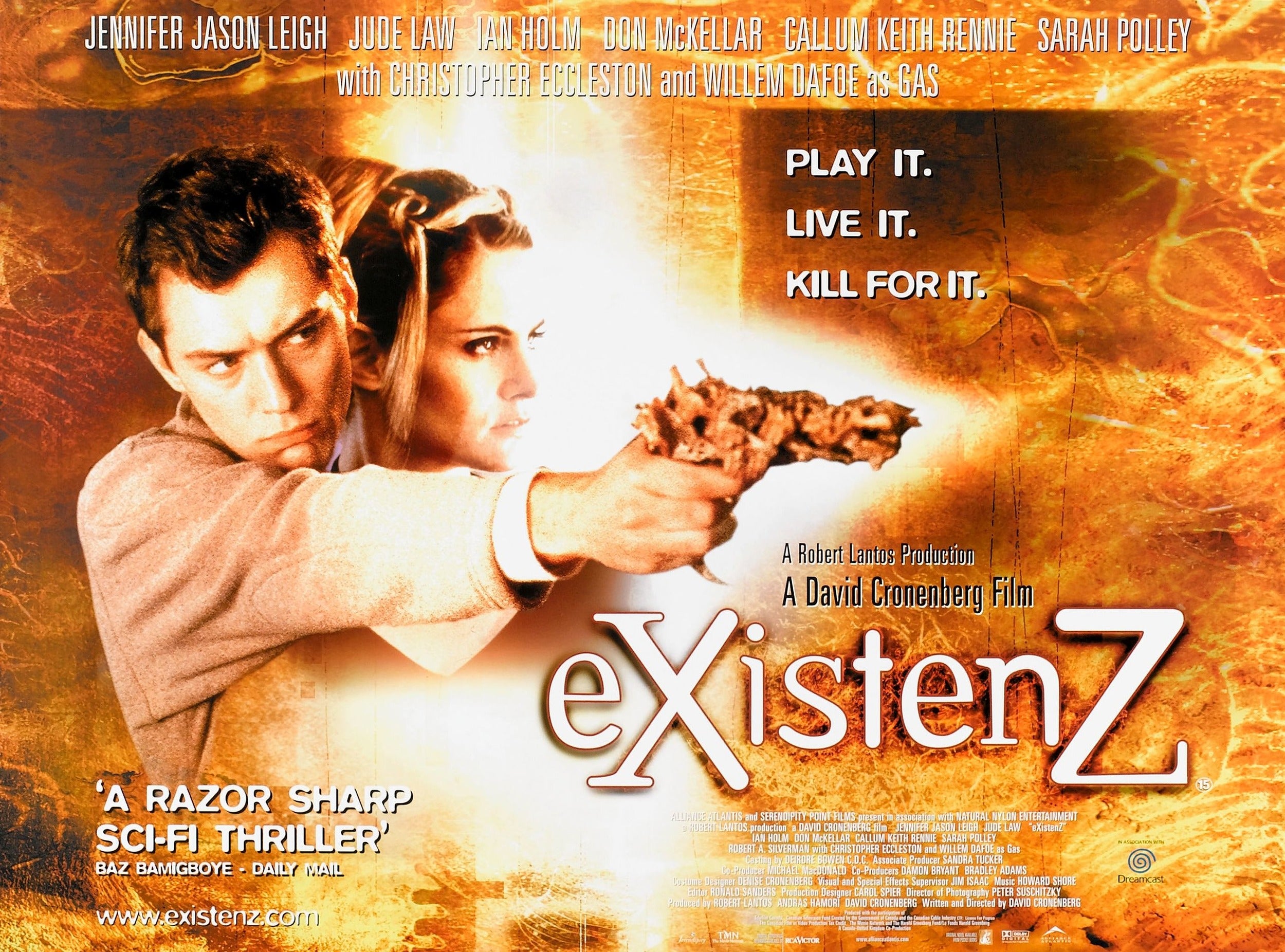
CAMPAIGN / 01
A thriller built around the weapon
On the sheet
Jude Law’s extended arm and the gristle gun dominate a scorched orange field. Jennifer Jason Leigh is placed behind him; the soft device becomes the sharp direction of the composition. A review line, a 15 badge and a Dreamcast mark sit among the sales information.
A reading
The design turns a hesitant player into the film’s action image. Its hot palette echoes the worked surface of the opening titles.
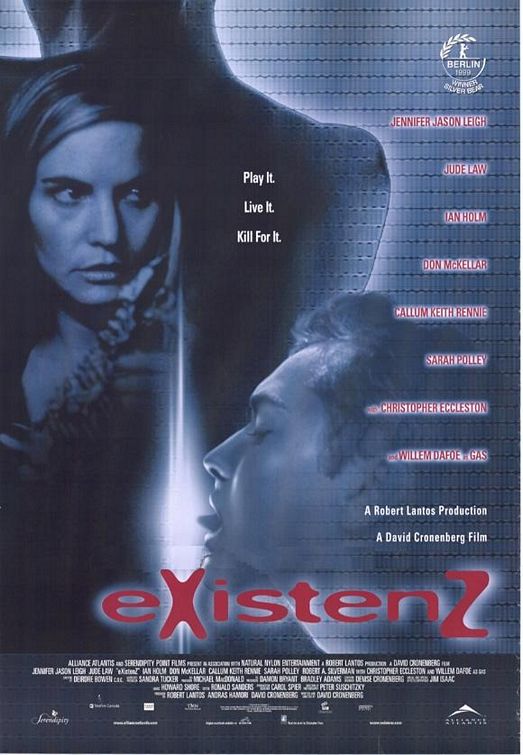
CAMPAIGN / 02
Bodies, faces and a cold surface
On the sheet
A torso, Leigh’s face and Law’s tilted profile are layered in blue. A repeated grid covers the surface. The red title interrupts that cool field, while the cast list and Berlin festival emblem supply a separate line of credentials.
A reading
The body is the environment here. Compared with the landscape’s forward-pointing weapon, this design sells contact, sensuality and uncertainty. The shared three-part play/live/kill slogan can support very different images.
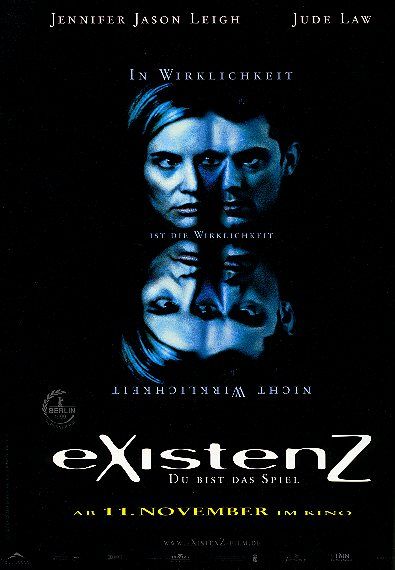
CAMPAIGN / 03
The same faces, turned against themselves
On the sheet
Two blue faces are repeated upside down against black. The German copy is divided around the mirrored heads; the white title and yellow cinema-date line are kept below. The composition gives the image a second orientation before a viewer enters the film.
A reading
Doubling becomes the campaign’s subject. Unlike the action-led landscape, this design offers no setting or visible game hardware: recognition itself becomes unstable. Language and printed marks are observable; a complete territory-distribution history still needs campaign records.
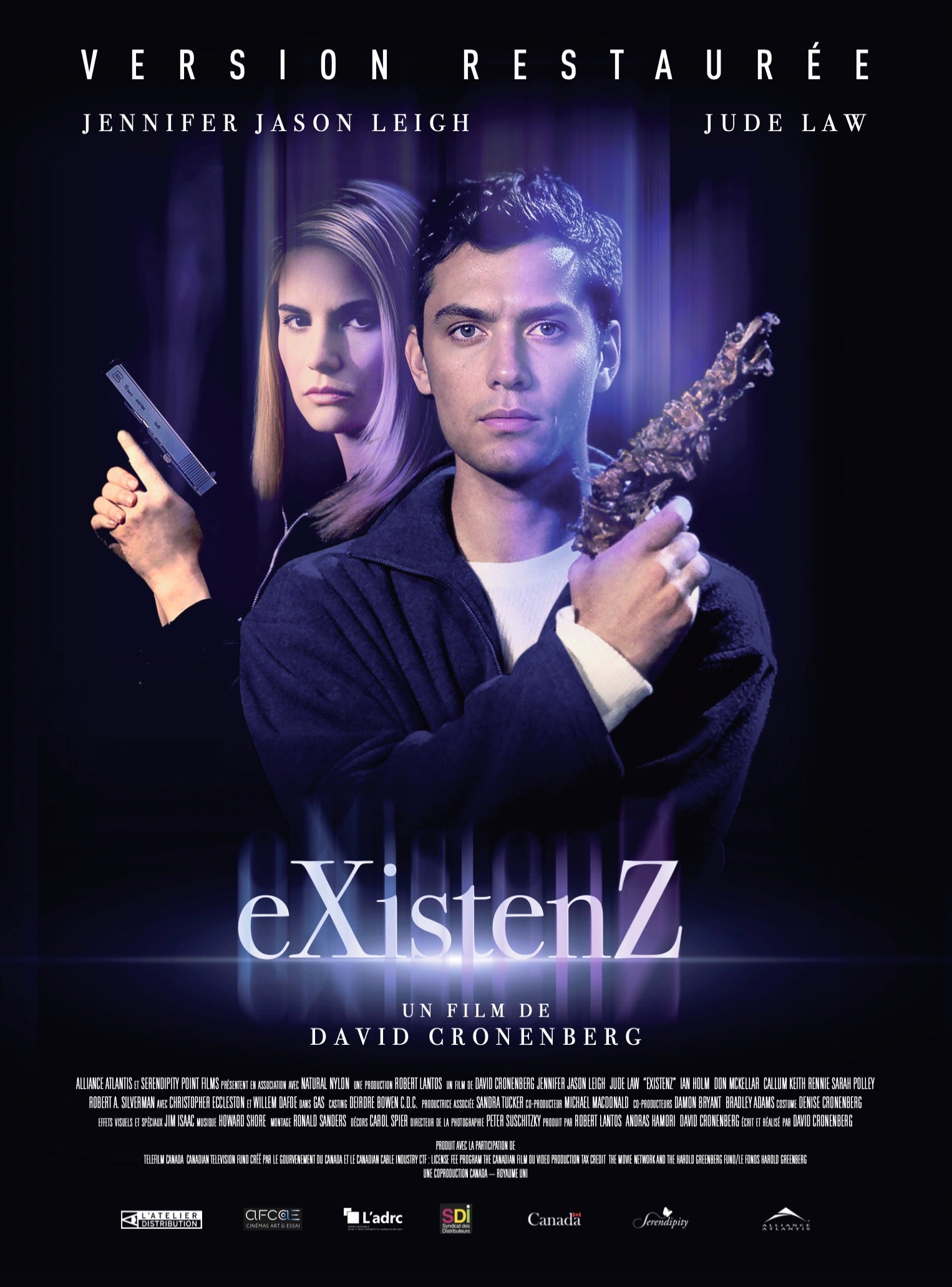
CAMPAIGN / 04
Two weapons, one restored film
On the sheet
Law faces forward with the gristle gun; Leigh stands behind with a conventional pistol. Vertical violet light binds the two portraits. The restoration announcement occupies the top line, while the distributor and partner marks form a band below the billing block.
A reading
The pair now look directly out of the poster. The two guns compress the film’s changes of material and narrative frame into one image, while the restoration line offers a new reason to return to a familiar title.
Original campaign reproductions: IMP Awards. French reissue artwork: L’Atelier Distribution. These are studies of supplied images; physical objects in the CRONENDROME collection are catalogued in the Museum.
08 / FIELD NOTES
The film has an afterlife, too.
Follow the release through contemporary responses, classification records, restoration, adaptation and the editions that preserve its production history.
CRITICAL RECEPTION / 1999
Four responses. A revealing disagreement.
The film’s humour, unstable performances and shifting rules divided these critics. Their individual arguments preserve more of that disagreement than a combined rating can.
Amy Taubin
The Village Voice · 20 April 1999
Play is part of the argument.
Taubin’s response connects the film’s comic energy to authorship and bodily technology. Allegra’s position as a female creator matters to that reading: the game becomes a way to think about who makes an experience and who is asked to enter it.
Roger Ebert
23 April 1999
The ordinary makes the strange stronger.
Ebert welcomes the film’s imagination and its intimate mixture of biological and manufactured things. He notices the provincial surroundings and the visual tension between flattened foregrounds and receding backgrounds. For him, uncertainty works through composition as well as through the plot.
Kevin Jackson
Sight and Sound · May 1999
Pleasure can soften the disturbance.
Jackson finds considerable playfulness and entertainment while questioning how deeply the film unsettles its audience. His response makes an illuminating counterpoint to Taubin: the same comic invitation can be understood as an intellectual strength or as a limit on the film’s force.
James Berardinelli
ReelViews · 1999
A world that does not sustain belief.
Berardinelli praises the set design and Leigh, but finds the narrative unengaging, Law an insufficiently compelling lead and a late twist too easy to anticipate. His objection exposes a basic demand the film places on a viewer: accepting unstable characters as a source of interest.
SOURCE COMPARISONS
Similar records can tell different stories.
Read each claim beside its source: a draft passage, a line of dialogue, a classification entry or a printed credit. The differences establish what each record can tell us.
CHECK / 01
The pink-fone call becomes shorter.
- 1996 draft excerpt
- The indexed call has Pikul explain the attack. Afterwards he identifies Alex Kindred at Antenna headquarters and reports a five-million-dollar bounty.
- Released dialogue
- The transcription reduces the call to a few words before the phone is discarded. The dispute turns immediately to whether the device offers help or lets someone locate them.
The compression makes the early escape less explanatory. This comparison concerns the call and its surrounding dialogue; the draft’s material description remains evidence of a proposed prop.
CHECK / 02
Joel becomes Noel.
- Fourth-draft admission scene
- The indexed 1996 passage names the arriving fan Joel Dichter, both on his invitation and in Pikul’s dialogue.
- Released dialogue
- Pikul checks the name Noel Dichter. The visitor still brings an obsolete Marway pod and passes through a security conversation about recording devices.
The admission scene survives with a changed first name. This small discrepancy makes the draft and the released dialogue separately identifiable records.
CHECK / 03
A running time needs a timebase.
- Cinema submission
- The BBFC records 96 minutes 51 seconds for the March 1999 cinema submission.
- Home-video submissions
- Later entries run 92 minutes 59 seconds. Playing 96:51 at 25 frames per second instead of 24 produces approximately 92:59.
The duration difference is consistent with playback-speed variation.
CHECK / 04
The restoration names its source element.
- Restoration record
- Vinegar Syndrome specifies a new 4K restoration from a 35mm interpositive, with a 1.85:1 presentation.
- Catalogue wording
- “Interpositive” identifies the film element used. “Original camera negative” would identify a different element and would change the claim.
The interpositive credit locates this restoration within the film’s material history. It identifies the generation of the surviving image used for the new master.
CHECK / 05
Two author names belong to one novelist.
- The book credit
- The HarperEntertainment edition identifies John Luther Novak; bibliographic records also associate the work with Christopher Priest.
- The author’s account
- Priest explains that Novak was his pseudonym for this commission. Some overseas publishers used his established name.
The two names are publication credits used by the same novelist.
CHECK / 06
A corporate name travels across media.
- Photographed graphics
- Antenna’s badge and Cortical’s Micro-Pod package give their companies visible marks, typography and commercial roles.
- Soundtrack vocabulary
- Shore’s official track list carries Antenna, Pilgrimage, Marway and UmbyCord into the album’s printed naming system.
The album preserves a vocabulary; the photographed graphics preserve a particular design. Each object answers a different catalogue question.
1999: a release beside another reality film
AFI records the Los Angeles opening on 23 April 1999. TIFF places the North American release shortly after The Matrix and traces markedly different responses across territories.
Quebec: trailers before the feature
The official register records one-minute English and French trailers in June and September 1998, then two-minute trailers in March 1999. The English feature was classified on 20 April 1999 and the French version the next day, both on 35mm. The feature’s recorded classification is 13+ with a violence notice; the English record identifies a distributor-requested revision.
The design survives beyond the projection
A surviving pod, a conservation replica, a home-video edition and an artist’s screen print have different relationships to the film. The Museum makes those relationships legible through object labels rather than putting every image into the same category.
France: the film returns in 2024
L’Atelier’s page dates the French theatrical return to 3 July 2024. Its supplied poster announces a restored version and places conventional and organic weapons side by side. This belongs to the film’s later circulation, separate from the three 1999 campaign images above.
Trailers can vary within a territory
Mondo Digital reports that the Alliance DVD’s French-language Canadian trailer uses different cutting and music from its English counterpart. Language variants deserve their own records: sharing a territory and feature does not make two promotional edits interchangeable.
S36 · reviewer’s comparison
EDITION GUIDE
Different editions preserve different conversations.
Distributors’ inventories and a specialist disc review trace the interviews, commentaries and written material carried by each edition.
Vinegar Syndrome · VS-454
4K UHD + Region A Blu-ray; 1.85:1; English 5.1 / 2.0.
Creator commentaries: Cronenberg, Suschitzky and Isaac. Interviews: Deverell, Dupuis, Lantos and Pilichowski; Spier featurette; archival EPK.
101 Films · Black Label 002
Region B Blu-ray and Region 2 DVD; listed runtimes 97 / 93 minutes.
Cronenberg commentary; separate critic tracks; Eccleston interview; making-of, effects and promotional material.
101 Films · limited-edition book
The booklet is a separate part of the edition.
Phillip Escott’s Denise Cronenberg interview and Alex Morris’s essay. Its costume testimony should be read alongside the image studies.
Alliance / Momentum · 2001 DVDs
Canadian and British special editions.
Mondo Digital traces the three creator commentaries to these editions. The early U.S. Buena Vista DVD instead offered a trailer as its sole extra.
Turbine · 2017 mediabook
German Blu-ray / DVD edition.
The disc review records the return of all three creator commentaries alongside the Spier documentary, effects material and promotional interviews.
09 / FIELD NOTES
Follow the source trail.
Frame collections, creator interviews, contemporary reporting and institutional records. Each entry identifies the kind of evidence and the material examined.
S01 / Visual sourceSelected film frames
eXistenZ (1999), frame collection at FilmGrab
Selected frames inspected at their supplied resolution. Frame numbers in this dossier identify gallery files, not film timecodes. Captions distinguish visible detail from interpretation.
Open source ↗S02 / Director interviewThe artist before the game
David Cronenberg interviewed by Alan E. Rapp, Salon, 29 April 1999
Questions on Rushdie, entering the game, technology, and the removal of everyday visual detail.
Open source ↗S03 / Period interviewGame Boy
Chris Rodley, Sight and Sound, April 1999; reprinted by eNotes
Cronenberg on development at MGM, changing the protagonist, and the design of a future without familiar science-fiction furniture.
Open source ↗S04 / Period interviewThe film director as philosopher
Richard Porton with David Cronenberg, Cineaste 24.4 (1999), pp. 4–9; reprinted by eNotes
Locators: questions on Philip K. Dick, accents, the restaurant performance, Suschitzky, and the title. The interview identifies the Perky Pat’s reference.
Open source ↗S05 / Period interviewAnd then I woke up
Sean Axmaker interviews David Cronenberg, Nitrate Online, 1999
Development chronology: the project was written before Crash and initially set up at MGM. This is recollection, not a dated production ledger.
Open source ↗S06 / Period interview and criticismHe got game
Amy Taubin, The Village Voice, 20 April 1999
A contemporary discussion of authorship, the female artist, and technology as an extension of the body.
Open source ↗S07 / Primary craft testimonyGristle gun: the restaurant effects
TIFF, David Cronenberg: Virtual Exhibition, 2:50
Caption transcript reviewed. 0:59–1:44: ear appliances; 1:51–2:44: face appliance and protective layer. The clip names Bob Hall as a collaborator.
Open source ↗S08 / Institutional treatment recordThe pod after the film
Canadian Conservation Institute, Annual Review 2013–2014
Section: “Treatment of David Cronenberg Film Props and Accessories From His Films The Fly and eXistenZ.” Documents material deterioration, treatment, and a conservation replica.
Open source ↗S09 / Published object captionsSurviving objects in photographs
Jillian Moore, “Fun and Games,” Art Jewelry Forum, 21 October 2015
Collection credits and measurements identify the photographed objects. TIFF collection photographs and Ava V. Gerlitz’s production photograph are credited individually.
Open source ↗S10 / Event reportDesigning with character
Liselotte Doeswijk, report of Carol Spier’s IFFR conversation, 1 February 2012
An attendee’s account of Spier discussing dental instruments, bone forms, and the relationship between design and lighting. Distinct from a verbatim interview transcript.
Open source ↗S11 / Composer interviewShore’s working method
Howard Shore in conversation with Philip Brophy, Cinesonic; talk 1998, published 1999
Questions on collaboration and composing from the director’s cut. Shore describes visiting the Toronto production.
Open source ↗S12 / Composer discographyThe soundtrack as a vocabulary
Howard Shore, official eXistenZ discography
Official track listing. Album titles are not automatically the same as names printed on screen.
Open source ↗S13 / Reproduced composer statementOrchestral perspective
“The Theremin in eXistenZ,” Theremin.info
Credits Lydia Kavina’s theremin performance and reproduces Shore’s account of the orchestral balance.
Open source ↗S14 / Institutional catalogueCredits and U.S. opening
American Film Institute, eXistenZ, catalogue entry 61144
Cast, principal crew, companies, rating, and April 1999 opening data. AFI identifies this as a title outside its fully researched 1893–1993 catalogue.
Open source ↗S15 / Institutional film essayCanadian context
Andrew McIntosh, Canadian Film Encyclopedia, TIFF
Narrative overview, awards, and contemporary release context. Credit hierarchies differ from AFI’s listing; principal producer credits here follow AFI.
Open source ↗S16 / Classification recordClassification and running times
British Board of Film Classification, eXistenZ
Separate cinema and home-video submissions. Runtime differences require a timebase check before they can support a claim of cuts.
Open source ↗S17 / Distributor specificationsRestoration and supplement map
Vinegar Syndrome, eXistenZ, VS-454
4K interpositive restoration, presentation specifications and supplement guide.
Open source ↗S18 / Period criticismA divided contemporary response
Kevin Jackson, Sight and Sound, May 1999; reprinted by eNotes
Praises the film’s playfulness while questioning the force of its philosophical unease. Read alongside Taubin, not as a consensus.
Open source ↗S19 / Bibliographic recordThe novelization as a separate object
Open Library, eXistenZ, 1999, OL24518639M
HarperEntertainment edition, ISBN 0-06-102027-3. Catalogues Christopher Priest and John Luther Novak. Bibliographic evidence, not a completed text comparison.
Open source ↗S20 / Screenplay access pointThe fourth-draft lead
David Cronenberg, eXistenZ, Fourth Draft, 1 October 1996
Indexed passages inspected: the dated opening, Dichter’s admission and the pink-fone call. The complete PDF was unavailable; the comparison identifies the particular excerpts used.
Open source ↗S21 / Author interviewThe novelizer’s account
Christopher Priest interviewed by Thomas Van Parys, Lien Jansen and Elisabeth Vanhoutte, Image & Narrative 9, October 2004; interview May 2004
Reviewed: commission, pseudonym and revisions. Retrospective testimony; not a comparison of the complete novel.
Open source ↗S22 / Campaign imagesThree theatrical designs
eXistenZ poster gallery, IMP Awards: versions 1–3
Three supplied poster images inspected. Gallery numbering is an access locator, not a release sequence. No designer attribution or physical sheet dimensions are established by these files.
Open source ↗S23 / Period director interviewThe project was already written in 1997
Gavin Smith interviews David Cronenberg, Film Comment, March–April 1997
The closing exchange identifies eXistenZ as an already-written science-fiction project and a possible next film.
Open source ↗S24 / Production recordThe Ontario production ledger
Shot in Ontario 1998; Ontario Creates archive, PDF page 2
The eXistenZ entry gives April–June shooting dates. Page inspected visually. Its administrative credit list is retained as a distinct record, not substituted for screen credits.
Open source ↗S25 / Period news reportThe casting announcement reaches the games press
Micheal Mullen, “Jennifer Jason Leigh as Game Maker?”, GameSpot, 13 April 1998; archived copy
Reports Alliance Communications’ casting announcement. Its suggestion of an actual game tie-in is speculation, not an announcement of a released product.
Open source ↗S26 / Period director testimonyActors, philosophy and projected selves
Alan Jones, “eXistenZ,” Cinefantastique 31.5, May 1999, p. 7
Article reviewed through the archive’s OCR. Cronenberg discusses entering the game, preparation for the actors and accents as expressions of a projected self.
Open source ↗S27 / Period director interviewPod Man Out
Richard von Busack interviews David Cronenberg, Metro, 22–28 April 1999
Games played by the director, MGM’s development response and a proposed camera effect that he declined.
Open source ↗S28 / Period director interviewMetaphor, spectators and earlier films
Rob Blackwelder, SPLICEDwire interview, 14 April 1999, San Francisco
Sexual metaphor, audience participation and the connection to Videodrome. Similar remarks in other interviews from this press visit are not independent corroboration.
Open source ↗S29 / Classification recordQuebec’s dated release trail
Répertoire du cinéma québécois, eXistenZ, film 128171
Separate trailer and feature submissions, with language, format and classification dates. Includes a distributor-requested revision.
Open source ↗S30 / Distributor inventoryThe British collector edition
101 Films, eXistenZ, Black Label 002, limited edition
Edition specifications and supplement guide.
Open source ↗S31 / Distributor page and artworkThe French restoration campaign
L’Atelier Distribution, eXistenZ, theatrical return 3 July 2024
Official film page and supplied poster inspected. This is the 2024 reissue campaign; the unavailable earlier press-PDF link is not treated as a reviewed pressbook.
Open source ↗S32 / Dialogue referenceThe dialogue’s changing assignments
eXistenZ, released-film dialogue transcription, Springfield! Springfield!
Used to check role changes and repeated cues. This is an unofficial dialogue transcription, not Cronenberg’s production screenplay or a timecoded edition.
Open source ↗S33 / Design studyTransforming locations into a designed world
Christopher Daniel Walker, “Production Design – Carol Spier,” 26 February 2016
Walker’s account of the church exterior, stage interior and reused ski-lodge spaces, including discussion of The Secret World of Carol Spier.
Open source ↗S34 / Published glossary and production notesThe French publicity vocabulary
AlloCiné, eXistenZ, “Petit lexique…” and “Les effets spéciaux”
French-language production publicity describing the fictional biological equipment and effects team. Related Film Scouts production notes: S41, S44 and S45.
Open source ↗S35 / Design creditThe opening-title designer
Watch the Titles, Rob Pilichowski, designer profile
The profile identifies Pilichowski’s work on the opening sequence. The surface analysis here is an original reading of frame 001.
Open source ↗S36 / Disc reviewThe supplements across editions
Mondo Digital, eXistenZ, review updated 2 February 2024
Used for the early DVD lineage, Canadian trailer variants and its account of Pilichowski’s interview. These are the reviewer’s observations; full recordings remain separate research objects.
Open source ↗S37 / Cinematographer interviewA look built from the film
Jon Fauer interviews Peter Suschitzky, Film and Digital Times, 16 May 2016
Questions on preparation, the evolving look and collaboration with Cronenberg. This retrospective describes his general method; equipment discussed for other productions is not assigned to eXistenZ.
Open source ↗S38 / Period criticismAn enthusiastic American response
Roger Ebert, eXistenZ, 23 April 1999
Read for the contrast between ordinary surroundings and organic technology, and the review’s attention to unsettling composition.
Open source ↗S39 / Period criticismThe game fails to persuade
James Berardinelli, eXistenZ, ReelViews, 1999
Read for objections to narrative involvement, the ending and performances, alongside praise for Leigh and the set design.
Open source ↗S40 / Later critical studyThe corporation as another body
Meike Robaard, “Cyborg Incorporated: Mechanics, Aesthetics, and Cyborg Narrativity in David Cronenberg’s Videodrome and eXistenZ,” LLIDS 3.2, Winter 2019, pp. 18–45
Selected discussion inspected, especially printed p. 33 (PDF page 16), on corporations as collective bodies. This is a named critical interpretation, distinct from production testimony.
Open source ↗S41 / Production publicity / maker testimonyGiving the pod a temperament
eXistenZ: Special Effects, production notes hosted by Film Scouts, undated
Complete web text inspected. The publicity identifies Isaac as special-effects supervisor, Lepkowsky as creature-effects supervisor and Dupuis as makeup-effects designer. Maker testimony and Toybox’s digital contribution are presented within that publicity account.
Open source ↗S42 / Auction object recordOrganic Bone Gun
Propstore, Entertainment Memorabilia Live Auction 2017, lot 131 / stock 71970
Catalogue description and supplied photograph inspected. Materials, dimensions and production attribution follow the seller’s record.
Open source ↗S43 / Auction object recordTed Pikul’s ID badge and bone pistol
Propstore, Entertainment Memorabilia Live Auction London 2019, lot 269 / stock 107255
Catalogue description and supplied photograph inspected. The badge and static pistol are documented as one sale lot; the photograph preserves their different scales.
Open source ↗S44 / Production publicity / design testimonyMaking an unplaceable present
eXistenZ: Behind the Scenes, production notes hosted by Film Scouts, undated
Complete web text inspected. Spier discusses settings and the chalet move; Denise Cronenberg explains the costume approach.
Open source ↗S45 / Production publicity / director testimonyThe game made physical
eXistenZ: Background, production notes hosted by Film Scouts, undated
Complete web text inspected. Used for Cronenberg’s explanation of the bodily interface and the player’s relationship to the game.
Open source ↗S46 / Prop catalogueHero Micro Pod
Propstore, sold archive, stock 75219; sale recorded 7 October 2019
Description and supplied photograph inspected. Silicone material and condition follow the seller’s account.
Open source ↗S47 / Auction object recordThe trout farm’s surviving creatures
Propstore, London 2022 auction, lot 887 / stock 147795
Description, group photograph and selected gallery views inspected. The lot combines a pod, cord, pass and two puppets. Sale-lot measurements are not individual creature dimensions.
Open source ↗About this edition and its evidence
Film Scouts preserves the effects, design and background production notes. The library also brings together interviews, institutional conservation records and auction catalogues.
Visual records distinguish observation from interpretation. Frame numbers locate selected images, not timecodes. Reprinted sources name both the original publication and the access copy; edition listings describe contents without implying a completed review of them.
Explore the October 1996 fourth-draft excerpts, Priest’s account of the novelization, edition guides, film frames and credited object photographs. The Museum’s artist edition has its own catalogue record.