Performance → camera → composite
Follow the acting, the repeatable camera move, the on-set preview and the finished optical construction as separate parts of the same scene.

Two lives inside one practice.
One identity coming apart.
Enter the Mantle clinic through its rooms, costumes, instruments and images. Follow a prop from drawing to display, examine the performance that makes two brothers from one actor, and trace the film into posters, criticism and music editions.
Find a person, technique, object, source or accession number. Choose a result to open its collection and detailed record.
Catalogue entries identify recorded documents and objects; their source notes distinguish metadata from inspected images. FilmGrab numbers identify gallery images, not film timecodes.
Follow the acting, the repeatable camera move, the on-set preview and the finished optical construction as separate parts of the same scene.
Compare the reproduced drawings, the surviving group and the film arrangements. Use the catalogue register to locate additional sheets without assuming each sheet matches a pictured tool.
Move between the actor’s preparation, the red clothing on screen and the construction details recorded for a surviving ensemble.
Read the finished spaces alongside their paper trail. Catalogue identities keep the clinic plans, the theatre concept and the separate trophy record distinct.
The development account draws on production histories and interviews. The complete screenplay and Twins novel have not been read for this dossier; a full adaptation comparison remains a separate study.
Beverly and Elliot Mantle share a profession, an apartment and an ability to pass for one another. Claire Niveau enters their practice as a patient and exposes the harm inside that arrangement. The drama turns on the difference between being close to another person and treating that person’s experiences as your own.

Cronenberg and Norman Snider’s screenplay draws on Bari Wood and Jack Geasland’s novel Twins, with the Marcus brothers’ lives as an earlier point of departure. Cronenberg told Bette Gordon that the real story supplied a premise from which he could invent. The Mantles belong to that fiction; their actions and surgical ending cannot be read back into the historical case.
Sources: Criterion: film and edition record · AFI Catalog: production history and credits · Cronenberg in conversation with Bette GordonDon Shay’s contemporary report traces the writing through two early Snider drafts, followed years later by Cronenberg’s substantial rewrite and revisions. The project’s development therefore involved changes in authorship as well as financing.
Sources: Don Shay: Double VisionAFI traces the project from an option in 1980 to interrupted financing. De Laurentiis Entertainment Group withdrew during 1987 pre-production, when Carol Spier’s sets were nearly finished. Cronenberg later recalled renting those rooms for commercials and events to preserve them while new financing was assembled; rebuilding would have made a restart more expensive.
Sources: AFI Catalog: production history and credits · Cronenberg: The Directors — Take FourCronenberg explained in 2003 that Mark Irwin was unavailable when the delayed film proceeded. He had admired Peter Suschitzky’s photography in It Happened Here and The Empire Strikes Back; their meeting in England began a new collaboration.
Sources: Cronenberg on choosing SuschitzkyThe title changed after a dispute with Universal over its competing Twins. The early title board preserves that earlier name, making the change visible in a surviving design object.
Sources: AFI Catalog: production history and credits · TIFF / Volumina: David Cronenberg: EvolutionThe anatomical model gives the young brothers a body they can open and examine together. Before the clinic or the instruments, their curiosity already takes the form of a shared object on a table. Follow the production and release chronology ↗

The twins control access to one another. Their patients, lovers, colleagues and collaborators gradually encounter the limits of that arrangement. This guide keeps the people distinct while following the roles they occupy in the film.
Scroll sideways to read all columns. Keyboard: focus the table, then use the arrow keys.
| Character | Performer | Relationship |
|---|---|---|
| Beverly Mantle | Jeremy Irons | His attachment to Claire unsettles the brothers’ shared life. |
| Elliot Mantle | Jeremy Irons | The more socially assured brother; manages the pair’s shared identity. |
| Claire Niveau | Geneviève Bujold | Actress and patient; discovers the brothers’ substitution. |
| Anders Wolleck | Stephen Lack | Artist associated with the instruments’ gallery presentation. |
| Cary | Heidi von Palleske | Elliot’s girlfriend. |
| Danuta | Barbara Gordon | Clinic receptionist. |
| Laura | Shirley Douglas | Claire’s friend. |
| Leo | Nick Nichols | Claire’s husband. |
| Birchall | Damir Andrei | Claire’s secretary. |
| Arlene | Lynne Cormack | Patient. |
| Mrs. Bookman | Miriam Newhouse | Patient. |
Jonathan and Nicholas Haley play Beverly and Elliot at nine. Jacqueline and Jillian Hennessy are credited as the escort twins. The adult Mantles’ doubling uses two separate jobs: John Bayliss as performance double and Graham Evans as picture double.
Sources: AFI Catalog: production history and creditsThe ethical fracture begins before the spectacular instruments. A person consents to an encounter with one man while the brothers privately treat identity as transferable. Claire’s discovery puts a name to that injury. Her perspective also gives the story an outside position: the relationship the twins experience as complete can look very different to somebody drawn into it.
At the 2013 TIFF discussion, Cronenberg explained why the profession could not simply be replaced by a more comfortable subject. Gynecology placed the brothers’ authority over women’s bodies and sexuality inside the story’s central relationship. The medical setting is therefore a source of power, as well as the environment in which the breakdown becomes visible.
Sources: Cronenberg and Irons at TIFF, 2013Cronenberg also described twinship as power turning into vulnerability. The pleasure of exchanging identities gives way to confusion and responsibility for another person’s actions. The brothers’ resemblance becomes a relationship neither can fully control.
Sources: Cronenberg in conversation with Bette GordonIn the vintage production featurette, Cronenberg explains his choice of Geneviève Bujold through the complexity she could bring to Claire. He wanted a performance with depth and unexpected line readings, avoiding a polished shorthand for a movie actress. The casting intention places Claire’s individuality beside the brothers’ struggle to become separate people.
Sources: Vintage production featuretteFollow performance through the composite ↗

Irons located Elliot’s energy in the forehead and Beverly’s in the throat, allowing posture, gaze and voice to change from within. When one brother impersonated the other, he kept the first character’s impulse beneath the second’s mannerisms. Cronenberg’s 1988 interview with Tim Lucas likewise rejects a simple good-twin/evil-twin division: the dependence between distinct people supplies the tragedy.
Sources: Jeremy Irons with Terry Gross · David Cronenberg with Tim Lucas, 1988Cronenberg’s preparation for Irons included gynaecology, Leslie Fiedler’s Freaks and a biography of Chang and Eng. Irons later recalled a Canadian camera test that eased his fear of technology overwhelming the acting, followed by separate wardrobe-shopping days and a deliberate reduction of the visible differences. His dressing-room recollection differs from Cronenberg’s; both accounts are retained in the source-history chapter.
Sources: David Cronenberg with Tim Lucas, 1988 · Jeremy Irons: A Life in Pictures
Balsmeyer’s compact system recorded the existing crew’s dolly, focus and camera movements for repetition. Irons could complete one side, change character and return for the other. An acting partner supplied eyelines; dialogue playback kept the second performance in time with the first.
Sources: Randy Balsmeyer: titles and twinning · Jeremy Irons with Terry Gross · Cronenberg: The Directors — Take FourScroll sideways to read all columns. Keyboard: focus the table, then use the arrow keys.
| Responsibility | People and process |
|---|---|
| Acting partner | John Bayliss supported rehearsals and eyelines. |
| Dialogue playback | Bryan Day’s earpiece system and Mary Ann Simmons’s switching returned the recorded dialogue to Irons. |
| Video preview | David Woods combined recorded and live performances for on-set review. |
| Film composite | Lee Wilson and John Furniotis at Film Effects oversaw moving, diffused mattes. |
The vintage featurette describes a backward dolly with the brothers walking together. An adjustable video split let the team review their interaction. That immediate preview helped judge the acting; the finished film composite required a separate optical process. Examine the video-assist photograph and compare the final embrace’s photographed elements.
Sources: Vintage production featurette · Don Shay: Double VisionThe technique varied by shot. Suschitzky’s later account includes doubles, split screens and an estimate of four or five motion-control shots. Shay’s contemporary report describes roughly a dozen motion-control scenes and nineteen or twenty twin shots filmed. These differently framed counts remain attributed to their sources; neither is presented as a tally of composites in the released film.
Sources: American Cinematographer: Dead Ringers Wrap Shot · Don Shay: Double VisionGleiberman’s contemporary set report describes Cronenberg directing a bedroom scene through a monitor, guiding Irons and Bujold from a kiss into a frightened awakening. Irons’s later TIFF recollection offers another kind of intervention: when he struggled with Beverly’s emotional collapse, Cronenberg sent the crew away briefly, allowing him to return to the scene and complete it in one take.
Sources: Owen Gleiberman: on the set · Jeremy Irons: TIFF virtual exhibition interviewSuschitzky remembered more extensive coverage on the early Cronenberg films than on their later work. That preparation leaves the finished scene free to appear ordinary. At the apartment bar, the counter, glassware and mirrored background give the brothers a plausible shared space; once that space is established, an eyeline or a cut can sustain the relationship. Follow the scene into the cutting room ↗
Sources: Peter Suschitzky: working with CronenbergFollow the clinic’s paper trail ↗

Carol Spier’s production design gives the Mantles a world of partitions, reflective surfaces and carefully contained light. A glass-block wall admits illumination while breaking up a view; blinds repeat the same promise of access and obstruction. The spaces offer visibility without openness.
The consultation room makes professional knowledge tangible through shelves, papers, a desk and directed task lighting. In the apartment, the television, drinks and lounge furniture sit inside similarly disciplined geometry. Work and private life have different objects but a closely related sense of enclosure.
Claire’s furnished room introduces another register: upholstery, mirrors, lampshades, patterned surfaces and drapery. The materials gather closely around her reclining figure. Compare these furnished interiors with the clinic’s more controlled geometry.
Sources: Dead Ringers: frame collectionChris Rodley’s Criterion essay reads the interiors as an aquarium-like environment for the twins. That critical analogy helps articulate the feeling produced by the glass, cool colour and restricted movement: the characters seem observable while remaining difficult to reach.
Sources: Chris Rodley: Dead RingersSpier’s own account sharpens the design intention. Speaking to Violet Lucca in 2025, she described an uncluttered environment organised around hard lines and emotional coldness. She rejected the suggestion that the set design began as a visual joke about fashionable interiors. The severity was deliberate.
Sources: Carol Spier: the instruments and the roomsThe clinic and apartment were constructed sets. Their enclosed geometry belongs beside the production’s use of real buildings: follow the Toronto locations, including Casa Loma’s transformation into a hotel suite.
Sources: AFI Catalog: production history and credits · Helen Lee: The fantastic reality of twinsCarol Spier’s production work has a substantial paper record. Artefacts Canada indexes fourteen clinic set drawings in diazotype and a separate operating-theatre concept in ink on drafting paper. The accession register connects the photographed rooms to specific documents in the David Cronenberg Collection.
Sources: Artefacts Canada: TIFF collection records
The production places built interiors inside a recognisable Canadian city. AFI records the move from the novel’s New York setting to Toronto and identifies a group of Toronto-area locations. The Mantle clinic and apartment were constructed sets.
Scroll sideways to read all columns. Keyboard: focus the table, then use the arrow keys.
| Place | Production record |
|---|---|
| University of Toronto | Location named in AFI’s production history. |
| Dexterity art gallery | Gallery location named in the production history. |
| Casa Loma | Blue Room dressed as a hotel suite; Helen Lee observed Elliot’s scene with two sisters there. |
| Trinity Square | Toronto location named in the production history. |
| Mississauga Civic Centre | Used to represent Washington, D.C. |
| Mantle clinic and apartment | Purpose-built interiors. |
This is a geography of the production, not a list of interchangeable scene addresses. A real civic building can represent another city; an exterior can establish a world that a studio interior continues. The passage from enclosed rooms to a public stair, a telephone enclosure or a road changes the scale of the story. These screen images can be compared without assigning every interior to the same building.
Helen Lee’s April 1988 set report identifies the Blue Room at Casa Loma as the hotel interior. Two identical sisters prepare a scene with Elliot while Cronenberg and Suschitzky adjust eyelines and blocking. The room’s conversion gives a specific example of the production’s use of Toronto: an existing interior becomes a temporary fictional address.
Sources: Helen Lee: The fantastic reality of twinsFollow drawings, props and screen images ↗

The instrument sequence links invention, prestige, delusion and harm. The Mantle Retractor Award gives a medical tool the status of a trophy. Beverly’s later designs push familiar handles, curves and articulated parts towards forms that seem to imitate anatomy. Their usefulness becomes impossible to separate from the mind proposing it.
The exhibition catalogue identifies nickel-plated brass and burlap among the surviving instrument materials. Its credits distribute the work across Cheryl Camack Grundy (sculptor), David Didur (fabricator), Peter Grundy (first assistant art director), Alicia Keywan (supervising art director) and David Dyder (designer). Peter Grundy is also credited for the ink-on-graph-paper concept drawings.
Sources: TIFF / Volumina: David Cronenberg: EvolutionThe names matter because the instruments are frequently discussed as if a single imagination had made them complete. The objects required drawing, sculptural judgement, fabrication and coordination within the art department. Cronenberg’s conception reached the screen through several distinct kinds of craft.
The catalogue records the Mantle Retractor Award as Carol Spier’s design, made from painted aluminium and acrylic, measuring 29.5 × 38.5 × 24 cm. The material record is more precise than calling it a gold surgical instrument: a trophy’s appearance and construction are different kinds of evidence.
Sources: TIFF / Volumina: David Cronenberg: EvolutionThe displayed objects preserve a tension visible in the film. They are recognisable enough to suggest a controlled action, yet strange enough to make that action threatening. The handgrip implies a user; the unusual working end makes the imagined recipient newly vulnerable.
The contemporary Cinema Canada credits name 2 Gorillas and Standing Metal Works for the radical surgical instruments. They also distinguish Lee Wilson’s optical supervision, Gordon Smith’s special-effects design and Walter Klassen’s mechanical design. These department credits reveal the wider production network around the individually catalogued objects.
Sources: Andrew Dowler: contemporary reviewSpier also describes the research behind the tools: the art department studied medical and dental implements alongside bone and muscle, combining bodily shapes with instrument forms. Sketches then passed to a jewellery maker for development and fabrication. This account explains why the props seem anatomical even before they touch a body.
Sources: Carol Spier: the instruments and the roomsThree kinds of authorship meet here: the fictional Beverly devises an instrument, the film’s art department develops its form, and the surviving museum object carries its own maker record. Wolleck’s gallery is another layer of the fiction. Keeping those roles separate makes the objects more interesting, because their journey can be followed without collapsing every maker into the director.
Discussing the tools with Gordon, Cronenberg held beauty, humour and fear together. Their sculptural forms express Beverly’s state of mind; imagining their contact with flesh changes the viewer’s response. The objects can attract the eye before their proposed use becomes unbearable.
Sources: Cronenberg in conversation with Bette GordonThe collection catalogue separates Peter Grundy’s ink drawings from collage studies combining photostat and graphite on graph paper. The latter preserve a different design medium: existing printed material and handwork occupy the same study. The thirteen paper entries give the development process a record beyond the two reproduced drawings.
Sources: Artefacts Canada: TIFF collection recordsThe material descriptions also need to travel with their sources. Evolution identifies nickel-plated brass and burlap; Artefacts Canada describes its instrument group as cast steel with a burlap tool bag. A metallic appearance cannot settle that difference. The ensemble record retains both descriptions.
Sources: TIFF / Volumina: David Cronenberg: Evolution · Artefacts Canada: instrument-group material record
The effects turn dependence into a physical problem. Three constructions answer different demands: tissue that appears to join the brothers, a sheet that conceals an optical boundary, and a miniature body made for a dream that was removed.
Scroll sideways to read all columns. Keyboard: focus the table, then use the arrow keys.
| Construction | Method and outcome |
|---|---|
| Nightmare connection | Smith recalled proposing concealed girdles so the performers could pull against the connecting tissue. The exposed-body design instead used glued prosthetics, limiting that movement. |
| Final embrace | A fixed sheet preserved the boundary between separate performances. Cinefex documents a fibreglass shell, a picture double and the optical matte. Compare the photographed elements ↗ |
| Deleted parasitic twin | Smith’s later account describes urethane immobilising mechanisms during construction. Cinefex documents a completed shoot and Cronenberg’s subsequent decision to remove the sequence because it did not fit the film. Examine the miniature and false torso ↗ |
The miniature photographs document an effect filmed during production. The nightmare connection and final embrace use different combinations of physical bodies, prosthetics and compositing.
Back to collections ↑Follow clothing and the surviving ensemble ↗

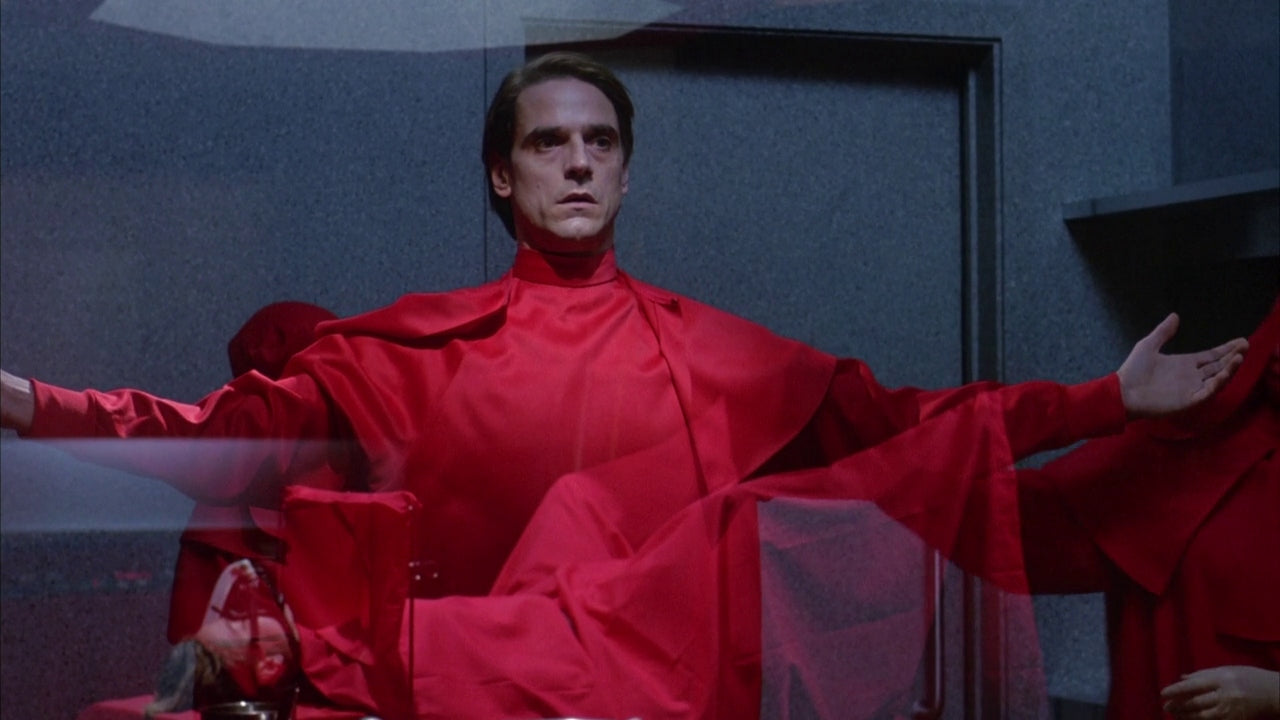
Denise Cronenberg’s costumes make the operating theatre one of the film’s most immediate images. The red is shared across a group, giving the clothes institutional force. Against cool walls and metallic equipment, the gowns turn routine professional activity into a ceremony.
Sources: Criterion: film and edition record · Dead Ringers: frame collectionThe head covering, mask and loose sleeves reduce individual features and gather attention around eyes and hands. Red fabric also covers the work surface. The instruments appear inside a continuous field of colour, so that dress, setting and prop display reinforce one another.
Outside the theatre, the difficulty is subtler. Irons recalled watching early rushes and deciding the brothers were too easy to distinguish. He mixed their clothes to recover the uncertainty the story needed. Costume therefore performs two apparently different tasks: it can announce a professional group, or make an individual identity harder to fix.
Sources: Jeremy Irons: A Life in PicturesThe red casual T-shirt offers a useful counter-image to the surgical gowns. Its soft, everyday shape carries the colour into the twins’ private space. In a still image, the contrast between informal clothing and a suit immediately changes the balance between two otherwise matching faces.
Sources: Dead Ringers: frame collectionCronenberg gave Lucas a specific explanation for the surgical red: Beverly regards medicine as a calling, with the solemnity of religious office. The papal and cardinal associations were intentional. The costume gives that belief a visible form; the brothers’ different attitudes to it deepen their distinction even when they wear the same colour.
Sources: David Cronenberg with Tim Lucas, 1988A 2019 auction catalogue attributes a complete surgical ensemble to Irons as Beverly. It records construction details that the film’s red silhouette conceals:
Scroll sideways to read all columns. Keyboard: focus the table, then use the arrow keys.
| Component | Catalogue description |
|---|---|
| Robe | Floor length; standing collar, knitted cuffs, three rear ties and a Velcro neck fastening. |
| Head and shoulders | Cap with capelet; separate bib secured by a hook and eye. |
| Accessories | Gauze mask and terry-cloth footwear. |
| Labels | Jeremy Irons in the robe; J.I in cap and bib. |

Randy Balsmeyer and Mimi Everett’s title boards arrange anatomical imagery and instruments over red fields. The exhibition catalogue records ink on Mylar mounted on card. One board retains Twins, preserving a design stage before the release title was settled.
Sources: TIFF / Volumina: David Cronenberg: EvolutionThe sequence of boards moves between isolated implements, bodies and crowded arrangements. The red ground makes each illustration legible as a specimen. That treatment anticipates the way tools will be set out for inspection inside the story.
A second kind of presentation appears in the gallery. Anders Wolleck, played by Stephen Lack, occupies the boundary between the practical object and the exhibited sculpture. The white display surface separates the metal forms from the work of surgery; they can be looked at as shapes before their purpose returns.
Sources: Criterion: film and edition record · Dead Ringers: frame collectionThe titles, trophy and gallery share a method: they extract an object from use and arrange it for attention. A tool can become a printed image, an honour or an artwork. Beverly carries it back towards the operating room, where that change of context becomes dangerous.
Balsmeyer recalled receiving the title commission after principal photography. Shared memories of an Italian torture exhibition led the designers and Cronenberg towards historical engravings; the New York Academy of Medicine supplied the book research. Alternating bodies with instruments connected the subject of surgery to its means.
Sources: Randy Balsmeyer: titles and twinningThe gallery also has its own production authorship. Cinema Canada credits Ted Hunter for the studio sculptures, distinct from Stephen Lack’s performance as Wolleck and from the instrument fabrication credits. A fictional artist, an actor and the makers of the displayed objects occupy different places in the film’s construction.
Sources: Andrew Dowler: contemporary reviewBack to collections ↑Shore describes Dead Ringers as a score composed away from the running film. In his 2017 UnderScores interview, he recalls watching once, developing the music on paper, then returning to place and orchestrate it for particular scenes. His starting point was the film’s ideas and emotional undertow. Synchronisation came later in the process.
Sources: Howard Shore: composing away from the pictureThat distinction helps explain the score’s independence. The music can hold a feeling across the clinical activity, creating continuity beneath the visible procedures. In this reading, its role is not exhausted by the objects or gestures that happen to be on screen.
Speaking to Little White Lies, Shore singled out the film’s balance of acting, photography, editing and music. He also confirmed the London Philharmonic recording, following the relationship begun on The Fly. The orchestra is part of the film’s production history as well as the identity of its soundtrack editions.
Sources: Howard Shore on the London PhilharmonicMusicologist Durrell Bowman reads Shore’s score as a connection between the twins. Where other twin films give opposing characters separate musical identities, this score develops shared material. His analysis follows a movement from the opening’s D-major theme toward chromatic uncertainty and a troubled return.
Scroll sideways to read all columns. Keyboard: focus the table, then use the arrow keys.
| Passage | Bowman’s reading |
|---|---|
| Opening and aftermath | The title theme establishes a musical world, followed by an extended stretch without underscore. |
| Dancing and collapse | The Five Satins’ “In the Still of the Night (I’ll Remember)” gives way to orchestral music when Beverly collapses. |
| Shaving and the ending | The late score reconnects with the opening, while changes of mode and chromatic material disturb the sense of resolution. |

Howard Shore’s music gives the story an emotional scale that its restrained surfaces can withhold. In Howe Records’ account, Shore describes a score concerned with what lies beneath the visible action. The label’s expanded edition adds fourteen minutes of previously unreleased material.
Sources: Howe Records: expanded soundtrackThe soundtrack performance is credited to the London Philharmonic Orchestra. Alongside the score, TIFF’s film record credits Bryan Day, Don White and Andy Nelson for sound. Music and the recorded, edited and mixed world of the film belong to related but distinct production work.
Sources: Howe Records: first vinyl edition · TIFF: Canadian Film EncyclopediaScroll sideways to read all columns. Keyboard: focus the table, then use the arrow keys.
| Form | Documented identity |
|---|---|
| Film score | Howard Shore; London Philharmonic Orchestra. |
| Expanded album | Howe Records collector’s edition; additional material beyond the earlier album. |
| Concert suite | Main Title, The Birthday Party and The End; 13 minutes. Premiere: Seville, 1 November 1996, conducted by Shore. |
| Vinyl design | Mondo / Howe release with original artwork by Randy Ortiz. |
These are different objects to collect and study. The suite reorganises film music for a concert programme; the album selects and presents recorded cues; the sleeve supplies a new visual interpretation. Their dates and credits should travel with them.

Spiros Angelikas’s US poster brings the faces together in a single photographic construction. Film on Paper credits him with the montage as well as the layout and lettering. Its catalogue identifies the single-sided printing with NSS number 880119. The campaign uses bodily resemblance as the immediate invitation to the film.
Sources: Film on Paper: US one-sheetContemporary praise was not unanimous. In Cinema Canada, Andrew Dowler admired Irons’s performances and the film’s visual control while arguing that its sustained mood weakened pacing and left Claire underdeveloped. He also questioned whether the invented instruments fulfilled their dramatic potential. The review is valuable because admiration and dissatisfaction remain in the same account.
Sources: Andrew Dowler: contemporary reviewTen years later, Chris Rodley’s Criterion essay emphasised melancholy, mutual dependence and the enclosed world. Reading the two together reveals a productive disagreement: what one critic experiences as restrictive can become another’s explanation of the film’s power.
Sources: Chris Rodley: Dead RingersThe Cinémathèque québécoise catalogues a Dead Ringers publicity mobile, 35 × 29 cm, under accession 1995.0012.01-06.OB and catalogue number G03F. It adds another documented promotional format beside the one-sheets and home-video press kit. Its catalogue identity belongs to the campaign’s object history even before its graphic layout can be compared with the posters.
Sources: Artefacts Canada: Dead Ringers publicity mobile
In 2011, Cronenberg recalled covering a Dead Ringers dialogue scene through progressively closer setups, playing the whole scene for each. That approach gave the cutting room several distances from the same encounter. The final intimacy was a choice among filmed alternatives.
Sources: Cronenberg on dialogue coverageSanders’s later account of his craft offers a useful companion to that recollection. Interviewed in 2007, he described his interest in small eye movements and reactions, and the freedom of cutting to a listener instead of automatically showing whoever speaks. This is his retrospective account of editing dialogue across his work.
Sources: Ronald Sanders: Behind the CutFor this story, listening carries a particular pressure. One face can conceal a mistaken identity, and an apparently ordinary reaction can alter the balance of power in a conversation. Choosing whose face to hold is also choosing what the audience is allowed to know. The twin effect provides two bodies; the cut gives their exchange its emotional shape.
Back to collections ↑
The home-video campaign generated its own paper trail. Royal Books catalogues this kit for the VHS and Betamax release, with an illustrated pocket folder, two groups of promotional text and four pages of reproduced reviews. Its purpose places it after the theatrical campaign: an existing film is being introduced to another market.
Sources: Media Home Entertainment press kitScroll sideways to read all columns. Keyboard: focus the table, then use the arrow keys.
| Edition | Published presentation | Contents of interest |
|---|---|---|
| Criterion DVD / spine 21 | 1.66:1; transfer approved by Cronenberg and Suschitzky. | Group commentary; title and instrument galleries; motion-control footage. |
| Scream Factory / 2016 / disc 1 | 1.78:1. | William Beard and Jeremy Irons commentaries. |
| Scream Factory / 2016 / disc 2 | New 2K transfer at 1.66:1, described by the publisher as the director’s preferred ratio. | Interviews with von Palleske, Lack, Smith and Suschitzky; vintage material and trailer. |
| BQHL / Faux-semblants | 1.78:1; English and French audio. Blu-ray BQ7516; DVD BQ7518. | Smith, Suschitzky and Lack interviews; Gayraud and Djoumi discussions; 36-page booklet. |
The ratios describe differently shaped presentations. They are useful edition identifiers, but the number alone cannot explain every framing choice. A disc’s transfer, supplement programme and printed enclosure each preserve a different part of the film’s history.
TIFF’s Film Reference Library separately catalogues a Dead Ringers research file as FRL-33532, indexed under the alternate titles Twins and Faux-semblants. Those names connect development, release and international circulation within the archival record.
Sources: TIFF: Dead Ringers film research fileBack to collections ↑
Scroll sideways to read all columns. Keyboard: focus the table, then use the arrow keys.
| Date | Production and release |
|---|---|
| 1977 | Bari Wood and Jack Geasland’s novel Twins is published. |
| 1980 | The novel is optioned for development. |
| December 1986 | DEG green-lights the project. |
| Summer 1987 | Financing collapses during pre-production; the constructed sets survive. |
| 1 February 1988 | Principal photography begins in Toronto. |
| Late April 1988 | Principal photography concludes. |
| 1 September 1988 | Toronto Film Festival screening, as recorded by AFI. |
| 23 September 1988 | Los Angeles and New York theatrical openings. |
These dates belong to the making and circulation of the film. The earlier Twins title board, the theatrical one-sheet and the home-video press kit occupy different points along that history. Read together, they show a project becoming a film and then a succession of release objects.
The clinic also has two identities across that boundary. Within the story it is the Mantles’ professional institution. The Mantle Clinic II, Ltd. appears in the production record as a company.
Sources: AFI Catalog: production history and creditsBack to collections ↑A newspaper case, a novel, a screenplay, a film and a publicity campaign can share names without becoming interchangeable records. The most revealing details often emerge where their purposes differ.
Rosenbaum and Edmiston’s 1976 Esquire report begins with mistaken identification of the bodies of Stewart and Cyril Marcus. It follows the doctors’ careers and decline while separating reported events from competing explanations of their deaths. The article describes Stewart’s eventual overdose finding and the unresolved circumstances of Cyril’s death.
Sources: The Marcus twins: Esquire, March 1976The Mantles’ surgical ending belongs to the film’s invented story. In Emery’s interview, Cronenberg explicitly recalls wanting freedom from biographical obligation. The real case supplied a beginning, not a requirement that every person, object and event have a historical counterpart.
Sources: Cronenberg: The Directors — Take FourAt BAFTA in 2016, Irons remembered two studio dressing rooms, separately decorated. In Emery’s earlier book, Cronenberg remembered refusing that request on budget grounds. These are different recollections of the same preparation. Irons’s explanation of distinguishing the brothers through internal physical impulses remains his own account of the acting method.
Sources: Jeremy Irons: A Life in Pictures · Cronenberg: The Directors — Take FourScroll sideways to read all columns. Keyboard: focus the table, then use the arrow keys.
| Record | What it preserves |
|---|---|
| Peter Grundy’s graph-paper drawings | A proposed form in ink: outlines and variations before fabrication. |
| Surviving instrument ensemble | A fabricated object group; Evolution records nickel-plated brass and burlap, while Artefacts Canada records cast steel and a burlap tool bag. |
| Mantle Retractor Award | A separate trophy designed by Carol Spier, in painted aluminium and acrylic. |
| Balsmeyer & Everett title boards | Graphic compositions made for the opening titles. |
| Wolleck’s studio sculptures | Displayed artworks credited to Ted Hunter in the production record. |
A photograph of a tool records a surface and a viewpoint. A drawing can record an intention that changed during fabrication. A screen image adds handling, colour and dramatic context. Reading all three together makes a stronger account than assigning an invented technical function to an ominous shape.
The survival of film material has its own history. Looking back on the Evolution exhibition, Cronenberg told Barend de Voogd that he had kept little himself. Tracking objects took years, and some materials had deteriorated. A prop’s screen life and its later life as a collection object place different demands on the same physical thing.
Sources: Cronenberg on the survival of propsThese distinctions change how an object should be described, credited or reconstructed. Each route leads to the relevant visual record.
Scroll sideways to read all columns. Keyboard: focus the table, then use the arrow keys.
| Evidence distinction | What follows from it | Explore |
|---|---|---|
| Tool / trophy | Evolution describes the instrument ensemble as nickel-plated brass; Artefacts Canada describes its group as cast steel. Both differ from the award’s painted aluminium and acrylic. Keep each material statement with its source. | Materials and makers ↗ · Instrument ensemble ↗ |
| Drawing / fabricated prop | Peter Grundy’s graph-paper designs record proposed forms. The surviving ensemble and film arrangements preserve later states. | Drawing study ↗ · Screen arrangement ↗ |
| Gallery tools / studio sculpture | Ted Hunter’s credit covers the studio sculptures. The instrument group has its own fabrication history. | Gallery study ↗ · Display record ↗ |
| Film clinic / production company | The Mantle Clinic II, Ltd. is the film’s credited production company. | Production record ↗ |
| Built effect / released image | The miniature was photographed but deleted. Its record belongs to production history, not the released film’s inventory. | Deleted effect ↗ · Object record ↗ |
| Film score / concert suite | Shore’s three-movement suite is a later concert arrangement. Its duration is not the length of the film score. | Music and editions ↗ |
Accession numbers distinguish objects that share a general title. The collection register keeps the ink drawings, collage studies and set drawings separate, including the catalogue’s original numbering.
Sources: Artefacts Canada: TIFF collection records · Artefacts Canada: instrument-group material recordThe film’s objects also survive as collection records. This register brings together thirty-one TIFF entries and one Cinémathèque québécoise entry, retaining their catalogue identifiers so that similarly titled documents remain distinct. These are catalogue records, separate from the forty-six illustrated entries in the object archive.
Six ink drawings sit beside seven collage studies made with photostat and graphite on graph paper. Both groups are credited to Peter Grundy. The collection’s distinction between a study and a prop drawing preserves stages of design work rather than treating every sheet as the same kind of image.
Scroll sideways to read all columns. Keyboard: focus the table, then use the arrow keys.
| Record | Type | Accession |
|---|---|---|
| AEKD14 | drawing | 2000-001-02.0003.012 |
| AEKD16 | drawing | 2000-001-02.0003.11 |
| AEKD18 | drawing | 2000-001-02.0003.10 |
| AEKD20 | drawing | 2000-001-02.0003.14 |
| AEKD22 | drawing | 2000-001-02.0003.13 |
| AEKD24 | drawing | 2000-001-02.0003.9 |
| AEKD15 | collage study | 2000-001-0.0003.001 |
| AEKD17 | collage study | 2000-001-02.0003.2 |
| AEKD19 | collage study | 2000-001-02.0003.3 |
| AEKD21 | collage study | 2000-001-02.0003.4 |
| AEKD23 | collage study | 2000-001-02.0003.5 |
| AEKD25 | collage study | 2000-001-02.0003.7 |
| AEKD26 | collage study | 2000-001-02.0003.6 |
The AEKD15 accession is transcribed as the index prints it: 2000-001-0.0003.001. Its numbering is retained without silently adding a missing digit.
Fourteen entries are described as clinic set drawings in diazotype. Twelve belong to the 07.0003 sequence; two belong to 07.0009. The separate operating-theatre concept below is catalogued in ink on drafting paper. These identifiers locate the design documents without assigning unseen sheets to particular rooms or inventing plan dimensions.
Scroll sideways to read all columns. Keyboard: focus the table, then use the arrow keys.
| Record | Accession |
|---|---|
| AEKD27 | 2000-001-07.0003.001 |
| AEKD28 | 2000-001-07.0003.002 |
| AEKD29 | 2000-001-07.0003.003 |
| AEKD30 | 2000-001-07.0003.004 |
| AEKD31 | 2000-001-07.0003.005 |
| AEKD32 | 2000-001-07.0003.006 |
| AEKD33 | 2000-001-07.0003.007 |
| AEKD34 | 2000-001-07.0003.008 |
| AEKD35 | 2000-001-07.0003.009 |
| AEKD36 | 2000-001-07.0003.010 |
| AEKD37 | 2000-001-07.0003.011 |
| AEKD38 | 2000-001-07.0003.012 |
| AEKD39 | 2000-001-07.0009.001 |
| AEKD40 | 2000-001-07.0009.002 |
Scroll sideways to read all columns. Keyboard: focus the table, then use the arrow keys.
| Record | Object or document | Accession |
|---|---|---|
| AEKD12 | Operating-theatre concept | 2000-001-02.0015 |
| AEKD11 | Mantle Retractor Award | 2000-001-01.0095 |
| AEKD13 | Instrument group | 2000-001-01.0106.1-8 |
| AEKD41 | Twins title storyboard | 2000-001-02.0014.004 |
| CQUE1995.0012.01-06.OB | Publicity mobile | 1995.0012.01-06.OB |
The award entry credits Carol Spier; the title storyboard credits Randy Balsmeyer and Mimi Everett. The instrument-group entry names Alicia Keywan and Peter Grundy, while the broader fabrication credits remain in the illustrated ensemble record. The publicity mobile belongs to the Cinémathèque québécoise collection record, distinct from TIFF’s production material.
Sources: Artefacts Canada: TIFF collection records · Artefacts Canada: instrument-group material record · Artefacts Canada: Dead Ringers publicity mobileCollection indexes and individual catalogue records identify the designs, makers, materials and dimensions.
TIFF catalogue index, page 2 ↗
TIFF catalogue index, page 3 ↗

The clear plinth gives the object the visual language of an award. Above it, paired upright handles frame a darker central form. The arrangement is almost symmetrical, but the long horizontal element prevents it from becoming a neutral emblem.
Its base separates the instrument from an operating surface. A tool ordinarily judged through use is elevated for looking, recognition and display. This shift matters to the brothers’ story: their professional identities rest partly on being celebrated as inventors.
Sources: TIFF / Volumina: David Cronenberg: EvolutionBack to collections ↑
The drawing joins two different visual rhythms. A relatively dense lower mechanism suggests a hand’s grip, while the upper arm travels in one long, thin curve. The small terminal loop makes the distance between the user and the working end particularly clear.
This is a prop drawing attributed to a fictional doctor within the story and an art-department collaborator in the production record. Keeping those two authorships visible lets the image work both as a narrative object and as evidence of filmmaking.
Sources: TIFF / Volumina: David Cronenberg: EvolutionBack to collections ↑
Two dark cylinders dominate the foreground while the surgeon’s eyes remain just visible behind them. The red hood and pale microscope housing form strongly separated blocks of colour. A human face is compressed into the narrow space between cloth and equipment.
The paired eyepieces echo the film’s recurrent doubling. More immediately, the photograph joins a person to an apparatus for looking. The instrument enlarges the act of observation while the hood and eyepieces conceal much of the observer.
Sources: Dead Ringers: frame collectionBack to collections ↑
The chair gives Claire a resting place inside a densely furnished room. Patterned walls, reflective surfaces and hanging fabric overlap rather than resolve into the clinic’s clean partitions. Lamps create small centres of attention around her.

The telephone scene introduces another decorative interior: pale columns, a chandelier, fringed lampshades and curved furniture. A desk holds the caller in the foreground while mirrors extend the room behind him. Its softness comes from an accumulation of objects and finishes, unlike the controlled surfaces of the apartment bar.
A telephone can connect two rooms without allowing either caller to see the other. Beside the public telephone enclosure, this interior makes communication itself a spatial motif: a voice crosses the boundary while a body remains inside it.
Sources: Dead Ringers: frame collectionBack to collections ↑
Space between the pieces makes each form available to the eye. The paintings supply a different scale of mark and colour behind them. Nothing in the display requires an immediate practical action from the viewer.
Compared with a red-covered operating surface, the white display encourages a different kind of attention. The change is not in the object alone. Placement, spacing and neighbouring images help decide whether an instrument looks like a work of art or a threat.
Sources: Dead Ringers: frame collectionBack to collections ↑
The US printing places pale faces against a nearly black field, with the red title below. The British one-sheet warms the image and extends red across the lower portion. A faint central face appears between the stronger outer features, making the portrait harder to settle into a single count.
Both designs make resemblance the first event, but the image sits differently on the paper. The US composition feels contained by its dark border; the British version lets skin, pale ground and red tint flow into one another. The smaller territorial credits remain part of each printing’s identity.
Sources: Posteritati: British one-sheet · Film on Paper: US one-sheetBack to collections ↑
The monitor makes an image inside the production photograph. Two people concentrate on a small rectangle, while cables and equipment fill the surrounding space. The finished film conceals that crowded working environment; here it becomes the subject.
Looking at the camera rig beside this photograph produces a useful pair: one image shows the machinery that carries the camera, the other the place where its result is examined. The images give technical work a human scale without turning the equipment into the whole explanation for the performance.
Sources: Randy Balsmeyer: titles and twinningBack to collections ↑
The circular boundary holds a curled figure, while its pale surround separates it sharply from the red ground. Fine lines gather inside the illustration; outside, the field is almost empty. The layout directs attention before any explanatory text is needed.
This is a different kind of image from the instrument drawing on graph paper. There, a line proposes something to be made. Here, the illustration offers a body to be contemplated. The dossier’s two drawing traditions place the intended tool and the imagined body in a continuing exchange.
Back to collections ↑
The bright cloth links the tray to the surgical clothing elsewhere in the film. Polished edges separate the metal forms from the fabric, while the dark openings between handles are as conspicuous as the highlights. The objects are arranged to be seen before they are put to use.

Held upright, one tool interrupts the face behind it. The hand supplies scale; the narrow stem divides the composition. The table view gives the instruments the authority of a complete set, while this view makes inspection personal. Neither image needs a technical name for the form to become threatening.
Sources: Dead Ringers: frame collectionBack to collections ↑
Cool light catches the glasses, foam and razor. The white lather divides the face into worked and unworked areas; a narrow strip of cleared skin marks the blade’s route. This is an everyday act of grooming, made visually strange by the colour and closeness of the image.
Placed beside the surgical tools, the razor creates a smaller comparison: another hand guides another edge against a body. The scale and purpose are familiar, but the film’s attention to handling makes the routine conspicuous. The blue light changes the surface of the face without turning it into a sculpted object.
Sources: Dead Ringers: frame collectionBack to collections ↑
Away from the operating theatre, the outfit reads as layered clothing. The shoulder drape widens the upper body; the long robe narrows toward the feet. Small gathers interrupt the large red planes at wrists and ankles. The photograph makes that changing outline easier to follow.
Sources: Surgical ensemble: the surviving costumeBack to collections ↑
The camera occupies much of the foreground, its magazine rising between the people gathered around it. Irons stands clear of the machinery at the left edge. The production photograph gives a compact view of the relationship the finished film conceals: a performance is being built within a crowded working space.
Sources: Helen Lee: The fantastic reality of twinsBack to collections ↑

A sheet fixed over a fibreglass shell preserved the join between performances. Irons played Beverly with Graham Evans underneath, then Elliot. The optical matte followed the sheet’s upper edge.

The comparison makes the cloth newly conspicuous. Its folds form a continuous surface while the person beneath it changes. In the combined image, Beverly’s diagonal body crosses Elliot’s upright torso; the practical boundary disappears into the posture of an embrace.
Sources: Don Shay: Double VisionBack to collections ↑
Gordon Smith’s team built a quarter-scale likeness; Walter Klassen supplied its mechanisms. A false torso concealed the join to Irons. The sequence was filmed, then removed: Cronenberg considered it out of keeping with the surrounding film.

The finished setup gives the small figure a disturbingly independent outline: a head, narrow shoulders and long arms rise from the larger body. The preparation photograph reveals the broad artificial chest that makes the attachment possible. These are records of a photographed production effect, outside the released film’s object world.
Sources: Don Shay: Double VisionBack to collections ↑Explore instruments, interiors, clothing and printed matter. Screen records examine visible form and scene context; object records trace production and catalogue evidence. Follow the comparison links to move between related objects.
A small body on the table establishes the twins’ shared interest in opening and examining.
Visible form
The tabletop holds a small anatomical model, glass containers, books and a task lamp. The boys work side by side in matching striped shirts.
Scene reading
The body begins as something shared, opened and studied. Books and containers give the childhood experiment a working environment before the adult clinic appears.
Related record
Compare the professional award ↗
Image reference
FilmGrab gallery image 02.

Shelves, paper and directed light organise the doctor’s working position.
Visible form
Deep bookshelves surround a desk crowded with open papers and stacked volumes. A small task light picks out the working surface; a bulky monitor occupies its far side.
Scene reading
The room makes professional knowledge visible through accumulation. The seated figure is enclosed by books and paperwork rather than presented against an empty office backdrop.
Related record
Compare the brighter reading desk ↗
Image reference
FilmGrab gallery image 08.

A reclined body and the clinician occupy different levels of the room.
Visible form
An overhead view shows a reclining examination chair, a sheet over the patient’s legs, raised foot supports and an articulated lamp. The clinician sits below and to one side.
Scene reading
The equipment positions the patient and doctor differently within one space. Its practical arrangement also determines what each person can see.
Related record
Compare the patient close-up ↗
Image reference
FilmGrab gallery image 06.
A domestic surface gives the shared performance a plausible spatial division.
Visible form
Bottles and glasses occupy a narrow reflective table between the twins. Repeated vertical lines in the background hold both figures inside the same composition.
Scene reading
The shared drinking surface gives the two performances an ordinary social action. Their hands, glasses and eyelines make a technical double image read as a conversation.
Related record
Compare the motion-control camera ↗
Image reference
FilmGrab gallery image 12.
An instrument is raised on a clear base and turned into a public achievement.
Designer
Carol Spier.
Materials
Painted aluminium and acrylic.
Dimensions
29.5 × 38.5 × 24 cm, as catalogued.
Object history
A trophy representing professional recognition, distinct from the surgical instrument ensemble.
Accession
2000-001-01.0095, TIFF Film Reference Library, as catalogued in Artefacts Canada.
TIFF / Volumina Evolution catalogue, PDF leaf 53; extracted illustration xref 394.
Open reference ↗The surviving forms are recorded together on burlap in the TIFF catalogue.
Material descriptions
Evolution lists nickel-plated brass and burlap. Artefacts Canada’s instrument-group entry, 2000-001-01.0106.1-8, lists cast steel and a burlap tool bag. The two descriptions remain attributed to their catalogues.
Credited makers
Cheryl Camack Grundy: sculptor; David Didur: fabricator; Peter Grundy: first assistant art director; Alicia Keywan: supervising art director; David Dyder: designer.
Production credits
Cinema Canada separately credits 2 Gorillas and Standing Metal Works for radical surgical instruments.
Fabrication credits The credits identify the team responsible for the instrument group.
Compare the records
Follow the instrument and drawing accessions ↗
TIFF / Volumina Evolution catalogue, PDF leaf 52; extracted illustration xref 374.
Open reference ↗A long arm rises from a compact grip in Peter Grundy’s prop drawing.
Maker
Peter Grundy.
Medium
Ink on graph paper.
Design stage
A proposed prop form, preserved as a drawing rather than a fabricated instrument.
Reading the object
The grid supports comparison of outline and proportion; it is not a verified measurement scale for a replica.
Drawing archive
The collection index distinguishes ink drawings from photostat-and-graphite collage studies. Browse the thirteen catalogue entries ↗.
TIFF / Volumina Evolution catalogue, PDF leaf 52; extracted illustration xref 378.
Open reference ↗
Two related forms invite comparison through outline and handle.
Maker and medium
Peter Grundy; ink on graph paper.
Design studies Two related outlines preserve variations at the drawing stage.
Drawing archive
The collection index distinguishes ink drawings from photostat-and-graphite collage studies. Browse the thirteen catalogue entries ↗.
TIFF / Volumina Evolution catalogue, PDF leaf 52; extracted illustration xref 376.
Open reference ↗The repeated blocks admit light while limiting a clear view through the wall.
Visible form
Large translucent blocks form a curved partition. Blue light catches part of the grid; a standing figure remains visible through the open passage beside it.
Scene reading
The wall offers two kinds of access: broken light through the blocks and a direct view through the doorway. It divides the room without becoming a flat opaque barrier.
Related record
Compare the circular privacy curtain ↗
Image reference
FilmGrab gallery image 29.

Repeated rails divide a broad stair and direct movement towards the upper landing.
Visible form
Several runs of bright handrails divide a broad stair. Dark wall panels, pale diagonal bands and rows of small lights draw the eye towards the upper landing.
Scene reading
The repeated rails channel movement through a public interior. The people supply scale while the architecture dominates the image.
Related record
Compare the lecture theatre ↗
Image reference
FilmGrab gallery image 26.

Hood, mask and gown gather the figure into a single field of red.
Costume design
Denise Cronenberg.
Colour and meaning
In his 1988 interview with Tim Lucas, Cronenberg connected the surgical red to Beverly’s understanding of medicine as a calling and to religious dress.
Evidence layers
This record shows clothing in a film frame. DR-43 separately records the construction of an auction-catalogued ensemble.
Paired dark eyepieces sit between the hooded observer and the viewer.
Visible form
Two black eyepieces project from a pale microscope housing. The observer’s glasses and eyes remain visible between the apparatus and the red hood.
Scene reading
The instrument creates another pair in a film organised around pairs. It also hides the face while extending the person’s ability to look.
Related record
Compare the surgical clothing ↗
Image reference
FilmGrab gallery image 18.

A familiar colour reappears in a soft, ordinary garment beside a suit.
Visible form
A plain red short-sleeved shirt appears beside a dark suit, pale shirt and patterned tie. One figure wears glasses; the other does not.
Scene reading
The frame contrasts relaxed and formal dress without changing the actor’s face. Red moves from the surgical group into a private, everyday garment.
Related record
Compare red at the dinner table ↗
Image reference
FilmGrab gallery image 20.
A cream telephone and pale desk place a caller among lamps, columns and mirrors.
Visible form
A pale desk, cream telephone, fringed lampshade and upholstered chairs fill an ornate room. Columns, mirrors and a chandelier extend the decoration behind the seated caller.
Scene reading
The call places one of the brothers inside a softer decorative vocabulary than the clinic. The furniture occupies the foreground while the telephone connects the room to someone beyond it.
Related record
Compare Claire’s furnished room ↗
Image reference
FilmGrab gallery image 33.

Books and papers crowd a low table in front of a pale sofa.
Visible form
A low table carries papers, books, cups and small objects in front of a pale sofa. Two adjustable lamps flank the seated figure; a large artwork hangs behind him.
Scene reading
The table spreads working material into a place for sitting. Its clutter complicates the broader impression of the twins’ world as uniformly empty and controlled.
Related record
Compare the consultation desk ↗
Image reference
FilmGrab gallery image 38.
The instruments are arranged on a gallery table beneath paintings, changing their setting from clinical use to display.
Visible form
Separate polished tools lie across a pale gallery table beneath a row of paintings. Space around the pieces makes their outlines easy to compare.
Scene reading The gallery table turns surgical instruments into objects of contemplation.
Related record
Compare the catalogued instrument ensemble ↗
Image reference
FilmGrab gallery image 55.
The earlier title survives beside a paired arrangement of instruments.
Design
Randy Balsmeyer and Mimi Everett.
Medium
Ink on Mylar mounted on card, as catalogued.
Title state
Twins preserves the project’s earlier title.
Use
An opening-title design board. Its production history is separate from the illustrated anatomy it incorporates.
Related archival record
A Twins title storyboard by Balsmeyer and Everett is catalogued as 2000-001-02.0014.004. See the archive register ↗.
TIFF / Volumina Evolution catalogue, PDF leaf 53; extracted illustration xref 386.
Open reference ↗
A dense collection of tools makes a tabletop into an anatomical still life.
Design
Randy Balsmeyer and Mimi Everett.
Object type
Opening-title board arranging instruments on a red field.
Design history
Balsmeyer’s account connects the titles’ historical imagery to research at the New York Academy of Medicine. The board is graphic design rather than a prop-fabrication plan.
TIFF / Volumina Evolution catalogue, PDF leaf 53; extracted illustration xref 404.
Open reference ↗
The long reflective table formalises a face-to-face encounter.
Visible form
A long dark table separates one seated man from three people opposite him. Small metallic objects lie along its centre; glassware occupies a tray near the corner.
Scene reading
The furniture organises scrutiny across a gap. Repeated overhead lights and high-backed chairs give the meeting a formal, institutional setting.
Related record
Compare the award as professional recognition ↗
Image reference
FilmGrab gallery image 48.

A screen, task lamp and drinkware share the apartment’s controlled surfaces.
Visible form
A television sits below the bar, with one brother seated in front of it and another behind the counter. A pale-shaded lamp, glasses, bottles and a plate divide the foreground into small stations.
Scene reading
The apartment holds several kinds of attention at once: the screen, a drink and another person. Its objects make the shared room functional while keeping the brothers spatially apart.
Related record
Compare the bar conversation ↗
Image reference
FilmGrab gallery image 51.

A curved translucent curtain isolates a treatment area within the larger room.
Visible form
A translucent white curtain hangs from a circular ceiling track around a chair. A small trolley stands outside; vertical blinds close the wall beyond.
Scene reading
Illumination reveals the chair through the cloth and throws radiating shadows across the floor. Privacy is supplied by a thin enclosure inside the larger room.
Related record
Compare the glass-block partition ↗
Image reference
FilmGrab gallery image 43.

Cool light separates the opened refrigerator from the surrounding room.
Visible form
Illuminated shelves hold small bottles, jars and cartons. The opened refrigerator casts blue light across glasses, a face and the small item held in the hands.
Scene reading
A domestic storage space becomes a source of close attention. The image joins the rows of containers to an act of handling, bringing the film’s clinical vocabulary into the apartment.
Related record
Compare another private routine ↗
Image reference
FilmGrab gallery image 57.

A small public enclosure brings the late movement outside into another bounded space.
Visible form
The caller stands in a cylindrical public telephone enclosure beneath a broad circular canopy. A church, larger buildings, lawn and passing people remain visible around it.
Scene reading
The telephone repeats the possibility of contact without a shared room. Its small enclosure carries the film’s pattern of separation into an open urban setting.
Related record
Compare the indoor telephone ↗
Image reference
FilmGrab gallery image 62.
Spiros Angelikas’s design joins likeness and publicity in a single portrait construction.
Format
1988 US one-sheet; single-sided printing.
Design credit
Spiros Angelikas: design, typography and central photographic montage.
Identifier
NSS 880119.
Image and attribution
The photographed example is from Posteritati; the design attribution comes from Film on Paper.
Posteritati photograph of the 1988 US one-sheet; design attribution from Film on Paper.
Open reference ↗A separately catalogued UK printing preserves its own arrangement and credits.
Format
British one-sheet, 1988, catalogued by Posteritati.
Territory
Retained as a separate printing from the US campaign object.
Attribution
The US design credit is not automatically transferred to this British layout.
The album packages Shore’s score as a separately documented listening object.
Edition
Howe Records expanded collector’s soundtrack, 2014.
Additional material
The label announcement identifies fourteen minutes of previously unreleased music.
Album edition The cover and release announcement document the score’s life on record.
Sources: Howe Records: expanded soundtrack
The later Mondo / Howe release introduces a new credited visual interpretation.
Release
Mondo / Howe vinyl edition.
Artwork
Randy Ortiz.
Recording
Howard Shore’s score, performed by the London Philharmonic Orchestra.
Object history
Later soundtrack packaging, distinct from the 1988 theatrical poster campaign.
A production photograph brings the camera system and performers into the same working space.
Production account
Randy Balsmeyer describes a compact system that recorded the existing crew’s camera, focus and dolly movements for repetition.
Photograph
Balsmeyer and Jeremy Irons; photograph by Attila Dory.
Purpose
Repeatable camera movement enabled separately photographed performances to share a moving frame.
A small monitor becomes the shared focus within a crowded field of equipment.
People
Randy Balsmeyer and video supervisor David Woods, identified in the published photograph.
Photographer
Attila Dory.
Workflow
Recorded and live performances could be compared together on video.
Distinction
An on-set preview aided judgement of timing and interaction; the finished film composite was a separate optical process.
An editor’s name sits within the same red visual system as the anatomical images.
Design
Balsmeyer & Everett title board, reproduced by Art of the Title.
Credit represented
Ronald Sanders, editor.
Object type An opening-credit design carrying Ronald Sanders’s editing credit.
Sources: Randy Balsmeyer: titles and twinningA pale roundel isolates a curled figure against the open red field.
Design
Balsmeyer & Everett.
Visual form
A pale anatomical roundel set against red.
Object type
A reproduced title-design board. Its image presents anatomy for contemplation, unlike the graph-paper drawings that propose a tool to fabricate.
An illustrated folder gathers the campaign into a portable package of paper.
Distributor
Media Home Entertainment.
Market
VHS and Betamax release.
Contents
Illustrated pocket folder, two groups of promotional text and four pages of reproduced reviews, according to the dealer’s description.
Catalogue identifier
Royal Books 154971.
Classification
Home-video publicity material, not the original theatrical pressbook.
Media Home Entertainment video press kit. Royal Books object 154971; dealer photograph.
Open reference ↗A lecturer faces tiered seating inside a pale, formally organised room.
Visible form
A curved teaching platform faces tiered seating. Tall pale wall divisions, a central crest and narrow upper windows frame the lecturer.
Scene reading
Professional authority is staged at the scale of a room. The audience looks towards a single figure while the architecture keeps the speaker and listeners in distinct zones.
Related record
Compare the institutional meeting table ↗
Image reference
FilmGrab gallery image 32.
The working set appears on surgical cloth, distinct from its later catalogue photograph.
Visible form
A group of bright sculptural instruments rests directly on red cloth. Their curved ends, paired openings and irregular shafts catch the light against the saturated ground.
Scene reading
This frame records the tools as arranged for the film. The catalogue photograph shows another presentation, on burlap, with a different purpose and lighting.
Related record
Compare the surviving ensemble photograph ↗
Image reference
FilmGrab gallery image 47.
A hand holds a narrow metal instrument upright in front of a woman’s face.
Visible form
A hand holds a narrow instrument vertically in front of a woman’s face. The open shapes at its upper end remain sharply visible while the face behind them is softer.
Scene reading
The hand supplies a human scale that the isolated drawings cannot. Raising the tool turns its outline into something a person studies at close range.
Related record
Compare the instrument drawing ↗
Image reference
FilmGrab gallery image 56.
A razor, shaving foam and round glasses divide the face into reflective and matte surfaces.
Visible form
White shaving foam covers the lower face beneath round glasses. A hand guides a razor along the skin while cool light catches the lenses and cleared areas.
Scene reading
This is an ordinary blade used for grooming. Set beside the strange surgical tools, its familiar handling makes the relationship between hand, edge and body newly noticeable.
Related record
Compare the raised instrument ↗
Image reference
FilmGrab gallery image 54.
The chair and low viewpoint organise a face within the clinical space.
Visible form
Claire’s face is shown against the segmented padding of the examination chair. Her head tilts back and her gaze travels upwards, beyond the frame.
Scene reading
The closer view returns attention to the person whom the room’s equipment positions. The chair is now a surround for an expression rather than the dominant object.
Related record
Compare the wider examination view ↗
Image reference
FilmGrab gallery image 07.
An upholstered reclining chair, lamps, mirrors and drapery gather around Claire.
Visible form
Claire reclines in an upholstered chair among lamps, mirrors, patterned walls and draped fabric. The room contains several overlapping layers of decoration.
Scene reading
Her resting place offers a different texture from the Mantles’ hard-edged interiors. The furnishings gather closely around a single person instead of arranging two figures across an open surface.
Related record
Compare the ornate telephone room ↗
Image reference
FilmGrab gallery image 23.

A seated figure and reading surface occupy a bright, spare rectangular room.
Visible form
A seated man turns away from a desk near a bright window with horizontal blinds. Books line one wall, while a large clear area of floor separates the chair from the viewer.
Scene reading
The blinds cast bands of light into an otherwise spare room. Compared with the heavily stocked consultation desk, this view gives the surrounding empty space greater weight.
Related record
Compare the consultation desk ↗
Image reference
FilmGrab gallery image 39.

Glassware, a plate and a red draped garment turn a meal into an arranged image.
Visible form
A red robe hangs loosely over dark clothing at a dining table. A bottle, stemmed glass, plate and fork occupy the foreground; blind shadows stripe the wall.
Scene reading
The saturated garment interrupts the room’s cooler colours. Glassware and the act of eating place that red inside a private ritual rather than the operating theatre.
Related record
Compare the casual red shirt ↗
Image reference
FilmGrab gallery image 16.
A fleshlike bridge turns the twins’ dependence into a visible connection between their bodies.
Effects account
Gordon Smith describes the practical connection between the bodies.
Construction choice
A proposed concealed-girdle arrangement gave way to glued prosthetics for exposed bodies, limiting the performers’ pulling movement.
Separate sequence
This fleshlike connection is distinct from the deleted miniature parasitic twin recorded as DR-46.
Emergency lights and wet-road reflections break into the cold blue of an exterior landscape.
Visible form
An emergency vehicle approaches along a wet road at dusk. Bright warning lamps reflect on the pavement beneath a dark treeline, snow and a lit building.
Scene reading
The exterior expands the film beyond its enclosed rooms. The moving lights interrupt the still blue landscape and make emergency visible before any interior is entered.
Related record
Compare the public telephone exterior ↗
Image reference
FilmGrab gallery image 42.
The auction photograph reveals the outfit’s layered silhouette beyond the film frame.
Catalogue attribution
Jeremy Irons as Dr. Beverly Mantle; Profiles in History / Heritage, lot 1689, 25 September 2019.
Components
Floor-length robe, cap with capelet, separate bib, gauze mask and terry-cloth footwear.
Construction
Standing collar, knitted cuffs, three rear ties, Velcro neck fastening and a hook-and-eye bib closure.
Labels
Jeremy Irons in the robe; J.I in cap and bib.
Catalogue record A surviving costume documented in the historical collection.
Sources: Surgical ensemble: the surviving costumeA contemporary photograph places Irons and the crew around the camera.
Publication
Cinema Canada, April 1988, no.151, p.5.
People identified
Jeremy Irons, David Cronenberg, Marvin Midwicki and Peter Suschitzky, as identified by the printed caption.
Photographic credit
No photographer is credited on the consulted page. The names in the caption identify the pictured people.
Production photograph reproduced in Helen Lee’s on-set report, Cinema Canada, April 1988, p.5. Photographer not identified in the consulted page. Extracted without retouching.
Open reference ↗Two performances joined at the edge of a fixed sheet.
Photographed elements
Irons as Beverly with picture double Graham Evans; a separate performance by Irons as Elliot.
Physical construction
A fixed sheet over a fibreglass shell maintained the boundary between the elements.
Composite
The optical matte followed the sheet’s upper edge.
Status
A construction for the released film’s final embrace; the linked study compares the elements.
Combined image in the final twin-shot construction. Don Shay, Double Vision, Cinefex 36, pp.47–48. Article credits photographs to The Mantle Clinic II, Ltd.; production stills by Attila Dory, additional stills by Richard Palin. Individual photographer not assigned.
Open reference ↗A filmed miniature effect removed from the finished film.
Effect team
Gordon Smith’s team; mechanisms by Walter Klassen.
Construction
Quarter-scale likeness mounted with a false torso to combine the miniature and Irons in one photographed setup.
Production status
Completed and filmed, then deleted. Cronenberg described a mismatch with the film’s tone.
Catalogue boundary
A production-history object, not an effect visible in the released cut.
Parasitic-twin puppet photographed with Jeremy Irons. Don Shay, Double Vision, Cinefex 36, pp.47–48. Article credits photographs to The Mantle Clinic II, Ltd.; production stills by Attila Dory, additional stills by Richard Palin. Individual photographer not assigned.
Open reference ↗Each entry identifies the source type and the material consulted. Follow its links back to the collections, visual studies and detailed object records that use it.
Film credits and edition contents for Criterion’s DVD, spine 21.
Open source ↗Used in this dossier
From Twins to Dead Ringers · The lives around the Mantles · The red of the operating theatre · The body becomes an illustration · A film with several printed lives · Red surgical clothing
2013 exhibition catalogue, hosted by co-curator Noah Cowan. Dead Ringers: PDF leaves 49–53; object records on leaves 52–53. Object photography credited to Maciek Linowski / Synthescape Art Imaging. Selected pages inspected, not a reading of the entire catalogue.
Open source ↗Used in this dossier
From Twins to Dead Ringers · An invention turns against its inventor · The body becomes an illustration · The distinctions that change the story · Making professional success visible · A hand-sized idea with an unsettling reach · Mantle Retractor Award · Instrument ensemble · Curved instrument drawing · Twins title board · Paired instrument drawing · Instrument-table title board
64 frame reproductions inspected. The image numbers used here identify the gallery sequence, not film timecodes. Visual descriptions and comparisons are CRONENDROME readings of these images.
Open source ↗Used in this dossier
A practice built from controlled surfaces · The red of the operating theatre · The body becomes an illustration · Two eyes behind a machine · Interiors beyond the clinic · Instruments on a gallery table · The instrument changes with its setting · An ordinary blade at the face · Red surgical clothing · Anatomical model · Consultation desk · Examination chair · Apartment bar · Glass-block partition · Public stair and handrails · Microscope and surgical hood · Red casual shirt · Ornate room and telephone · Sofa and reading table · Gallery display · Boardroom table · Television and drinks · Circular privacy curtain · Refrigerator interior · Public telephone · Lecture theatre · Instrument layout on red · Instrument held for inspection · Razor and shaving foam · Examination-room patient view · Claire’s furnished room · Reading desk and blind · Dinner place setting · Ambulance at dusk
History by Lynn Bateson, citing contemporary trade reports and production notes. Used for development, financing, title change and release chronology.
Open source ↗Used in this dossier
From Twins to Dead Ringers · The lives around the Mantles · A practice built from controlled surfaces · Toronto outside the clinic · Keeping the project alive · The distinctions that change the story · Twins title board
Fresh Air, 30 March 1998. Interview transcript: Irons on internal energy, posture, his stand-in and motion-control shooting.
Open source ↗Used in this dossier
One actor, two centres of gravity
BAFTA transcript, 10 September 2016; interview by Danny Leigh. Dead Ringers discussion covers a technical test, wardrobe shopping, two dressing rooms and reducing the visible difference between the twins.
Open source ↗Used in this dossier
One actor, two centres of gravity · The red of the operating theatre · The distinctions that change the story
Matt Mulcahey interview, Filmmaker, 10 March 2015. Retrospective account of the collaboration’s beginning and Cronenberg’s changing approach to coverage.
Open source ↗Used in this dossier
One actor, two centres of gravity
Interview, 2014. Cronenberg discusses the technical and emotional demands of Dead Ringers. Used as retrospective testimony, not as a shot-by-shot effects specification.
Open source ↗Official concert catalogue. Three movements; duration 13 minutes; world premiere in Seville, 1 November 1996. This concert arrangement is distinct from the film soundtrack.
Open source ↗Used in this dossier
The feeling beyond the clinical surface · The distinctions that change the story
Label announcement for the 2014 expanded collector’s edition. Identifies 14 minutes of previously unreleased material and quotes Shore on musical subtext. Announcement consulted; no cue-by-cue listening claim.
Open source ↗Used in this dossier
The feeling beyond the clinical surface · Expanded soundtrack cover
Official announcement of the Mondo / Howe release: London Philharmonic Orchestra and original cover artwork by Randy Ortiz. Historical release record; no present stock or price claim.
Open source ↗Used in this dossier
The feeling beyond the clinical surface · Randy Ortiz vinyl sleeve
Eddie Shannon collection. Credits Spiros Angelikas with design, typography and the central photographic montage. Identifies the 1988 single-sided US printing and NSS 880119.
Open source ↗Used in this dossier
Selling a double image · Two printed lives of the same film · US one-sheet
Image source for the 1988 US one-sheet; separate from the Film on Paper design attribution.
Open source ↗Used in this dossier
US one-sheet
Object record and photograph for the 1988 UK one-sheet.
Open source ↗Used in this dossier
Two printed lives of the same film · British one-sheet
Cinema Canada, November 1988, issue 157, pp.23–24. Complete Dead Ringers review read within the downloaded review-section PDF. Later reviews in the same PDF are unrelated.
Open source ↗Used in this dossier
An invention turns against its inventor · The body becomes an illustration · Selling a double image · The distinctions that change the story · Instrument ensemble
Criterion essay, 13 October 1998. A retrospective reading of the twins, enclosed interiors and the film’s melancholy.
Open source ↗Used in this dossier
A practice built from controlled surfaces · Selling a double image
Institutional film entry. Credits Bryan Day, Don White and Andy Nelson for sound; discusses the red surgical clothing and instruments. Runtime differs from Criterion and AFI; the dossier follows their 115-minute record.
Open source ↗Used in this dossier
The lives around the Mantles · One actor, two centres of gravity · The feeling beyond the clinical surface · A film with several printed lives
Official release announcement reproduced by Daily Dead, 12 October 2016. Dead Ringers release date: 15 November 2016. Includes the edition’s supplement guide.
Open source ↗Used in this dossier
A film with several printed lives
Cinefex 36, November 1988, pp.32–49. Complete article and illustrations reviewed in a public archival issue export.
Open source ↗Used in this dossier
From Twins to Dead Ringers · One actor, two centres of gravity · The body as an engineered illusion · The distinctions that change the story · The final embrace, assembled · A third body that left the film · Video-assist station · Final embrace composite · Deleted parasitic twin · Nightmare connection
Catalogue listing for a complete screenplay by David Cronenberg and Norman Snider.
Open source ↗Will Perkins interview, Art of the Title, 31 August 2016; edited by Lola Landekic. Firsthand production account, original boards and Attila Dory photographs.
Open source ↗Used in this dossier
One actor, two centres of gravity · The body becomes an illustration · Watching the performance return · Twins title board · Motion-control camera · Video-assist station · Instrument-table title board · Editing-credit board · Anatomical title board
SPIN, November 1988; republished online in 2019. Interview on the twins, performance preparation and surgical red.
Open source ↗Used in this dossier
One actor, two centres of gravity · The red of the operating theatre · Red surgical clothing
Walter Chaw interview, Film Freak Central, March 2003. Retrospective account of the change in cinematographer.
Open source ↗Used in this dossier
From Twins to Dead Ringers
Andrew O’Hehir interview, Salon, 3 December 2011. Cronenberg recalls the range of setups used for Dead Ringers.
Open source ↗Used in this dossier
The person listening matters
Adam Azimov interview, IONCINEMA, 15 October 2007. A later account of Sanders’s approach to dialogue and reactions.
Open source ↗Used in this dossier
The person listening matters
Publisher specifications: Blu-ray BQ7516 and DVD BQ7518; French release with booklet and supplements.
Publisher’s edition specifications and supplement guide.
Open source ↗Used in this dossier
A film with several printed lives
Royal Books, object 154971. Illustrated folder and promotional papers for the VHS and Betamax release.
Object description and photograph of the press materials.
Open source ↗Used in this dossier
A film with several printed lives · Video-release press kit
Film Reference Library catalogue record FRL-33532; alternate titles Twins and Faux-semblants.
TIFF catalogue entry for the film’s research file.
Open source ↗Used in this dossier
A film with several printed lives
Violet Lucca, “Visible Woman, Pt. 1,” 18 April 2025. Firsthand interview with the production designer.
Open source ↗Used in this dossier
A practice built from controlled surfaces · An invention turns against its inventor
Robert J. Emery, The Directors—Take Four, Allworth Press, 2003. Cronenberg’s Dead Ringers discussion, printed pp.137–140; PDF leaves 146–149.
Open source ↗Used in this dossier
From Twins to Dead Ringers · One actor, two centres of gravity · The distinctions that change the story
Ron Rosenbaum and Susan Edmiston, “Dead Ringers,” March 1976. Original reporting reproduced by Esquire; illustration credited to Charles Santore.
Open source ↗Used in this dossier
The distinctions that change the story
Olivier Desbrosses, Florent Groult and Stéphanie Personne, interview conducted 5 October 2017, published 15 October. Shore describes composition, scoring and orchestration as distinct stages.
Open source ↗Used in this dossier
The feeling beyond the clinical surface
Adam Woodward interview, Little White Lies, 6 April 2018. Shore recalls the orchestra and the balance of the film’s creative elements.
Open source ↗Used in this dossier
The feeling beyond the clinical surface
Jacqueline Valencia’s transcript of the TIFF discussion moderated by Piers Handling, published 6 November 2013.
Open source ↗Used in this dossier
The lives around the Mantles
TIFF’s Dead Ringers Timeline film, 4:05 in the player. Caption transcript reviewed; the recollection of an emotional-collapse scene begins at 2:25.
The caption transcript supplies the cited recollection; this is not a frame-by-frame review of the interview video.
Open source ↗Used in this dossier
One actor, two centres of gravity
Retrospective Gordon J. Smith interview, publicly available in a MeduFiles upload. Automatic captions reviewed: connection and sheet effects, 4:30–7:30; miniature construction and failure, 7:31–13:53. This is not a verified disc-timecode log.
Open source ↗Used in this dossier
The body as an engineered illusion · Nightmare connection
Stephen Pizzello, July 2023, p.72. Indexed article text reproduces Suschitzky’s account of doubles, split screens and limited motion-control use; the complete issue was not downloaded.
Open source ↗Used in this dossier
One actor, two centres of gravity
Institutional film entry and supporting-character identifications.
Open source ↗Used in this dossier
The lives around the Mantles
Profiles in History / Heritage, lot 1689, 25 September 2019. Catalogue attribution and photograph.
Open source ↗Used in this dossier
The red of the operating theatre · Red, from head to foot · Surviving surgical ensemble
Intersections 27(1), 2006, pp.54–73. The Dead Ringers analysis occupies pp.66–73.
The selected Dead Ringers analysis was reviewed. Its musical markers are not independently verified timecodes for a selected film edition.
Open source ↗Used in this dossier
The feeling beyond the clinical surface
BOMB, Winter 1989. A conversation about identity, medicine and the film’s instruments.
Open source ↗Used in this dossier
From Twins to Dead Ringers · The lives around the Mantles · An invention turns against its inventor
American Film, October 1988, pp.38–43. Public excerpt of “Cronenberg’s Double Meanings.”
Open source ↗Used in this dossier
One actor, two centres of gravity
Barend de Voogd interview, 2014. Reflections on the Evolution exhibition and collecting film material.
Open source ↗Used in this dossier
The distinctions that change the story
Cinema Canada, April 1988, no.151, p.5. Contemporary on-set report; complete article read.
Open source ↗Used in this dossier
A practice built from controlled surfaces · Toronto outside the clinic · The people around the camera · On-set camera group
Caption guide to the public REVOK upload, 7:08: casting at 4:25–4:49; video compositing at 5:50–6:16. Locators refer to this upload’s automatic captions.
Open source ↗Used in this dossier
The lives around the Mantles · One actor, two centres of gravity · Video-assist station
TIFF-contributed catalogue: contributor-index pages 1–5 and individual object records. The register contains 31 relevant entries: fourteen clinic set drawings, thirteen instrument drawings and studies, the operating-theatre concept, award, instrument group and title storyboard.
Open source ↗Used in this dossier
A practice built from controlled surfaces · An invention turns against its inventor · The distinctions that change the story · The paper trail behind the objects · Mantle Retractor Award · Curved instrument drawing · Twins title board · Paired instrument drawing
AEKD13, accession 2000-001-01.0106.1-8. Full metadata reviewed: Alicia Keywan, with Peter Grundy as other artist; the material field describes cast steel and a burlap tool bag. This differs from the Evolution catalogue’s nickel-plated brass description. The records are retained separately, without inferring that one corrects the other.
Open source ↗Used in this dossier
An invention turns against its inventor · The distinctions that change the story · The paper trail behind the objects · Instrument ensemble
Cinémathèque québécoise record 1995.0012.01-06.OB; catalogue number G03F. Film-promotion material, 35 cm high × 29 cm wide.
Open source ↗Used in this dossier
Selling a double image · The paper trail behind the objects
From screen to collection
Collect the cinema that stays with you: original film material, identities from the screen and new CRONENDROME editions.

Original theatrical posters, Japanese chirashi, lobby cards and artist editions from our sister collections.
Enter the Museum ↗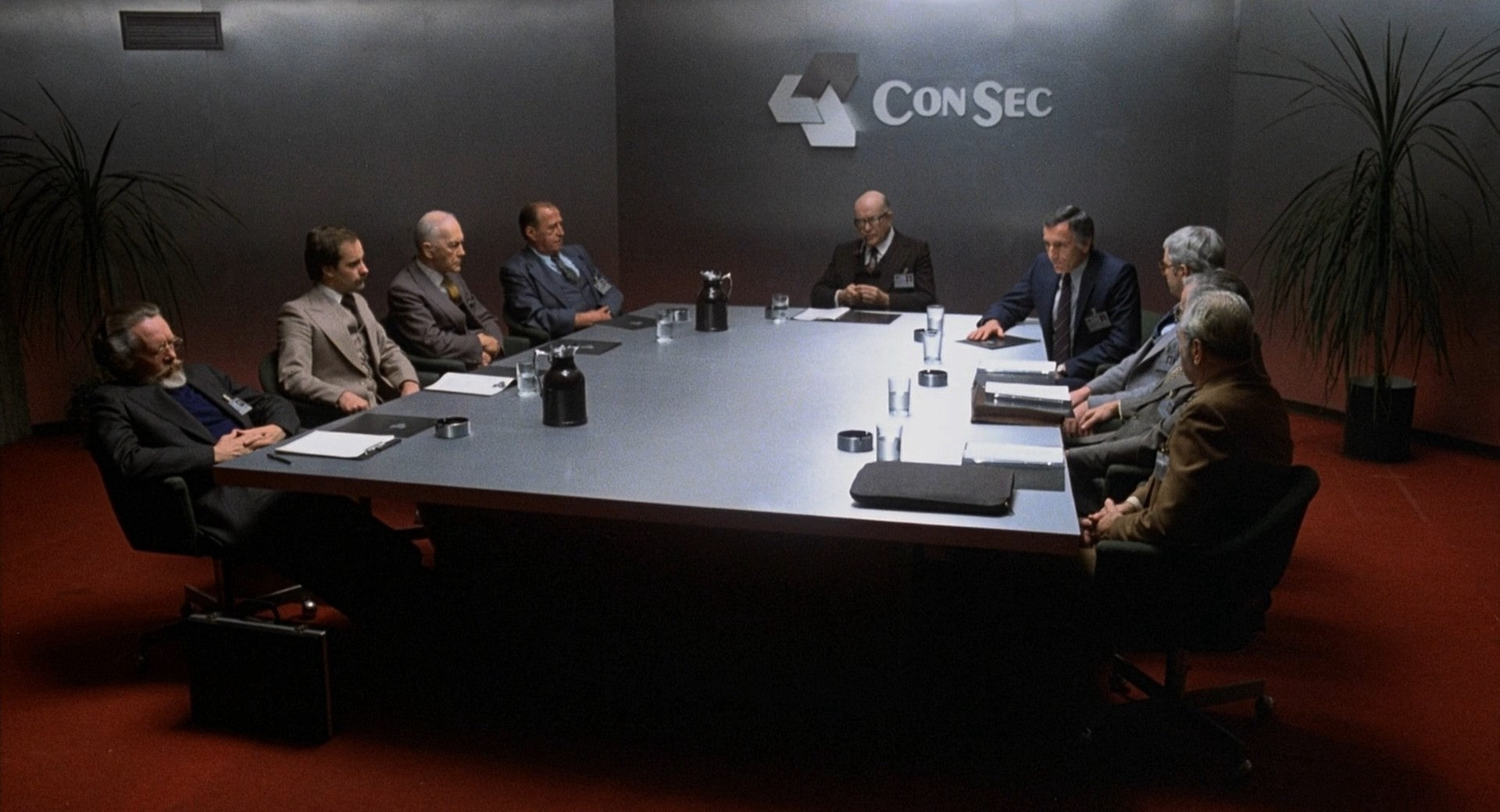
ConSec and other identities from the films, developed as shirts and everyday objects.
Explore Film merch ↗Original Cronendrome images in limited editions. Landscape and portrait. Framed or unframed.
Explore Art prints ↗