CASE FILE 06 / FILM WORLD

SCANNERS

ConSec. Biocarbon. Ephemerol. RIPE. Explore the institutions, objects, characters and production history of David Cronenberg’s Scanners.
DAVID CRONENBERG / 1981 / CASE FILE 06

CASE FILE 06 / SCANNERS / 1981

Choose a way into the film.

Corporate identities, psychic histories, script pages and the physical work behind the screen. Open a collection, follow an image, then go as deep as you like.

Nine collections · Search the whole dossier or browse at your own pace.

EXPLORE / 01On-screen worldConSec, Biocarbon, Ephemerol and the chronology inside the film.Open collection

SCANNERS / FIELD GUIDE

The world behind the film.

The film’s corporations, pharmaceutical network and computer systems form an interconnected world, documented through screen evidence, the screenplay and production records.

Film frames: Fictional Brands Archive.

FICTIONAL SYSTEM
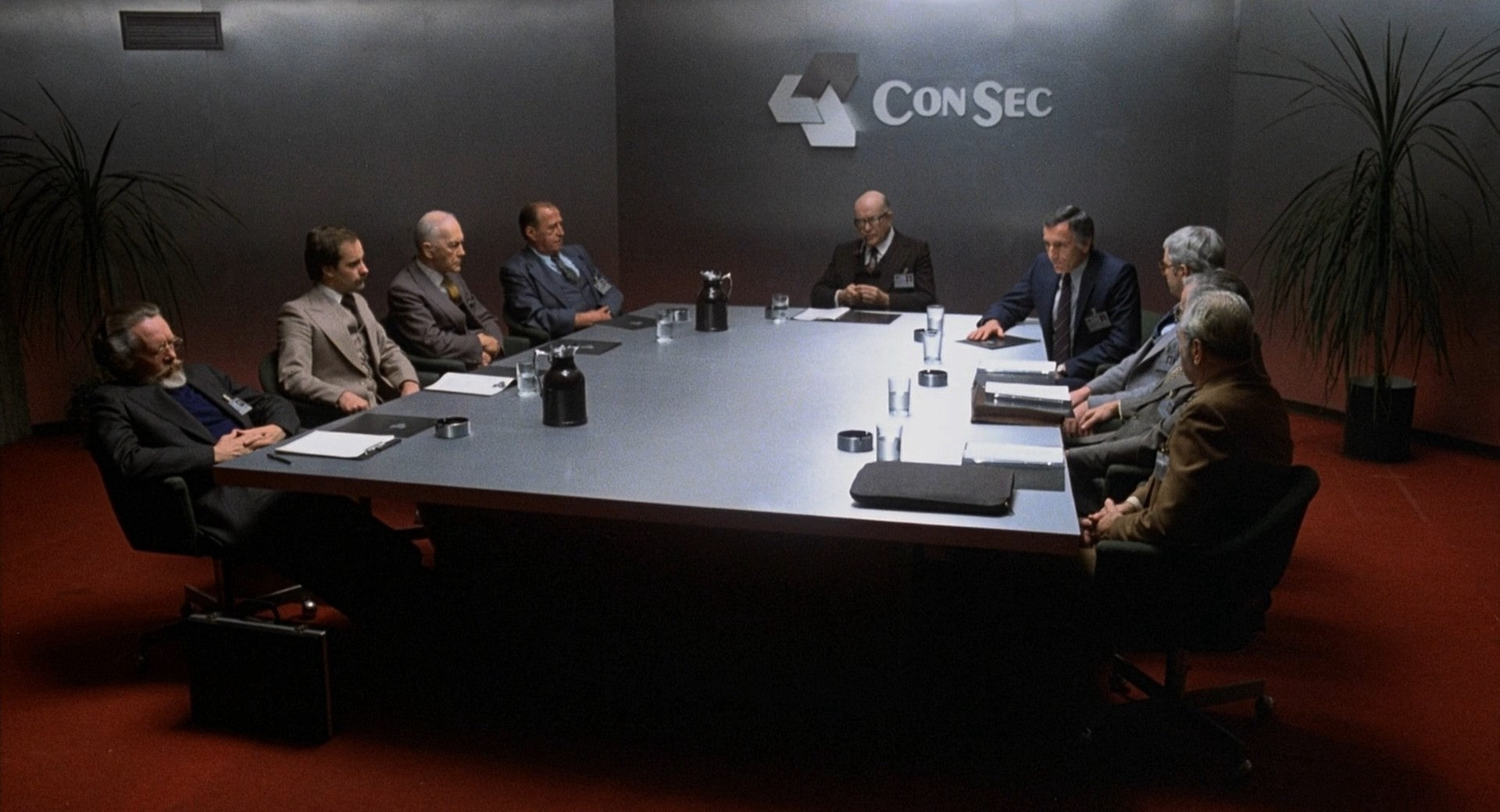
ConSec boardroom and wall emblem

CONSEC

Continental Security Inc.

Read the record

ConSec is the private security and weapons corporation attempting to identify, study and ultimately control Scanners. The 1979 screenplay expands the abbreviation as Continental Security Inc. and calls its headquarters ConSec Central.

Its identity is unusually complete for a fictional company: architectural signage, employee credentials, uniforms, stationery and transport all carry the same visual system.

Screenplay, printed p. 1 (PDF 2) · Screenplay, printed p. 9 (PDF 10)

Open ConSec identity record →

FICTIONAL SYSTEM
Biocarbon Amalgamate interior sign

BIOCARBON

Biocarbon Amalgamate.

Read the record

Dr. Paul Ruth says he founded Biocarbon in 1942 and later sold it to ConSec. By the events of the film, the company functions as an industrial and pharmaceutical operation tied to the manufacture and distribution of Ephemerol.

The photographed corporate name is Biocarbon Amalgamate. The film gives it symbol-only, interior, exterior, packaging, industrial-equipment and vehicle applications.

Screenplay, printed pp. 66–67 (PDF 67–68) · Biocarbon frame collection

Open Biocarbon identity record →

DRUG / ORIGIN
Protective-suited Biocarbon staff operating a branded factory cart

EPHEMEROL

A sedative that created a generation.

Read the record

Ephemerol was tested on pregnant women and becomes the biological link between Dr. Ruth, the first generation of Scanners and Revok's later plan to create more of them. The screenplay and released dialogue place the original test campaign in 1947.

The film turns that history into physical evidence: a vintage advertisement, a branded vial and Biocarbon's modern distribution system.

Screenplay, printed pp. 92–93 (PDF 93–94)

Open Ephemerol archive →

PDF p. 62 · assets.scriptslug.com
COMPUTER PROGRAM

RIPE

The distribution network inside ConSec.

Read the record

RIPE is explicitly described as a ConSec program. Vale's access reveals a database connecting doctors, female patients and small North American towns, exposing the infrastructure behind the prenatal Ephemerol operation.

The terminal language is restrained and procedural: access requests, internal-monitor codes and the identifier IM 863 rather than futuristic graphics.

Screenplay, printed p. 61 (PDF 62) · Screenplay, printed pp. 78–81 (PDF 79–82)

Open RIPE interface record →

DIEGETIC CHRONOLOGY

The chronology of Scanners.

Dates below come from the screenplay, film dialogue and institutional footage rather than a later fan chronology.
1942

Biocarbon founded.

Read the record
Paul Ruth says he founded the company that would later be sold to ConSec.

Screenplay, printed p. 66 (PDF 67)

1947

Ephemerol campaign.

Read the record
Pregnant women receive the experimental drug. The film presents the campaign through a vintage LIFE advertisement.

Screenplay, printed p. 93 (PDF 94)

1958

Benjamin Pierce, age ten.

Read the record
Ruth dates Pierce's childhood attempt to kill his father, mother and sister to 1958, placing Pierce's birth near the original Ephemerol campaign.

Screenplay, printed p. 33 (PDF 34)

JAN 4, 1967

Crane record #32407.

Read the record

The screenplay specifies a Crane Psychiatric Institute film card identifying Darryl Revok, age 22, dated January 4, 1967, under reference #32407.

Screenplay, printed p. 27 (PDF 28)

FILM PRESENT

236 known Scanners.

Read the record
ConSec's list covers 236 known Scanners. RIPE reveals a mechanism capable of expanding that population.

Screenplay, printed p. 12 (PDF 13)

AD CAMPAIGN

237.

Read the record
Avco Embassy advertising used 237 instead. Both numbers are authentic period evidence; only 236 belongs to the film's spoken world.

1981 U.S. campaign poster

EXPLORE / 02People & placesCharacter identities, real locations and the places imagined in the script.Open collection

CHARACTER LEDGER

The people of Scanners.

The ledger preserves finished-film identity, screenplay identity and production-stage credit names instead of forcing them into a single modern database label.
Film still • Criterion gallery · criterion.com
CAMERON VALE / STEPHEN LACK

The subject becomes the investigator.

Read the record
A homeless Scanner brought into Ruth's program, taught to control his condition and sent toward Revok. The screenplay's computer sequence turns Vale's nervous system into a bridge between biological and electronic networks.

Screenplay, printed pp. 78–81 (PDF 79–82)

Film still • Criterion gallery · criterion.com
DARRYL REVOK / MICHAEL IRONSIDE

The first enemy is also evidence.

Read the record

The screenplay’s Crane Psychiatric Institute film identifies Revok as age 22 on January 4, 1967. His institutional history leads back to Ephemerol and Ruth.

Screenplay, printed pp. 27–30 (PDF 28–31)

PDF p. 7 · cinemacanada.athabascau.ca
BENJAMIN PIERCE / ROBERT SILVERMAN

Art as psychic containment.

Read the record
A Scanner who rejects both Revok and Gaudi, Pierce channels his condition into sculpture. His giant fiberglass head, trapped self-portrait and organ forms make his studio one of the film's richest constructed worlds.

Screenplay, printed pp. 33–44 (PDF 34–45)

CHARACTER REGISTER / NAMES IN THE RECORD

DR. PAUL RUTH / PATRICK McGOOHAN

Scientist, father, founder.

Read the record
Ruth says he founded Biocarbon in 1942, conducted the Ephemerol pregnancy campaign and later sold the company to ConSec. The film deliberately complicates his position as mentor and origin point.

Screenplay, printed pp. 66–67 (PDF 67–68)

KIM OBRIST / JENNIFER O'NEILL

A surname revision survives on the page.

Read the record
The 1979 draft introduces her as Kim Rothberg and later calls her Kim Obrist. The finished identity is Obrist, matching the name of a real production assistant.

Screenplay, printed p. 37 (PDF 38) · Screenplay, printed p. 69 (PDF 70) · Production roster, p. 23 (PDF 4)

TONY GAUDI / CHARLES SHAMATA

A surname nearly lost from modern credits.

Read the record
The screenplay repeatedly names him Tony Gaudi; contemporary production records preserve Gaudi, while many later listings reduce him to Tony. Cronendrome restores the full character name.

Copie Zéro no. 10, entry 5124, p. 40

CRAIG / ANTHONY SHERWOOD

Craig in the production record.

Read the record
The screenplay and 1981 Cinémathèque catalogue identify Anthony Sherwood’s character as Craig. Later databases use Aiden.

Copie Zéro no. 10, entry 5124, p. 40

SHANE / KEN UMLAND

A production-era name recovered.

Read the record
The 1981 catalogue identifies Ken Umland as Shane, a name absent from the searchable final draft and flattened to a generic attic Scanner in later listings.

Copie Zéro no. 10, entry 5124, p. 40

JACK / JACK MESSINGER

The Scanner at the door has a name.

Read the record
The screenplay names Jack as the Scanner attacked on the stairs before the attic assault; institutional credits preserve Jack Messinger as Jack.

Screenplay, printed p. 53 (PDF 54) · Cinémathèque française, film record 39040

BRAID / ALEX STEVENS

Assassin and crew member.

Read the record
Period documentation identifies stunt coordinator Alex Stevens as Braid. The same performer also appears in production-era credits as Programmer 3.

Copie Zéro no. 10, entry 5124, p. 40

MERYL / FLAVIA / JIM

Named in script, incompletely mapped on screen.

Read the record
Meryl is shot in the attic; Flavia is pulled from the fire by Gaudi; Jim escapes into the Materiology van. Their screenplay identities are recorded alongside the finished-film cast.

Screenplay, printed pp. 52–55 (PDF 53–56)

PATCH / SCREENPLAY CHARACTER

A name without a secure face.

Read the record
The screenplay names Braid’s partner Patch.

Screenplay, printed pp. 52–55 (PDF 53–56)

LOCATION LEDGER

Fictional place. Script place. Real place.

Explore the relationship between fictional settings, screenplay descriptions and the locations used for filming.
Biocarbon interior · on-screen location reference
CORPORATE ARCHITECTURE

CONSEC CENTRAL

Vaudreuil-Dorion, Québec.

Read the record

Modern location accounts identify the Future Electronics complex at 1000 Avenue Saint-Charles with ConSec’s exterior. Irwin’s firsthand account places the demonstration in a suburban Montréal community-college lecture hall, followed by a separate warehouse shoot for the exploding-head insert.

Irwin, ASC interview: “Scanners (1981)”

INDUSTRIAL LOCATION

BIOCARBON INTERIOR

Charles J. Des Baillets water-treatment plant.

Read the record

An extra identified as Ted, writing to the 80s Movies Rewind location archive, recalls the drug-processing scenes at the Charles-J. Des Baillets filtration plant in LaSalle and his own work in a white protective suit. This is a participant’s recollection preserved by the location site.

80s Movies Rewind, contribution credited to Ted

SCREENPLAY SETTING

CROSTIC GALLERY

Downtown Toronto in the screenplay.

Read the record
The screenplay places Crostic Gallery in a renovated Victorian townhouse with a bay window.

Screenplay, printed p. 34 (PDF 35)

URBAN LOCATION

HALFWAY HOUSE

Old Montréal.

Read the record
Location accounts place the Scanner group’s house in Old Montréal. Contemporary production reporting also records an upstairs-apartment fire-effects shoot in that district.

Siegel, apartment-fire location, p. 21 (PDF 2)

LOCATION HISTORY

OPENING SHOPPING COMPLEX

Montréal or Toronto?

Read the record
Modern location records identify 20/20 University in Montréal while an older location archive identifies the Yonge/Bloor complex in Toronto. This stays disputed until period architecture or production paperwork resolves it.

80s Movies Rewind, contribution credited to Julie · Later location listings

PRODUCTION RECORD

LOCATION PAPERWORK

The production’s location archive.

Read the record

Christine Burt is credited as location manager in the contemporary production roster.

Production roster, p. 23 (PDF 4)

More names in the record.

The cast history extends beyond the characters usually named in a synopsis.

PERIOD CAST

The Dornhoff and Reiss names

The catalogue credits Elijah Siegler as Martin Dornhoff; Mikhail Berkut as Mr. Dornhoff; Danny Silverman, Louise Draper and Bob Peters as the Reiss boy, mother and father; and Don Buchsbaum and Dave Patrick as squash players.

Copie Zéro no. 10, entry 5124, p. 40

SCREENPLAY IDENTITIES

Meryl, Flavia and Patch

The draft gives Meryl and Flavia distinct actions in the Halfway House attack: Meryl is shot; Gaudi pulls Flavia from the fire. Patch accompanies Braid through the house. The names describe characters on the page; the surviving records do not securely map all three to performers.

Screenplay, printed pp. 52–55 (PDF 53–56)

EXPLORE / 03Inside Pierce’s studioSculpture, performance and the artist’s constructed world.Open collection

BENJAMIN PIERCE / RECENT WORKS

An artist inside the Scanner condition

Pierce is not simply the eccentric artist Vale visits. The screenplay gives him an institutional history, an art career, a gallery exhibition and a reason for making the work: art is what keeps him sane.
CROSTIC GALLERY / RECENT WORKS
BENJAMIN
PIERCE
SCULPTURE / LITHOGRAPH / PSYCHIC SELF-PORTRAIT

Ruth's dossier dates Pierce's attempt to murder his father, mother and sister to 1958, when Pierce was ten. He was subsequently confined in a prison for the criminally insane, where art therapy became the mechanism through which his work first reached the outside world.

An international promoter discovered Pierce through a prison art show. Critics later campaigned for his release. By the time Vale reaches Crostic Gallery, Pierce has a public career substantial enough to support a show titled Benjamin Pierce Recent Works, complete with catalogues carried by guests.

His work is inseparable from his Scanner identity. The sculptures turn the body inside out: a walk-in fiberglass head, a terrified self-portrait trapped behind glass, shiny organ-like forms and lithographs owned by Ruth.

PDF p. 7 · cinemacanada.athabascau.ca
FIBERGLASS

THE GIANT HEAD

A sculpture that becomes a set

Read the record

The script describes a giant fiberglass head. Vale and Pierce enter through its neck into simulated veins, sinus cavities and brain structures. The sculpture becomes an inhabitable setting.

Screenplay, printed pp. 39–41 (PDF 40–42)

PLASTER CAST

THE GLASS ROOM

Pierce trapped inside himself

Read the record

The screenplay describes a plaster-cast self-portrait: a terrified man strapped to a chair inside a glass room, with Pierce’s own face. “Plaster” is the specified material on the page.

Screenplay, printed pp. 33–34 (PDF 34–35)

PERIOD CREDIT

WHO MADE THE WORK?

The sculptors behind Pierce’s world

Read the record

The contemporary production roster names Tom Coulter as sculptor. Expanded credits also list Peter Borowski and Peter Dowker.

Siegel, “artists of illusion”, p. 23 (PDF 4)

GALLERY EPHEMERA

CROSTIC EPHEMERA

Pierce’s exhibition catalogue

Read the record
The screenplay explicitly puts printed catalogues in guests' hands. Its printed format forms part of the exhibition’s design history.

Screenplay, printed p. 34 (PDF 35)

Explore Pierce artifacts →

EXPLORE / 04Script, screen & productionNames and numbers, then the departments, lenses, makeup and effects behind the image.Open collection

SOURCE FORENSICS

Script, screen and campaign.

Production history lives in the differences between the screenplay, the released film and the theatrical campaign. These records trace those changes to their sources.
A name revision on the page · 1979 screenplay, PDF p. 38
PROP HISTORY

1946 / 1947

Story date versus physical magazine.

Read the record

The screenplay places the Ephemerol advertisement in a June 1947 issue of LIFE. That is the story’s date. The older research also recorded a possible 1946 physical magazine, but an identified issue and page are needed before treating that as the prop’s date.

Screenplay, printed pp. 92–93 (PDF 93–94)

SCREENPLAY / PERIOD CATALOGUE

CRAIG / AIDEN

A later name enters the metadata.

Read the record
The screenplay and 1981 Cinémathèque catalogue identify Anthony Sherwood's Scanner as Craig. Aiden appears in later institutional metadata without a known primary source.

Copie Zéro no. 10, entry 5124, p. 40

REVISION FOSSIL

ROTHBERG / OBRIST

Kim changes surname inside one draft.

Read the record
The surviving screenplay first introduces Kim Rothberg, then later has her identify herself as Kim Obrist. The finished identity is Kim Obrist, a name shared with a real production assistant.

Screenplay, printed p. 37 (PDF 38) · Screenplay, printed p. 69 (PDF 70)

ON-SCREEN FORM WINS

AMALGAMATE / AMALGAMATED

Biocarbon's photographed name.

Read the record
The film's signs use Biocarbon Amalgamate. The occasional screenplay form 'Amalgamated' is retained as a textual variant rather than replacing what was photographed.

Biocarbon screen references · Screenplay, printed p. 61 (PDF 62)

PRODUCTION REVISION

FIVE / FOUR KILLERS

A hit team changes size.

Read the record

The draft describes five attackers at Pierce’s studio, then calls them four in later dialogue and action. The cast catalogue separately lists four numbered Executors and Braid. The mismatch is evidence of changing documentation, not proof that a specific fifth performer was filmed and cut.

Screenplay, printed p. 39 (PDF 40) · Screenplay, printed p. 44 (PDF 45) · Screenplay, printed p. 47 (PDF 48) · Screenplay, printed p. 52 (PDF 53) · Copie Zéro no. 10, entry 5124, p. 40

How the film was physically made.

Design, camera, makeup and physical effects meet in the same image. The records let us follow their separate contributions.

PRODUCTION DESIGN

A division of physical work

Carol Spier headed the art department, with Claude Benoit assisting and Tom Coulter credited as sculptor. The period roster separately identifies Delphine White for costume design, Renée April as dresser and Peter Bray for set dressing. Ron Sanders edited the film.

The corporate marks, Pierce’s sculptures and the special-makeup heads belong to different kinds of design work. A department credit alone cannot identify the designer of a particular logo.

Production roster, p. 23 (PDF 4) · Copie Zéro no. 10, entry 5124, p. 40

MARK IRWIN / CINEMATOGRAPHY

Wide lenses and clear air

In Donald Martin’s 1984 interview, Mark Irwin specifically names 14mm and 20mm lenses for Scanners. He explains that blocking established the coverage and that the location helped determine the lighting. His discussion of Jennifer O’Neill’s photography also describes Cronenberg’s preference for crisp images over fog filters or rooms filled with smoke.

The resulting tension is visible in the spaces: the lens can make a room feel unstable while its surfaces remain sharply legible.

“Let there be light,” March 1984, p. 7 (PDF 2)

SPECIAL MAKEUP

The makeup workshop

Lois Siegel’s contemporary report names Chris Walas, Tom Schwartz and Stephan Dupuis as the makeup-effects team, with Dick Smith credited as consultant. Its photographs and interviews describe life impressions, plaster positives, rubber molds and gelatin heads. Applied hair, eyes and internal assemblies completed the doubles.

Siegel, “artists of illusion”, p. 24 (PDF 5) · Fabrication account, p. 25 (PDF 6)

THE DEMONSTRATION SCANNER / LOUIS DEL GRANDE

One effect, two locations

In his 2021 ASC interview, Irwin recalls filming the demonstration in a suburban Montréal lecture hall, then moving the backdrop to a waterfront warehouse for the insert. Five cameras covered the prop, including a Mitchell Mark II at 36 fps. He remembers Cronenberg rejecting the visible sparks from internal squibs.

Irwin attributes the successful explosion to Gary Zeller’s shotgun and describes its load as salt. In his account, subsequent replacement attempts were rejected and the first successful shotgun take remained in the film. These are the cinematographer’s later recollections of the shoot.

Iain Marcks, ASC, 5 November 2021: “Scanners (1981)”

GARY ZELLER / PHYSICAL EFFECTS

Fire, prosthetics and the hand

Siegel reported from the Old Montréal apartment-fire shoot and photographed the effects work. The same article describes a foam-rubber hand appliance for the dart effect.

A surviving dart was later catalogued by Propstore: an aluminium body, pink-fur fletching and a dull needle attached to a flesh-coloured mounting piece, measuring 8 × 2 × 2 cm. The dimensions describe that auctioned object, not every version made for production.

Location report, p. 21 (PDF 2) · Dart appliance, p. 25 (PDF 6) · Propstore, catalogue 78, object 18460

EXPLORE / 05Before ScannersWorking titles, revisions and reshoots.Open collection

DEVELOPMENT HISTORY

Before it was Scanners.

The released film is one state in a project that mutated for years, then continued changing during editing.
The surviving final draft · 1979 screenplay
SURVIVING ARCHIVAL MATERIAL

TELEPATHY 2000 / THE PSYCHICS

The earlier telepathy project.

Read the record
Surviving Cronenberg development material at TIFF includes an early Telepathy 2000 treatment; academic and secondary sources also associate the title The Psychics with this proto-Scanners material. Published sources disagree over exact dating and chronology, so the archive keeps those questions open until the TIFF documents are inspected directly.

TIFF Film Reference Library, David Cronenberg collection · 2014 exhibition account: treatment and outline

DIRECTLY CONFIRMED WORKING TITLE

THE SENSITIVES

The Sensitives becomes Scanners.

Read the record

The Sensitives is another documented working title. The title Scanners gives the psychic ability a harder, technological name, bringing the body and the corporate world into the same vocabulary.

Exhibition account identifying The Sensitives outline

POST-PRODUCTION WRITING

NEW SCENES DURING EDITING

The screenplay did not stop when shooting stopped.

Read the record

In March 1981, Cronenberg told John G. Harkness that Scanners was his first film to gain newly written scenes during editing. Additional Revok–Keller meetings were photographed in Toronto so their collusion could be seen, rather than explained only in dialogue.

“Brilliantly Bizarre”, p. 11 (PDF 4)

RESHOT

THE FINAL DUEL

The ending was photographed more than once.

Read the record

Cronenberg’s 1981 account explicitly confirms that he redid the ending because he was dissatisfied with the effects. A printed “Final Draft” therefore records a production stage, not the last form of the film.

“Brilliantly Bizarre”, p. 11 (PDF 4)

EDITING-STAGE STRUCTURE

THE HEAD EXPLOSION

Originally contemplated as the opening.

Read the record

The surviving screenplay begins with ConSec’s demonstration and the exploding head. The released film first introduces Vale in the shopping complex. The change can be established directly by comparing their openings.

Screenplay, printed pp. 1–3 (PDF 2–4)

ARCHIVE TARGET

TIFF CRONENBERG PAPERS

The documents that can settle the title chronology.

Read the record
TIFF’s Film Reference Library holds Cronenberg’s personal papers. The 2013 David Cronenberg: Evolution exhibition displayed material from both Telepathy 2000 and The Sensitives.

TIFF Film Reference Library, David Cronenberg collection

EXPLORE / 06Music & soundHoward Shore’s recorded textures, orchestral writing and the score on record.Open collection

A nervous system made of sound.

The score gives psychic action an audible form. Follow the composer’s account, then the recordings and release editions.

HOWARD SHORE / SCORE

Making the inside of a mind audible

Howard Shore described the final duel to Terry Gross as an experiment combining orchestra with electronic sounds he created through recording and tape manipulation. He traced the method to the musique concrète techniques he had explored with tape recorders and splicing as a young musician, and recalled hearing Toru Takemitsu’s work early in life.

His explanation concerns the score’s materials. Gross’s comparison with animal growls is a listening impression in the interview, not an identification of a particular animal recording used in the film.

Fresh Air, 18 March 2002, transcript: discussion immediately after the Scanners duel excerpt

COMPOSER’S ACCOUNT

A score built in the studio

In his 1998 Cinesonic conversation, Shore grouped Scanners with his early experimental Cronenberg scores and compared its studio-built approach with Videodrome and Crash. He also described a collaboration that begins with the script and develops through conversations, a director’s cut and a spotting session.

That account helps distinguish the creation of recorded musical material from the later act of placing it in a finished film. The electronic component is part of the composition, not simply an adjective for its mood.

Philip Brophy, Cinesonic, 1999; conversation delivered in 1998, questions on collaboration and Crash

MONDO / HOWE RECORDS / 2015

The score as a record

Mondo’s January 2015 release with Howe Records paired Scanners on side A with The Brood on side B, with artwork by Sam Wolfe Connelly. Its nine Scanners tracks provide a useful listening index. Album durations are not film timecodes.

  1. Main Title1:37
  2. Vale Captured4:09
  3. Ephemerol1:21
  4. The Ripe Program2:52
  5. The Injection2:50
  6. Dirge for the Assassins2:38
  7. Vale’s Lonely Walk1:03
  8. The Dart1:34
  9. Scanner Duel5:48

Mondo, 12 January 2015: release announcement and side-A track list

EXPLORE / 07Campaign & printPosters, pressbooks, publicity photographs and the novelization.Open collection

The film becomes an image.

Theatrical publicity, printed adaptations and later editions each carry Scanners into a different setting.

THE U.S. ONE-SHEET

Joann Daley’s theatrical image

Posteritati’s record 24972 identifies the 1981 U.S. 27 × 41-inch one-sheet and credits Joann Daley. Its central image belongs to the theatrical campaign; later artist prints and home-video packaging have their own makers and publication histories.

Posteritati, record 24972

POSTER / TRAILER / RADIO

237 in the campaign, 236 in ConSec’s list

The campaign’s 237 Scanners became part of the film’s public identity. Keller’s screenplay dialogue instead refers to a list of 236 known Scanners. The difference is between promotional copy and an in-world count, which need not describe the same thing.

The timed 10 / 15 / 20-second escalation and the tagline “Their thoughts can kill” turn psychic power into a sales proposition.

Screenplay, printed p. 12 (PDF 13) · 1981 one-sheet · Criterion: trailer and radio spots

CAMPAIGN FORMATS

Publicity photographs and exhibitor paper

The saved research distinguishes the Avco Embassy SCA photographs, the advertising manual, standard lobby cards and miniature cards. Each is a different publication format: the manual directs exhibitors; the cards and captioned stills circulate selected images.

The recorded SCA sequence contains thirteen identified photographs between SCA-1 and SCA-14, with SCA-13 absent from that documented group.

Object register: publicity, pressbook and lobby cards

PRINT ADAPTATION

Leon Whiteson’s novelization

Tower Books published Leon Whiteson’s Scanners novelization in 1980, based on Cronenberg’s screenplay.

WorldCat: Scanners / Leon Whiteson

EXPLORE / 08Objects & graphic identitiesCredentials, packaging, sculptures, interfaces, vehicles and campaign paper.Open collection

The object register.

Follow each object to its screenplay passage, published frame or catalogue record. Script descriptions remain distinct from photographed details.

PUBLISHED FRAME REFERENCE

ConSec Employee Badge

A landscape-format ConSec credential with portrait and corporate mark is visible in the published reference frame. Its small lettering and physical measurements cannot be read reliably from this image.

Fictional Brands Archive, ConSec record 14 · View reference image

SCREENPLAY OBJECT

Ephemerol advertisement / story date 1947

The screenplay specifies a June 1947 LIFE page showing the drug advertisement. Its publication language turns Ruth’s medical experiment into a domestic promise. The date describes the story; the physical magazine’s issue has not been securely identified.

Screenplay, printed pp. 92–93 (PDF 93–94)

SCREENPLAY OBJECT

RIPE / the scripted terminal exchange

The screenplay identifies RIPE as the ConSec-controlled program, stages a refused access request and introduces internal-monitor code IM 863. The display then produces paired doctor and female-patient names and addresses.

Screenplay, printed pp. 78–81 (PDF 79–82)

SCREENPLAY OBJECT

Crane Psychiatric Institute / record #32407

The script specifies the institute, reference #32407, January 4, 1967 and Darryl Revok, age 22. That description ties a medical image to an institutional identifier and date.

Screenplay, printed p. 27 (PDF 28)

SCREENPLAY OBJECT

Dr. L. Frane / lawn sign

The screenplay specifies the doctor’s name, general practice and an instruction to use the side entrance. It also describes a white three-storey brick Victorian residence with a turret and curved verandah. This is a scripted object and setting, not a measured reconstruction.

Screenplay, printed p. 84 (PDF 85)

PUBLISHED FRAME REFERENCE

Biocarbon Industrial Transport Cart

A mundane factory vehicle carrying an oversized Biocarbon symbol, useful evidence that the art department maintained the corporate identity across background machinery.

Fictional Brands Archive, Biocarbon record 15

SCREENPLAY OBJECT

Benjamin Pierce Giant Fiberglass Head

The screenplay describes an immense walk-in fiberglass human head with an interior environment of simulated veins, sinus cavities and brain structures.

Screenplay, printed pp. 39–41 (PDF 40–42)

SCREENPLAY OBJECT

Benjamin Pierce Glass-Enclosure Self-Portrait

The screenplay describes a plaster-cast figure of a terrified man strapped to a chair inside a glass room, bearing Benjamin Pierce's own face.

Screenplay, printed pp. 33–34 (PDF 34–35)

SCREENPLAY OBJECT

Pierce’s anatomical forms

The script describes glossy plastic shapes resembling spleens and kidneys, in blood-red lighting around Pierce’s den. The language describes the envisioned environment; it is not a complete inventory of photographed sculptures.

Screenplay, printed p. 39 (PDF 40)

SCREENPLAY OBJECT

Benjamin Pierce Exhibition Catalogue

The screenplay describes a potentially fabricated exhibition catalogue for Pierce's show. No surviving copy has yet been located in published sources.

Screenplay, printed p. 34 (PDF 35)

SCREENPLAY OBJECT

Revok’s assault van

The screenplay stages an unmarked black van whose side panels open to expose shotgun muzzles and fire a broadside at the Scanner group’s vehicle. Its mechanism and narrative function belong to the scripted action.

Screenplay, printed pp. 55–56 (PDF 56–57)

CATALOGUED PROP

Cameron Vale’s dart prosthetic

Propstore catalogued a surviving dart with an aluminium shell, pink-fur fletching and a flesh-coloured mounting piece. The published dimensions, 8 × 2 × 2 cm, refer to that specimen. Siegel’s contemporary report separately describes the hand appliance used for the effect.

Propstore, catalogue 78 / object 18460 · Siegel, dart effect, p. 25 (PDF 6)

THEATRICAL POSTER

Joann Daley Theatrical Campaign Artwork

The principal illustrated Scanners campaign artwork by Joann Daley, reused across multiple formats and territories while typography and copy changed around it.

Posteritati, record 24972

PUBLICITY OBJECT

Avco Embassy / SCA publicity photographs

The earlier research records thirteen captioned photographs, with SCA-13 absent from the documented SCA-1–14 group. Keep the group description separate from a claim about the complete original issue.

Heritage Scanners catalogue search · Campaign context

PUBLICITY OBJECT

Lobby cards / theatre display

The saved research distinguishes standard 11 × 14-inch cards and miniature 8 × 10-inch cards. The pictured cards preserve a publicity photograph inside a campaign border; they are printed objects, distinct from film frames.

Heritage Scanners catalogue search · Campaign context

PUBLISHED FRAME REFERENCE

ConSec document folder

The published frame records the mark applied to office paperwork, extending the identity from architecture to an object handled in a meeting.

Folder reference frame

PUBLISHED FRAME REFERENCE

ConSec helicopter marking

The helicopter frame extends the corporate identity onto another vehicle.

Helicopter reference frame

EXPLORE / 09The reading roomOriginal screenplay, period reporting and firsthand interviews.Open collection

The reading room.

Edition details, exact pages and archival identifiers keep each source within reach.

SOURCE RECORD

The 1979 Final Draft

David Cronenberg; FilmPlan International copyright 1979. 97 PDF pages: title leaf plus 96 numbered screenplay pages. Printed p. 1 is PDF page 2. The word “Final” describes this document’s title, not the completed film.

Open source

SOURCE RECORD

Copie Zéro no. 10

Cinémathèque québécoise, Annuaire longs métrages Québec 1980, published 1981. Scanners is entry 5124, printed/PDF p. 40: technical information, crew and character names.

Open source

SOURCE RECORD

Lois Siegel: “artists of illusion”

Cinema Canada, March 1980, pp. 20–27. PDF p. 2 / print p. 21: Old Montréal effects location; PDF p. 4 / print p. 23: production roster; PDF pp. 5–6 / print pp. 24–25: makeup fabrication and dart; PDF p. 7 / print p. 26: Pierce production photograph.

Open source

SOURCE RECORD

John G. Harkness: “Brilliantly Bizarre”

Cinema Canada, March 1981. Interview with David Cronenberg, printed p. 11 / PDF p. 4: writing during editing, Toronto Revok–Keller scenes and reshooting the ending.

Open source

SOURCE RECORD

Donald Martin: “Let there be light”

Cinema Canada, March 1984, pp. 6–9. Mark Irwin interview; printed p. 7 / PDF p. 2: 14mm and 20mm lenses, blocking, location lighting and clear photography.

Open source

SOURCE RECORD

Iain Marcks: “The Darker Side of Mark Irwin, ASC, CSC”

American Society of Cinematographers, 5 November 2021. Section “Scanners (1981)”: lecture hall and warehouse, five cameras, rejected squibs and the shotgun take. Later firsthand recollection.

Open source

SOURCE RECORD

Howard Shore with Terry Gross

Fresh Air, 18 March 2002. Transcript discussion directly after the final-duel audio excerpt: orchestra, electronic sounds, tape manipulation and musique concrète. The audio and transcript belong to one interview.

Open source

SOURCE RECORD

Howard Shore: “Composing with a very wide palette”

Conversation delivered in 1998, transcribed and edited by Philip Brophy; published in Cinesonic, AFTRS, 1999. Questions on collaboration and the studio-built score. The 2011 reprint is the same interview lineage.

Open source

SOURCE RECORD

Scanners / The Brood LP

Mondo, 12 January 2015 announcement for the 13 January release with Howe Records. Side A lists the nine Scanners tracks and their album durations; Sam Wolfe Connelly is credited for the cover art.

Open source

SOURCE RECORD

Scanners production photographs

Cinémathèque québécoise, series 1995.2482.PH. Individual photographic records name Denis Fugère; item 1995.2482.PH.18 credits Thérèse Bérubé.

Open source

SOURCE RECORD

ConSec and Biocarbon frame collections

Fictional Brands Archive, ConSec record 14 and Biocarbon record 15. Published visual references for the photographed marks and their applications.

Open source

SOURCE RECORD

1981 U.S. one-sheet

Posteritati record 24972: country, year, 27 × 41-inch format and attribution to Joann Daley.

Open source

SOURCE RECORD

Cameron Vale’s dart prosthetic

Propstore catalogue 78, object 18460. Object description, measurements and photographs; seller attribution to Scanners.

Open source

SOURCE RECORD

Criterion: Scanners

Criterion’s edition lists a 103-minute film, director-supervised restoration, Michael Lennick’s The “Scanners” Way, interviews, a trailer and radio spots.

Open source

SOURCE RECORD

Second Sight: standard 4K UHD

Catalogue 2NDBR4243. Edition listing includes mono 1.0 and 5.1 audio, Mind Fragments with Howard Shore, The Eye of Scanners with Mark Irwin, and effects interviews with Stephan Dupuis and Chris Walas.

Open source

SCANNERS / OBJECTS

Objects from the dossier

Research into the film’s graphic identities, props and printed matter informs new physical editions.
IN DEVELOPMENT

Corporate reconstructions

ConSec, Biocarbon and other fictional identities are being rebuilt from documented screen evidence before they become physical objects.
IN DEVELOPMENT

Printed ephemera

Period-style documents, exhibition material and archival facsimiles will grow directly out of the research database.
IN DEVELOPMENT

Cronendrome editions

Books, prints, shirts and other transmissions will enter the store only when they have a finished object behind them.

CASE FILE UPDATES

Follow the investigation

New evidence, artifact reconstructions and additions to the Scanners dossier.