CRONENDROME / CASE FILE 03 / 1975

SHIVERS

Starliner Towers: the architecture and circulation of infection.

DAVID CRONENBERGCANADA / 35MM / COLOURTHEY CAME FROM WITHIN
Lynn Lowry as Nurse Forsythe revealing the parasite
Lynn Lowry as Nurse Forsythe, revealing the parasite. Film frame · 01:16:34.027

ENTER THE CASE

A complete world.
A permeable boundary.

Start with Starliner’s world, follow the film scene by scene, or go straight to its effects, people and material history.

THE RESEARCH / NINE CHAPTERS

Inside Starliner.

Open a chapter below or use the index to move between the film’s world, its making and its afterlife.

EXPLORE / 01 / THE ON-SCREEN WORLDA building designed to contain everything

Starliner Towers promises a complete life within a single residential system. Hobbes’s experiment turns that promise inside out: the residents, rooms and shared amenities become the means by which the parasite circulates. Roger St. Luc’s attempt to contain the outbreak ends with the infected residents leaving for Montréal.

TIFF Canadian Film Encyclopedia: Shivers

The opening’s sales presentation makes the building a product before it becomes a trap. The closing broadcast supplies another reassuring public voice. Maurice Yacowar identified this framing in 1977: the messages of ordinary urban life continue even after the audience has seen the social order change.

Maurice Yacowar: You Shiver Because It’s Good

Starliner is also a name with a built-in journey. In his 2014 discussion with Piers Handling, Cronenberg compared the island complex to an isolated spacecraft. Read that image back into the architecture: a bounded habitat, shared services, passengers and an outside world that appears comfortably remote.

Allan Tong: Cronenberg on architecture and his early work (24 January 2014)

Containment is a service

The clinic, laundry, pool, delivery system and parking garage belong to one residential promise. Each brings people or material through a boundary that an individual apartment cannot control. Read together, the opening’s amenity images and Dory’s production photographs make the same point: the building’s conveniences already contain the routes of its failure.

Art of the Title: Shivers · Attila Dory: A camera in the laundry — PH.03 · Attila Dory: The cane in the corridor — PH.15 · Attila Dory: Searching the incinerator — PH.19
Residents crowd the glazed doors of Starliner’s pool
Residents crowd the pool’s glazed doors. Starliner’s shared spaces turn proximity into a threat. Film frame · 01:23:32.028

The story also changes the meaning of being a good neighbour. Helping someone, admitting a visitor, delivering food and tending an injury all require proximity. A building built around shared services cannot make every encounter safe merely by keeping the city outside. This is the organizing tension of the case file.

Back to collections ↑
EXPLORE / 02 / DEVELOPMENT & PRODUCTIONThe commercial threshold

Shivers is Cronenberg’s third feature, following Stereo and Crimes of the Future. Written and directed by Cronenberg, it was produced by Ivan Reitman for DAL Productions; André Link, John Dunning and Alfred Pariser are credited as executive producers. Robert Saad photographed it and Patrick Dodd edited it.

TIFF Canadian Film Encyclopedia: Shivers

The film’s controlled spaces were also practical working conditions. Looking back in Cinema Canada in 1981, Cronenberg explained that camera movement on Shivers had been constrained by time: a dolly move became a major undertaking, and crane shots were beyond reach. The static framing cannot be understood solely as a theoretical decision.

Robert MacMillan: Shivers …Makes Your Flesh Creep! / adjacent Cronenberg interview

Hannah Ferguson’s location study describes the production’s use of residents’ apartments, drawing on Cronenberg’s recollections in Cronenberg on Cronenberg. The domestic interiors belong to the film’s found environment as well as to its fiction.

Hannah Ferguson: Shivers, Nuns’ Island and haunted utopian urbanism (May 2023)

The numbers describe different things

The Canada Year Book 1976–77 records $259,000 in Canadian box-office receipts for Shivers within its 1975–76 distribution discussion. That is a territory-and-period measure, not a production budget or lifetime worldwide gross.

Statistics Canada: Canada Year Book 1976–77

Swipe or scroll sideways to read every column → Keyboard: focus the table and use the left/right arrow keys.

RecordWhat it actually reports
Government yearbook, p. 340$259,000: Canadian box-office receipts in the 1975–76 discussion.
Hofsess, Cinema Canada$135,000 described as CFDC support; more than $2 million gross. A contemporary polemical account, not an audited cost report.
The Music Scene, July–August 1976$70,000 CFDC contribution, attributed to Clyde Gilmour; repaid from early returns.
TIFF film-history entry$179,000 budget and $145,000 CFDC investment; later retrospective figures.
Statistics Canada: Canada Year Book 1976–77 · John Hofsess: Goodbye to all that from a banned filmmaker · The Music Scene, July–August 1976 · TIFF Canadian Film Encyclopedia: Shivers

These records agree on the film’s commercial importance while describing different accounting categories and reporting different contributions.

The filmmaker inside the funding argument

In the CBC interview preserved by TIFF, Cronenberg says that getting Shivers made took four years and brought him $13,000. His answer challenges the interviewer’s suggestion of quick exploitation profits. He then describes the CFDC’s competing obligations: it could be attacked for losing public money, yet a profitable horror film could expose it to political embarrassment. The controversy made commercial success and cultural respectability separate tests of the same production.

David Cronenberg on Shivers — CBC interview preserved by TIFF

Cinépix and the producer’s apprenticeship

John Dunning remembered Cronenberg and Ivan Reitman arriving separately at Cinépix. Cronenberg wanted to make horror; Reitman brought greater producing experience. Dunning paired their abilities, asking Reitman to guide the production. His account describes a practical apprenticeship within a commercial distributor willing to work across genre cinema.

Calum Waddell interviews John Dunning — The Dark Side Digital 6

A working title with a working day

A daily report dated 23 August 1974 records the third shooting day under Starliner. It names Tudor’s office and the tower, with locations at 1 Place du Commerce and 100 de Gaspé. Read the report with the annotated location map →

Starliner: daily production report, 23 August 1974

Cinépix’s defence brochure claimed that the film had sold into 52 foreign countries and recovered its total $165,000 investment before the Canadian opening. Those are the distributor’s contemporary claims. The amount describes total investment, not the CFDC contribution.

Cinépix: Is There a Place for Horror Films in Canada’s Film Industry?

A director attached to his script

In his Fangoria interview with Chris Alexander, Cronenberg recalled that Cinépix wanted his screenplay before it was certain about him as director. He made the two inseparable. The company saw horror as a route into the American market, where its sex films had been harder to place.

Chris Alexander: The First Flesh, Fangoria 309 (January 2012)

He also remembered taking the project to Los Angeles while Canadian financing stalled. CFDC participation made it possible to remain in Canada. In this account, public investment and an exploitation distributor created the working conditions in which his authorship could develop. Dunning supplied creative encouragement; Link concentrated on finance and distribution.

Chris Alexander: The First Flesh, Fangoria 309 (January 2012)

Two accounts of the partnership

Dunning later resisted a neat division between Link’s business role and his own creative role. In The Terror Trap, he described their decisions as shared. That recollection complicates Cronenberg’s account of their contrasting contributions: the director’s experience of the partnership and the partners’ account of themselves need not be identical.

The Terror Trap: John Dunning interview, Part II (March 2011) · Chris Alexander: The First Flesh, Fangoria 309 (January 2012)
Back to collections ↑
EXPLORE / 03 / LOCATIONS & PRODUCTION DESIGNModernism, occupied

The Starliner location is the Nuns’ Island high-rise identified as Hi-Rise no. 3 in Ferguson’s study. Its connection with Mies van der Rohe places the film inside a real Montréal experiment in residential planning. The difference between the towers matters: an image of the better-known first tower is not automatically a photograph of the filming building.

Hannah Ferguson: Shivers, Nuns’ Island and haunted utopian urbanism (May 2023)

NEUF’s history traces the later architectural phases. After Philip D. Bobrow’s departure in 1970, Tornay-Desmarais continued the development; Towers II and III added balconies to the Miesian volume.

NEUF: With Mies on Nun’s Island (1 December 2022)

The title images inventory a tower, a bedroom, an island, a garage, a furnished lounge, a pool and a medical room. Bright yellow lettering ties the changing rooms together. A private habitat is introduced through the places in which its residents sleep, move, relax and receive care.

Art of the Title: Shivers
A shoulder-held film camera works between a performer and a bank of top-loading washers. Raised lids and overhead fluorescent fittings turn an ordinary communal service room into a compact shooting space. — Attila Dory, 2012.1397.PH.03.
A shoulder-held film camera works between a performer and a bank of top-loading washers. Raised lids and overhead fluorescent fittings turn an ordinary communal service room into a compact shooting space. — Attila Dory, 2012.1397.PH.03. Attila Dory: A camera in the laundry — PH.03

Found rooms; credited design work

The Cinemateca Portuguesa programme credits Erla Gliserman for sets. The production selected, dressed, lit and framed the real rooms for the film.

Antonio Rodrigues: Shivers, Cinemateca Portuguesa (2 and 6 May 2024)

The surviving photographs resist a simple “sterile modernism” description. Ribbed glazing, patterned clothing, breakfast ceramics, notices, a woven bread basket and an overflowing refrigerator populate the larger architectural grid. The building may be sold as a system, but its rooms contain the habits and possessions of particular people.

Attila Dory: Tudor at the office — PH.12 · Attila Dory: Public display, private violence — PH.16 · Attila Dory: Breakfast as a designed scene — PH.23 · Attila Dory: The open refrigerator — PH.25

Swipe or scroll sideways to read every column → Keyboard: focus the table and use the left/right arrow keys.

SpaceEvidenceWhat the space contributes
Rental office and lobbyOpening excerpt; title compositeAdmission, salesmanship and controlled access.
Tudor apartmentPH.23 and PH.25Domestic routines whose interruption registers as personal damage.
Shared laundryPH.03–04A bank of machines and limited room for both performers and crew.
Corridor and delivery hatchPH.15A boundary that lets material pass between a home and a common route.
Incinerator roomPH.19Waste disposal becomes an investigative destination.
PoolPH.06, .11, .14, .22, .24A recreation space, a camera environment and the collective climax.

Characters fitted to rooms

In his 2013 conversations with Noah Cowan and Piers Handling, Cronenberg recalled adapting characters to the apartments the production could obtain. Existing interiors shaped the fiction, with little alteration.

TIFF / Volumina: David Cronenberg: Evolution (2013), curator-hosted digital catalogue

A room with its own colour

Tudor’s interior: pale upholstery, wood shelving, glassware and a red angular telephone. FilmGrab frame 26.
Tudor’s interior: pale upholstery, wood shelving, glassware and a red angular telephone. FilmGrab frame 26. FilmGrab: Shivers frame gallery (3 October 2025)

The telephone’s compact, sloping form sits beside a round drinks tray and transparent vessels. Red recurs in the floor and the small lamp, while the pale chair gives Tudor a broad, quiet background. The room’s objects organize colour at domestic scale. Its individuality complicates the tower’s repeated exterior grid.

FilmGrab: Shivers frame gallery (3 October 2025)

The telephone as a furnishing

A period manufacturer’s catalogue places the red angular telephone in a wider domestic design history. Compare the room and the catalogue →

Northern Electric: CONTEMPRA Standard Telephone Sets, T9 catalogue leaves (11/72)
Back to collections ↑
EXPLORE / 04 / CAST & PERFORMANCEIntimacy under pressure

Paul Hampton plays Roger St. Luc; Lynn Lowry is nurse Forsythe; Joe Silver is Rollo Linsky; Susan Petrie is Janine Tudor; Barbara Steele is Betts. Allan Kolman, credited under the name Alan Migicovsky, plays Nicholas Tudor. Ronald Mlodzik, familiar from Cronenberg’s earlier work, appears as rental agent Mr. Merrick.

Cinémathèque québécoise: Shivers screening record · Art of the Title: Shivers

Lowry recalled that Reitman came to New York to discuss the role after her work in The Crazies. She initially found Hampton’s indifference frustrating to act opposite, but later felt it suited St. Luc. Her recollection makes the emotional distance part of the performance history rather than a simple verdict on its quality.

Alex DiVincenzo: Lynn Lowry retrospective (11 November 2022)

The pool climax also had a physical reality. Lowry remembered the cold water and the difficulty of working among enthusiastic extras who crowded the performers. The scene’s mass intimacy was a logistical problem as well as an image.

Alex DiVincenzo: Lynn Lowry retrospective (11 November 2022)
A concerned older colleague leans over Tudor at a desk. His broad-lapelled suit and spotted tie contrast with her patterned blouse and vest. — Attila Dory, 2012.1397.PH.12.
A concerned older colleague leans over Tudor at a desk. His broad-lapelled suit and spotted tie contrast with her patterned blouse and vest. — Attila Dory, 2012.1397.PH.12. Attila Dory: Tudor at the office — PH.12

The character register

Swipe or scroll sideways to read every column → Keyboard: focus the table and use the left/right arrow keys.

PerformerIdentityPlace in the case
Paul HamptonRoger St. LucThe building’s doctor; professional confidence meets a failure of containment.
Lynn LowryNurse ForsytheClinical colleague and intimate partner; the dream speech gives the bodily transformation a voice.
Joe SilverRollo LinskyResearch colleague who explains the organ-replacement project.
Susan PetrieJanine TudorThe domestic and emotional centre of the Tudor household.
Alan Migicovsky / Allan KolmanNicholas TudorThe first sustained view of a host living with the organism.
Barbara SteeleBettsJanine’s confidante; her apartment and the pool connect private comfort with collective infection.
Ronald MlodzikMerrickThe rental agent whose welcome gives the building a human sales voice.
Fred DoederleinEmil HobbesThe experiment’s originator, encountered at the moment of catastrophe.
Camil Ducharme / Hanka PosnanskaMr. and Mrs. GuilbaultThe older couple in institutional cast records; keep the draft’s alternate names distinct.
Vlasta Vrána / Silvie DeboisKresimer and Benda SvibenNew arrivals whose entrance introduces the residential system.
Wally MartinDoormanThe threshold between private development and outside visitor.
Barry BolderoDetective HellerThe initial investigative authority.
Al RochmanParkinsA clinic patient connecting symptoms with the building’s hidden relationships.
Charles PerleyDelivery boyA service role moving between floors and apartments.
Cinémathèque québécoise: Shivers screening record · They Came from Within: US ad-campaign sheet (1975)

Costume as continuity

A professional surface, carried through the action

A / PORTRAIT
St. Luc’s herringbone jacket, long collar and broad patterned tie. Attila Dory, 2012.1397.PH.20.
St. Luc’s herringbone jacket, long collar and broad patterned tie. Attila Dory, 2012.1397.PH.20. Cinémathèque québécoise ↗
B / ACTION PHOTOGRAPH
The same outfit appears with blood on the lapel while St. Luc holds the gun. Attila Dory, 2012.1397.PH.21.
The same outfit appears with blood on the lapel while St. Luc holds the gun. Attila Dory, 2012.1397.PH.21. Cinémathèque québécoise ↗

Swipe or scroll sideways to read every column → Keyboard: focus the table and use the left/right arrow keys.

DetailRead the comparison
ContinuityThe jacket pattern, collar and tie provide stable points of comparison across the two photographs.
ChangeThe bloodied lapel makes deterioration legible on the previously orderly costume.
CreditThe End Roll Credits typescript acknowledges Aquascutum for Paul Hampton’s wardrobe.

St. Luc’s herringbone jacket, broad tie and long collar provide a legible professional surface. Dory’s gun photograph retains that outfit but adds blood on the lapel. The bloodied lapel carries the doctor’s deteriorating authority into the same familiar outfit.

Attila Dory: St. Luc’s professional surface — PH.20 · Attila Dory: The doctor with the gun — PH.21
Barbara Steele’s dark sleeveless dress is offset by several long necklaces and wrist jewelry. The monochrome photograph emphasizes their contrasting shapes and surfaces. — Attila Dory, 2012.1397.PH.07.
Barbara Steele’s dark sleeveless dress is offset by several long necklaces and wrist jewelry. The monochrome photograph emphasizes their contrasting shapes and surfaces. — Attila Dory, 2012.1397.PH.07. Attila Dory: Betts at the doorway — PH.07

Betts’s repeated jewelry and dark sleeveless dress offer another continuity thread between doorway and pool. Across these views, the jewelry remains a recognizable extension of Betts’s presence.

Attila Dory: Betts at the doorway — PH.07 · Attila Dory: Betts and St. Luc at the water — PH.24

Steele remembers the invitation

Barbara Steele recalled Cronenberg arriving at her Malibu home with a large bouquet of marigolds during violent winter weather. In her 2025 interview, the warmth of that first meeting sits beside her memory of the Montréal building: beautiful, isolated and physically constricting. She also remembered the discomfort of filming an intimate scene with an actress who had flu. Her account makes proximity a working condition as well as the film’s subject.

Olivier Rossignot: Barbara Steele interview (17 November 2025)

Speaking to Sight and Sound in 2020, Steele remembered a focused, assured director. Her memory diverged from his account of a confrontation: she did not recall pushing him against a wall over the treatment of another performer. The two recollections preserve the incident differently.

David Cairns and Daniel Riccuito: Barbara Steele interview (25 October 2020)

The wardrobe behind the professional surface

The marked End Roll Credits typescript acknowledges Aquascutum of London for Paul Hampton’s wardrobe and Freedman of Montreal for tailoring Joe Silver’s. Dory’s portraits show patterned cloth, broad lapels and ties holding their professional shape as the bodies become disordered.

Cinépix archive: End Roll Credits, marked typescript · Attila Dory: St. Luc’s professional surface — PH.20 · Attila Dory: The doctor with the gun — PH.21

The same document names Joy Coghill’s character as Mona Wheatley. Its makeup department places Suzanne Riou-Garand with assistant Louisette Champagne, and David Dittmar as assistant to Joe Blasco. These names give the production’s bodily transformations a wider working team.

Cinépix archive: End Roll Credits, marked typescript
Back to collections ↑
EXPLORE / 05 / MAKEUP & PRACTICAL EFFECTSThe parasite has a body

The opening credits assign “special make-up and creature created” to Joe Blasco. That on-screen attribution anchors the effects history.

Art of the Title: Shivers

In the Vestron supplement Outside and Within, as described by Bryant Frazer, Blasco recalls being drawn to the production by Barbara Steele and wanting to do her makeup. He also displays a surviving creature and claims a directing role in effects scenes. These are Blasco’s later recollections, distinct from the wording of his original credit.

Bryant Frazer: Shivers, Vestron Blu-ray (29 September 2020)

Frazer also reports Carmody’s account of the chemical smoke effect on Joe Silver and Cronenberg’s recollection of Silver becoming ill. The effect had a cost outside the fictional body.

Bryant Frazer: Shivers, Vestron Blu-ray (29 September 2020)

MacMillan’s 1981 analysis follows the film’s conversion of familiar things into threats: the umbrella that receives a parasite, the pickle that echoes its form, the mailbox and the pool. The creature changes the meaning of everyday objects before it changes the whole city.

Robert MacMillan: Shivers …Makes Your Flesh Creep! / adjacent Cronenberg interview
The upper edge of the torso panel runs across the chest. Side fastenings and the real shoulders remain visible during adjustment. Framing and costume would conceal the appliance boundary in the finished image. — Attila Dory, 2012.1397.PH.02.
The upper edge of the torso panel runs across the chest. Side fastenings and the real shoulders remain visible during adjustment. Framing and costume would conceal the appliance boundary in the finished image. — Attila Dory, 2012.1397.PH.02. Attila Dory: The edge of the effect — PH.02

An appliance at human scale

Dory’s torso photographs expose the part the finished film must hide: the border between the performer and the constructed body. The wide panel covers chest and abdomen, with a visible upper edge and side fastenings. The performer and fabricated surface meet at an edge that framing and clothing can conceal.

Attila Dory: Tudor’s artificial torso — PH.01 · Attila Dory: The edge of the effect — PH.02
Makeup is applied to Joe Silver around his forehead, cheeks and jaw. Blood staining extends onto the collar and shirt. The still records a fabrication stage before the effect is presented as an injury. — Attila Dory, 2012.1397.PH.05.
Makeup is applied to Joe Silver around his forehead, cheeks and jaw. Blood staining extends onto the collar and shirt. The still records a fabrication stage before the effect is presented as an injury. — Attila Dory, 2012.1397.PH.05. Attila Dory: Linsky’s damaged face — PH.05

The facial-work photograph is similarly specific. Blood staining, built-up areas around Silver’s face and active brushwork document an effect being prepared. It can be compared with later accounts of the attack without treating a makeup-room image as a frame from the completed shot.

Attila Dory: Linsky’s damaged face — PH.05
Crew members stand in the water supporting a camera with a large protective covering and a tripod assembly. A cable runs toward the deck. — Attila Dory, 2012.1397.PH.11.
Crew members stand in the water supporting a camera with a large protective covering and a tripod assembly. A cable runs toward the deck. — Attila Dory, 2012.1397.PH.11. Attila Dory: Taking the camera into the pool — PH.11

The pool setup broadens the effects story beyond the parasite itself. Keeping the camera working among performers and water was also a physical problem. The photograph places filmmaking equipment inside the same environment as the actors.

Attila Dory: Taking the camera into the pool — PH.11

Swipe or scroll sideways to read every column → Keyboard: focus the table and use the left/right arrow keys.

Production stageMaterial record
FittingPH.01–02 show the artificial torso laid over the performer and adjusted.
MakeupPH.05 records the injury effect being worked on around Silver’s face.
StagingPH.03–04 place cast and crew among the laundry machines.
Camera operationPH.11 places the protected camera and crew in the pool.
Ensemble actionPH.22 gathers the residents around St. Luc in the water.

A surviving creature

A preserved parasite connects Blasco’s screen credit to a catalogued physical object. Explore its materials and dimensions in the object study →

TIFF / Volumina: David Cronenberg: Evolution (2013), curator-hosted digital catalogue
Back to collections ↑
EXPLORE / 06 / SCRIPT & SCREENWhat the page proposes

The IMSDb transcription carries a “1975 shooting-draft” label without a dated production original attached. Its matching Selling Your Screenplay copy belongs to the same textual lineage. The comparisons below distinguish its written proposals from released-film accounts and production photographs.

Shivers: circulated shooting-draft transcription, IMSDb

Swipe or scroll sideways to read every column → Keyboard: focus the table and use the left/right arrow keys.

Written proposalComparison or significance
Spergazzi coupleInstitutional film credits use Guilbault.
Annabelle HorsefieldAnnabelle Brown in Beard’s account.
Fire in the openingReleased-film sources describe acid.
Multi-tentacled parasites with suckersThe visible torso appliance is separate evidence of fabrication.
Water-pick; doctor-on-call cardObjects described in the screenplay.
Milk-delivery hatchMore precise than the generic “mailbox” label; PH.15 supplies an architectural reference.
Freud in Forsythe’s dreamBeard’s transcription of the released speech describes an unnamed man.
Janine transmits the parasite at the poolBeard identifies Forsythe in the completed climax.
Resident chant in the garageThe final broadcast belongs to the released-film accounts.
Shivers: circulated shooting-draft transcription, IMSDb · William Beard: The Artist as Monster, revised and expanded edition (2006) · Cinémathèque québécoise: Shivers screening record · Sitges Film Festival: Shivers programme record · Attila Dory: The cane in the corridor — PH.15

The differences map an alternative written version of Starliner, with other names, a more elaborate organism and a different distribution of action at the climax.

Back to collections ↑
EXPLORE / 07 / EDITING, VOICE & MUSICReassurance as a sound

Michael Higgs receives the sound credit and Ivan Reitman the music credit in the institutional film record. A contemporary report in The Music Scene describes Reitman as arranging the music; Tim Salmons’s later account identifies the use of library recordings. These credits describe different kinds of work: the film’s recorded and constructed sound world, and its selection and arrangement of music.

TIFF Canadian Film Encyclopedia: Shivers · The Music Scene, July–August 1976 · Tim Salmons: Shivers Blu-ray review (9 October 2020)

Physical presence is made

In his October 1975 interview with Stephen Chesley, Cronenberg credited Dan Goldberg with constructing the film’s sonic realism. Relative levels prompted post-synchronization; ambience and movement tracks were built deliberately. For the sound of people putting on coats, Goldberg used a wetsuit. Familiarity was an effect the crew manufactured.

Stephen Chesley: It’ll Bug You, Cinema Canada 22 (October 1975)

This detail gives the film’s material world another layer. The jacket can be supplied, worn and photographed, while its audible movement comes from another object. Sound joins the body to the room through a separate act of fabrication.

Swipe or scroll sideways to read every column → Keyboard: focus the table and use the left/right arrow keys.

WorkCredit or testimony
Location recordingMichael Higgs; boom: Jean-Claude Matte and Jim Thompson.
Sound assistanceLen Blum, in the working credit typescript.
Constructed ambience and movementDan Goldberg, identified by Cronenberg in 1975; the archived filmography calls him sound supervisor.
Re-recordingNolan Roberts, in the working credit typescript.
Cinépix archive: End Roll Credits, marked typescript · Stephen Chesley: It’ll Bug You, Cinema Canada 22 (October 1975) · Cinépix archive: printed Shivers production-credit entry

The first assembly and the pace

Cronenberg told Chesley that his first rough cut protected continuity at the expense of pace. Reitman helped reshape it and clarify the narrative. This is a specific account of editorial collaboration, alongside Patrick Dodd’s editing credit. It connects the film’s practical apprenticeship to the shape of the finished story.

Stephen Chesley: It’ll Bug You, Cinema Canada 22 (October 1975) · TIFF Canadian Film Encyclopedia: Shivers

The voice that sells the building

Maurice Yacowar’s 1977 reading connects the opening sales presentation with the final broadcast. Both offer a confident public account of everyday life. Between them, the residents experience a transformation those reassuring forms cannot contain. Read this way, the framing voices become part of Starliner’s architecture: they organize the audience’s access to a world whose apparent order is already failing.

Maurice Yacowar: You Shiver Because It’s Good

Explanation moves into intimacy

The film distributes knowledge among different voices. Merrick introduces the residential promise; the doctors supply an explanation for the organism; Forsythe’s dream moves the argument into intimate speech. The speaker’s social position changes what an explanation feels like. An invitation, a clinical account and a dream can concern the same threatened body while addressing the listener very differently. This is the case file’s reading of the narrative described in the institutional synopsis and Beard’s study.

TIFF Canadian Film Encyclopedia: Shivers · William Beard: The Artist as Monster, revised and expanded edition (2006)

The circulated draft makes Freud a figure in Forsythe’s dream. In the speech Beard transcribes from the released film, the man is unnamed. The comparison changes the speech’s authority: the page invokes an identifiable interpreter of desire, while the released account lets the dream speak through a less fixed presence.

Shivers: circulated shooting-draft transcription, IMSDb · William Beard: The Artist as Monster, revised and expanded edition (2006)

Space, cutting and practical limits

Robert Saad’s photography and Patrick Dodd’s editing work with rooms that already divide bodies: the corridor, the clinic, apartment doors and the pool’s glass wall. Dory’s pool photographs preserve several planes of action, from a foreground figure to the people gathered beyond the glass. Their spatial organization helps explain how the building can hold an individual emergency and a larger collective threat in the same setting.

TIFF Canadian Film Encyclopedia: Shivers · Attila Dory: The pool threshold — PH.06 · Attila Dory: Inside and outside the glass — PH.14

Cronenberg’s 1981 account also gives the style a production history. Limited time made a dolly move a major undertaking and placed crane work beyond reach. The film’s controlled compositions belong to both its architectural idea and the practical demands of the shoot.

Robert MacMillan: Shivers …Makes Your Flesh Creep! / adjacent Cronenberg interview

Mono on a later carrier

The 2020 Vestron disc presents an English DTS-HD 2.0 mono track, according to Salmons. Its two-channel carrier preserves a mono presentation. The format sits within the film’s later edition history alongside changing titles, restored image elements and corrected pressings.

Tim Salmons: Shivers Blu-ray review (9 October 2020)
Back to collections ↑
EXPLORE / 08 / RECEPTION & CENSORSHIPA disputed public body

The Canadian controversy joined the film’s sexual horror to the question of public support for cinema. Robert Fulford, writing as Marshall Delaney in Saturday Night, attacked the use of tax money. TIFF’s Canadian Film Encyclopedia records that the CFDC investment was repaid with profit.

TIFF Canadian Film Encyclopedia: Shivers

John J. Wolotko’s November 1975 editorial “A Parasite-free Ottawa?” discusses police pressure on Ilsa, She Wolf of the SS and fears that Ottawa audiences might next be denied Cronenberg’s film.

John J. Wolotko: A Parasite-free Ottawa?

Yacowar defended the film in February 1977 through a strongly moral reading of appetite and community. In Susan Ayscough’s December 1983 interview, Cronenberg resisted a single literal political explanation: he confirmed that the infected residents would spread the transformation, while offering ideological contagion as another possible reading. The disagreement is part of the film’s history.

Maurice Yacowar: You Shiver Because It’s Good · Susan Ayscough: Sex … Porn … Censorship … Art … Politics …

Sitges awarded Cronenberg the 1975 Gold Carnation Medal for Best Feature Film Director. The British quad incorporates a red festival medallion dated 1975 with the advertising phrase “1st PRIZE.”

Sitges Film Festival: Awards 1975 · Original Film Poster: Shivers UK quad

Interpretation remains a dispute

William Beard’s extended reading distinguishes the film’s assaultive spectacle from the recognizable hurt inside the Tudor marriage. Janine’s distress matters to his account because it gives the film a human cost that a simple celebration of liberation cannot absorb. That interpretation sits productively beside Yacowar’s moral defence and Cronenberg’s resistance to a fixed political meaning.

William Beard: The Artist as Monster, revised and expanded edition (2006) · Maurice Yacowar: You Shiver Because It’s Good · Susan Ayscough: Sex … Porn … Censorship … Art … Politics …

The tension between liberation and violation gives this critical history its force. The transformation can overturn an oppressive order while remaining devastating to the people caught inside it.

A second campaign: defending the film

Dunning recalled answering the Saturday Night controversy with pamphlets sent to government members; in The Terror Trap, he specified every MP in Ottawa. Their argument invoked festival screenings to establish horror’s place in Canadian cinema. Alongside the advertising aimed at audiences, this was a campaign addressed to the institutions supporting production.

Calum Waddell interviews John Dunning — The Dark Side Digital 6 · The Terror Trap: John Dunning, Part I

What the argument demanded

The full Fulford article, reprinted in Cinépix’s packet, moves from disgust with the film to a demand for scrutiny of the CFDC. It questions the alliance between public investment and commercial distributors, then proposes other routes for Canadian production and exhibition. The dispute concerns who should shape an industry, as well as which images it should make.

Cinépix: Is There a Place for Horror Films in Canada’s Film Industry?
Cinépix’s defence brochure makes the reader’s verdict part of its cover design.
Cinépix’s defence brochure makes the reader’s verdict part of its cover design. Cinépix: Is There a Place for Horror Films in Canada’s Film Industry?

The appended letters preserve mixed responses. British Columbia’s R. W. McDonald disliked the film but acknowledged the relevance of commercial success; Nova Scotia minister A. Garnet Brown opposed subsidy on Fulford’s terms. Several other recipients declined judgment because they had not seen it. The packet records advocacy and replies, rather than a unanimous official endorsement.

Cinépix: Is There a Place for Horror Films in Canada’s Film Industry?

Whose ending?

In the interview excerpt from The Shape of Rage, Cronenberg places his sympathies with the infected and describes the ending as happy. He also accepts the horror of what happens to an unwilling person. That tension matters: an author’s identification can coexist with the violence experienced by a character. It keeps the liberation reading unsettled rather than cancelling the film’s coercion.

William Beard and Piers Handling: Cronenberg interview, The Shape of Rage (1983), excerpt

The argument inside The Shape of Rage

Robin Wood’s objection was broader than an accusation of hostility to homosexuality. He argued that Shivers makes released sexuality generally disgusting and leaves little positive value in ordinary life either. He noticed that the infected appear healthy at the end, but resisted allowing that final state to cancel the horror through which the film has presented their transformation.

Robin Wood: Cronenberg: A Dissenting View, The Shape of Rage (1983), excerpt

John Harkness approached the same problem through speculative science: what might an experiment produce beyond its inventor’s intentions? Yet he, too, identified a distance between Cronenberg’s account of liberation and the predatory behaviour organized through horror conventions. Their disagreement concerns how to judge that distance, not simply whether it exists.

John Harkness: The Word, The Flesh and David Cronenberg, The Shape of Rage (1983), excerpt

Together, these readings make a demanding test for the case file. A collective ending cannot settle the question of consent. The sterile apartment and the infected crowd offer different arrangements of bodies, but a change in arrangement is not itself proof that anyone has become free.

The controversy reaches the doorstep

Cronenberg’s own Globe and Mail essay, dated 14 May 1977 in TIFF’s bibliography, recounts his landlady demanding that he leave after connecting Shivers, Fulford’s criticism and Marilyn Chambers’s casting in Rabid. He describes buying the house opposite, then receiving a zoning inspector following an allegation that he made pornography at home.

TIFF selected bibliography, p.12David Cronenberg: The night Attila met the anti-Christ, she was shocked and he was outraged

His account turns housing into the material consequence of a dispute about images. That gives Starliner’s promise of a secure residence an unexpected echo outside the film: the filmmaker casts his own home as a place whose safety depends on how other people classify his work.

TIFF Higher Learning: Cronenberg and Ron Sanders on Videodrome, selected bibliography
Back to collections ↑
EXPLORE / 09 / RELEASES & RESTORATIONA title rebuilt; a cut corrected

The film’s identities include Shivers, The Parasite Murders and the American release title They Came from Within. They form separate trails through advertising, prints and home video.

Noah Cowan: Shivers restoration programme note (2013)

For TIFF’s 2013 restoration, multiple Cinémathèque québécoise elements were used, principally a 35mm American print. Noah Cowan’s programme note explains that the Canadian title was reconstructed at Cronenberg’s request, with colour work supervised by the director at Technicolor Toronto. A restored Shivers title is therefore not automatically an untouched 1975 title element.

Noah Cowan: Shivers restoration programme note (2013)

Brad Deane’s contemporary interview identifies the missing Canadian title as a particularly difficult part of the work. The restoration’s premiere at TIFF and a later disc’s completeness are separate questions.

Brad Deane interview, That Shelf (3 September 2013)

Swipe or scroll sideways to read every column → Keyboard: focus the table and use the left/right arrow keys.

EditionWhat distinguishes it
Arrow, initial 2014 pressingContains the shortened version documented in the 2014 shot comparison.
Arrow, corrected pressingMcKelvey identifies discs marked “2ND PRESSING”; replacement editions restored the missing footage.
Vestron, 2020Reported uncut; a different supplement package includes Cronenberg and Don Carmody commentaries.
Image / Metrodome DVDsEarlier transfers offer comparisons of framing, grading and presentation.
John W. McKelvey: Dueling Blus, Shivers, Arrow vs Vestron · Muck47: initial Arrow Blu-ray vs German DVD comparison (28 October 2014)

The 2014 comparison records ten differences totalling 25.2 seconds between the initial Arrow Blu-ray and the German Splendid DVD. Logos and PAL playback add separate duration differences. A shorter displayed runtime, on its own, is not a shot-by-shot censorship finding.

Muck47: initial Arrow Blu-ray vs German DVD comparison (28 October 2014)

The American exhibitor’s object

US campaign-sheet front: the stacked title and arrow make “within” into a direction. The bathtub illustration and exorcism language sell the film through a different promise from Starliner’s residential advertisement.
US campaign-sheet front: the stacked title and arrow make “within” into a direction. The bathtub illustration and exorcism language sell the film through a different promise from Starliner’s residential advertisement. They Came from Within: US ad-campaign sheet (1975)
US campaign-sheet reverse: National Screen poster and lobby formats, cast, credits and technical specifications. Two faces of the physical campaign sheet.
US campaign-sheet reverse: National Screen poster and lobby formats, cast, credits and technical specifications. Two faces of the physical campaign sheet. They Came from Within: US ad-campaign sheet (1975)

The sheet identifies a Trans-American release, gives 88 minutes and 1.85:1, and credits Don Carmody as production manager. Its poster panel lists a one-sheet and a 40 × 60 format. Those are exhibition and advertising records, distinct from a modern transfer’s dimensions or distributor runtime.

They Came from Within: US ad-campaign sheet (1975)

Original paper belongs in the Museum. A newly designed Starliner item belongs in Artifacts. The same image can be a historical reference for one and an inspiration for the other without making the new object a screen-used prop.

The British theatrical submission

The BBFC’s record for the 1975 British theatrical submission gives a precise point of comparison. Target International Films Ltd submitted Shivers; it received an X certificate on 9 September 1975. The approved duration is 87m 28s, and the record states that the work was passed uncut.

BBFC: Shivers, theatrical classification record AFF024302

Swipe or scroll sideways to read every column → Keyboard: focus the table and use the left/right arrow keys.

RecordWhat it establishes
BBFC AFF024302The 1975 British submission: X, 87m 28s, passed uncut.
US campaign sheetThe distributor’s advertised specification: 88 minutes and 1.85:1.
Initial Arrow pressing, 2014Later shot comparisons identify missing material in this particular home-video master.
Corrected Arrow pressingA replacement edition, distinguishable from the first pressing in the published comparisons.

The classification decision belongs to its submitted print. The later Arrow omissions belong to a different master and release history. Keeping those records separate prevents a transfer defect from becoming an invented 1975 censorship event.

BBFC: Shivers, theatrical classification record AFF024302 · They Came from Within: US ad-campaign sheet (1975) · Muck47: initial Arrow Blu-ray vs German DVD comparison (28 October 2014) · John W. McKelvey: Dueling Blus, Shivers, Arrow vs Vestron

The film leaves the island

A Cannes screening invitation, a dated Sitges letter and a bilingual Film Festival Bureau sheet follow the film through the work of selling, selecting and explaining it. Follow the international paper trail →

The Parasite Murders: Cannes screening invitation · Antonio Ráfales to Warner Wolfe: Sitges invitation, 20 August 1975 · Film Festival Bureau: Shivers / Frissons bilingual information sheet
Back to collections ↑

SHIVERS / THE FILM, IN DETAIL

Inside the organism.

Follow the outbreak through the film’s rooms, bodies and objects. A chronological image guide, close studies of the gore and effects, dialogue and broadcast readings, and the screen credits behind the work.

33 scene studies · 12 effects studies · 7 dialogue readings · 118 selected frames

01 / CHRONOLOGICAL GUIDE

A building becomes a body.

Open a scene study to follow the image into the archive. Time ranges identify sequences; each enlarged still carries its own source timecode.

SCENES 01–11Arrival & first breaches

The building sells a complete lifeSC-01 / 00:00–02:17

The building sells a complete life

Read scene study +

A tower, a furnished bedroom, the island and its amenities: the opening turns property advertising into the film’s first visual language. The yellow title sits over a bed. Kitchen appliances, a swimming pool and a medical suite promise that every bodily need can be met inside one development. The later outbreak takes those promises literally, moving through the same rooms and services.

Enlarge frame / 00:00:20.041 ↗Continue in the dossier ↗
Arrival and concealed violenceSC-02 / 02:18–06:29

Arrival and concealed violence

Read scene study +

The prospective tenants enter through glass doors and meet Merrick, whose desk makes the tower legible as a managed enterprise. The film alternates this orderly welcome with Hobbes’s attack in an apartment. Public hospitality and private violence share the same address. The lobby’s open sightlines offer reassurance while the rooms above it keep their activities separate.

Enlarge frame / 00:05:20.341 ↗Continue in the dossier ↗
Breakfast beside an operating tableSC-03 / 06:30–09:29

Breakfast beside an operating table

Read scene study +

Janine serves breakfast among fruit, ceramics and kitchen appliances while Nick’s body refuses the domestic routine. Elsewhere, Hobbes converts a dining table into an operating surface. Eating and surgery occupy parallel household spaces. The opening’s furnished rooms are already being reassigned: a table can feed a body, open it or attempt to destroy what it carries.

Enlarge frame / 00:08:40.040 ↗Continue in the dossier ↗
A numbered door hides the aftermathSC-04 / 09:30–11:19

A numbered door hides the aftermath

Read scene study +

Nick passes through the elevator and the rental party’s apparently normal social world before reaching apartment 1511. The corridor’s repeated doors make each household look interchangeable. Inside, that system of neat numbering breaks down into a crime scene. The threshold is crucial: the building contains the event spatially, but its lifts and corridors continue to circulate the people who know about it.

Enlarge frame / 00:10:40.661 ↗Continue in the dossier ↗
Janine and Betts: another domestic registerSC-05 / 11:20–12:19

Janine and Betts: another domestic register

Read scene study +

The floral bedroom and Betts’s relaxed, draped figure introduce a warmer interior than the clinic or corridors. Barbara Steele gives the space an established social presence: this is somebody’s lived-in room, not a neutral horror set. Janine’s visits build a relationship that becomes central to the film’s movement between consolation, desire and infection.

Enlarge frame / 00:11:30.711 ↗Continue in the dossier ↗
The building becomes a caseSC-06 / 12:20–15:29

The building becomes a case

Read scene study +

Medical staff, police, telephones and the removal of a body reorganize the development into an investigative workplace. Information travels through people and paperwork while the residents continue their routines. The same institution that sells privacy now has to explain an intrusion into it. Its administrative response is visible; the organism’s routes remain harder to see.

Enlarge frame / 00:13:50.851 ↗Continue in the dossier ↗
Linsky’s appetite and the medical discussionSC-07 / 15:30–19:09

Linsky’s appetite and the medical discussion

Read scene study +

Joe Silver’s Linsky eats at a cluttered desk while the doctors discuss the case. The food keeps the body insistently present inside an intellectual conversation. Books, papers and specimens surround a performance built from ordinary appetite. The film’s medical authority is never disembodied: the people explaining organisms are themselves eating, touching, tiring and becoming vulnerable.

Enlarge frame / 00:16:21.001 ↗Continue in the dossier ↗
The specimen behind glassSC-08 / 19:10–20:19

The specimen behind glass

Read scene study +

Glass vessels and the laboratory specimen give the organism a temporary scientific frame. A contained object can be approached, examined and discussed. Later scenes reverse this arrangement: the creature moves through drains, doors and bodies, while the human observers are trapped inside the larger container of Starliner Towers. The laboratory and apartment block become competing models of containment.

Enlarge frame / 00:19:31.191 ↗Continue in the dossier ↗
The clinic and the white sofaSC-09 / 20:20–23:49

The clinic and the white sofa

Read scene study +

Janine brings her concerns into the clinic; Nick retreats into an apartment furnished with a white sofa and a bright red telephone. These spaces promise diagnosis and communication, but neither restores control over his body. The red instrument remains an ordinary domestic object even as his movements become increasingly physical and unstable. Objects retain their designed functions while their owners lose command of theirs.

Enlarge frame / 00:22:11.351 ↗Continue in the dossier ↗
From balcony to drainSC-10 / 23:50–25:09

From balcony to drain

Read scene study +

The creature leaves the apartment’s private interior and enters an exterior chain of balcony, umbrella, grass and drain. Changes in camera height organize its route. The women below initially remain part of an everyday outing; the low view of the parasite turns the ground beneath that outing into another channel of circulation. Architecture extends the body’s escape route.

Enlarge frame / 00:24:41.501 ↗Continue in the dossier ↗
The laundry room is breachedSC-11 / 25:10–27:09

The laundry room is breached

Read scene study +

Rows of washing machines make the laundry room a space of repetitive maintenance. A blood trace and a sudden attack interrupt that routine. The sequence moves from a shared facility to a face at close range, bringing the building’s service system into direct contact with flesh. The machines remain in place after the human action collapses to the floor.

Enlarge frame / 00:26:44.040 ↗Continue in the dossier ↗

SCENES 12–22The infection circulates

Consultation, shopping, visitingSC-12 / 27:10–29:59

Consultation, shopping, visiting

Read scene study +

The film returns to consultation and domestic visiting rather than abandoning ordinary life after the laundry attack. Janine’s movements between household, shop and Betts’s apartment sustain the impression of a functioning community. This uneven distribution of knowledge matters: one resident can experience a crisis while another crosses the same building on a familiar errand.

Enlarge frame / 00:29:31.791 ↗Continue in the dossier ↗
The refrigerator lights Nick’s collapseSC-13 / 30:00–31:09

The refrigerator lights Nick’s collapse

Read scene study +

Nick lies beside the open refrigerator, its bright interior framing his weakened body at floor level. An appliance designed to preserve food becomes the scene’s light source and the focus of a failed domestic routine. Janine’s care takes place among the same cupboards and provisions that furnished the earlier breakfast. The apartment’s comforts have become measures of bodily failure.

Enlarge frame / 00:30:31.851 ↗Continue in the dossier ↗
The mail slot becomes a bodily openingSC-14 / 31:10–31:49

The mail slot becomes a bodily opening

Read scene study +

The parasite appears at a door slot while children occupy the long red-carpeted corridor. Cuts between the opening and their reactions make the door’s ordinary purpose strange: something living passes through a device intended for paper. A thin blood trail makes the sealed apartment visibly porous. The corridor’s depth then gives the children space to run.

Enlarge frame / 00:31:34.038 ↗Continue in the dossier ↗
Movement beneath the skinSC-15 / 31:50–33:59

Movement beneath the skin

Read scene study +

Nick watches and handles his changing torso. Raised movement under the abdominal surface makes the body’s interior legible without immediately opening it. The effect gains force from the framing that includes his face and hands: the performer reacts to an apparently autonomous event occurring within his own outline. The close insert makes the deformation more explicit.

Enlarge frame / 00:33:35.076 ↗Continue in the dossier ↗
Care beside the patterned lampSC-16 / 34:00–35:09

Care beside the patterned lamp

Read scene study +

Janine returns to the bedside under a lamp with an organic green pattern. The decorative surface echoes the film’s interest in bodies and interior life without needing to become a literal clue. Care remains an active part of this room: proximity allows Janine to comfort Nick and also exposes her to what his body is becoming.

Enlarge frame / 00:34:22.081 ↗Continue in the dossier ↗
Bathing, specimens and preparationsSC-17 / 35:10–40:49

Bathing, specimens and preparations

Read scene study +

Betts prepares her bath while medical work continues elsewhere. The bath’s clean surfaces, water and solitary comfort give the next attack a precise setting. The intervening returns to specimens and conversation delay the breach. The structure links the scientific effort to understand the organism with a resident’s confidence that her own bathroom remains private.

Enlarge frame / 00:36:42.221 ↗Continue in the dossier ↗
The bathtub attackSC-18 / 40:50–43:19

The bathtub attack

Read scene study +

The drain produces a moving form where the bathroom should carry waste away. The film alternates Betts’s face with views of the water, feet and creature, then registers the attack through disturbed water and a fallen glass. Later inserts hold on the residue of the event. The sequence makes plumbing, performance and physical effects act together.

Enlarge frame / 00:41:20.040 ↗Continue in the dossier ↗
Delivery and the compromised thresholdSC-19 / 43:20–46:39

Delivery and the compromised threshold

Read scene study +

A delivery trolley, elevator and apartment door extend the network of ordinary services. Food and visitors keep arriving even as those routes become unsafe. Forsythe’s domestic preparations are interrupted at the door, turning a boundary between hospitality and protection into a site of struggle. The building’s conveniences repeatedly require somebody to open a threshold.

Enlarge frame / 00:43:52.651 ↗Continue in the dossier ↗
St. Luc follows physical tracesSC-20 / 46:40–49:11

St. Luc follows physical traces

Read scene study +

St. Luc’s search brings medical observation into disturbed domestic space. Blood on a parquet floor becomes something to inspect and collect. The change of scale—from a room to a trace—briefly promises that the outbreak can be reconstructed through evidence. Yet the film keeps moving between separate apartments, so his inquiry follows events that are already spreading elsewhere.

Enlarge frame / 00:48:52.951 ↗Continue in the dossier ↗
The cane carries the attack upwardSC-21 / 49:12–50:19

The cane carries the attack upward

Read scene study +

A walking stick connects the corridor floor to Guilbault’s hand. The parasite exploits that vertical line, changing a support into a route of attack. The sequence alternates the visible creature, the couple’s response and the eventual strike against it. Its residue returns the event to the red carpet: the practical effect has changed an ordinary circulation space into contaminated ground.

Enlarge frame / 00:49:29.029 ↗Continue in the dossier ↗
Elevator care and the service basementSC-22 / 50:20–56:39

Elevator care and the service basement

Read scene study +

The elevator carries injured residents into contact with the medical staff, while St. Luc’s later descent reaches the building’s disposal facilities. The incinerator area exposes the work hidden beneath the furnished apartments. Bags, pipes and refuse turn the development’s promise of cleanliness inside out. Keeping the visible world orderly requires a second world of removal and concealment.

Enlarge frame / 00:55:13.331 ↗Continue in the dossier ↗

SCENES 23–33The building gives way

The mouth refuses its familiar meaningSC-23 / 56:40–58:09

The mouth refuses its familiar meaning

Read scene study +

Janine holds Nick’s face as the creature appears at his mouth. Close framing makes care and revulsion occupy the same intimate distance. His hands and her responses keep the effect tied to a relationship rather than presenting it as an isolated specimen. An opening associated with speech, eating and kissing becomes the place where the body exposes its alien activity.

Enlarge frame / 00:57:35.056 ↗Continue in the dossier ↗
Reception loses controlSC-24 / 58:10–63:19

Reception loses control

Read scene study +

The doorman’s desk, telephone equipment and lobby no longer organize a reliable welcome. People converge there with different knowledge and different intentions. The film turns reception—the point where the building recognizes arrivals—into a place where identities and bodily control become unstable. Calls can still be made, but communication alone cannot restore the system they are meant to serve.

Enlarge frame / 01:00:03.621 ↗Continue in the dossier ↗
The garage fails as an exitSC-25 / 63:20–68:29

The garage fails as an exit

Read scene study +

Cars, concrete columns and narrow driving lanes complicate escape. The garage was one of the opening’s advertised amenities; now its enclosure and traffic geometry obstruct movement. The collision and smoke make the exit route physically difficult to read. St. Luc’s struggle moves through an environment whose usefulness depends on orderly drivers and unobstructed passage.

Enlarge frame / 01:06:54.031 ↗Continue in the dossier ↗
Consolation becomes transmissionSC-26 / 68:30–71:09

Consolation becomes transmission

Read scene study +

Janine and Betts’s embrace returns the outbreak to a relationship already established through visits and sympathy. Elsewhere, St. Luc and Forsythe seek refuge among electrical equipment. These encounters place touch inside two very different interiors. Tenderness does not disappear from the film when infection spreads; it becomes inseparable from the danger of approaching another body.

Enlarge frame / 01:09:04.161 ↗Continue in the dossier ↗
Linsky enters the patient’s roomSC-27 / 71:10–73:19

Linsky enters the patient’s room

Read scene study +

Linsky’s arrival brings another attempt at medical explanation into Nick’s apartment. Examination shifts toward the covered abdomen, and the bed becomes a display surface for a bodily transformation. The sequence uses his professional attention as an invitation to look more closely. The next revelation makes that proximity dangerous.

Enlarge frame / 01:12:14.351 ↗Continue in the dossier ↗
The opened torso and the kitchen struggleSC-28 / 73:20–75:09

The opened torso and the kitchen struggle

Read scene study +

The uncovered abdomen presents a bloody opening in the body. The attack reaches Linsky’s face, and his attempt to deal with it takes him into the kitchen, where an ordinary tool and sink become emergency instruments. Nick rises with the wound still exposed. The body effect moves from a bed-bound reveal into upright performance and physical struggle.

Enlarge frame / 01:13:35.057 ↗Continue in the dossier ↗
Forsythe’s mouth and the improvised gagSC-29 / 75:10–77:09

Forsythe’s mouth and the improvised gag

Read scene study +

The close exchange between Forsythe and St. Luc ends with a sudden view into her open mouth. The transformation makes another apparently intimate encounter unreadable. St. Luc then turns available material into a gag. The doctor’s response changes from diagnosis to forcibly managing an opening through which speech, desire and infection have become entangled.

Enlarge frame / 01:16:34.027 ↗Continue in the dossier ↗
Storage cages and corridors close inSC-30 / 77:10–81:29

Storage cages and corridors close in

Read scene study +

Wooden storage partitions, reaching hands and repeated corridors compress the remaining escape routes. The building divides space without securing it. St. Luc’s movement becomes a series of temporary evasions rather than a route to an exterior. Doorways and partitions now connect him to more bodies; their ability to separate residents has failed.

Enlarge frame / 01:17:44.681 ↗Continue in the dossier ↗
The swimming pool becomes a collective bodySC-31 / 81:30–85:09

The swimming pool becomes a collective body

Read scene study +

The glass enclosure initially separates the crowd from the pool. Once that boundary fails, hands, bodies and water coordinate St. Luc’s capture. Forsythe approaches across the same leisure space introduced beneath Blasco’s opening credit. The final kiss is sustained by surrounding bodies holding the doctor in position. The amenity has become an apparatus of collective incorporation.

Enlarge frame / 01:24:58.114 ↗Continue in the dossier ↗
The inhabitants drive outSC-32 / 85:10–86:32

The inhabitants drive out

Read scene study +

After the pool, the film returns to the tower exterior and garage. Cars leave in an orderly succession, carrying familiar residents beyond the development. This calm departure is the decisive expansion of scale. The building no longer contains the outbreak: its transport system exports it, and the distant city replaces the apartment as the next field of circulation.

Enlarge frame / 01:25:35.151 ↗Continue in the dossier ↗
The city beneath the credit rollSC-33 / 86:33–87:47

The city beneath the credit roll

Read scene study +

The credit roll overlays distant urban lights. It also supplies a material map of the production: performers and roles, effects assistance, art direction, still photography, sound work and location acknowledgements. The restoration cards that follow belong to the later life of this copy. Keeping these records distinct lets the film’s making and its preservation be read precisely.

Enlarge frame / 01:27:10.079 ↗Continue in the dossier ↗

02 / GORE & EFFECTS

The body breaks its boundaries.

Twelve expanded studies trace the setup, effect and aftermath. Joe Blasco receives the film’s special make-up and creature credit; David Dittmar is credited as his assistant. The images below connect their department’s work to performance, editing and physical space.

FX-01 / 4 FRAMES

Hobbes: clinical control turns inward

Open sequence study +

The opening associates violence with a controlled medical procedure before it gives the parasite an independent screen presence. Gloves, a mask and the doctor’s concentrated face make the apartment an improvised clinical space. The visible throat wound then turns that authority onto its own body. The face and blood effect carry the selected images here; the sequence’s wider assault is documented in the chronological guide.

The frame isolates Hobbes’s masked face, glove and upper body.
FX-01.01 · 00:09:10.070The frame isolates Hobbes’s masked face, glove and upper body.
The doctor turns the violence onto his own throat.
FX-01.02 · 00:09:14.074The doctor turns the violence onto his own throat.
Blood marks the throat and chest.
FX-01.03 · 00:09:17.077Blood marks the throat and chest.
The aftermath holds on the doctor’s face and upper body.
FX-01.04 · 00:09:19.079The aftermath holds on the doctor’s face and upper body.
Continue in the dossier ↗
FX-02 / 5 FRAMES

Balcony, umbrella, grass, drain

Open sequence study +

The creature’s movement is constructed across several physical environments. Height, direction and scale connect the balcony to the women below, then to the low ground and drain. The umbrella briefly gives the falling material a familiar, protective surface to strike. The outdoor insert establishes the parasite as a separate object; the drain makes that object part of the building’s hidden circulation. These frames document the route and changing presentation, rather than attributing an unseen operating mechanism.

Nick at the balcony: an interior crisis reaches the building’s exterior.
FX-02.01 · 00:23:52.035Nick at the balcony: an interior crisis reaches the building’s exterior.
The downward view establishes the people below.
FX-02.02 · 00:24:08.051The downward view establishes the people below.
The transparent umbrella becomes a receiving surface.
FX-02.03 · 00:24:16.059The transparent umbrella becomes a receiving surface.
The parasite is isolated against the grass.
FX-02.04 · 00:24:40.083The parasite is isolated against the grass.
The drain converts the ground into another entrance.
FX-02.05 · 00:25:02.105The drain converts the ground into another entrance.
Continue in the dossier ↗
FX-03 / 6 FRAMES

Laundry: routine, trace, impact

Open sequence study +

The laundry attack gives the effect a sharply defined ordinary task to interrupt. Coins, machine lids and rows of appliances establish a repetitive rhythm of use. A bloody trace changes the surface of a machine before the action contracts around the woman’s face. Her defensive gesture and the fall supply the impact that a static creature photograph cannot communicate. Compare the finished framing with Attila Dory’s laundry production photographs PH-03 and PH-04 in the existing production collection.

A resident works among the laundry machines.
FX-03.01 · 00:26:30.026A resident works among the laundry machines.
A blood trace interrupts the machine’s clean surface.
FX-03.02 · 00:26:44.040A blood trace interrupts the machine’s clean surface.
The reaction redirects attention from appliance to body.
FX-03.03 · 00:26:49.045The reaction redirects attention from appliance to body.
Hands rise to the face during the attack.
FX-03.04 · 00:26:50.046Hands rise to the face during the attack.
The fall opens the composition to the surrounding machines.
FX-03.05 · 00:26:53.049The fall opens the composition to the surrounding machines.
The face carries the visible aftermath.
FX-03.06 · 00:26:55.051The face carries the visible aftermath.
Continue in the dossier ↗
FX-04 / 6 FRAMES

The parasite at the mail slot

Open sequence study +

A domestic door contains the effect within a narrow rectangle. The red corridor and pale interior face of the door give the opening two different environments, joined by blood and movement. Alternating the small aperture with the children’s larger field of movement makes the creature’s scale part of the suspense. The final trace preserves the event on the architecture after the human witnesses have moved away.

The interior door bears a downward blood trace.
FX-04.01 · 00:31:10.014The interior door bears a downward blood trace.
The corridor establishes the children’s position relative to the door.
FX-04.02 · 00:31:13.017The corridor establishes the children’s position relative to the door.
A close view concentrates the effect at the slot.
FX-04.03 · 00:31:32.036A close view concentrates the effect at the slot.
The wet form projects beyond the door surface.
FX-04.04 · 00:31:34.038The wet form projects beyond the door surface.
The children retreat along the corridor.
FX-04.05 · 00:31:40.044The children retreat along the corridor.
The remaining blood trail marks the breached threshold.
FX-04.06 · 00:31:43.047The remaining blood trail marks the breached threshold.
Continue in the dossier ↗
FX-05 / 6 FRAMES

The living surface of Nick’s abdomen

Open sequence study +

The torso effect works first as a disturbance of the body’s intact outline. Broad framing keeps the abdomen, head and hands in a common field; a closer insert then makes the raised movement easier to read. Nick’s touching and watching give the deformation a second observer inside the shot. Dory’s PH-01 and PH-02 reveal the torso appliance in production. Those photographs explain the presence of an applied construction; the finished frames show how performance and framing integrate it with the body.

The medium view includes Nick’s response as the abdominal surface changes.
FX-05.01 · 00:33:00.041The medium view includes Nick’s response as the abdominal surface changes.
Raised forms disturb the apparently continuous skin.
FX-05.02 · 00:33:10.051Raised forms disturb the apparently continuous skin.
The deformation remains visible within the performer’s full torso.
FX-05.03 · 00:33:24.065The deformation remains visible within the performer’s full torso.
A closer insert isolates the abdominal surface.
FX-05.04 · 00:33:35.076A closer insert isolates the abdominal surface.
A hand tests the changing outline.
FX-05.05 · 00:33:36.077A hand tests the changing outline.
The wider view restores the effect to a reacting person.
FX-05.06 · 00:33:48.089The wider view restores the effect to a reacting person.
Continue in the dossier ↗
FX-06 / 9 FRAMES

The bathtub: entry, assault, residue

Open sequence study +

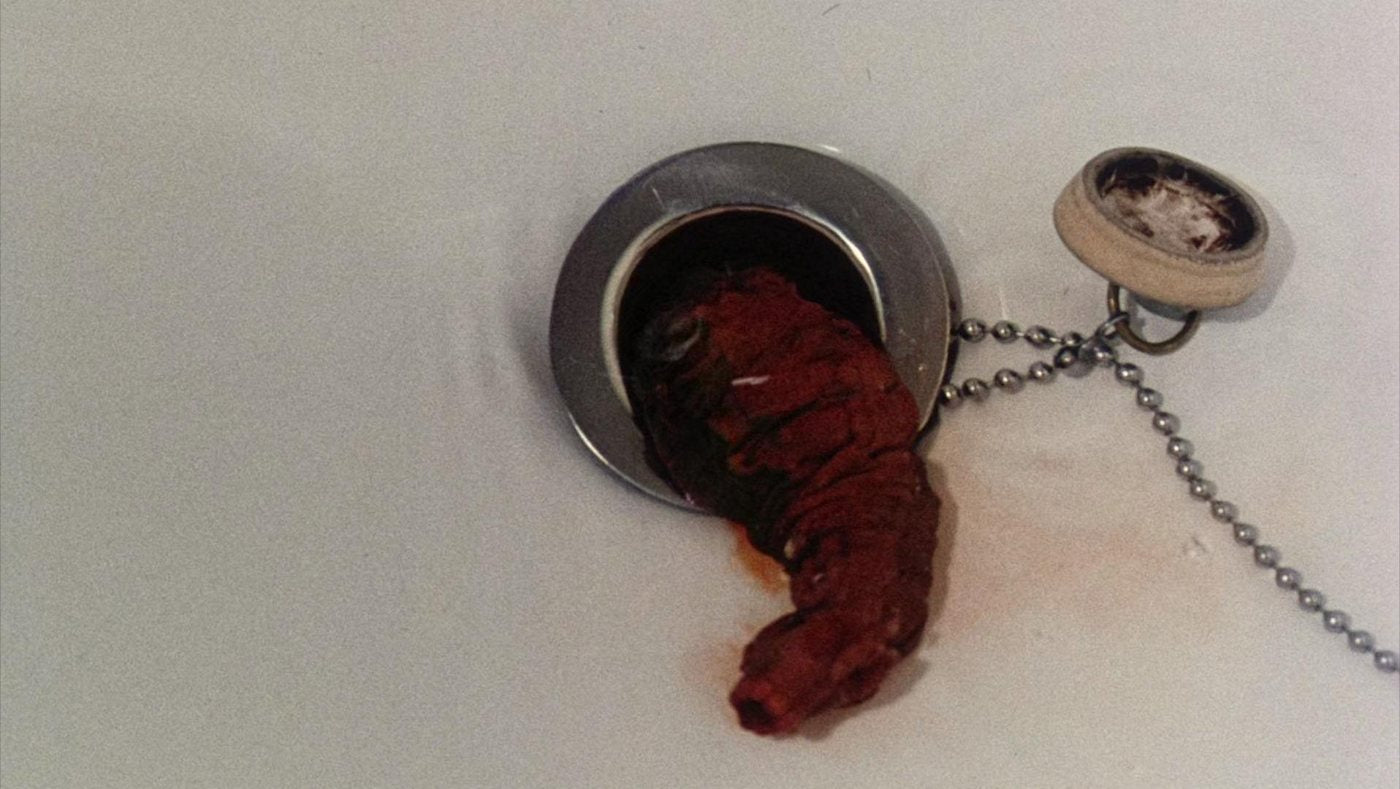
The bathtub sequence makes the plumbing reverse its expected direction. The organism enters through the drain, crosses the water’s field and transforms a protected bodily ritual into an attack. The editing distributes the event among the creature, Betts’s face, water movement and the fallen glass. The later glass and drain images give the scene an aftermath, rather than ending at the largest reaction. Steele’s performance and the physical environment carry as much of the sequence as the creature insert.

The plug and chain establish the ordinary drain.
FX-06.01 · 00:40:55.015The plug and chain establish the ordinary drain.
The creature displaces the plug and enters the bath.
FX-06.02 · 00:40:58.018The creature displaces the plug and enters the bath.
The parasite has emerged through the drain.
FX-06.03 · 00:41:08.028The parasite has emerged through the drain.
The overhead view fixes its position in the bath.
FX-06.04 · 00:41:20.040The overhead view fixes its position in the bath.
Betts’s face provides the human register of the encounter.
FX-06.05 · 00:41:30.050Betts’s face provides the human register of the encounter.
Water movement begins to disrupt the stable composition.
FX-06.06 · 00:41:34.054Water movement begins to disrupt the stable composition.
The edit cuts away from the body to the bathroom floor.
FX-06.07 · 00:41:36.056The edit cuts away from the body to the bathroom floor.
The close view holds on the performer’s reaction.
FX-06.08 · 00:41:51.071The close view holds on the performer’s reaction.
Aftermath: the fallen glass remains beside the bath.
FX-06.09 · 00:43:05.020Aftermath: the fallen glass remains beside the bath.
Continue in the dossier ↗
FX-07 / 6 FRAMES

The walking stick becomes a conduit

Open sequence study +

The cane gives the creature a route from floor to arm while preserving a clear spatial relationship between the couple and the effect. Close inserts of the object alternate with wider reactions. The support is then used as a weapon, reversing its function a second time. A dark residue on the red carpet concludes the local action. Dory’s PH-15 supplies a production-side comparison for the corridor and cane material; it should not be treated as a substitute for this edited screen progression.

The effect begins at the lower end of the cane.
FX-07.01 · 00:49:20.020The effect begins at the lower end of the cane.
The creature’s position shifts upward along the support.
FX-07.02 · 00:49:25.025The creature’s position shifts upward along the support.
The parasite reaches the forearm.
FX-07.03 · 00:49:29.029The parasite reaches the forearm.
The couple’s reaction establishes the attack’s bodily consequence.
FX-07.04 · 00:49:31.031The couple’s reaction establishes the attack’s bodily consequence.
The cane is used to strike rather than support.
FX-07.05 · 00:49:40.040The cane is used to strike rather than support.
A dark smear remains on the corridor carpet.
FX-07.06 · 00:49:43.043A dark smear remains on the corridor carpet.
Continue in the dossier ↗
FX-08 / 7 FRAMES

Nick’s mouth: care and expulsion

Open sequence study +

The mouth effect arrives within Janine’s attempt to hold and comfort Nick. Tight views turn the lips into a frame around the wet creature form, while her face and their hands interrupt the isolated spectacle. The sequence makes the effect relational: the frightening object is emerging from somebody she knows. Its changing visibility is documented here without assigning the individual insert to a particular operator beyond the film’s credited effects team.

Janine supports Nick’s head at close range.
FX-08.01 · 00:57:20.041Janine supports Nick’s head at close range.
The red form becomes visible at the mouth.
FX-08.02 · 00:57:25.046The red form becomes visible at the mouth.
The protruding effect interrupts the face’s familiar outline.
FX-08.03 · 00:57:28.049The protruding effect interrupts the face’s familiar outline.
Janine’s response gives the reveal an emotional countershot.
FX-08.04 · 00:57:31.052Janine’s response gives the reveal an emotional countershot.
The close insert isolates the mouth and creature.
FX-08.05 · 00:57:35.056The close insert isolates the mouth and creature.
Hands keep the encounter tied to physical contact.
FX-08.06 · 00:57:37.058Hands keep the encounter tied to physical contact.
The mouth’s appearance changes again before Janine leaves.
FX-08.07 · 00:57:46.067The mouth’s appearance changes again before Janine leaves.
Continue in the dossier ↗
FX-09 / 7 FRAMES

The ruptured torso and Linsky’s face

Open sequence study +

Removing the covering reveals an abdomen that is already open. The selected frames do not show an intact surface bursting: the reveal, wound inserts and attack on Linsky establish the rupture through an edited succession. Linsky’s glasses rest across the bloody abdomen after the attack, leaving a sharply recognizable personal object inside the effect image. The effect then changes scale from the patient’s whole torso to a second man’s face, carrying the medical observer into the physical event he approached to examine.

The examination moves toward the covered abdomen.
FX-09.01 · 01:13:14.036The examination moves toward the covered abdomen.
The opened torso is revealed beneath the covering.
FX-09.02 · 01:13:20.042The opened torso is revealed beneath the covering.
The wound fills a closer composition.
FX-09.03 · 01:13:24.046The wound fills a closer composition.
The attack reaches Linsky’s face.
FX-09.04 · 01:13:26.048The attack reaches Linsky’s face.
Linsky’s glasses lie across the bloody abdominal surface.
FX-09.05 · 01:13:35.057Linsky’s glasses lie across the bloody abdominal surface.
The glasses give a familiar scale to the wound insert.
FX-09.06 · 01:13:36.058The glasses give a familiar scale to the wound insert.
Linsky withdraws from the bedside.
FX-09.07 · 01:13:43.065Linsky withdraws from the bedside.
Continue in the dossier ↗
FX-10 / 7 FRAMES

Removal, exposed body and struggle

Open sequence study +

The kitchen turns household tools and washing facilities into an emergency effects environment. Pliers and the sink offer a crude continuation of the medical examination. Nick then stands with the abdominal construction exposed, allowing the wound to remain part of a moving performance. The struggle shifts attention between the prosthetic surface, bloodied faces and grasping hands. The effect’s function has changed from revelation to sustained bodily action.

Linsky selects a tool in the kitchen.
FX-10.01 · 01:13:58.080Linsky selects a tool in the kitchen.
The face carries blood and the aftermath of the attack.
FX-10.02 · 01:14:04.086The face carries blood and the aftermath of the attack.
The sink becomes part of the attempted removal.
FX-10.03 · 01:14:19.101The sink becomes part of the attempted removal.
Nick stands with the abdominal wound exposed.
FX-10.04 · 01:14:22.104Nick stands with the abdominal wound exposed.
The two bodies meet in a physical struggle.
FX-10.05 · 01:14:31.113The two bodies meet in a physical struggle.
Close framing concentrates the action around faces and hands.
FX-10.06 · 01:14:45.127Close framing concentrates the action around faces and hands.
Blood remains part of the performance after the first impact.
FX-10.07 · 01:15:00.142Blood remains part of the performance after the first impact.
Continue in the dossier ↗
FX-11 / 7 FRAMES

Forsythe: the mouth reveal

Open sequence study +

Forsythe’s transformation is concentrated into a sudden change of angle and scale. Her open mouth exposes a red form, and St. Luc’s immediate withdrawal changes the intimate spacing of the preceding exchange. The following material—her collapsed posture, his improvised preparation and the gag—translates the reveal into a new form of physical control. The scene’s spoken ideas belong with the dossier’s dialogue sources; these images establish its visual reversal.

The close exchange places the two faces within intimate reach.
FX-11.01 · 01:16:30.023The close exchange places the two faces within intimate reach.
The mouth opens to reveal the red creature form.
FX-11.02 · 01:16:34.027The mouth opens to reveal the red creature form.
The altered angle emphasizes the mouth and throat.
FX-11.03 · 01:16:35.028The altered angle emphasizes the mouth and throat.
St. Luc pulls back from the encounter.
FX-11.04 · 01:16:36.029St. Luc pulls back from the encounter.
Forsythe’s posture changes after the reveal.
FX-11.05 · 01:16:38.031Forsythe’s posture changes after the reveal.
Available material is gathered for an improvised restraint.
FX-11.06 · 01:16:46.039Available material is gathered for an improvised restraint.
The mouth is covered by the gag.
FX-11.07 · 01:16:54.047The mouth is covered by the gag.
Continue in the dossier ↗
FX-12 / 8 FRAMES

The pool: choreography replaces the isolated creature

Open sequence study +

The climax expands the effects study beyond prosthetics. Bodies, glass, water and coordinated movement turn the pool into a collective mechanism. The railing temporarily separates St. Luc from the crowd, but a hand at his leg and pressure from several directions remove that separation. Forsythe’s approach culminates in a forced kiss while the surrounding bodies hold him. A visible parasite insert is unnecessary here: the film transfers the force of the earlier creature effects to the organized human group.

Residents converge outside the pool enclosure.
FX-12.01 · 01:23:20.016Residents converge outside the pool enclosure.
The grip binds the dry ledge to the water below.
FX-12.02 · 01:23:28.024The grip binds the dry ledge to the water below.
The crowd breaches the glass boundary.
FX-12.03 · 01:23:32.028The crowd breaches the glass boundary.
The doctor is caught between the railing, water and approaching residents.
FX-12.04 · 01:23:52.048The doctor is caught between the railing, water and approaching residents.
Another body enters the pool.
FX-12.05 · 01:24:10.066Another body enters the pool.
St. Luc is held in the water as Forsythe approaches.
FX-12.06 · 01:24:28.084St. Luc is held in the water as Forsythe approaches.
The kiss is sustained by surrounding hands and bodies.
FX-12.07 · 01:24:44.100The kiss is sustained by surrounding hands and bodies.
The close encounter expands into a crowded pool composition.
FX-12.08 · 01:25:04.120The close encounter expands into a crowded pool composition.
Continue in the dossier ↗

03 / DESIGN & PERFORMANCE

What makes the effect work.

The sales image returns as a trap
CRAFT-01 · 00:01:06.087The sales image returns as a trap

The sales image returns as a trap

The opening establishes the garage, pool, domestic interiors and clinic as desirable amenities. Their later appearances turn that catalogue into a structural map: the garage obstructs escape, the pool absorbs the doctor, the apartment becomes a laboratory and the clinic cannot contain the organism. The development’s completeness is precisely what gives the outbreak so many connected spaces.

Continue in the dossier ↗
Objects change jobs
CRAFT-02 · 00:30:31.851Objects change jobs

Objects change jobs

A refrigerator lights a collapse, a cane carries an attack, a mail slot admits a creature and kitchen pliers become emergency medical equipment. These are not incidental decorations. Each object begins with a recognizable use and acquires a second, bodily function. The film’s design makes the transformation legible without having to redesign the whole environment.

Continue in the dossier ↗
The appliance and the performance
CRAFT-03 · 00:33:36.077The appliance and the performance

The appliance and the performance

The abdominal construction has a documented life outside the finished image in Attila Dory’s production photographs. On screen, the performer’s hands and face bridge the prosthetic surface and the character’s experience. The later upright wound and kitchen struggle show a different requirement: the construction has to remain convincing while participating in broader bodily action.

Continue in the dossier ↗
Blood as a wayfinding device
CRAFT-04 · 00:31:43.047Blood as a wayfinding device

Blood as a wayfinding device

The film often lets a trace precede or outlast a creature: the door, laundry machine, parquet floor and red corridor carpet retain marks of contact. Those marks direct attention through spaces whose surfaces were introduced as clean and functional. Blood becomes a visible record of circulation, linking effects work to the architecture’s ordinary routes.

Continue in the dossier ↗
From glass container to glass enclosure
CRAFT-05 · 01:23:32.028From glass container to glass enclosure

From glass container to glass enclosure

The specimen behind glass offers one model of observation; the pool’s glass wall offers another. The first separates a scientific observer from a contained organism. The second briefly separates a threatened doctor from an approaching crowd. Once the barrier breaks, observation gives way to participation. The film’s visual logic moves from looking at a body to being taken into one.

Continue in the dossier ↗
Domestic taste gives the outbreak texture
CRAFT-06 · 00:11:30.711Domestic taste gives the outbreak texture

Domestic taste gives the outbreak texture

Floral textiles, sculptural seating, patterned lamps, red telephones and kitchen provisions distinguish the apartments from the institutional corridors. Those differences prevent the tower from becoming an abstract diagram. Infection travels through recognizable styles of living, and each scene changes the meaning of a room that was built to serve a particular comfort.

Continue in the dossier ↗

04 / DIALOGUE & BROADCASTS

What the building tells itself.

Sales language, medical explanations, private conversations and news bulletins give the outbreak its competing accounts. Seven readings connect the spoken text to the film’s rooms, objects and movement.

DL-01 / 00:00:05–00:02:25

The building speaks before the residents

Read dialogue study +

Merrick introduces Starliner as a luxury cruise that can be lived every day. The address moves from the bridge and underground garage to guest parking, domestic appliances, recreation, shops and medical care. The residents become passengers in a world designed to meet their needs without requiring them to leave.

That list is also a map of the film to come. The garage, corridors, clinic and pool belong to one connected system. The sales pitch makes enclosure sound like freedom; the outbreak turns the same self-contained convenience into a mechanism for contact. Even the assurance of exclusive ownership works against the residents once their bodies stop respecting private boundaries.

Continue in the dossier ↗Dialogue source / SH-D01
DL-02 / 00:03:31–00:03:41

A gun sold as an amenity

Read dialogue study +

Asked whether he ever uses his gun, the doorman explains that it has never left its holster. His company carries guns because a rival company does. The weapon is part of the sales presentation: a visible promise of protection rather than a response to an identified danger.

The exchange sharpens the opening tour’s idea of security. Starliner offers the appearance of a controlled environment, complete with a uniform, a desk and a gun. The threat is already developing inside that environment, beyond the entrance the guard is stationed to protect.

Continue in the dossier ↗Dialogue source / SH-D01
DL-03 / 00:15:33–00:17:43

The parasite begins as useful work

Read dialogue study +

Linsky describes an alternative to organ transplantation: breed a parasite that takes over an organ’s function. His kidney example imagines the organism joining the circulation, filtering blood and taking a share for itself. The parasite enters the film’s explanation as a practical biological arrangement, before its other purpose is disclosed.

The lunch-table conversation joins bodily appetite to professional ambition. St. Luc interrupts the explanation to ask for mustard. Linsky then praises Hobbes’s ability to secure grants and names an organ-transplant society as the project’s sponsor—even though the proposed replacement could undermine its business. Medicine, money and consumption occupy the same conversation. The sponsor belongs to the film’s fiction; it is not a production-financing credit.

Continue in the dossier ↗Dialogue source / SH-D01
DL-04 / 00:36:48–00:40:31

The explanation travels through files and a telephone

Read dialogue study +

Forsythe brings patient files and published papers; Linsky subsequently calls with a different account drawn from Hobbes’s personal notes. The contrast matters. The respectable research record describes medical work, while the private papers disclose an attempt to reverse an excess of rational control by acting directly on bodily instinct.

Linsky describes the new organism as combining sexual stimulation with transmissible disease. He also explains Hobbes’s attempt to destroy the parasites in Annabelle. The call reorganizes what the opening violence meant, then turns the explanation into urgent clinical instructions. Knowledge has to move between apartments, papers and a telephone before St. Luc can connect the separate patients to one outbreak.

Continue in the dossier ↗Dialogue source / SH-D01
DL-05 / 00:00:05–00:02:25 / 00:35:23–00:36:23 / 01:26:24–01:27:02

Three public accounts of Starliner

Read dialogue study +

Between the opening advertisement and the final bulletin, a news report describes the deaths in Annabelle’s apartment. It presents the bodies as a murder-suicide and an unexplained medical operation, with names withheld, then moves on to a labour story. The catastrophe enters the public record as one item in the ordinary news sequence.

The closing bulletin reports assaults spreading from the vicinity of Starliner Island into Montreal while withholding police confirmation; a police spokesman dismisses the reports. The audience has already seen the residents leave. Across the three addresses, the building passes from an advertised refuge to a contained crime story to a citywide emergency that official language has yet to acknowledge. The broadcasts enlarge the film’s geography without requiring another city scene.

Continue in the dossier ↗Dialogue source / SH-D01
DL-06 / 01:06:56–01:07:21

Property management becomes a lure

Read dialogue study +

Residents approach Merrick with a noise complaint. He replies with a story about their locker being broken into and invites them to his office to identify scattered belongings. He uses the familiar language of a building manager dealing with residents’ property.

The exchange turns an everyday service relationship into a way of directing bodies. A complaint, a damaged locker and an offer of help provide the route into danger. Starliner’s management language keeps working after its promise of protection has failed.

Continue in the dossier ↗Dialogue source / SH-D01
DL-07 / 01:15:07–01:16:30

Talking and breathing enter the dream

Read dialogue study +

Forsythe’s dream moves from an encounter with an old, dying man to a claim that erotic life includes disease, dying, speech, breath and physical existence itself. Her account does more than repeat Hobbes’s programme. It gives the new bodily order a vocabulary from within an intimate conversation.

The inclusion of talking and breathing is decisive: the distinction between sexual activity and ordinary life collapses. Words themselves become part of the body’s activity, rather than a detached explanation of it. Set beside Linsky’s telephone account, the speech marks a shift from a doctor describing an experiment to a participant accepting its world.

Continue in the dossier ↗Dialogue source / SH-D01

05 / THE SCREEN RECORD

The names on the film.

Read the credits in this copy, with the relevant frame beside each record.

CR-01

Restoration identification

Read credit record +

The opening card identifies a digital restoration by TIFF. This establishes the restoration lineage visible in the supplied file, not a specific retail disc edition.

Restoration identification
CR-01 · 00:00:02.023Restoration identification
CR-02

Director of photography

Read credit record +

Robert Saad is credited over the kitchen image.

Director of photography
CR-02 · 00:01:00.081Director of photography
CR-03

Special make-up and creature

Read credit record +

The opening credit names Joe Blasco for special make-up and creation of the creature.

Special make-up and creature
CR-03 · 00:01:10.091Special make-up and creature
CR-04

Editing, sound supervision and production management

Read credit record +

The opening card names Patrick Dodd as editor, Dan Goldberg as sound supervisor and Don Carmody as production manager.

Editing, sound supervision and production management
CR-04 · 00:01:18.099Editing, sound supervision and production management
CR-05

Music supervision

Read credit record +

Ivan Reitman is credited as music supervisor. This is a supervision credit, not a claim that he composed every piece of music used.

Music supervision
CR-05 · 00:01:26.107Music supervision
CR-06

Writing and direction

Read credit record +

David Cronenberg’s writing and directing credit appears over the medical suite.

Writing and direction
CR-06 · 00:02:14.155Writing and direction
CR-07

Principal role credits

Read credit record +

The roll pairs Roger St. Luc with Paul Hampton, Rollo Linsky with Joe Silver, Forsythe with Lynn Lowry, Nicholas Tudor with Allan Migicovsky, Janine Tudor with Susan Petrie and Betts with Barbara Steele. The opening card spells the Tudor performer’s first name “Alan”; the end roll uses “Allan”. He is known as Allan Kolman.

Principal role credits
CR-07 · 01:26:42.051Principal role credits
CR-08

Laundry woman and Annabelle

Read credit record +

The end roll identifies Nora Johnson as Laundry Woman and Cathy Graham as Annabelle. Annabelle has no surname in this credit; screenplay surname variants remain a separate record.

Laundry woman and Annabelle
CR-08 · 01:26:52.061Laundry woman and Annabelle
CR-09

Stunts and continuity

Read credit record +

Fournier Frères is credited for stunts and Diane Boucher for continuity.

Stunts and continuity
CR-09 · 01:26:58.067Stunts and continuity
CR-10

Effects assistance, stills and art department

Read credit record +

The roll identifies Attila Dory for stills, David Dittmar as assistant to Joe Blasco, Erla Gliserman as art director and Rose Marie McSherry as art assistant. These credits do not assign a particular creature insert to Dittmar or a particular prop to Gliserman.

Effects assistance, stills and art department
CR-10 · 01:27:08.077Effects assistance, stills and art department
CR-11

Sound and laboratory

Read credit record +

Michael Higgs is credited as sound recordist; Jean-Claude Matte and Jim Thompson for boom; Len Blum as sound assistant; Nolan Roberts for re-recording; Mirrophonic Sound as sound studio; and Québec Film Labs as laboratory.

Sound and laboratory
CR-11 · 01:27:14.083Sound and laboratory
CR-12

Locations and wardrobe

Read credit record +

The producers thank the developers of Nuns’ Island, Montreal, for buildings and facilities. Paul Hampton’s wardrobe is credited to Aquascutum of London and Joe Silver’s to Freedman of Montreal.

Locations and wardrobe
CR-12 · 01:27:22.091Locations and wardrobe
CR-13

Preservation elements

Read credit record +

The restoration card identifies elements preserved and provided by the Cinémathèque québécoise in Montréal.

Preservation elements
CR-13 · 01:27:40.109Preservation elements
CR-14

Digital restoration services

Read credit record +

Technicolor receives the digital restoration services credit on the final card.

Digital restoration services
CR-14 · 01:27:44.113Digital restoration services
Source SH-V01 / image and timecode record

Frames are from the supplied English-title reference copy of Shivers, carrying the TIFF digital restoration credit and closing credits for Cinémathèque québécoise elements and Technicolor restoration services. Container runtime: 01:27:50.250. Picture: 1916 × 1080. The retail edition is unidentified.

Timecodes measure elapsed time from the start of this file, including the restoration card. Still references retain the decoded presentation timestamp. Sequence ranges are reading guides, not frame-exact cut lists. Full-frame images accompany close visual analysis; production photographs remain identified separately in the dossier.

Film frames: Shivers (1975), written and directed by David Cronenberg. Images reproduced for film study and criticism. All film-image rights remain with their respective holders.

Dialogue source SH-D01. Readings use the English track in source copy SH-V01. A full-file local speech-recognition transcript was compared with overlapping, bounded transcriptions of the cited passages using two model sizes. The entries paraphrase the dialogue; time ranges locate passages in this file and are not frame-exact speech boundaries. These are transcript-based readings, not a direct listening log of music, vocal delivery or effects.

Explore the dossier’s full source file ↗

OBJECT ATLAS / THE FILM IN COLOUR

Objects on screen.

Rooms, clothes and everyday things inside Starliner. These colour frames come from the film; each can be enlarged and traced to its source locator.

Timecodes refer to the supplied viewing copy. Viewing copy & timebase ↗

Rooms & infrastructure

Props & appliances

The Tudor breakfast table — colour frame from Shivers
FILM FRAME / 00:07:30.513

ONE SCENE / THREE OBJECT RECORDS

The Tudor breakfast table

Patterned mugs, banded bowls and a woven basket bring texture to the apartment’s daily routine. Read the objects together, then compare the table in Dory’s production photograph.

Costume & jewellery

Bloodied lapel — colour frame from Shivers
FILM FRAME / 01:21:24.943

SH-A21 / Costume

Bloodied lapel

Blood marks the jacket’s lapel and front as St. Luc reaches the pool. The professional outfit now carries the building’s violence on its surface.

Source & locator

In Dory’s photograph: The same professional outfit carries visible damage while the doctor holds the gun.

The jacket’s blood staining in the film; Dory’s PH.21 separately records St. Luc holding the gun.

2012.1397.PH.21

Attila Dory: The doctor with the gun — PH.21
Betts layered necklaces — colour frame from Shivers
FILM FRAME / 01:10:44.303

SH-A22 / Costume

Betts layered necklaces

Several necklaces and bracelets contrast with a dark sleeveless dress. Their repeated shapes connect the doorway and pool photographs.

Source & locator

The necklaces and dark dress in the electrical room; compare the doorway and pool photographs in Dory’s gallery.

2012.1397.PH.07 and PH.24

Attila Dory: Betts at the doorway — PH.07

The creature

Hobbes parasite — colour frame from Shivers
FILM FRAME / 00:41:08.028

SH-A09 / Creature

Hobbes parasite

Blasco’s creature turns plumbing and domestic space into routes through the building. Its body is shown here at the bathtub drain.

Surviving creature

A surviving Blasco creature catalogued by TIFF.

Surviving Blasco creature reproduced in the Evolution catalogue

Read the object study →

Source & locator

Screen appearance of the parasite. The collection record below describes the surviving physical creature.

Digital catalogue, PDF p.22; David Cronenberg Collection

TIFF / Volumina: David Cronenberg: Evolution (2013), curator-hosted digital catalogue

Follow the gore and effects sequences → · See the torso appliance under construction →

6 SCREEN-OBJECT STUDIES

Objects in use.

Follow the building, its furnishings and practical effects through the film and their surviving records.

OBJECT STUDY / SH-A01, SH-A02, SH-A03, SH-A05, SH-A06, SH-A19, SH-A29, SH-A34, SH-A41The building as a circulation system
The opening title images introduce Starliner through its rooms and amenities.
The opening title images introduce Starliner through its rooms and amenities. Art of the Title: Shivers

Starliner’s identity is assembled from places. The title sequence’s tower, bedroom, garage, lounge, pool and medical room promise that a resident can live through the building’s services. The sequence makes the development legible as a product: its parts appear together under a consistent field of yellow credits.

Art of the Title: Shivers

Dory’s photographs take the same system down to the scale of use. Washer lids open along a shared work surface; a delivery hatch crosses an apartment boundary; an incinerator receives what residents discard. These are three different kinds of circulation—cleaning, provision and disposal. Each depends on a connection between private life and common infrastructure.

Attila Dory: A camera in the laundry — PH.03 · Attila Dory: The cane in the corridor — PH.15 · Attila Dory: Searching the incinerator — PH.19

The interpretive link is permeability. A door may define an apartment, but the household still relies on people, materials and services crossing its perimeter. In this reading, the organism exploits relationships already built into the development. The building’s machinery gives the threat a social route as well as a physical one.

The incinerator makes that route especially concrete. Its chamber, cover, latch and pipework occupy the photograph as working equipment, while St. Luc’s long tool extends his reach into it. A piece of plant becomes a place to investigate.

Attila Dory: Searching the incinerator — PH.19

Goods and specimens

The resident shop combines refrigerated goods with shelves of everyday merchandise. FilmGrab frame 09.
The resident shop combines refrigerated goods with shelves of everyday merchandise. FilmGrab frame 09. FilmGrab: Shivers frame gallery (3 October 2025)
A 500 mL conical flask stands between broad specimen jars. FilmGrab frame 22.
A 500 mL conical flask stands between broad specimen jars. FilmGrab frame 22. FilmGrab: Shivers frame gallery (3 October 2025)

The shop arranges supplies for circulation; the specimen display holds bodies still for examination. Glass makes the contents visible in both settings. The conical flask’s 500 mL marking supplies a concrete scale designation, while the varied jar shapes prevent the group from reading as a uniform laboratory kit. These are different forms of managed access within the same residential world.

FilmGrab: Shivers frame gallery (3 October 2025)

RELATED RECORDS

Back to screen objects ↑
OBJECT STUDY / SH-A09, SH-A15, SH-A16The artificial torso and its concealed edge
The upper edge of the torso panel runs across the chest. Side fastenings and the real shoulders remain visible during adjustment. Framing and costume would conceal the appliance boundary in the finished image. — Attila Dory, 2012.1397.PH.02.
The upper edge of the torso panel runs across the chest. Side fastenings and the real shoulders remain visible during adjustment. Framing and costume would conceal the appliance boundary in the finished image. — Attila Dory, 2012.1397.PH.02. Attila Dory: The edge of the effect — PH.02

The torso panel is a body-sized object worn over another body. Its upper edge runs across the chest; the performer’s shoulders remain outside it. Side attachments and the hands attending to the fitting make the appliance’s boundaries unusually clear. The construction has to accommodate both the actor and the camera.

Attila Dory: Tudor’s artificial torso — PH.01 · Attila Dory: The edge of the effect — PH.02

The photograph suggests a central design problem: the artificial surface must be large enough to carry the effect, while its border must fall outside the convincing image. That relationship links fabrication to costume and framing. The effect is completed by what the composition includes and excludes, as well as by the panel itself.

Joe Blasco’s on-screen credit connects special makeup and creature creation. Dory’s separate photograph of Silver’s facial makeup extends the record from a wearable torso to an injury built on the face. Brushwork and blood on clothing place the latter image during preparation.

Art of the Title: Shivers · Attila Dory: Linsky’s damaged face — PH.05

Read together, these records show a production constructing bodily change at more than one scale. The torso gives a large surface to disturbance beneath the skin; facial work concentrates damage around a recognizable performer. The same fictional infection requires different physical objects and different kinds of contact with the actor.

The creature in the collection

Hobbes parasite. David Cronenberg Collection, TIFF Film Reference Library. Object photograph: Maciek Linowski / Synthescape Art Imaging.
Hobbes parasite. David Cronenberg Collection, TIFF Film Reference Library. Object photograph: Maciek Linowski / Synthescape Art Imaging. TIFF / Volumina: David Cronenberg: Evolution (2013), curator-hosted digital catalogue

Swipe or scroll sideways to read every column → Keyboard: focus the table and use the left/right arrow keys.

Catalogue fieldRecorded value
CreatorJoe Blasco
MaterialsFoam latex, paint, metal wire
Dimensions, as listed7.6 × 54.6 × 8.9 cm

The catalogue photograph preserves the ribbed body and projecting wire. This surviving object adds a different kind of evidence to Dory’s photographs of effects work on the performer.

TIFF / Volumina: David Cronenberg: Evolution (2013), curator-hosted digital catalogue

At the drain

The ribbed creature crosses the bath-drain opening beside the plug and chain. FilmGrab frame 41.
The ribbed creature crosses the bath-drain opening beside the plug and chain. FilmGrab frame 41. FilmGrab: Shivers frame gallery (3 October 2025)

The creature’s folds press against the drain’s rigid circular edge, while the chain remains an ordinary domestic detail. The household fitting gives the impossible body an immediate sense of scale.

FilmGrab: Shivers frame gallery (3 October 2025)

RELATED RECORDS

Back to screen objects ↑
OBJECT STUDY / SH-A23, SH-A24, SH-A25, SH-A26The Tudor breakfast table
The Tudor table combines patterned mugs, contrasting bands on bowls, saucers, pale-handled cutlery, tumblers, bread and a woven basket. Ribbed glazing stands behind the couple. — Attila Dory, 2012.1397.PH.23.
The Tudor table combines patterned mugs, contrasting bands on bowls, saucers, pale-handled cutlery, tumblers, bread and a woven basket. Ribbed glazing stands behind the couple. — Attila Dory, 2012.1397.PH.23. Attila Dory: Breakfast as a designed scene — PH.23

Dory’s breakfast photograph brings several decorative systems into one small field. Tall mugs carry patterns, bowls have contrasting bands, and the pale handles of the cutlery sit among saucers and tumblers. Bread and rolls gather in a shallow woven basket. The table is arranged for an ordinary shared routine.

Attila Dory: Breakfast as a designed scene — PH.23

The ribbed glazing behind the Tudors adds another pattern: long vertical repetitions against the smaller curves and bands of the tableware. Its architectural rhythm remains visible behind a collection of portable possessions. The photograph makes the apartment feel occupied through this meeting of fixed finish and domestic objects.

For a material reading, the distinction matters. A tower’s exterior can suggest a uniform residential population; the breakfast surface gives the household its own texture. Different vessels share the same table without having to become a perfectly matched service. The basket introduces another material and another scale of repetition.

The open-refrigerator photograph returns to the home from floor level. Janine attends to Tudor while bottles remain in the door shelves and a can lies nearby. In this pairing, domestic things retain their use and familiarity as the people around them lose the ability to sustain the routine. Breakfast and refrigeration place bodily need inside the apartment before the infection transforms it.

Attila Dory: The open refrigerator — PH.25

RELATED RECORDS

Back to screen objects ↑
OBJECT STUDY / SH-A07, SH-A08, SH-A28Umbrella, hatch and walking aid
Two older women stand beneath the tower. One carries a transparent domed umbrella with a dark border; gloves, handbags, beads and a hat complete the carefully dressed outing. The transparent canopy makes an impact above the face visible. — Attila Dory, 2012.1397.PH.13.
Two older women stand beneath the tower. One carries a transparent domed umbrella with a dark border; gloves, handbags, beads and a hat complete the carefully dressed outing. The transparent canopy makes an impact above the face visible. — Attila Dory, 2012.1397.PH.13. Attila Dory: The transparent umbrella — PH.13

The umbrella offers a miniature version of enclosure. A clear domed canopy surrounds the space above its carrier’s head, while a dark rim draws the boundary. Gloves, handbags, beads and a hat situate the two figures within a carefully prepared outing. The photograph holds the face and the canopy in the same readable field.

Attila Dory: The transparent umbrella — PH.13

Its transparency gives protection an unusual visual property: an intrusion on the outside can remain visible in relation to the person beneath. MacMillan’s 1981 essay singled out the umbrella among the ordinary objects whose meaning the film changes.

Robert MacMillan: Shivers …Makes Your Flesh Creep! / adjacent Cronenberg interview
The older couple has fallen beneath a delivery hatch beside an apartment door. A four-footed walking aid reaches across the struggle. Everyday access and support equipment become part of the crisis. — Attila Dory, 2012.1397.PH.15.
The older couple has fallen beneath a delivery hatch beside an apartment door. A four-footed walking aid reaches across the struggle. Everyday access and support equipment become part of the crisis. — Attila Dory, 2012.1397.PH.15. Attila Dory: The cane in the corridor — PH.15

The corridor photograph presents another boundary at a lower height. A delivery hatch sits beside an apartment door, and a four-footed walking aid extends across the fallen couple. The draft calls the opening a milk box. Together, hatch and cane connect the architecture of access with the physical work of moving through it.

Attila Dory: The cane in the corridor — PH.15 · Shivers: circulated shooting-draft transcription, IMSDb

These objects belong to different tasks—shelter, delivery and support—but their usefulness depends on closeness to a body. This study reads them as local versions of Starliner’s larger promise of convenience. The disturbance becomes legible where familiar equipment meets an exposed person.

The colour frame distinguishes the umbrella’s red rim and matching handle from its clear canopy. FilmGrab frame 32.
The colour frame distinguishes the umbrella’s red rim and matching handle from its clear canopy. FilmGrab frame 32. FilmGrab: Shivers frame gallery (3 October 2025)

RELATED RECORDS

Back to screen objects ↑
OBJECT STUDY / SH-A04, SH-A17, SH-A32One amenity, three kinds of enclosure
From across the pool, one foreground figure is isolated against a glazed wall with figures beyond. Reflections and the handrail divide the available planes of action. — Attila Dory, 2012.1397.PH.14.
From across the pool, one foreground figure is isolated against a glazed wall with figures beyond. Reflections and the handrail divide the available planes of action. — Attila Dory, 2012.1397.PH.14. Attila Dory: Inside and outside the glass — PH.14

Glass and railings organize the pool before the crowd fills it. Dory’s wide views divide foreground action from figures beyond the glazed wall; reflections add another layer to the separation. The room can display a person in isolation while keeping other bodies in sight.

Attila Dory: The pool threshold — PH.06 · Attila Dory: Inside and outside the glass — PH.14

The furniture carries that organization down to the deck. In the photograph of Betts and St. Luc, an overturned chair lies beside the water. His suit, patterned socks and shoes and her necklaces and bracelets preserve the appearance of dressed residential life at the pool edge. The displaced chair adds a visible disturbance to the setting.

Attila Dory: Betts and St. Luc at the water — PH.24
Crew members stand in the water supporting a camera with a large protective covering and a tripod assembly. A cable runs toward the deck. — Attila Dory, 2012.1397.PH.11.
Crew members stand in the water supporting a camera with a large protective covering and a tripod assembly. A cable runs toward the deck. — Attila Dory, 2012.1397.PH.11. Attila Dory: Taking the camera into the pool — PH.11

A production photograph then places crew members and a protected camera inside the water. The support assembly and trailing cable turn the amenity into a working camera environment. The crew’s physical position belongs to the image-making problem: the scene is filmed among the same material conditions that surround the performers.

Attila Dory: Taking the camera into the pool — PH.11

Finally, the group photograph encloses St. Luc with residents. Arms and faces replace the room’s glass as the immediate boundary around him. Read across the photographs, enclosure changes scale—from architecture, to working space, to bodies. Lowry’s recollection of cold water and crowded performers gives that visual progression a cast member’s physical perspective.

Attila Dory: The crowd becomes the enclosure — PH.22 · Alex DiVincenzo: Lynn Lowry retrospective (11 November 2022)

RELATED RECORDS

Back to screen objects ↑
OBJECT STUDY / SH-A35The telephone as a furnishing

Two interiors, one design language

A / THE FILM
The closed red telephone sits at the lower right of Tudor’s furnished room. FilmGrab frame 26.
The closed red telephone sits at the lower right of Tudor’s furnished room. FilmGrab frame 26. FilmGrab ↗
B / THE MANUFACTURER
Contempra catalogue cover: the telephone occupies the foreground of a staged social interior. Northern Electric; TCI watermark retained.
Contempra catalogue cover: the telephone occupies the foreground of a staged social interior. Northern Electric; TCI watermark retained. Catalogue leaf T9-1·01·01 ↗

Swipe or scroll sideways to read every column → Keyboard: focus the table and use the left/right arrow keys.

DetailRead the comparison
ProfileA and B show a sloping handset nested in a low angular base. The shared silhouette supports the family comparison.
PlacementThe film places the appliance beside drinks and glassware; the catalogue places it beside a rose on a marble table. Both present communications equipment as part of domestic taste.
IdentityThe catalogue supplies the Contempra name. The film’s closed handset leaves the rotary or push-button variant unseen; the maker label is not visible.

A small architecture on the table

The telephone repeats the room’s hard edges in miniature: a low wedge, a ridged handset and a sharply sloping base. Its red casing joins the carpet, lamp and chair frame in an otherwise pale interior. The appliance has the visual weight of a furnishing.

FilmGrab: Shivers frame gallery (3 October 2025)

The screen telephone’s profile closely matches the Contempra illustrated here. Northern Electric’s November 1972 leaves offered rotary and push-button versions with the dial inside the handset, and listed Bright Red among the finishes. The closed handset in the film frame prevents a choice between those two variants.

Northern Electric: CONTEMPRA Standard Telephone Sets, T9 catalogue leaves (11/72)

Convenience, displayed

The manufacturer sold the telephone as a sign of taste as well as a communications device. Its catalogue photograph places the compact form on a marble table, with a rose and a couple behind it. In Tudor’s room, the corresponding cluster is a telephone, bottles, glassware and a seated body. Read together, the images show how an ordinary service could become part of the promise of a cultivated private life.

Northern Electric: CONTEMPRA Standard Telephone Sets, T9 catalogue leaves (11/72)

This is a material connection between Starliner’s modern conveniences and the consumer world outside the film. It also gives the telephone a place in the case beyond its usefulness to the plot: domestic technology helps make the apartment look settled and complete.

RELATED RECORDS

Back to screen objects ↑

MAKING SHIVERS

Production records.

A shooting report, an annotated map, script details and the restored title: documents of the film’s construction.

OBJECT STUDY / SH-A38, SH-A39A day on Starliner

A dated day beside a working map

A / DAILY REPORT
The report itself is dated 23 August 1974 and identifies shooting day three under Starliner. Cinépix archive.
The report itself is dated 23 August 1974 and identifies shooting day three under Starliner. Cinépix archive. Daily report ↗
B / LOCATION MAP
Handwritten markings identify working destinations on a residential development map. Cinépix archive.
Handwritten markings identify working destinations on a residential development map. Cinépix archive. Annotated island map ↗

Swipe or scroll sideways to read every column → Keyboard: focus the table and use the left/right arrow keys.

DetailRead the comparison
DateThe report records the shooting day as 23 August and the production start as 21 August.
PlaceThe report records 1 Place du Commerce and 100 de Gaspé. The map combines development information with practical location markings.
ScheduleThe report schedules the production to finish on 17 September.

Swipe or scroll sideways to read every column → Keyboard: focus the table and use the left/right arrow keys.

FieldRecorded value
Working title / shooting dayStarliner / 3
Start / scheduled finish21 August 1974 / 17 September 1974
Location entry1 Place du Commerce – 100 de Gaspé
Setups completed that day14
Named performersAllan Migicovsky, Joy Coghill and Sue Petrie
Starliner: daily production report, 23 August 1974

This page measures filmmaking in a day’s work: calls, setups, script coverage and locations. Its finish date is a schedule, not a record of the eventual wrap. Tudor’s office and the tower appear within the same day’s logistics.

Starliner: daily production report, 23 August 1974

The map’s residential sales language and the crew’s handwritten annotations occupy the same sheet. A development sold as a desirable place to live becomes a set of places to work. Read beside the daily report, it shows how the fictional enclosure was assembled through practical movement across the island.

Cinépix archive: annotated Nuns’ Island location map · Starliner: daily production report, 23 August 1974

RELATED RECORDS

Back to production records ↑

ATTILA DORY / PRODUCTION PHOTOGRAPHS

On the set of Shivers.

Eighteen photographs from the Cinémathèque québécoise collection. Dory records performances, rooms, costume details, makeup and the camera at work. Enlarge any photograph to inspect it.

The torso appliance — photograph by Attila Dory
The torso applianceAttila Dory · 2012.1397.PH.02Cinémathèque québécoise ↗
Object & production notes
A camera in the laundry — photograph by Attila Dory
A camera in the laundryAttila Dory · 2012.1397.PH.03Cinémathèque québécoise ↗
Object & production notes
Working below the washer — photograph by Attila Dory
Working below the washerAttila Dory · 2012.1397.PH.04Cinémathèque québécoise ↗
Linsky’s makeup — photograph by Attila Dory
Linsky’s makeupAttila Dory · 2012.1397.PH.05Cinémathèque québécoise ↗
Object & production notes
Betts at the doorway — photograph by Attila Dory
Betts at the doorwayAttila Dory · 2012.1397.PH.07Cinémathèque québécoise ↗
Taking the camera into the pool — photograph by Attila Dory
Taking the camera into the poolAttila Dory · 2012.1397.PH.11Cinémathèque québécoise ↗
Object & production notes
Tudor at the office — photograph by Attila Dory
Tudor at the officeAttila Dory · 2012.1397.PH.12Cinémathèque québécoise ↗
The transparent umbrella — photograph by Attila Dory
The transparent umbrellaAttila Dory · 2012.1397.PH.13Cinémathèque québécoise ↗
Inside and outside the glass — photograph by Attila Dory
Inside and outside the glassAttila Dory · 2012.1397.PH.14Cinémathèque québécoise ↗
The cane and delivery hatch — photograph by Attila Dory
The cane and delivery hatchAttila Dory · 2012.1397.PH.15Cinémathèque québécoise ↗
Object & production notes
The common-room display — photograph by Attila Dory
The common-room displayAttila Dory · 2012.1397.PH.16Cinémathèque québécoise ↗
Object & production notes
Searching the incinerator — photograph by Attila Dory
Searching the incineratorAttila Dory · 2012.1397.PH.19Cinémathèque québécoise ↗
St. Luc’s professional surface — photograph by Attila Dory
St. Luc’s professional surfaceAttila Dory · 2012.1397.PH.20Cinémathèque québécoise ↗
The doctor with the gun — photograph by Attila Dory
The doctor with the gunAttila Dory · 2012.1397.PH.21Cinémathèque québécoise ↗
The indoor pool — photograph by Attila Dory
The indoor poolAttila Dory · 2012.1397.PH.22Cinémathèque québécoise ↗
Breakfast as a designed scene — photograph by Attila Dory
Breakfast as a designed sceneAttila Dory · 2012.1397.PH.23Cinémathèque québécoise ↗
Object & production notes
Betts and St. Luc at the water — photograph by Attila Dory
Betts and St. Luc at the waterAttila Dory · 2012.1397.PH.24Cinémathèque québécoise ↗
Object & production notes
The open refrigerator — photograph by Attila Dory
The open refrigeratorAttila Dory · 2012.1397.PH.25Cinémathèque québécoise ↗

CAMPAIGN & RELEASE MATERIALS

Selling Shivers.

Posters, exhibitor sheets, invitations and publicity documents: the film’s public identity beyond the screen.

CAMPAIGN STUDYOne film, several promises.
British quad, 30 × 40 inches. Striped green lettering and the red Sitges medallion distinguish the British campaign; the dealer watermark is retained.
British quad, 30 × 40 inches. Striped green lettering and the red Sitges medallion distinguish the British campaign; the dealer watermark is retained. Original Film Poster: Shivers UK quad

The British quad and American campaign sheet organize fear differently. One foregrounds the title’s shuddering graphic rhythm and festival recognition; the other turns the word “within” into an upward arrow and pairs the bathtub with exorcism language. These are objects made to sell a film, not neutral records of its story.

Original Film Poster: Shivers UK quad · They Came from Within: US ad-campaign sheet (1975)Open the release and campaign collection →
OBJECT STUDY / SH-A12, SH-A13, SH-A33, SH-A36, SH-A40The campaign sheet as an exhibitor’s tool
The reverse of the US campaign sheet combines release information, advertising formats and credits.
The reverse of the US campaign sheet combines release information, advertising formats and credits. They Came from Within: US ad-campaign sheet (1975)

The US sheet addresses an exhibitor with both imagery and instructions. Its front carries a sized advertising block, identified as AD 303B and specified at three columns by eight inches, with 336 lines. On the reverse, the film becomes a set of distributable materials: cast, credits, poster formats and presentation information.

They Came from Within: US ad-campaign sheet (1975)

The arrow in They Came from Within gives the title a direction; the bathtub illustration and exorcism language give the campaign a sensational point of entry. The advertised 88 minutes and 1.85:1 belong to this release document. The one-sheet and 40 × 60 listing describe paper an exhibitor could use to sell it.

They Came from Within: US ad-campaign sheet (1975)

The British quad builds a different surface around the same film. Striped green lettering makes the title vibrate, while a red Sitges medallion supplies festival recognition. Its dealer record describes the 30 × 40 inch format. The official festival record identifies Cronenberg’s 1975 award as Best Feature Film Director.

Original Film Poster: Shivers UK quad · Sitges Film Festival: Awards 1975

The title’s later restoration adds another material layer. Cowan describes the Canadian title being reconstructed for TIFF’s 2013 restoration from elements centered on an American print. Campaign paper and restored screen lettering therefore trace different stages in the film’s changing identity.

Noah Cowan: Shivers restoration programme note (2013)

From a photograph to a market pitch

Cinépix’s Cannes advertisement reuses a studio photograph of a model seated on film containers.
Cinépix’s Cannes advertisement reuses a studio photograph of a model seated on film containers. Cinépix at Cannes: branding advertisement and studio photograph

The Cannes layout places the model on a stack of film containers, adds the Parasite Murders campaign and turns the company’s slate into a promise of profit. The separate studio photograph exposes the starting material. The advertisement sells a business encounter as well as individual titles.

Cinépix at Cannes: branding advertisement and studio photograph
French Frissons sales-sheet face, with a MARTI signature at the right edge. Société Nationale.
French Frissons sales-sheet face, with a MARTI signature at the right edge. Société Nationale. Frissons: French sales sheet, Société Nationale

The French sheet replaces the building with a dripping pink head, an enormous eye and a reaching figure. Its reverse returns to a synopsis and scene photographs. The design shifts between surreal bodily threat and practical plot explanation, while the paired titles keep the film recognizable across territories.

Frissons: French sales sheet, Société Nationale
The Parasite Murders sticker photographed on a staff T-shirt; model unidentified in the Cinépix archive.
The Parasite Murders sticker photographed on a staff T-shirt; model unidentified in the Cinépix archive. Cinépix archive: The Parasite Murders promotional sticker

The small rounded rectangle reduces the campaign to a screaming face and three lines of title. Its placement makes the wearer a carrier of the advertisement. The archive identifies a sticker applied to clothing, which gives this object a different production logic from a screenprinted shirt.

Cinépix archive: The Parasite Murders promotional sticker

RELATED RECORDS

Back to campaign materials ↑
OBJECT STUDY / SH-A42, SH-A43The film leaves the island
The Parasite Murders screening invitation: horror imagery above a precise schedule and André Link’s Cannes contact. Cinépix archive.
The Parasite Murders screening invitation: horror imagery above a precise schedule and André Link’s Cannes contact. Cinépix archive. The Parasite Murders: Cannes screening invitation

Three appointments with a nightmare

The invitation gives buyers three opportunities to see the film: two at Cinema Vox and one at Cinema Star 2. The screaming face, looming tower and clutching bodies sell disorder; the timetable beneath them makes the transaction orderly. Its reverse reduces the pitch to a huge red SHOCK!

The Parasite Murders: Cannes screening invitation

Swipe or scroll sideways to read every column → Keyboard: focus the table and use the left/right arrow keys.

ScreeningVenueTime
Friday 16 MayCinema Vox10:00
Saturday 17 MayCinema Vox14:30
Monday 19 MayCinema Star 216:00
The Parasite Murders: Cannes screening invitation

From a sales screening to competition

On 20 August 1975, Sitges director Antonio Ráfales wrote to Cinépix’s Warner Wolfe in Paris. Following their telephone conversation, he expressed interest in The Parasite Murders for the competitive section and asked for the entry forms to be returned. This is the administrative work behind the festival story: a distributor’s conversation becomes an invitation and a request for paperwork.

Antonio Ráfales to Warner Wolfe: Sitges invitation, 20 August 1975
English face of the Film Festival Bureau’s bilingual Shivers / Frissons information sheet.
English face of the Film Festival Bureau’s bilingual Shivers / Frissons information sheet. Film Festival Bureau: Shivers / Frissons bilingual information sheet

The Film Festival Bureau sheet offers another register. Technical specifications, named companies and a CFDC acknowledgment frame a synopsis that reveals the ending. Its French face describes a closed environment of glass, steel, carpets and automatic doors; its English face follows the cars leaving for the city. The building’s failure becomes an exportable explanation of the film.

Film Festival Bureau: Shivers / Frissons bilingual information sheet

Who gets remembered first?

In December 1989, John Dunning sent Shivers to Miami Herald critic Bill Cosford after reading his praise of the chest eruption in Alien. Dunning argued for his earlier film’s place in effects history, actively shaping its legacy.

John Dunning to Bill Cosford, Miami Herald, 29 December 1989

These papers follow distinct kinds of circulation: a buyer enters a screening, a film enters a competition, an institution distributes a synopsis, and a producer contests a later account of the past. The same work moves through each system under different descriptions.

RELATED RECORDS

Back to campaign materials ↑

SOURCE TRAIL

Follow the evidence.

Contemporary records, archival photographs, production testimony and later criticism remain separately identifiable.

TIFF Canadian Film Encyclopedia: Shivers

Institutional film record

Credits and film-history entry

Open source ↗
Cinémathèque québécoise: Shivers screening record

Institutional programme

Cast and location description

Open source ↗
Art of the Title: Shivers

Title-sequence reference

Nine-frame composite, read left to right

Open source ↗
Noah Cowan: Shivers restoration programme note (2013)

Restoration participant / programme

Restoration paragraph; archived equivalent owl-plane-mehm.squarespace.com/cronenberg/shivers

Open source ↗
Brad Deane interview, That Shelf (3 September 2013)

Firsthand restoration interview

Shivers restoration discussion

Open source ↗
Attila Dory: Shivers photographs, Cinémathèque québécoise

Archival collection

2012.1397.PH.01–26

Open source ↗
NEUF: With Mies on Nun’s Island (1 December 2022)

Architectural practice history

In the Footsteps of Mies van der Rohe

Open source ↗
Hannah Ferguson: Shivers, Nuns’ Island and haunted utopian urbanism (May 2023)

Scholarly critical essay

Hi-Rise no. 3; residents’ apartments; Rodley citation

Open source ↗
Allan Tong: Cronenberg on architecture and his early work (24 January 2014)

Reported public conversation

OCAD conversation with Piers Handling; Shivers passage

Open source ↗
Shivers: circulated shooting-draft transcription, IMSDb

Unauthenticated screenplay transcription

Labelled SHOOTING DRAFT / 1975. Opening, rental office, Linsky’s arrival and attack, and Forsythe’s dream. Matching copies share one textual lineage.

Open source ↗
Robert MacMillan: Shivers …Makes Your Flesh Creep! / adjacent Cronenberg interview

Period criticism and interview

Cinema Canada, March 1981, printed pp. 11–15; PDF pp. 1–5. Interview and essay occupy separate columns.

Open source ↗
Maurice Yacowar: You Shiver Because It’s Good

Period criticism

Cinema Canada, February 1977, pp. 54–55; PDF pp. 2–3

Open source ↗
Susan Ayscough: Sex … Porn … Censorship … Art … Politics …

Firsthand director interview

Cinema Canada, December 1983, pp. 15–18; Shivers discussion PDF p. 2

Open source ↗
John J. Wolotko: A Parasite-free Ottawa?

Contemporary editorial

Cinema Canada, November 1975, p. 53, bottom half. Shares page with John Hofsess.

Open source ↗
Alex DiVincenzo: Lynn Lowry retrospective (11 November 2022)

Firsthand cast interview

Reitman audition; Hampton; pool sequence

Open source ↗
Bryant Frazer: Shivers, Vestron Blu-ray (29 September 2020)

Disc review reporting supplements

Blasco, Carmody and Cronenberg supplement descriptions

Open source ↗
Tim Salmons: Shivers Blu-ray review (9 October 2020)

Disc review / supplement inventory

Audio paragraph and extras list

Open source ↗
John W. McKelvey: Dueling Blus, Shivers, Arrow vs Vestron

Edition comparison

Updated 22 September 2020; pressing identification and transfers

Open source ↗
Muck47: initial Arrow Blu-ray vs German DVD comparison (28 October 2014)

Shot comparison by another researcher

10 differences / 25.2 seconds; source-specific timebases

Open source ↗
Sitges Film Festival: Awards 1975

Official festival record

Gold Carnation Medal for Best Feature Film Director

Open source ↗
Sitges Film Festival: Shivers programme record

Official festival synopsis

Released-film opening: acid

Open source ↗
Original Film Poster: Shivers UK quad

Dealer object record / image

30 × 40 inches; folded; Broomhead litho; award medallion

Open source ↗
William Beard: The Artist as Monster, revised and expanded edition (2006)

Scholarly monograph / publisher preview

PDF pp. 40–59; bibliographic page PDF 4

Open source ↗
Statistics Canada: Canada Year Book 1976–77

Contemporary government record

Printed p. 340: Distribution, 1975–76 Canadian box-office receipts

Open source ↗
The Music Scene, July–August 1976

Contemporary music-industry report

Ivan Reitman item; text says he arranged the music, citing Clyde Gilmour on finance

Open source ↗
John Hofsess: Goodbye to all that from a banned filmmaker

Period industry polemic

CFDC / Cinepix discussion; figures are the author’s contemporary claims

Open source ↗
Antonio Rodrigues: Shivers, Cinemateca Portuguesa (2 and 6 May 2024)

Institutional screening programme

Opening credits block: sets / cenários Erla Gliserman; essay by Antonio Rodrigues

Open source ↗
They Came from Within: US ad-campaign sheet (1975)

Period publicity object via dealer photographs

Front: AD 303B, 3 Col. × 8 inches, 336 lines; reverse: cast, credits, formats, 88 minutes / 1.85:1

Open source ↗
Shivers: Merrick welcomes the Svibens

Released-film excerpt, unidentified transfer

Opening excerpt, 00:00–00:15 (clip clock).

Open source ↗
Joy Coghill: career, 1970–1979

Performer memorial / career record

Mona Wheally spelling in memorial; archive PH.12 shows Tudor with the older office colleague

Open source ↗
David Cronenberg on Shivers — CBC interview preserved by TIFF

Primary director interview / archival television

00:04–00:10 development and pay; 00:42–01:30 public funding and political pressure

Open source ↗
David Cairns and Daniel Riccuito: Barbara Steele interview (25 October 2020)

Primary cast interview

Shivers paragraphs immediately before the Winds of War discussion

Open source ↗
Olivier Rossignot: Barbara Steele interview (17 November 2025)

Primary cast interview / bilingual publication

English version: question beginning “Your role in David Cronenberg’s Shivers”; Malibu meeting and Montréal shoot

Open source ↗
Calum Waddell interviews John Dunning — The Dark Side Digital 6

Primary producer interview

Printed pp.19–20 / PDF pp.19–20: Cinépix, Reitman and the government pamphlet campaign

Open source ↗
BBFC: Shivers, theatrical classification record AFF024302

Official classification record / archived capture

Classification dated 9 September 1975; Target International Films Ltd; X; 87m 28s; passed uncut

Open source ↗
TIFF / Volumina: David Cronenberg: Evolution (2013), curator-hosted digital catalogue

Primary exhibition catalogue and director interview

PDF p.22: Hobbes parasite caption; pp.21 and 23: Shivers interview; p.14 / printed p.27: interview dates; printed p.237: photography credit

Open source ↗
Cinépix archive: End Roll Credits, marked typescript

Primary production credit document

PDF p.1 cast; p.2 crew, sound and wardrobe acknowledgments

Open source ↗
Starliner: daily production report, 23 August 1974

Primary daily production record

Shooting day 3; start 21 August; scheduled finish 17 September; locations and 14 setups on p.1

Open source ↗
Cinépix archive: annotated Nuns’ Island location map

Primary annotated location document

Prime Location, Store and Place du Commerce annotations

Open source ↗
Cinépix archive: printed Shivers production-credit entry

Archive-hosted filmography extract

Sound supervisor Dan Goldberg; reported filming 21 August–14 September 1974; 10 October 1975 Montréal opening

Open source ↗
William Beard and Piers Handling: Cronenberg interview, The Shape of Rage (1983), excerpt

Primary director interview / book excerpt

Printed pp.173, 176 and 179: showing the parasite, the ending and identification

Open source ↗
Stephen Chesley: It’ll Bug You, Cinema Canada 22 (October 1975)

Contemporary director interview

Printed pp.23–25; p.25: editing, Dan Goldberg, post-sync, ambience and coat movement tracks

Open source ↗
Cinépix: Is There a Place for Horror Films in Canada’s Film Industry?

Primary publicity brochure and appended correspondence

PDF pp.1–14 brochure; pp.6–8 Fulford article reprint; pp.15–21 letters. PDF pagination differs from printed brochure pagination.

Open source ↗
Cinépix archive: The Parasite Murders promotional sticker

Primary promotional-object photograph

Single page; rounded rectangular screaming-face sticker

Open source ↗
Cinépix at Cannes: branding advertisement and studio photograph

Primary trade advertisement and source photograph

PDF p.1 model on film containers; p.2 advertisement using the same photograph

Open source ↗
Frissons: French sales sheet, Société Nationale

Primary territorial marketing paper

PDF p.1 illustrated face; p.2 synopsis and scene montage

Open source ↗
They Came from Within: US publicity stills and lobby cards

Primary marketing-paper scan collection

PDF pp.1–9 monochrome; pp.10–17 colour campaign cards

Open source ↗
Frissons: French lobby cards, Société Nationale

Primary marketing-paper scan collection

Blue Frissons title block, Parasite Murders subtitle, age-restriction line

Open source ↗
FilmGrab: Shivers frame gallery (3 October 2025)

Released-film frame gallery / unidentified transfer

Shivers_09 shop; _10 medical room; _22 specimens; _26 telephone; _32 umbrella; _41 drain creature

Open source ↗
David Cronenberg: The night Attila met the anti-Christ, she was shocked and he was outraged

Primary autobiographical newspaper essay / later reproduction

Reproduction p.15. TIFF’s bibliography cites the original Globe and Mail article, 14 May 1977, p.14.

Open source ↗
Chris Alexander: The First Flesh, Fangoria 309 (January 2012)

Primary director interview / edited print version

Printed pp.47–48: directing condition, CFDC financing, title changes and retrospective claims

Open source ↗
Antonio Ráfales to Warner Wolfe: Sitges invitation, 20 August 1975

Primary festival correspondence

Invites The Parasite Murders for competitive section and requests completed entry paperwork

Open source ↗
John Dunning to Bill Cosford, Miami Herald, 29 December 1989

Primary producer correspondence

Dunning’s argument for the film’s priority in effects history.

Open source ↗
The Parasite Murders: Cannes screening invitation

Primary sales invitation

Cinema Vox, Friday 16 May 10:00 and Saturday 17 May 14:30; Cinema Star 2, Monday 19 May 16:00; André Link contact

Open source ↗
Film Festival Bureau: Shivers / Frissons bilingual information sheet

Primary institutional publicity paper

35mm, colour, 87 minutes; Dal Productions, Cinépix and CFDC acknowledgment; music field names Ivan Reitman

Open source ↗
Robin Wood: Cronenberg: A Dissenting View, The Shape of Rage (1983), excerpt

Original critical essay / book excerpt

Shivers argument pp.129–130; reply to Harkness in p.129 footnote

Open source ↗
John Harkness: The Word, The Flesh and David Cronenberg, The Shape of Rage (1983), excerpt

Original critical essay / book excerpt

Speculation and scientific intention pp.88–91; controlled environments pp.91–92

Open source ↗
Northern Electric: CONTEMPRA Standard Telephone Sets, T9 catalogue leaves (11/72)

Manufacturer catalogue / period design reference

Standard-set leaves T9-1·01·01–03; reverse leaves printed 11/72. Repository title contains 1962, which does not date these leaves.

Open source ↗
TIFF Higher Learning: Cronenberg and Ron Sanders on Videodrome, selected bibliography

Institutional bibliography / clipping reference

Lists Cronenberg’s Attila essay in The Globe and Mail, 14 May 1977, p.14.

Open source ↗
The Terror Trap: John Dunning interview, Part I (March 2011)

Primary producer interview / indexed passages

Questions about Shivers dailies, screenplay and Is There a Place for Horror Films in Canada?

Open source ↗
The Terror Trap: John Dunning interview, Part II (March 2011)

Primary producer interview / indexed passage

Final question: whether Link as money man and Dunning as creative man is an oversimplification.

Open source ↗