The clinic gives her a new body. The city inherits its hunger.
WRITTEN & DIRECTED BY DAVID CRONENBERGCANADA / COLOUR / 1977FULL-FILM SPOILERS
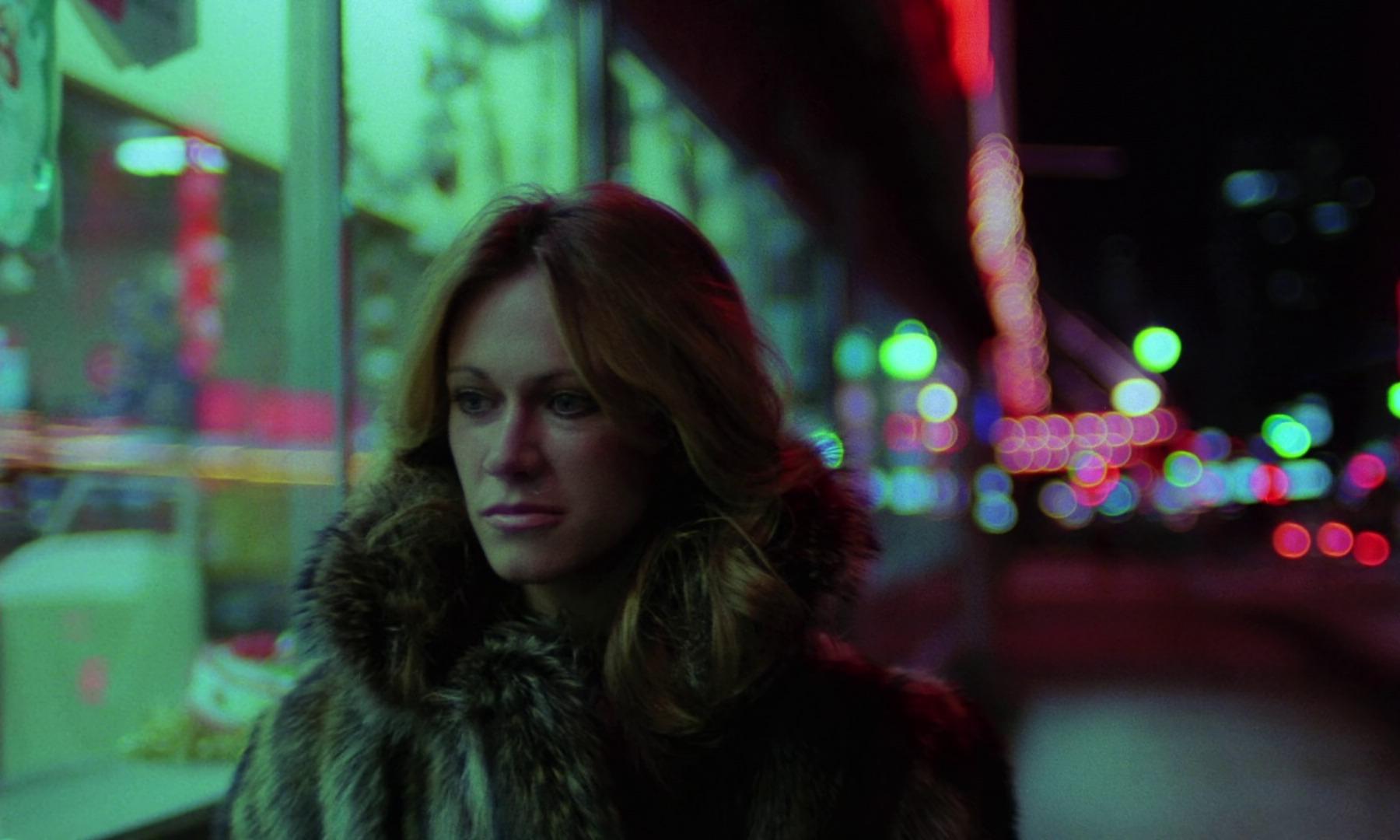
Rose in the city’s coloured light. Fur, glass and neon bring the private wound into public space. RB-V01 / 00:54:22.030
From the red K on a patient’s robe to the anonymous white suits of the clean-up teams, Rabid builds its catastrophe out of ordinary design. Enter the clinic, follow the objects into Montreal, and examine the production paper that carried the film into the world.
RABID / THE FILM, IN DETAIL
A private wound. A city infected.
Follow Rose from the Keloid Clinic into Montreal’s streets, cinemas and transit systems. A chronological image guide, close studies of the gore and effects, dialogue and broadcast readings, and the screen credits behind the work.
Open a scene study to follow the image into the archive. Time ranges identify sequences; each enlarged still carries its own source timecode.
SC-01 / 00:00–01:31
Two riders and a road
Read scene study +
Rose begins in black leather and a white helmet: a body equipped for movement and protection. The road occupies the centre of the image while close views of boots, wheels and controls bind the riders to their machine. The film establishes mobility before it introduces the institution that will interrupt it.
The red K stands against a wood-grain sign outside a horizontal brick building. Inside, Murray Cypher discusses the clinic’s future with the Keloids. The office, formal clothes and business conversation place surgery inside a commercial organization. The later emergency grows out of this reassuring professional world.
A camper blocks the road. The sequence moves between its occupants, the approaching motorcycle, the riders’ protective equipment and the field where the bike lands. Fire turns the roadside into an emergency scene. The clinic’s bright ambulance brings the injured bodies inside the branded institution introduced moments earlier.
Scrubbing, an anaesthetic mask, green drapes, suspended bottles and an array of circular lamps divide medical work into visible tasks. The skin-removal insert makes the graft concrete: tissue can be cut, lifted and transferred to a tray. The film gives the treatment a material reality before showing what it produces.
The hospital bed sits against a woven headboard with warm bedside lighting. Hart’s visit and farewell kiss make this a room of intimacy as well as treatment. The arrangement matters later: the same bed and bodily closeness will accommodate a different kind of exchange.
Lloyd Walsh’s robe and the clinic’s wooden corridors continue the language of a private resort. Rose draws him close on the bed. Her face, his collapsing posture and blood running across pale fabric tell the story before the new organ is clearly displayed. An embrace has become an operation neither person understands.
Walsh staggers into another patient’s room; blood transfers to a white glove. Under the examination lamp his wound becomes an enlarged, blue-green circle. The movement from embrace to diagnostic image does not restore control. Medicine can see the injury without yet grasping the process that made it.
Rose leaves by the exterior stairs and moves into the barn’s chains, rough timber and animal stalls. Her pale institutional gown carries the clinic into this agricultural setting. The encounter with the cow and the farmer makes hunger physical while shifting the action outside the medical staff’s sightlines.
Hart works among a dismantled motorcycle, tools and a red chest while Rose calls from the clinic. Repair occupies both sides of their separation: a machine can be worked on visibly, while her transformed body remains difficult to explain. The handset connects the rooms but cannot close the distance between them.
The hospital’s illuminated exterior gives way to a patient leaving with a bag and entering a taxi. The chain of transmission now uses an ordinary service. A vehicle that should carry someone home becomes an enclosed space in which a driver cannot keep his passenger at a safe distance.
The clinic’s small tiled pool supplies another setting for bodily ease. Rose approaches Judy Glasberg in the water; the camera alternates a view of the entire pool with tightly compressed contact. The handrail, tiled edges and churning surface keep the action spatially confined. Rose ends stretched against the poolside.
Walsh’s attack crosses the taxi’s front and back seats. Road views interrupt the struggle, showing the consequences outside the passenger compartment. The overturn and the approaching truck enlarge a bodily crisis into a moving hazard for people who have had no contact with Rose.
Microscopic scrutiny and bedside reassurance lead to a close inspection of the opening beneath Rose’s arm. Fingers, skin and the doctor’s face make the examination tactile. When Keloid leans into the embrace, professional proximity becomes the route of infection. The person who changed her body is now exposed to its new function.
In the bright roadside restaurant, sunglasses briefly conceal the farmer’s altered eyes. His eating becomes aggressive, then the encounter turns into an attack. Windows, counter seating and a waitress’s pink uniform hold the scene inside everyday commerce. The disorder has arrived in a place built to satisfy ordinary appetite.
The film returns to the lamp cluster and green operating clothes. Keloid’s reddened eyes interrupt the appearance of professional concentration. His attack converts the hand offered for surgical work into a site of injury. The ensuing struggle breaks the team’s carefully ordered arrangement around the patient.
Rose changes into outdoor clothes and reaches the highway while Hart and Murray approach in the Keloid station wagon. The emblem remains on the car even as police occupy the clinic. These crossing routes give the sequence its frustration: the men arrive at an institution whose patient has already moved beyond it.
Hart follows a policeman through the clinic’s service space. The refrigerator door opens onto Judy, still in her blue swimsuit, with frost covering her face and hair. A leisure costume and a storage appliance now frame a corpse. This is Judy’s body, a distinction that also matters when reading the film’s publicity imagery.
Rose sits high in the truck cab, surrounded by its broad windscreen, controls and the driver’s belongings. Food, sickness and physical assistance bring the two people closer. The highway then supplies another change of vehicle. The sequence turns informal kindness and ordinary travel into links in the outbreak.
An official presents his credentials through a car window; elsewhere men hold a patient in a busy institutional room. Identification, restraint and medical equipment now operate together. The response is spreading through the same transport and workplace networks as the illness.
The truck reaches a depot under night lighting. A bite and a violent struggle unfold among doors, scales and work surfaces. The driver’s body arches as a red wound appears at his abdomen. The setting is functional and unglamorous: infection has entered the infrastructure that moves goods through the city.
A television sits among houseplants and domestic objects while Claude Lapointe appears beneath a bureau-of-health caption. The broadcast gives a scattered series of attacks an official public form. The small screen can name an emergency while the people watching it remain embedded in their normal rooms and relationships.
Hart’s consultation is interrupted by a visibly infected policeman. Bars, uniforms and guns establish a system of authority, but the officer is already inside it. The shooting leaves a damaged body against a blood-marked wall. The response now produces its own graphic aftermath.
Mindy’s apartment gives Rose a temporary domestic refuge. Outside, the fur collar catches green shop light and coloured street bulbs; the Eve marquee advertises another form of bodily spectacle. She enters the cinema as both a spectator and someone looking for bodily contact. The city’s surfaces make her conspicuous and anonymous at once.
Rows of seats, a dim blue wash and the red exit sign surround Rose and the man who moves beside her. His approach reads as a familiar cinema encounter. Brief inserts of the underarm opening and pointed organ disclose the action concealed by their seated bodies and her coat. She leaves him behind among the spectators.
Rose lies on the kitchen floor beside the refrigerator and cupboards. Mindy’s ordinary household becomes another place of attempted care. The image brings hunger down to floor level, replacing the clinic’s supervised bed with the hard surface of a domestic room.
Mindy enters a packed train. A pale passenger with discoloured eyes stands within touching distance of strangers, and the attack breaks through the carriage’s ordinary jostling. Handrails and doorways channel bodies without giving them room to separate. Public transport becomes an amplifier of proximity.
A car crosses a winter worksite; workers approach it, while further television coverage and crowded institutional interiors broaden the emergency. The film builds scale from recognizable tasks and places. The epidemic does not replace the city with an abstract wasteland: it changes how its existing workplaces and services function.
Rose sits beneath mall decorations while police and soldiers occupy the shopping environment. A man approaches her before another attack triggers gunfire. The sequence cuts through bodies, a Christmas ornament and Santa’s display. The cheerful set dressing makes the indiscriminate reach of the response brutally legible.
Pink checked bedding, a stuffed toy and Mindy’s large glasses make the bedroom distinctly personal. Rose curls into the bed while her friend tends her. Care is no longer an institutional procedure, but its dependence on bodily closeness remains unchanged. The room’s warmth gives the later attack its emotional weight.
Vaccination equipment, soldiers, documents and brightly lit entrances turn movement into an administered process. Hart and Murray drive through wet streets marked by emergency vehicles and protective clothing. The Keloid emblem travels through a city whose systems of care and control are now inseparable.
The staircase leads into patterned wallpaper, a hanging mobile, a crib and a toy-filled room. Murray’s search ends in a domestic catastrophe organized around what these objects imply rather than a graphic display of every injury. The nursery’s careful furnishing makes the destruction of family safety immediate.
Mindy tends Rose in bed, then moves into the kitchen while Hart continues through the controlled streets. Rose dresses and approaches her friend at the door. The hug draws on the gestures of comfort established throughout their scenes together. By returning to this familiar contact, the film makes affection part of the transmission route.
The long corridor postpones Hart’s arrival. Inside, Mindy lies on the pale carpet with blood visible at her arm; Rose covers her own exposed underarm. Their confrontation then moves into the sharply shadowed stairwell. The architecture turns an argument about responsibility into a physical struggle and separation.
Rose selects another man, then lies beside a telephone while he remains in the same room. Hart receives the call from Mindy’s apartment. The composition lets the viewer see the danger getting up behind Rose while she stays absorbed in the conversation. Her attempt to settle the question of responsibility becomes the final demonstration of it.
The film moves from interior intimacy to an alley of leaves, refuse bags and service doors. White-suited workers carry Rose to a garbage truck. Her blue clothing remains recognizable, but the collection procedure gives her no special status. The credit roll continues over the vehicle and alley: the system carries on after the central body has disappeared.
Twenty expanded studies trace the setup, effect and aftermath. The opening credits name Joe Blasco Make-Up Association for special makeup design and Byrd Holland, JBMA, as special makeup artist. The closing roll credits Al Griswold and Joe Elzner separately for physical effects. Each study follows the visible image, performance and cut; individual mechanisms remain tied to the production sources that describe them.
FX-01 / 5 FRAMES
Impact, separation and fire
Open sequence study +
The crash is assembled from changes in scale and angle: a boot at the controls, the road obstruction, the airborne motorcycle, a helmeted body on the ground, then a distant fireball. Each view supplies a different piece of the event. The frames document the visible stunt and pyrotechnic sequence; the film credits Fournier Frères Cascadeurs for stunts and Al Griswold for special effects without assigning individual shots.
FX-01.01 · 00:03:42.034Boot and motorcycle controls establish the rider’s physical connection.FX-01.02 · 00:03:49.041The camper occupies the motorcycle’s path.FX-01.03 · 00:03:52.044The motorcycle and riders leave the ground in silhouette.FX-01.04 · 00:03:55.047The fallen machine and helmeted body share the field.FX-01.05 · 00:04:00.052A wide view makes the fireball distinct from the preceding close shots.
The operation moves from Rose’s still face and the surgical team to a tightly bounded rectangular wound. Forceps lift a thin layer; vertical blood trails give the surface weight and gravity. A separate tray insert completes the transfer. The effect is organized around handling and sequence, turning the medical explanation into an object the viewer can follow.
FX-02.01 · 00:09:35.012Rose lies under the surgical drapes.FX-02.02 · 00:09:40.017The team and equipment establish the operating space.FX-02.03 · 00:09:48.025The tissue strip begins to lift.FX-02.04 · 00:09:54.031The raised layer exposes the red rectangle beneath it.FX-02.05 · 00:10:03.040The removed material is placed in a metal tray.FX-02.06 · 00:10:09.046Fingers work directly against the tissue in the tray.
The first feeding withholds a clear view of the mechanism. The embrace places Walsh’s neck beneath Rose’s arm; her expression and the blood travelling over her skin and his robe carry the action. The eventual stillness changes the same arrangement from intimacy to collapse. The costume functions as a pale surface on which the effect can register.
FX-03.01 · 00:16:18.081Rose holds Walsh close, with his head beneath her arm.FX-03.02 · 00:16:22.085Blood runs down the arm and onto the cream robe.FX-03.03 · 00:16:30.093The two bodies fall back together on the bed.FX-03.04 · 00:16:40.103Rose continues to hold the collapsed man.
The film gives the first feeding a second account through its aftermath. A helper discovers blood on a white glove. The clinical examination then enlarges the wound within a circular illuminated lens before returning to the doctor, nurse and patient. The round frame concentrates attention on injured tissue while the wider shot reasserts the medical setting.
FX-04.01 · 00:17:17.015Walsh’s weight falls against the other patient.FX-04.02 · 00:17:19.017The white glove makes the transferred blood unmistakable.FX-04.03 · 00:17:29.027The injury fills the illuminated magnifying lens.FX-04.04 · 00:17:33.031The wider view locates the lens over the patient’s exposed side.
The farmer’s advance brings his face close to Rose’s blood-marked mouth and pale gown. Her grasp changes their relation: his body bends and drops while she remains upright. The sequence relies on the positioning of two performers and the concealment of the point of contact. Its concluding wide shot returns the fallen man to the barn’s working environment.
FX-05.01 · 00:23:45.111Rose faces the farmer with blood visible around her mouth.FX-05.02 · 00:23:49.115The encounter closes the distance between their faces.FX-05.03 · 00:23:57.123His head drops against her shoulder and arm.FX-05.04 · 00:24:01.127Rose holds the slack body across her lap.FX-05.05 · 00:24:09.135The barn’s wider space contains the aftermath.
The small pool offers a complete geography before the attack breaks it into fragments. Rose’s hand, Judy’s face and the point of contact alternate with high views of the tiled enclosure. Water and close framing obscure the feeding mechanism. Rose’s final position against the wet pool edge makes the encounter look physically exhausting rather than effortless.
FX-06.01 · 00:27:49.022Rose extends a hand from the bubbling water.FX-06.02 · 00:27:51.024Judy rests against the tiled edge in a blue swimsuit.FX-06.03 · 00:27:58.031A high view places the embrace within the entire pool.FX-06.04 · 00:28:03.036A tight insert reduces the action to neck, hair and contact.FX-06.05 · 00:28:16.049Rose lies against the poolside after the struggle.
The taxi sequence links a bodily attack to a road stunt through alternating interiors and exteriors. The driver and passenger struggle within a restricted space, then the car rolls onto its side. The approaching truck extends the threat beyond the first vehicle. The cut pattern supplies the causal link without requiring every part of the event to occupy one continuous view.
FX-07.01 · 00:28:55.046The struggle crosses the division between driver and passenger.FX-07.02 · 00:28:57.048The taxi approaches traffic at an unstable angle.FX-07.03 · 00:28:59.050The car begins to overturn.FX-07.04 · 00:29:01.052The vehicle slides on its side.FX-07.05 · 00:29:06.057The approaching truck enters the road geometry.
Keloid first manipulates the puckered opening with his fingers. Close views make it a textured aperture rather than a simple painted wound. The feeding follows through an embrace, reaction shots and inserts of the extended red organ. The scene alternates an inspectable surface with a functioning weapon. The precise hidden rig remains a production question; the on-screen progression is visible here.
FX-08.01 · 00:34:08.025Fingers frame the underarm opening.FX-08.02 · 00:34:18.035The opening is spread for inspection.FX-08.03 · 00:34:26.043Its ridged interior is held in close view.FX-08.04 · 00:35:18.095Keloid’s face supplies the reaction to the feeding.FX-08.05 · 00:35:20.097A separate insert shows the red organ projecting from the skin.FX-08.06 · 00:35:36.113The extended form crosses a dark, tightly cropped frame.
The farmer’s dark glasses initially withhold the most conspicuous facial changes. When they are displaced, reddened eyes, mottled skin and the mouth become the centre of the scene. Eating gives way to biting without a change of setting. The bright restaurant allows the makeup and performance to be read against a familiar social routine.
FX-09.01 · 00:36:56.026Food and sunglasses sustain an ordinary customer’s appearance.FX-09.02 · 00:37:03.033The glasses are pulled away.FX-09.03 · 00:37:05.035Discoloured eyes and bared teeth reveal the changed face.FX-09.04 · 00:37:07.037The bite converts the counter encounter into an attack.
Reddened eyes above a surgical mask announce Keloid’s transformation while his clothing still identifies him as a doctor. The scene isolates the nurse’s hand, cuts to his face, then shows the bite with blood at the fingers. A wider struggle scatters the operating arrangement. The same clinical equipment used to establish competence now frames its collapse.
FX-10.01 · 00:38:53.060Reddened eyes appear above the surgical mask.FX-10.02 · 00:39:02.069The nurse holds up her gloved hand.FX-10.03 · 00:39:12.079The bite is shown at close range.FX-10.04 · 00:39:13.080The team attempts to restrain Keloid.FX-10.05 · 00:39:18.085The lamp cluster remains above the violent struggle.
The reveal is staged through an appliance door, Hart’s reaction and the frozen figure inside. Frost clings to hair, eyebrows and exposed skin; Judy’s blue swimsuit identifies the body across the change of location. A wider view shows her folded into the metal enclosure. This is a makeup and staging study, distinct from the later campaign’s reuse of the image.
FX-11.01 · 00:43:59.032Shelves and dishes establish the clinic’s service area.FX-11.02 · 00:44:04.037Hart looks into the open refrigerator.FX-11.03 · 00:44:05.038Frost covers the face and hair.FX-11.04 · 00:44:12.045The blue swimsuit and metal enclosure complete the identification.
The truck driver’s attack moves among working doors and a large scale. A blade-like implement appears across the abdomen as his body arches; another worker then strikes during the struggle. Brief inserts of the weapon, the wound and the reacting body divide the action into readable impacts. The shots establish the physical result without revealing the protective arrangements used during filming.
FX-12.01 · 00:49:57.057The driver bites at the other man’s neck.FX-12.02 · 00:50:03.063The arched body exposes the red abdominal effect.FX-12.03 · 00:50:05.065A worker enters the fight carrying a length of wood.FX-12.04 · 00:50:12.072The injured body remains low in the work space.
Greenish material at the mouth and darkened eyes make the officer visibly ill before gunfire marks his uniform. Bars and doorways separate the reacting personnel from the approaching body. The final view holds blood across both the wall and the fallen man. Makeup, costume damage and the room’s surfaces collaborate to make the shooting legible.
FX-13.01 · 00:52:58.029The officer enters with visible facial discoloration.FX-13.02 · 00:53:04.035The mouth and eyes occupy the close view.FX-13.03 · 00:53:10.041A first blood mark appears on the uniform.FX-13.04 · 00:53:11.042Multiple marks spread across the chest.FX-13.05 · 00:53:28.059The fallen body and marked wall present the aftermath.
The cinema sequence offers a particularly clear progression of the feeding anatomy. An open, wet aperture fills one insert. A rounded red form presses outward in the next stage; a pale point becomes visible in another close view. The surrounding two-shots keep the act concealed under the couple’s embrace. These edited stages reveal the design’s changing silhouette without exposing its internal mechanism.
FX-14.01 · 00:57:58.037The embrace hides the underarm area from the room.FX-14.02 · 00:58:03.543The wet opening is isolated in close-up.FX-14.03 · 00:58:05.545A rounded form protrudes through the aperture.FX-14.04 · 00:58:13.553A pale point extends from the red tip.FX-14.05 · 00:58:17.056The marquee returns the sequence to the public street.
The affected woman is introduced within a compressed group of passengers. Pallor and darkened eyes precede the lunge. The bite, the victim’s face and the attacker’s bloodied mouth appear in separate close views while other bodies block the edges. The carriage supplies the pressure: public proximity becomes forced contact.
FX-15.01 · 01:01:10.021The attacker’s pale face is compressed among passengers.FX-15.02 · 01:01:12.023The bite takes place at the side of the man’s head.FX-15.03 · 01:01:17.028A close view registers blood at the injury.FX-15.04 · 01:01:19.030Blood marks the attacker’s mouth.FX-15.05 · 01:01:26.037The doorway fills with people trying to move away.
The infected man, police weapons, a breakable ornament and Santa’s platform form a chain of impacts. The ornament insert momentarily removes people from the frame, making the spread of gunfire visible through a fragile object. The following display shots place the casualties inside the mall’s festive design. The effect crosses bodies, costume and set dressing rather than remaining a single wound.
FX-16.01 · 01:07:50.546The Christmas platform sits directly behind the struggle.FX-16.02 · 01:07:52.548The policeman faces the attack with his weapon raised.FX-16.03 · 01:07:54.550A red impact mark registers on the grey coat.FX-16.04 · 01:07:55.551The Christmas ornament breaks apart.FX-16.05 · 01:07:57.052The display is struck as the helper ducks.FX-16.06 · 01:07:59.555Further impacts mark the moving body.
The nursery uses implication and reaction to carry the violence. A mobile, crib, toys and a small carriage establish the room’s intended life. Murray’s bloodied hand and his collapse supply the human response. The sequence does not need a detailed view of every injury: the arrangement of cherished objects makes the loss specific.
FX-17.01 · 01:14:00.040Patterned walls and the nursery doorway frame Murray’s search.FX-17.02 · 01:14:34.491The room’s crib and toys surround his discovery.FX-17.03 · 01:14:44.501A hand lies against the red carpet.FX-17.04 · 01:15:04.521Murray raises his bloodied hand near his face.
Mindy’s care culminates in an embrace at the apartment door. Hart’s approach down the long corridor delays his arrival, then the film reveals Mindy on the carpet and isolates the bleeding wound at her arm. Rose’s folded arms hide her own changed anatomy. The paired gestures turn the cause and consequence into a visual argument before the confrontation continues.
FX-18.01 · 01:20:14.831Mindy holds Rose in an apparently comforting embrace.FX-18.02 · 01:20:34.058Hart arrives at the long corridor.FX-18.03 · 01:20:52.076Rose is discovered beside Mindy on the carpet.FX-18.04 · 01:20:56.080Rose covers her underarm with both hands.FX-18.05 · 01:21:04.088Blood runs from the wound at Mindy’s arm.
The man begins as a slack figure while Rose speaks into the telephone. His eyes and posture change; he rises into the foreground of the wider composition. Her attention remains on the receiver until the threat reaches her. The phone drops, and the film cuts to Hart’s response. The sequence makes divided attention and screen space as important as the makeup.
FX-19.01 · 01:26:39.048Rose lies beside the telephone, with the man in the same room.FX-19.02 · 01:27:15.251His altered face is held in close view.FX-19.03 · 01:27:33.102He stands while Rose continues the call.FX-19.04 · 01:27:45.114Her face remains turned toward the receiver.FX-19.05 · 01:28:00.129The reaction finally breaks the conversational pose.FX-19.06 · 01:28:03.132The dropped telephone remains on the floor.
The ending changes the scale of attention. Rose is first recognizable among leaves and refuse, then becomes a body carried by white-suited workers. Gloves, masks and the truck’s loading mechanism define the action as a task. A final close view of her face among the rubbish preserves the person the procedure erases. The credit roll begins over the same working environment.
FX-20.01 · 01:28:38.042Rose lies among leaves and refuse bags.FX-20.02 · 01:28:58.062A protected worker reaches toward the body.FX-20.03 · 01:29:06.070Two workers carry her across the alley.FX-20.04 · 01:29:15.371The body reaches the truck.FX-20.05 · 01:29:25.381Her face remains visible among the rubbish.FX-20.06 · 01:29:34.098The truck’s rear mechanism occupies the final working view.
CRAFT-01 · 00:01:33.072A red K that follows the patient
A red K that follows the patient
The emblem begins on a roadside sign, reappears on pale patient clothing and travels on the clinic’s station wagon. It unifies architecture, costume and transport. The design’s consistency makes the institution legible even after its medical authority fails. The surviving department credits establish art and property roles; they do not identify an individual logo designer.
The clinic corridor combines timber, patterned carpet, artwork and plants. Its hospitality contrasts with the green drapes, metal trays and intense circular lamps of the operating room. Rabid’s medical world has both a public face and a working interior. Moving between them changes the body from guest to material.
Rose’s thick fur collar frames her face against the street’s saturated lights. In the cinema, the same volume helps conceal contact at the shoulder and underarm. Costume supplies both a public image and a practical cover for the effects staging. Erla Gliserman’s wardrobe credit and Carolynne Roberts’s assistant credit remain distinct from supplier acknowledgments.
The bedroom’s checked bedding, soft toy, framed pictures and crowded surfaces give care a domestic setting. Mindy’s large tinted glasses are another recurring visual marker. These details keep the apartment from becoming a generic refuge, and make the later body on its pale carpet feel like an invasion of an established life.
The domestic television among plants and the institutional set on a counter place broadcasts in different social environments. The official face appears inside another rectangular frame, with titles and microphones defining its authority. The city’s explanation of the outbreak is itself a designed image circulating through ordinary rooms.
Vaccination equipment and papers operate beside soldiers and controlled entrances. The material language of care expands into public administration. The new boundaries are portable: a desk, a uniform, an instrument and a document can turn a shop entrance or street into a checkpoint.
Wet pavement carries reflections from storefronts and emergency vehicles, while the Keloid wagon passes through pools of light. The night city retains its commercial colour rather than becoming visually empty. This makes the emergency look embedded in Montreal’s active streets, not detached from them. René Verzier’s cinematography credit belongs alongside the location and design records.
Hard diagonal shadows cut across the concrete-block stairwell as Rose and Hart separate. The transition from the apartment’s soft surfaces to exposed masonry strips the encounter of domestic protection. The rail and steps turn their confrontation into a struggle with height, balance and a narrow route of escape.
Rose’s dark receiver and Hart’s pale one join two furnished rooms without placing them in a shared space. The final scene exploits that separation: he cannot see the figure rising behind her. The telephone becomes an instrument of explanation that cannot provide physical protection.
The closing names pass over the garbage truck and alley rather than replacing the city with a neutral background. The acknowledgments connect the production to clothing, transport, medical and municipal resources. Their presence provides a record of assistance; it does not by itself map each supplier to a particular on-screen object.
Twelve readings follow the film’s speech from the clinic’s business pitch to Rose’s final call. Medical explanations, news reports and intimate exchanges connect the visible effects to the outbreak’s changing public meaning.
DL-01 / 00:01:38–00:02:20
A clinic imagined as a chain
Read dialogue study +
Murray presents franchised plastic-surgery resorts as an inevitable business opportunity. Keloid anticipates professional opposition and a bank withdrawing its support. His comparison with Colonel Sanders makes the dispute concrete: the surgeon resists becoming the public face of a standardized, repeatable service.
The conversation gives the red K a commercial future. The emblem on the clinic, patient clothing and vehicles belongs to an institution being considered for expansion. Before the outbreak spreads from one body through Montreal, the opening imagines another form of expansion through a reproducible medical brand.
The emergency is presented as a conflict between Rose’s remaining time and the distance to a fully equipped hospital. Before operating, the doctors discuss the danger of using neutral-field grafts internally. Keloid then explains the fictional technique to the team: treated tissue loses its original specialization and can develop according to its new location, like embryonic tissue. He acknowledges the risk of carcinoma and describes the procedure as compensation for missing equipment.
This explanation makes the skin-removal inserts more than surgical spectacle. The film first shows tissue becoming portable material, then describes the loss of the limits that defined it. The later organ grows out of that premise. The operation is a calculated emergency gamble whose anticipated danger differs from the catastrophe it actually produces.
Walsh cannot explain his injury. The examination moves through possible sleepwalking, persistent bleeding and loss of sensation on one side of his body. Keloid considers a stroke, orders blood taken from the wound and arranges transfer to the general hospital. The dialogue supplies a sequence of reasonable clinical actions without identifying what the audience has just seen happen.
The wound close-up and the conversation therefore do different work. The image establishes a material injury; the questions and provisional diagnosis show the institution trying to fit it into familiar categories. The scene makes misrecognition part of the outbreak’s movement: a victim is transferred before the mechanism of transmission is understood.
Keloid asks Rose to describe what is wrong and reassures her that a known problem can be repaired. She describes herself as hideous, mad and monstrous. During the examination she reports no pain, says she has been conscious for days and insists that she feels strong. Intravenous nutrients make her sick; they are no longer her only source of food.
The exchange moves from medical questioning to a demonstration that exposes the examiner himself. Rose’s strength is evidence of a functioning new appetite, while the doctor continues to approach her as a recovering patient. The underarm inserts reveal the anatomy; her answers establish the changed relation between nourishment, sickness and survival.
Keloid promises to telephone Hart as soon as Rose begins to regain consciousness. Rose eventually calls Hart herself, asking him to come and get her. Hart’s return call reaches a recording; Murray offers to try Keloid’s private line. Later, Hart can telephone Mindy but cannot leave the quarantined police station to reach Rose.
The repeated calls connect people while exposing the limits of connection. Official reassurance, a recorded message, a private number and quarantine each determine who can act on what they hear. This sequence prepares the final call, when Hart can warn Rose but cannot see or physically interrupt the danger beside her.
The radio report identifies the farmer as Fred Atkins and summarizes the restaurant attack, his death and the authorities’ suspicion of rabies. It reports that those involved have been vaccinated, then announces a station break and a coming item about science eliminating earthquakes. The men immediately return to the ordinary question of getting something to eat.
The bulletin turns an attack the audience has witnessed into a small, apparently manageable news event. Its transition to another promise of scientific control gives the sequence an additional irony. The film’s appetite motif persists in everyday speech even as eating has become inseparable from biting and infection.
Lapointe initially describes an unfamiliar strain of rabies, outlining rapid incubation, violent biting, coma and death. He identifies saliva entering wounds as the route of infection and recommends rabies shots. Shortly afterward, the police-station dialogue states that the officer who has just been shot had already received those injections.
The later television interview changes the account. Dr. Gentry explicitly distinguishes the disease from rabies, while allowing a possible relationship to its virus. He discusses a new vaccine as a possible preventive measure and declares patients with violent symptoms beyond medical help. These are successive claims made within the film, not one consistent diagnosis. Their revision is part of how Rabid dramatizes an emergency overtaking its explanations.
Gentry endorses martial law and presents shooting the violently affected as an available response. The bulletin then announces plastic identity cards for recipients of the new vaccine, restricts unnecessary travel and says police, army and militia may demand the cards. A later report describes martial law already operating in Montreal; at the checkpoint, the demand for an ID card becomes a repeated condition of passage.
The dialogue gives the small document its force. A card does not merely record treatment: it allows or blocks movement through ordinary city space. The warning to keep car windows closed and doors locked also separates protection against infection from protection against attack. The film’s uniforms, guns, queues and cards form one system of emergency administration.
The film playing inside the cinema supplies talk of love, sexual freedom, dreams and happiness. In the seats, Rose tells the man beside her that she likes these films but dislikes being bothered by men. He offers to sit with her so that other patrons will assume they are together. Their conversation turns an offer of protection into the arrangement that permits her to feed.
Keeping the two sources of speech distinct changes the scene’s reading. The projected film voices a fantasy of liberated intimacy while Rose and the spectator negotiate actual proximity. The anatomical inserts reveal what that apparently familiar encounter conceals. The dialogue from the projected film belongs to the cinema setting; it should not be assigned to Rose or treated as a statement by her.
A complaint that the mayor is not taking the epidemic seriously enough receives an administrative answer: the city is a complex machine requiring constant attention. The car then stops behind a truck. A passenger suggests that the obstruction may be a labour dispute before the approaching men are recognized as infected.
The exchange condenses the film’s city-scale argument into a short scene. Government explains delay through the complexity of its systems, then encounters a failure it initially interprets as routine workplace trouble. A window, a blocked road and a familiar explanation become the immediate limits of institutional understanding.
A televised account maps the outbreak back to the Keloid Clinic and raises the possibility of a carrier who transmits the disease without succumbing to it. The speaker also warns against a witch hunt. After finding Mindy, Hart turns that public explanation into an accusation against Rose. She insists on her continuing identity and explains that blood is now the only food she can take.
The argument changes the scale of the question. A carrier can be a point on an epidemiological map; Rose remains a person describing an unwanted bodily necessity. Hart’s proposals to involve the police or a hospital return to the institutions whose limits the film has already established. The scene joins responsibility, identity and survival without making them the same problem.
The final call turns a hypothesis into an experiment
Read dialogue study +
Rose tells Hart that his accusation frightened her because it might be true. She has selected an apparently healthy man, fed from him and decided to remain until she knows whether he becomes ill. Hart recognizes the danger of that test and urges her to leave. She withholds the location while treating the man’s continuing health as the answer that could clear her.
The composition gives the audience information the telephone cannot give Hart: the man begins to change and rise behind her. Her attempt to establish the truth produces another victim and exposes her to the same violence. The call completes the film’s movement from a medical experiment performed on Rose to a desperate experiment she conducts herself.
Read the credits in this copy, with the relevant frame beside each record.
CR-01
Special makeup design and application
Read credit record +
The opening credits distinguish “special make-up design by Joe Blasco Make-Up Association” from “special make-up artist Byrd Holland, JBMA”. These are separate credits. Kathy Flynn appears in the closing roll as special make-up effects assistant.
CR-01 · 00:01:14.053Special makeup design and application
CR-02
Editing, sound supervision and music supervision
Read credit record +
The opening groups editor Jean Lafleur, sound supervisor Dan Goldberg and music supervisor Ivan Reitman. A music-supervision credit is not an original-score composition credit.
CR-02 · 00:01:21.060Editing, sound supervision and music supervision
The roll maps Rose to Marilyn Chambers, Hart Read to Frank Moore, Murray Cypher to Joe Silver, Dr. Dan Keloid to Howard Ryshpan and Dr. Roxanne Keloid to Patricia Gage.
CR-04 · 01:29:43.024Rose, Hart and the Keloids
CR-05
Mindy, Walsh, the nurses and Judy
Read credit record +
Mindy Kent — Susan Roman; Lloyd Walsh — J. Roger Periard; Nurse Louise — Lynne Deragon; Judy Glasberg — Terry Schonblum; Claude Lapointe — Victor Désy; Nurse Rita — Julie Anna. The still preserves the spellings used in this copy.
CR-05 · 01:29:45.026Mindy, Walsh, the nurses and Judy
CR-06
The farmer, cinema and plaza
Read credit record +
The roll identifies the farmer as Terrence G. Ross, the man in the cinema as Miguel Fernandes, the police sergeant as Robert O’Ree and the young man in the plaza as Greg Van Riel.
CR-06 · 01:29:48.029The farmer, cinema and plaza
CR-07
Additional performance records
Read credit record +
The end credits name Bob Silverman as the man in hospital, Ron Mlodzik as the man patient, Isabelle Lajeunesse as the waitress, Terry Donald as the cook and Bob Girolami as the newscaster. Character labels are retained from the screen record.
CR-07 · 01:30:02.043Additional performance records
CR-08
Wardrobe and location sound
Read credit record +
Wardrobe — Erla Gliserman; wardrobe assistant — Carolynne Roberts; sound recordist — Richard Lightstone; boom man — Jim Thompson. Jean Lafleur also receives the second-unit director credit.
CR-08 · 01:30:10.051Wardrobe and location sound
CR-09
Makeup, hair and stunts
Read credit record +
The closing roll separates key makeup Mireille Recton and assistant Heather Allan from Miss Chambers’ hair by John of Le Pavillon. Stunts are credited to Fournier Frères Cascadeurs.
CR-09 · 01:30:14.055Makeup, hair and stunts
CR-10
Camera assistants and production stills
Read credit record +
First assistant camera — Denis Gingras; second assistant camera — Jean-Jacques Gervais; stills — Joel Sussman. Production photography and extracted frames from the finished film remain distinct types of image.
CR-10 · 01:30:17.058Camera assistants and production stills
CR-11
Properties and physical effects
Read credit record +
Prop master — Jean Lavigne; prop assistant — Andrew Deskin; special effects — Al Griswold; assistant special effects — Joe Elzner. The physical-effects credits are separate from the opening’s makeup-design and makeup-artist billing.
CR-11 · 01:30:20.061Properties and physical effects
CR-12
Continuity and post-production support
Read credit record +
The roll names Debbie Karjala as assistant editor, Patrick Dodd as assistant sound editor, Len Blum as sound assistant and Tanya Mahilloff for continuity. These records identify departments without attributing individual cuts or sounds to a particular person.
CR-12 · 01:30:24.065Continuity and post-production support
CR-13
Effects assistance, construction and rerecording
Read credit record +
Special make-up effects assistant — Kathy Flynn; set construction — Romeo Turcotte; post-sync recording — Austin Grimaldi; rerecording — Joe Grimaldi; medical technical advisor — Susan Thompson.
CR-13 · 01:30:28.069Effects assistance, construction and rerecording
CR-14
Locations and suppliers in the acknowledgments
Read credit record +
Special thanks include Notre Dame Hospital, Carl Zeiss Canada, The Cavendish Mall and S. Kuretsky Furs. These acknowledgments complement the production file without establishing a complete object-by-object supply record.
CR-14 · 01:30:39.080Locations and suppliers in the acknowledgments
CR-15
Transport and disposal resources
Read credit record +
The later acknowledgments include Clarke Transportation, Hotel Meridien, Air France, Boutin Sanitary Services and Verdun Excavation. The closing image makes the municipal and service side of the film unusually prominent.
CR-15 · 01:30:45.086Transport and disposal resources
Source RB-V01 / image, dialogue and timecode record
Source RB-V01 is the supplied English-language reference file of Rabid (1977), J10_Disc5_FEATURE_02.mp4. Container runtime: 01:30:53.010. Picture: 1800 × 1080. The retail edition and restoration provenance of this file are unidentified.
Timecodes measure elapsed time from the start of this file, beginning with the opening roadside image. Still references retain the decoded presentation timestamp. Sequence ranges are reading guides, not frame-exact cut lists. Full-frame images accompany close visual analysis; production photographs remain identified separately in the dossier.
Film frames: Rabid (1977), written and directed by David Cronenberg. Images reproduced for film study and criticism. All film-image rights remain with their respective holders.
Dialogue source RB-D01. The readings use the English audio track in source copy RB-V01. A complete local speech-recognition transcript and a second full-file pass in overlapping 30-second windows were reviewed; the cited passages were cross-checked with another model size. The entries paraphrase the spoken text. Time ranges locate passages in this file, not frame-exact speech boundaries. This is a transcript-based dialogue review, not a direct listening log of music, vocal delivery or sound effects.
COLLECTION 01 / Blackfly, Rose and the shape of the catastropheA treatment becomes an epidemic+
A motorcycle accident brings Rose to the Keloid Clinic. An experimental operation saves her life and changes what her body needs. Blood hunger becomes a chain of attacks, carrying a private surgical crisis into the streets of Montreal. The city-scale disaster grows out of a body its own rescuers no longer understand.
The April 1976 working-script extract specifies a Norton Commando 850, Bell helmets and a light-box sign for the clinic. Scene headings restore the sequence of the surviving leaves, with the opening on PDF leaf 9. The written specifications and photographed objects provide two views of the design as it developed.
COLLECTION 02 / Wood, pale fabric, a red K and the promise of repairThe clinic as a complete identity+
Keloid is more than an operating room. The roadside sign presents a private institution with its own emblem. The corridor offers dark wood, framed pictures, patterned carpet and warm wall lights. A cream robe carries the same emphatic initial. Surgery arrives wrapped in the visual language of hospitality: the patient can feel like a guest before becoming a specimen.
A patient under a green examination light at the clinic. FilmGrab image 09. View source ↗
That comfort gives the operating theatre its force. Green drapes, suspended fluid bottles and the clustered surgical lamp belong to a different system of visibility: the body is exposed so that specialists can alter it. The film’s threat does not require a Gothic laboratory. It inhabits a plausible commercial service, with a reassuring sign and a wearable identity.
The script makes the business ambition explicit through a meeting about franchised surgery resorts. Its proposed expansion links bodily improvement to repeatable commercial design. Read beside the robe and exterior sign, that proposal turns the K into more than decoration: it is a promise that the same institution could appear anywhere.
COLLECTION 03 / A wardrobe that changes the meaning of an embraceRose: protection, exposure, disguise+
Black riding leathers and a white helmet introduce Rose inside a protective shell. At the clinic, the cream robe turns her into a patient and displays institutional ownership across her chest. Later, the dense collar of a fur coat frames her face against the city’s coloured lights. These changes move her between mobility, dependence and public anonymity.
Rose’s fur collar frames her face in the darkened cinema. FilmGrab image 45. View source ↗
The embrace is Rabid’s most unstable gesture. It can offer shelter, intimacy or concealment. With the new organ hidden under Rose’s arm, an apparently reassuring closeness becomes physically dangerous. The coat’s volume and the robe’s folded fabric matter because they control what another person can see. The horror can remain invisible until the distance between two bodies has already collapsed.
Cronenberg later recalled that the producers proposed Marilyn Chambers, while he had been interested in Sissy Spacek. He tested Chambers and chose her after the audition; he explicitly resisted treating the casting as a calculated statement about pornography. Her existing public image gives the performance another layer: the campaign sells a familiar star while Rose struggles to understand an unfamiliar body.
COLLECTION 04 / Surgery, prosthetics and the concealed mechanismA new organ, two effects departments+
Revealing the body in pieces
The organ is introduced through fragments: a wound, a mirror, an emerging shape, an embrace. Its location reorganizes familiar anatomy without requiring a creature to detach and crawl away. The body becomes both host and weapon. The circular mirror gives the wound a frame within the frame, making Rose’s attempt to understand herself part of the spectacle.
The round mirror isolates a face within the clinic’s dressing-table arrangement. FilmGrab image 14. View source ↗
Departments and individual attribution
The production credits distinguish special makeup design by the Joe Blasco Makeup Association, special makeup artist Byrd Holland and effects assistant Kathy Flynn from special effects by Al Griswold, assisted by Joe Elzner. The design combines special makeup with a separate physical-effects department.
In John Hofsess’s contemporary profile, Cronenberg credits Joe Blasco with designing the retractable organ and making several versions in different sizes. Hofsess links its feeding function to a proboscis and the attacks to Rose’s embraces.
In the Lee Rolfe interview, Cronenberg describes Rabid as a film of discovery alongside its central character, in contrast to Shivers’ more immediate disclosure. He also regrets removing a short explanation of the condition for pacing. The cut made the mechanism less explicit while preserving the film’s movement through Rose’s discoveries.
The upper photograph on printed p.27 shows the organ extending from Chambers’ underarm. Cropped from the Cinépix scan of Cinefantastique, PDF leaf 2. Open the original page ↗
The crew-photograph caption identifies Byrd Holland as the special-effects makeup man, complementing his special-makeup credit. The appliance photograph records the organ’s appearance.
COLLECTION 05 / Transit, shopping, television and containmentMontreal becomes the ward+
The epidemic’s scale is made legible through everyday systems. A subway platform promises routine movement; the theatre promises anonymous spectatorship; the shopping centre gathers customers, seasonal entertainment and crowds. Each makes bodies circulate. Once infection enters those routes, the city’s ordinary convenience becomes its weakness.
An official consultation gathers around a television monitor. FilmGrab image 52. View source ↗
The shopping-centre scenes were made at Cavendish Mall. Cinépix’s photograph captions identify both the crowd panic and the Santa sequence there. The archive also identifies the Eve Theatre as a Cinépix-owned venue used for filming. These two locations place the epidemic inside the company’s own Montreal: commercial leisure becomes the setting for panic.
The French dialogue document sends Keloid’s frozen graft material to the Institut Sperling (PDF leaf 8). Later, Claude Lapointe identifies himself with Quebec’s health ministry (leaf 30); broadcasts move from explanation to emergency orders, and vaccination cards become conditions of passage (leaves 39–44). The paper traces the expansion from private treatment to public control.
Emergency administration uses the same spaces. The temporary vaccination table turns a shopping route into a medical queue. Hooded white suits and respirators make response workers immediately recognizable, while also hiding the individuals inside. On a domestic television, the identifying caption for Claude Lapointe and the Quebec Bureau of Health turns official information into an object inside a room.
TIFF reads the film’s armed emergency response in relation to the October Crisis. The connection sharpens the contrast between everyday Montreal and its sudden militarization. Cronenberg’s own account in The Shape of Rage begins with private disturbance entering an orderly society. Together these readings expose the tension between one person’s catastrophe and a public apparatus that must suppress it.
The epidemic also changes what a person must carry. The English screenplay transcription specifies photographic vaccination cards and plates worn on jackets. Lita Recio’s French dialogue makes the card audible as a repeated demand: the broadcast announces its issue, and street officers stop people who cannot produce one. The comparison connects the emergency’s administrative language to a small, portable object.
Swipe or scroll sideways to read every column →
Document
Design or dialogue instruction
Locator
English screenplay transcription
Plastic photo ID; vaccination plates on Hart and Cypher’s jackets.
Camelford station / televised emergency bulletin
French adapted dialogue
Card distribution, followed by demands to show it before passing.
Ivan Reitman’s role is music supervision. The New World press kit uses that precise credit. Cronenberg later explained that the music for Rabid was drawn from existing library recordings and fitted to the film; The Brood was the point at which he had a budget for a score written specifically for his film. Reitman supervised the selection and use of existing music.
Chris Alexander’s 2016 review identifies Keith Mansfield’s Summer’s Coming as the main theme and Brian Bennett’s Hideout as another central cue. Ben Simington’s 2012 MUBI essay also identifies Bennett’s recording and KPM 1157, The Hunter (Drama Suite) / Adventure Story.
Extreme Music’s KPM Vintage catalogue identifies Hideout by Brian Laurence Bennett as KVS1157_05, ISRC GBBGL7500250, with a listed duration of 1:58. Be With Records’ 2019 reissue of the 1975 album lists Hideout, Hideout (Shock) and Hideout (Let Down) separately. The catalogue pins down a recording and its neighbouring variants; the film-use attribution remains the one made by Simington and Alexander.
The 1:58 figure belongs to that catalogue entry. It is not a scene duration or a measurement of the film’s edit. A cue may be shortened, repeated or combined with other material when fitted to a picture—the process Cronenberg describes in his account of Reitman’s library selections.
The sound work also has distinct stages. The reference credits identify Richard Lightstone for sound recording, Jim Thompson on boom, Dan Goldberg as sound supervisor, Austin Grimaldi for post-synchronization recording and Joe Grimaldi for rerecording. Together they trace the passage from location recording to dialogue work and the final mix.
The credits describe a division of labour, rather than assigning every effect to one maker. TIFF condenses the sound credit to Goldberg and music to Reitman; the fuller credit sheet and the press kit distinguish recording and supervision from composition.
Telephone conversations and television reports make information travel between spaces that bodies have not yet connected. The domestic receiver and the public broadcast connect intimate space to the developing emergency.
The campaign had its own audio. New World’s accessories list offers two thirty-second radio spots. Cinépix preserves a radio-spots file; it is linked here as advertising evidence, separately from the feature soundtrack.
COLLECTION 07 / The freezer image, the stamped title and a travelling campaignSelling the infection+
The American campaign places the distressed RABID title across a frozen woman’s body. The figure is Judy Glasberg, played by Terry Schonblum, rather than Rose or Marilyn Chambers. This distinction matters: the advertisement selects an image of a victim and lets it stand for the film’s entire threat.
The design survives changes of scale. The large cover uses a deep black field, a photographic enclosure and heavy white lettering. The small sticker concentrates that system into a close face and yellow title. A repeated strip shows the identity designed for multiplication. Its blunt mark behaves like a warning stamp even where the story is reduced to a single image.
Cinépix’s 1977 Cannes brochure places Rabid beside Cathy’s Curse; another face promotes The Tigress and lists company contacts. The brochure presents the film as part of Cinépix’s international sales slate. The bilingual Festival Bureau sheet supplies a different context, presenting Rabid / Rage as a Canadian export and naming the federal film agency’s financial participation.
The Milan sales sheet takes a different route. Chambers’s face dominates the upper field, while a line of white-suited responders advances through a lighted passage below. The image sells the star and the city-wide emergency together, explicitly connecting the new film to Shivers. The contact panel identifies it as working sales material.
The trade advertisement turns reported box-office receipts into an argument for booking the film. Its sales pitch addresses exhibitors directly, adding commercial momentum to the campaign’s images of fear.
Richard Lewis’s 1977 novelization, published by Mayflower / Granada, carries the frozen-body photograph into another format. The cover gives Cronenberg’s name the top line, enlarges the distressed title in pale blue, and adds a diagonal yellow film tie-in banner. The same campaign image now introduces a book.
COLLECTION 08 / A personal disaster inside a public catastropheReception, versions and the ending+
The contemporary Variety review describes a highly exploitable film while finding its transformation of Montreal unconvincing. Its attention to violence, Chambers’ visibility and saleability records the terms on which a trade readership was invited to assess it.
Connie Tadros’s review in the Montreal Gazette on 16 April 1977 reaches a different emphasis. She finds the film effective because it treats extraordinary events with restraint, praises Chambers’s screen presence, and highlights René Verzier’s photography. Read alongside Variety’s trade assessment, it shows how the same quiet surface could be experienced as either controlled unease or insufficient spectacle.
The 1983 anthology The Shape of Rage preserves a disagreement about what the film asks its audience to fear. Robin Wood reads Rabid as turning female agency and an attempt at medical progress into sources of horror. He acknowledges Rose’s victimhood, but argues that sympathy does not undo the sexual politics of the imagery. His comparison with Romero turns on the possibility of new social relationships: he finds that possibility absent here.
John Harkness approaches the films through speculative science and unintended consequences. Keloid means to save Rose; the catastrophe exceeds his ability to anticipate the result. Harkness also stresses the orderly hospitals, shopping centres and transit spaces: their controlled appearance makes the eruptions more disturbing. The disagreement concerns both the experiment’s meaning and how the film’s style frames its consequences.
William Beard places the emotional weight elsewhere. He reads Rose as a frightened person whose need for comfort cannot be separated from the danger of her embrace. Where Wood finds pervasive negativity, Beard finds a tragic loss: the ending matters because the people who suffer have already been made valuable to the viewer.
Cronenberg’s interview in the same book rejects Wood’s understanding of his allegiance to the infected. He then explains the difference in emotional distance between Shivers and Rabid: a collective upheaval can carry a very different tone from the consequences followed through one individual. The final images give that distinction material form. Rose’s body lies among refuse and is collected by protected workers; a person at the centre of the story becomes an item in the city’s disposal process.
The CIC Video sleeve retains the frozen-body image and the rough red-and-yellow title. Cinépix identifies the pictured copy as a 1990 duplication run in the small-box format. CFP’s later collector’s sleeve makes Cronenberg’s surname the dominant element, adds his portrait, and advertises a remaster and an on-camera interview. The archive dates that interview to 1998.
A CIC sales sheet pairs Rabid with Shivers and invokes the box-office success of The Fly. Bats, a Gothic silhouette and a graveyard wrap the two covers in a conventional horror identity. Cronenberg’s later success becomes the reason to revisit the earlier films.
The 2025 package lists commentaries by Cronenberg, William Beard, and Jill C. Nelson with Ken Leicht. Its interviews include Paul Corupe and Violet Lucca alongside archival material with Susan Roman, Ivan Reitman and Don Carmody. The edition brings criticism, performance recollection and production testimony together around the film.
Dave Pirie’s review in the same January 1978 issue praises the film’s city-wide scope and its balance of shock with near-parody, singling out the chicken takeaway. Against Variety’s reservations, he reads the larger canvas as a gain in political and cinematic sophistication.
COLLECTION 09 / Financing, crew and the photographed cityMaking the outbreak+
Rabid moves Cronenberg’s biological horror beyond an enclosed residential building and into a working city. The production brought together Montreal locations, commercial genre financing and a crew whose separate crafts made the clinic and epidemic feel continuous.
The production behind the outbreak
John Dunning produced the film; André Link and Ivan Reitman were executive producers, with Dan Goldberg as associate producer and Don Carmody as production manager. The archived production sheet places the shoot between 1 November and 5 December 1976 and records a budget of $530,000. AFI’s production chronology begins on 28 October. Both records place the work in Montreal in late 1976.
The New World press kit identifies 35mm Eastmancolor photography and Panaflex equipment supplied by Panavision. Verzier’s images hold two environments together: the clinic’s warm wood and pale fabrics, and the city’s hard surfaces and coloured lights. The contrast is visible in the corridor and street portraits; it gives Rose’s movement through Montreal a change of texture as well as geography.
AFI’s history, drawing on contemporary reporting, describes the CFDC’s reluctance to publicize its support after the controversy surrounding Shivers. In Ruth-Ann MacKinnon’s 1977 interview, Cronenberg says funding for Rabid came with difficulty. The same interview records the gap between a successful film’s box-office receipts and money actually reaching its director.
In his interview with Serge Grünberg, published in 2000, Cronenberg recalls a plan to finance Rabid within a group of films, softening the visibility of the CFDC’s support. When the other projects fell away, the corporation acknowledged that it was backing Rabid itself. He describes the officials as apprehensive but supportive. The recollection gives a practical shape to the film’s financing difficulties after Shivers.
Hofsess’s profile presents Cronenberg’s horror as a distortion of bodily processes rather than supernatural punishment. His account of filmgoing is equally direct: the ambition is to produce a physical response. That position makes the medical environment central to the film. Its equipment and routines supply the ordinary world from which the impossible body emerges.
In Verina Glaessner’s January 1978 Time Out interview, Cronenberg describes Rabid as a move towards action, with much of its disorder taking place in the streets. He contrasts his early films’ visual austerity with the more recognisable everyday world of Shivers and Rabid. The strange events enter that familiar setting. He also insists that the humour is intentional without making the films spoofs: laughter belongs within their disturbing conception of bodily life.
COLLECTION 10 / Cast, performance and adapted identitiesThe people inside the epidemic+
The epidemic is carried through relationships before it becomes a public statistic. Patients, partners, colleagues and strangers form a chain in which care and proximity make people vulnerable.
Rose’s body changes faster than her understanding of it. Hart’s search preserves a personal scale within the widening emergency, while Mindy offers the familiar domestic refuge that Rose can no longer safely occupy. At the clinic, Keloid’s confidence in the operation gives the later loss of control its particular force. Murray’s commercial optimism connects the institution’s proposed expansion to the disaster spreading outside it.
Performance and public image
Cronenberg told Lee Rolfe that Chambers’s audition settled his doubts. He praises her work through cold, mud and demanding conditions, describing a committed professional. The New World campaign foregrounds her name, but the performance itself works through the difference between visible distress and an appetite she cannot explain.
The 1977 French dialogue document credits adaptation to Lita Recio. Its final telephone exchange uses Laure for Rose and addresses Hart as Alex while keeping READ as his speaker label. Those parallel names preserve the work of adaptation on the page. The French Festival Bureau synopsis also calls Chambers’s character Laure.
Released-film frame; FilmGrab gallery image 04. View source ↗Cinépix archive photograph, local locator A49; image type distinct from a released-film frame. View source ↗
The exterior sign offers entry; the robe offers belonging. Both carry a red K, but their materials change its relationship to the body. One stands outside and names the institution. The other sits directly on a patient, making that institution part of her public appearance. The same emblem shifts from an architectural landmark to an intimate mark of care.
Rabid: working-script extract; PDF page 9. View source ↗Cinépix archive photograph, local locator A60; image type distinct from a released-film frame. View source ↗
The script names a Norton Commando 850 and white Bell helmets. The archive photograph makes the Norton name and paired riding clothes visible, while the released-film helmet close-up makes Bell legible. These are different identifications: the Commando 850 model belongs to the written specification; the photograph establishes the Norton brand.
Cinépix’s annotated pages and the Daily Script transcription preserve different arrangements of the opening. Their shared characters and dialogue do not make them interchangeable witnesses.
Swipe or scroll sideways to read every column →
Moment
Cinépix annotated extract
English web transcription
The obstruction
A converted 1962 VW enters from a side road and stalls while turning left.
A family’s route dispute leads to a stalled three-point turn.
Who sees the crash
Walsh is already using binoculars; Jackie looks up from her paperback.
Jackie spots the fire while birdwatching, then gives Walsh the binoculars.
A patient sits up in a hospital bed wearing a checked gown over blue nightclothes. FilmGrab image 27. View source ↗Cinépix archive photograph, local locator A42; image type distinct from a released-film frame. View source ↗
The patient’s gown marks an individual as someone receiving care. The emergency suit hides the worker’s face and repeats across a team. Both organise bodies through clothing, but one promises personal restoration and the other permits collective intervention. The changing uniform makes the city’s response visible without requiring an explanatory diagram.
New World Pictures: Rabid press kit; PDF page 1. View source ↗Rabid promotional stickers; PDF page 1. View source ↗
The full-height frozen-body image contracts into a face on the sticker. The distressed title survives the change and becomes more dominant. The surviving sticker uses yellow to intensify the title. The yellow changes the campaign’s register from a photographic horror scene to a compact warning sign.
French dialogue title leaf: Lita Recio’s adaptation credit and A/B voice instructions. View source ↗Final telephone exchange: Laure addresses Alex; READ replies to Laure. PDF leaf 52, detail. View source ↗
The title leaf distinguishes ordinary speech from lines marked for alteration. The later page places those instructions beside the telephone conversation. Naming and voice treatment belong to the adaptation’s working paper, making this a different kind of source from the annotated English working pages.
The English transcription gives Keloid a digestive-system explanation for Rose’s altered feeding and later identifies her new growth as possible external intestinal tissue. Recio’s dialogue follows a more compressed path. Cue 201 reports graft growth and uncertain consciousness; cues 407–408 move through pain, waking, strength and the rejected intravenous feed before the attack.
Read side by side, the documents redistribute information: extended explanation in one, immediate questions and bodily responses in the other. This is a comparison of written versions.
A domestic interior arranged around separated bodies and a divided face. Released-film frame; FilmGrab image 62. View source ↗
The head stands low beside the lamp, with a dark opening dividing its face. Rose lies across the room while the man occupies the foreground. The patterned upholstery, exposed wooden sofa frame and pictures leaning against the wall give the space a lived-in density. The sculpture places another face between the two people.
Beard reads this divided head as an image of the conflict between mind and body, and connects it to Benjamin Pierce’s sculptures in Scanners. It belongs to his wider account of décor: the blood-marked clinic painting and Mindy’s pink checked bedding turn ordinary furnishings into expressions of disorder or threatened care. These are critical readings of the objects’ placement.
CIC Video: distressed red title on yellow; director’s name above the frozen-body photograph. View source ↗CFP collector’s edition: Cronenberg’s portrait and large yellow surname lead the sleeve. View source ↗
Both sleeves retain the body and the refrigerator. Their hierarchy changes. CIC gives the distressed title a bright rectangular field; CFP replaces it with tall red lettering beneath the director’s much larger name. The portrait, collector’s heading and interview notice turn authorship into a visible part of the package.
Cinépix handling label. Binder PDF leaf 2. View source ↗Numbered photographs 45–48. Binder PDF leaf 14. View source ↗
Cinépix’s binder places colour and black-and-white photographs in numbered groups of four. The motorcycle portrait appears in both formats, as numbers 30 and 46. Its subjects become reusable production images within an ordered file. The circular handling label offers separate picture, sound, 16mm and 35mm boxes: the archive preserves the film’s material circulation alongside its photographed world.
Production paper, director testimony, contemporary criticism and frame observations have different jobs. The frame gallery opens the film’s visual world; the production documents and interviews trace how that world was made and circulated.
Cinépix: Rabid production and publicity archive
Archive photographs and scanned production paper. Individual items are identified below.
Three scanned spreads: cover; synopsis, credits and ads (leaf 2); biographies and advertising accessories (leaf 3). The latter lists two 30-second radio spots.
Open source ↗Rabid production credits: archived reference sheet
Single-leaf archived reference sheet. The central crew block separates makeup, special effects, sound recording, sound supervision, post-sync and rerecording. Publication origin remains unidentified.
Cinefantastique, printed pp.26–27. Interview on p.26; appliance and crew photographs with captions on p.27 / PDF leaf 2. The archive filename incorrectly names Cinema Canada.
Open source ↗William Beard and Piers Handling: The Interview
The Shape of Rage (1983), pp.172–179; Rabid discussion concentrated on pp.174–177.
Open source ↗Walter Chaw interviews David Cronenberg, 2003
Director testimony: Chambers casting and the use of library music before The Brood.
Open source ↗John Hofsess: Fear and Loathing to Order
Three scans, printed pp.14–17. Cronenberg’s attribution of the differently sized Blasco appliances is on p.17 / PDF leaf 3. Contemporary director testimony; not a mechanism diagram.
Open source ↗Connie Tadros: Rabid low key but full of horror
The Saturday Gazette, 16 April 1977, Lively Arts. Review appears beside Anthony Malucci’s report on Cinépix.
Open source ↗Ruth-Ann MacKinnon: Selling movies by the gross
The Albertan, November 1977. Director interview on funding, receipts, national reception and the horror genre.
Open source ↗Rabid: French dialogue adapted by Lita Recio
S.N.D. 1977 / Cinépix. 53 leaves of adapted dialogue, vocal directions and corrections. Institut Sperling appears on leaf 8; the final exchange occupies leaves 51–53.
ComingSoon, 11 November 2016. Critical account identifying Mansfield and Bennett cues.
Open source ↗Scream Factory: 2025 Collector’s Edition
Distributor’s listing at GRUV. 4K UHD and Blu-ray package, released 16 December 2025; transfer specifications and supplement inventory.
Open source ↗Robin Wood: Cronenberg: A Dissenting View
The Shape of Rage (1983), excerpt pp.126–133, including “A Joyless World.” Rabid’s sexual politics, social change and the limits of pessimism.
Open source ↗John Harkness: The Word, The Flesh and David Cronenberg
The Shape of Rage (1983), excerpt pp.88–93, including “The Road to Hell Is Paved with Good Intentions.” Scientific intention, accident and controlled environments.
Time Out, 6–12 January 1978, p.35; PDF leaf 4. Same archive compilation as the Glaessner interview.
Open source ↗Rabid: English screenplay transcription
Complete-length text hosted by Daily Script, headed “Shooting Draft / 1977”. Its opening differs from Cinépix’s annotated extract. Used here as a distinct textual witness, without assigning a revision date.
The Hunter (Drama Suite) / Adventure Story, KVS1157. Hideout: KVS1157_05; Brian Laurence Bennett; ISRC GBBGL7500250; listed duration 1:58. Catalogue identity, not a Rabid cue sheet.
Open source ↗Be With Records: The Hunter (Drama Suite) / Adventure Story
BEWITH072LP, released 13 December 2019; reissue of KPM’s 1975 album. Track list distinguishes Hideout, Hideout (Shock) and Hideout (Let Down). Label identifies original analogue tapes as its remastering source.